
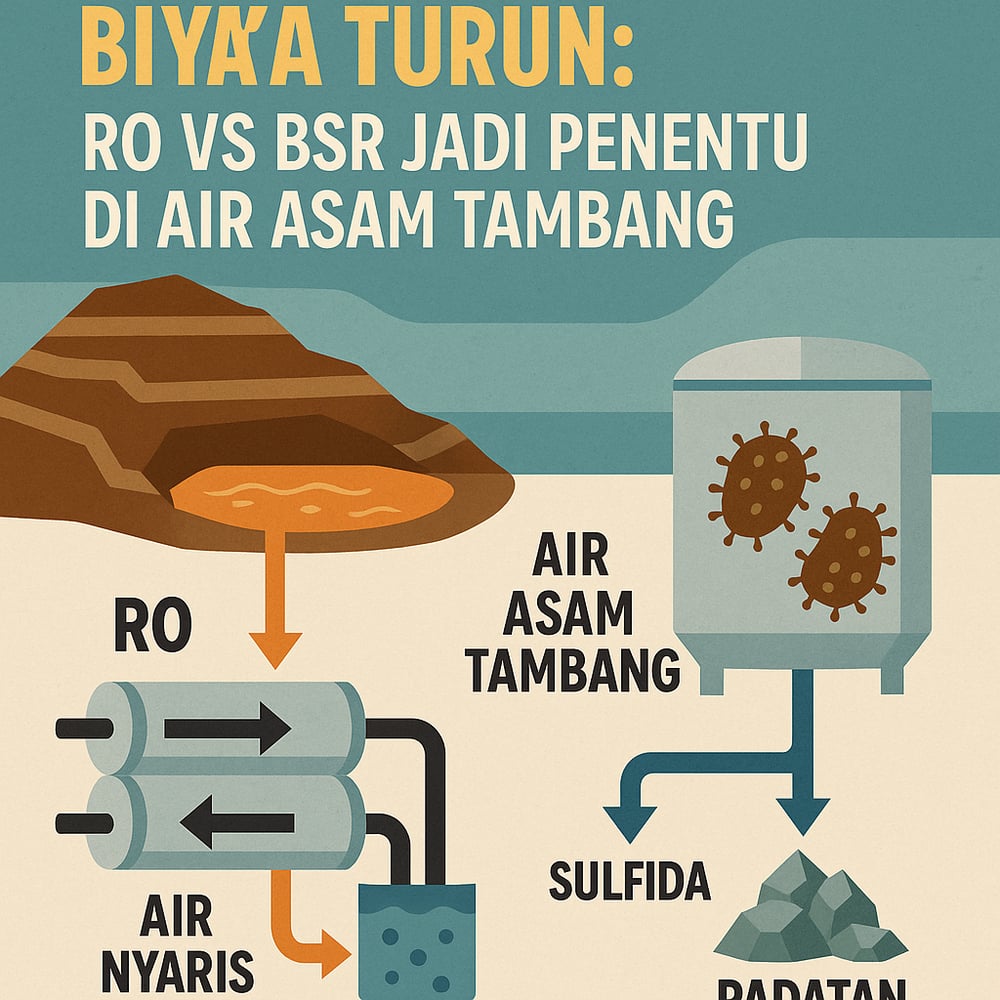
Nanofiltration and reverse osmosis stack up against biological sulfate reduction on cost, performance, and risk. The data show both can clear the regulatory bar, but the right choice hinges on brine, bugs, and balance sheets.
Two very different playbooks now dominate sulfate removal from acid mine drainage (AMD, acidic runoff laden with sulfate and metals): high-pressure membranes and low-energy microbes. In controlled trials, nanofiltration (NF) and reverse osmosis (RO) consistently cut sulfate by over 90–99%, producing permeates below 200 mg/L in a Brazilian gold-mine case (scielo.br).
But NF also delivered 7–12× higher permeate flux than RO under similar conditions, with one “NF90” membrane matching RO’s sulfate retention at significantly higher throughput (scielo.br) (scielo.br).
On the other side, biological sulfate reduction (BSR, an anaerobic process where sulfate-reducing bacteria convert SO₄²⁻ to sulfide) has logged ~94% sulfate removal with 95–99% metal removal in optimized bioreactors, while elevating pH from ~2.8 to 7.5 in 14 days in ethanol- or glycerol-fed systems (mdpi.com). Operating costs for BSR have landed as low as R4.5–11/m³ (USD $0.3–0.7) in a South African analysis (scielo.org.za).
Membrane nanofiltration and reverse osmosis
Membrane filtration splits contaminants physically: NF (nanofiltration) rejects multivalent ions such as SO₄²⁻, Ca²⁺, and Mg²⁺, while RO (reverse osmosis) rejects essentially all salts. In practice, both can reduce sulfate by over 90–99% and deliver permeates with <200 mg/L sulfate in mine effluent (scielo.br). For compact installations, packaged membrane systems are a common platform for industrial water treatment.
Notably, one study found NF offered 7–12× higher permeate flux than RO with comparable sulfate rejection, and the “NF90” membrane achieved similar sulfate retention to RO at much higher throughput (scielo.br) (scielo.br), supporting the case for nanofiltration where multivalent removal is the main target.
Operating pressures and pretreatment needs
Typical operating pressures diverge: NF at 10–20 bar and RO at 25–50 bar, which often gives NF an energy edge. Pretreatment—pH control and filtration—is standard to mitigate CaSO₄ scaling, biofouling, and suspended solids. Plants commonly stage pretreatment before RO, and many specify ultrafiltration as a robust barrier ahead of high-pressure membranes.
Primary solids removal upstream helps protect membranes and can include a clarifier to drop heavy precipitates, followed by granular media steps such as sand filtration and fine polishing with a cartridge filter. For scaling control, programs often include membrane antiscalants to extend run time between cleanings.
Economics and brine management
Membranes “virtually guarantee low‑sulfate permeate,” but concentrate disposition is the catch: treating 1 m³ of feed commonly yields only 0.5–0.8 m³ permeate and 0.2–0.5 m³ brine, which then needs evaporation ponds, deep well injection, or processing. One analysis put the energy (ozone + brine evaporation) to handle RO brine at ~R33/m³ (≈US$2.2/m³) (scielo.org.za).
Costs vary by site. In a Brazilian gold-mine example, NF delivered sulfate removal at an estimated US$0.83/m³ including capital amortization (scielo.br). A South African estimate put RO (plus brine handling) at ~R33/m³ (≈US$2.2) (scielo.org.za)—for perspective, R4.5–11/m³ is US$0.3–0.7 (scielo.org.za). For brackish AMD streams, brackish-water RO platforms are commonly engineered to the feed’s total dissolved solids (TDS).
Membrane CAPEX is high (membrane modules and high-pressure pumps), and OPEX is dominated by power plus maintenance. Fouling shortens membrane life, so clean-in-place cycles and compatible membrane cleaners are a recurring line item. The upside: membranes remove most anions (sulfate, chloride, nitrate) and many metals, often yielding near‑pure water for reuse or discharge.
Biological sulfate reduction reactors
BSR harnesses sulfate‑reducing bacteria (SRB) in anaerobic conditions to convert SO₄²⁻ to sulfide (H₂S/HS⁻) using an electron donor such as ethanol, glycerol, waste organics, or hydrogen. The sulfide then precipitates metals (e.g., FeS, ZnS), removing acidity and metals alongside sulfate. Reviews report ~94% sulfate removal with 95–99% metal removal in optimized systems (mdpi.com), and one anaerobic bioreactor lifted pH from ~2.8 to 7.5 within 14 days under ethanol/glycerol feed (mdpi.com). Engineered biological digestion systems are the typical backbone for active BSR.
Throughput hinges on design and carbon source, but high‑rate reactors can often treat tens of kg‑SO₄ per day per cubic meter of biomass. Configurations range from fixed‑bed bioreactors to proprietary hydrogen‑based systems (e.g., THIOPAQ®) that demand tight substrate dosing and sulfide management; fixed media designs align with fixed‑bed bioreactors used in industrial wastewater.
Passive wetlands versus active systems
Passive constructed wetlands leverage natural organics and plants at low cost but generally remove sulfate more slowly (weeks to months) and variably—often 20–50%—and rarely drive >1000 mg/L down to <50 mg/L (researchgate.net). Active reactors achieve higher, faster removal but need reliable energy and chemical logistics, including precise carbon addition via a dosing pump.
An advanced variant—a hydrogen‑based membrane bioreactor—has demonstrated near‑complete sulfate elimination with sulfur recovery, though complexity remains a barrier (frontiersin.org).
Effectiveness and cost comparison
Removal efficiency: membranes can deliver >95% sulfate removal down to hundreds of mg/L in a single pass (scielo.br). High‑rate BSR clocks ~90–94% reductions (mdpi.com), while passive wetlands tend toward tens of percent. BSR simultaneously removes most dissolved metals via sulfide precipitation (mdpi.com), whereas membranes leave metals in the concentrate stream.
Cost: published values point to higher cost for membranes relative to BSR. NF/RO have been estimated around US$0.8–2.5 per m³ (site‑dependent) (scielo.org.za) (scielo.br), while BSR has been estimated at R4.5–11/m³ (USD $0.3–0.7) (scielo.org.za), with ethanol or hydrogen accounting for roughly half of that (scielo.org.za).
Byproducts and waste: membranes produce brine rich in sulfate, chloride, and metals. The eMalahleni plant in South Africa has highlighted how brine evaporation energy can add ~R33/m³ (scielo.org.za). BSR produces a metal‑sulfide sludge and hydrogen sulfide gas; the sludge is generally smaller by weight, but H₂S and odor must be controlled.
Water reuse: membrane permeate is very clean and can meet stringent reuse or potable targets, while BSR effluent will still carry monovalent ions (Na, Cl, NO₃) and may contain residual organics or sulfide; aeration/oxidation is a common polishing step.
When advanced sulfate treatment is needed
Regulatory and reuse drivers set the bar. Advanced treatment becomes necessary when discharge must stay below tight sulfate limits or the water is earmarked for reuse. Where regulators demand <500 mg/L sulfate—a widely referenced threshold (sciencedirect.com)—membranes or BSR are candidates. Simple neutralization may meet pH and metal limits yet leave sulfate near ±1000 mg/L; gypsum (CaSO₄) precipitation alone bottoms out around ~1500 mg/L in theory (sciencedirect.com).
Feedwater chemistry and flow constraints
Feed characteristics shape the choice. Very high sulfate (>2000 mg/L), hardness, or TDS can favor multi‑stage membranes if scaling is managed. For monovalent leakage tolerance and lower energy, NF is often attractive; when salt rejection must be near‑total, RO/NF platforms dominate.
Conversely, if sulfate is moderate (<1000 mg/L) and metals/acidity remain, BSR is compelling because it neutralizes acid and precipitates metals while reducing sulfate. For very saline water (>10,000 mg/L TDS), membranes may need staged recovery or dilution. Microbial salt tolerance limits BSR around ~50–100 g/L TDS. At scale, high‑flow plants lean toward membranes; “many MLD” can be treated in compact footprints (tens of m² membrane area for ~1 MLD).
Power, operations, and byproduct recovery
Power and skills matter. Membrane plants require reliable electricity and trained operators, whereas remote mines sometimes rely on passive BSR if land is available. In some underground operations with suitable gases, SRB systems can integrate for sulfur recovery and cleanup.
Byproducts differ: membranes yield clean water and a concentrate stream that can be sent to evaporation/crystallization (even salt crystals), while BSR can produce elemental sulfur or metal sulfides with on‑site water reuse potential (mdpi.com). For hybrid trains, lime neutralization and clarification—often via a clarifier—frequently precede polishing by membranes or BSR.
Hybrid treatment trains
Many flowsheets start with AMD neutralization to drop iron and form gypsum, then pivot to the tighter sulfate removal step. NF can polish post‑precipitation to hit very low limits; BSR can be applied to post‑clarifier water where land and low‑energy operations are favored. Auxiliary equipment—for example, supporting water‑treatment ancillaries—round out dosing, monitoring, and control.
Indonesia context and planning
Indonesia does not yet mandate numeric sulfate limits in mining effluent, but permits tie discharge to “point of compliance” receiving‑water classes and quality. In practice, Class I–II water quality and the WHO drinking‑water reference of 250 mg/L sulfate can be invoked for reuse decisions (sciencedirect.com). Domestic work in Kalimantan coalfields has flagged sulfate’s challenge in AMD (mdpi.com). As standards tighten (as happened recently for TSS, Bitcoin, etc.), mines are planning for advanced AMD treatment and considering membranes or BSR.
Pilot testing and water‑balance modeling are essential because AMD chemistry varies widely. Key metrics include sulfate before/after, water recovery, residual H₂S (for BSR), sludge/brine volume, and lifecycle cost (USD per tonne SO₄ removed or per m³ treated). The data points summarized here—costs of ~$0.3–2/m³ and >90% removal achievable—frame a practical decision for coal‑mine AMD in Indonesia (scielo.org.za) (sciencedirect.com) (mdpi.com).
Sources and references
Sources: Authoritative reviews and case studies were used, including engineering journals and industry reports (scielo.org.za) (scielo.br) (scielo.br) (scielo.br) (sciencedirect.com) (mdpi.com) (metadata below).
References: Rafaella Vieira et al., 2017, Braz. J. Chem. Eng., vol. 34(1), “Nanofiltration and Reverse Osmosis Applied to Gold Mining Effluent…”, DOI:10.1590/0104-6632.20170341s20150082 (scielo.br) (scielo.br); M. van Rooyen et al. (Mintek), 2021, J. S. Afr. Inst. Min. Metall., vol. 121(10), “Sulphate removal technologies for treatment of mine-impacted water” (scielo.org.za); D. Mafane et al., 2025, Sustainability, “Anaerobic Bioremediation of AMD using Sulphate-Reducing Bacteria” (mdpi.com); M. Zaror et al. (eds.), 2018, Environmental Research, vol. 167, “How to tackle the stringent sulfate removal requirements…” (sciencedirect.com). Additional data from peer‑reviewed mine‑water and water‑treatment sources (scielo.org.za) (mdpi.com).
