

Industry: Aquaculture | Process: Wastewater_Treatment
Intensive aquaculture moves a lot of nutrients. Striped catfish farms, for example, discharge about 46 kg of nitrogen (N) and 14.4 kg of phosphorus (P) per tonne of fish produced (commercial feed basis) (pmc.ncbi.nlm.nih.gov). Raw recirculating aquaculture system (RAS) and shrimp‑pond effluent commonly shows 50–200 mg NH4‑N/L and roughly 5–15 mg PO4‑P/L, with total suspended solids (TSS) in the tens of mg/L. That means every 1,000 m³ of effluent can carry on the order of 50–200 kg N and 5–15 kg P—enough to trigger eutrophication if discharged untreated.
Scale matters: world aquaculture production hit about 94.4 million tonnes of fish in 2022 (www.fao.org). The treatment question is no longer academic—it’s design, capex, and daily operations.
The consensus answer is a three‑stage train: physical solids removal (clarification enhanced by coagulation/flocculation), biological nutrient removal (BNR) for nitrogen, then chemical precipitation for P using alum or ferric salts. Below, every key parameter, rate, and cost is spelled out with the original references intact.
Aquaculture effluent profile and risk
Typical raw loads—50–200 mg NH4‑N/L and ~5–15 mg PO4‑P/L—translate to major mass flux at farm scale, with TSS accumulating from uneaten feed and feces. The 46 kg N and 14.4 kg P per tonne figure for striped catfish sets a directional benchmark (pmc.ncbi.nlm.nih.gov), while the FAO’s 94.4‑million‑tonne tally frames the global footprint (www.fao.org).
Stage 1: solids removal and clarification
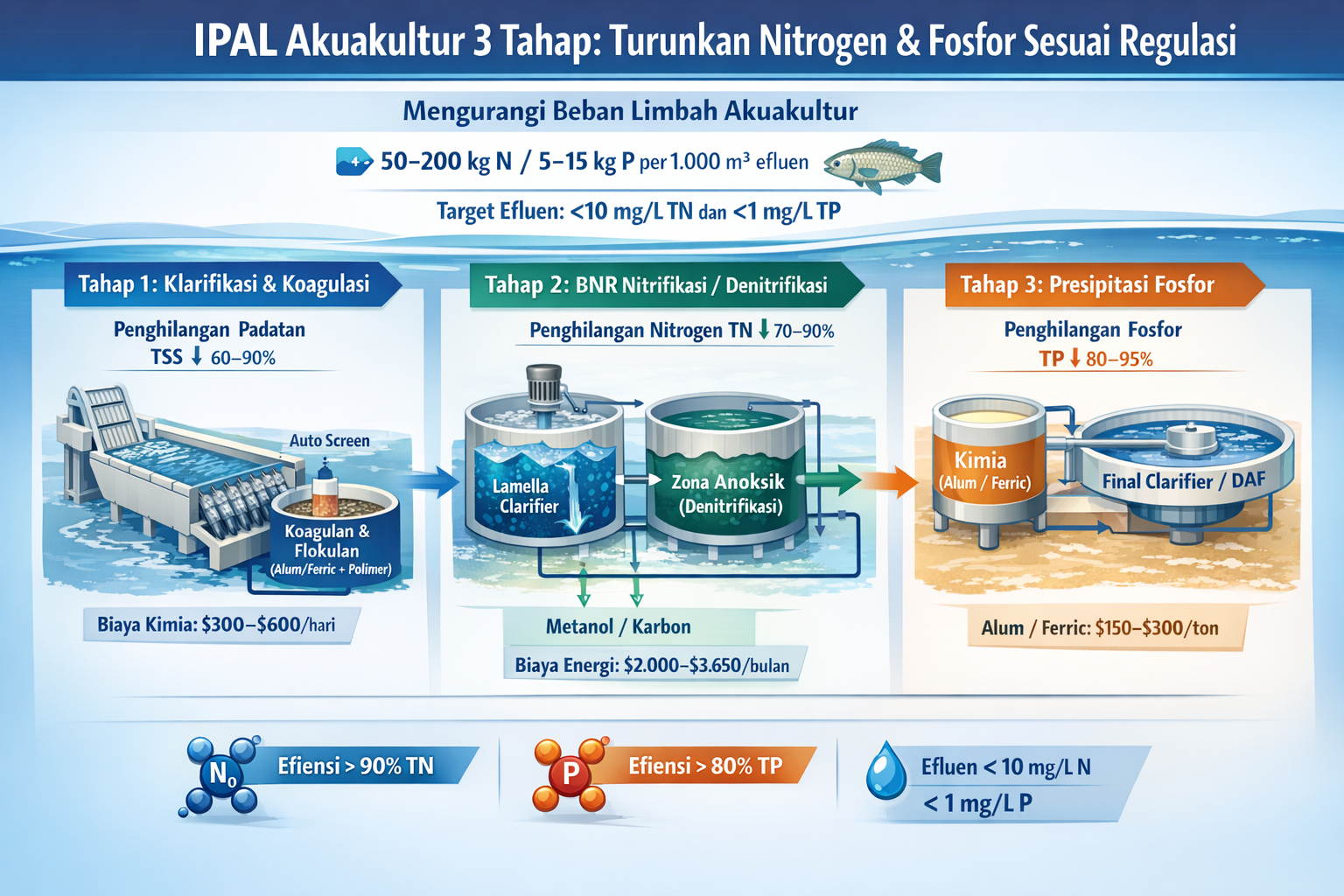
Primary clarification alone can cut TSS by ~50–60% and BOD (biochemical oxygen demand, a measure of organic load) by ~20–30% (blog.enduramaxx.co.uk). Screens, hydrocyclones, and drum filters remove 15–58% solids per pass in field trials (mjae.journals.ekb.eg). Upstream debris control is typically handled with fine screening; facilities often standardize on compact primary equipment such as an automatic screen or a broader headworks package like wastewater physical separation.
Coagulation/flocculation ahead of a clarifier materially lifts capture. In jar tests, 40 mg/L ferric chloride with ~0.5 mg/L polymer removed ~70% of soluble P and achieved 80–90% TSS removal (~50% BOD removal) (nepis.epa.gov) (nepis.epa.gov). A well‑designed clarifier can remove on the order of 80% of settleable solids. Design anchors include a surface overflow rate around 12–18 m³/m²·h, flocculation retention of ~10–20 minutes, and ~30–60 minutes of settling.
Coagulant dose typically runs ~50–300 mg/L (as Al or Fe), with alum at 150 mg/L (Al:P ≈1.5:1 by weight) removing ~74% of influent P in tests (nepis.epa.gov). Plants pair chemistry with metering, for example a dosing pump feeding coagulants such as coagulants and polymers like flocculants into a rapid‑mix basin ahead of a clarifier.
Footprint‑constrained sites often opt for high‑rate settling. A compact lamella settler reduces footprint by up to 80% versus conventional clarifiers, and a tube settler can lift clarifier capacity by 3–4×. Where buoyant solids persist, dissolved‑air flotation is a fit; a packaged DAF unit commonly serves as a polishing step.
Stage 2: biological nitrogen removal (BNR)
The nitrogen problem splits in two: aerobic nitrification (oxidizing NH4⁺ to NO3⁻) and anoxic denitrification (reducing NO3⁻ to N₂). Nitrification—driven by autotrophs such as Nitrosomonas/Nitrobacter—consumes about 4.6 g O₂ per g NH4‑N oxidized and typically achieves volumetric rates of ~0.1–0.3 kg NH4‑N/m³·day when operated with dissolved oxygen (DO) ≥2 mg/L and pH ~7.5–8.5. In RAS practice, trickling filters and rotating biological contactors (RBCs) are often sized with empty‑bed contact times (EBCT) of 10–20 minutes and vertical air/waste ratios to achieve ~90% NH4‑N removal.
Nitrate (NO3⁻) is less toxic and can accumulate to ~200 mg/L without harm (www.intechopen.com), but discharge and reuse targets typically require active denitrification. The anoxic zone (oxygen‑free, mixed but not aerated) uses organic carbon—often an external source—to reduce NO3⁻→N₂. Stoichiometry is straightforward: about 3 kg of methanol per kg of NO3‑N removed, so 1 g NO3‑N needs ~3 g MeOH; at roughly $0.5/kg, that’s about $1.5 per kg‑N removed. Denitrification reactor volume commonly runs ~20–40% of total, with volumetric rates around 0.1–0.2 kg NO3‑N/m³·day and DO held below ~0.5 mg/L to sustain 85–95% N removal.
Operations focus on oxygen control and monitoring: sustain DO ~2 mg/L in nitrification, maintain anoxic conditions in denitrification, and track NH4⁺, NO2⁻, and NO3⁻ daily. Properly operated RAS report ~70–90% overall N removal. Systems typically choose between suspended‑growth and biofilm designs; common configurations include activated sludge, a sequencing batch reactor, or biofilm options like a moving bed bioreactor or fixed‑bed bio‑reactor. High‑area carriers such as honeycomb bio media or advanced media like Levapor foam MBBR media help reach the cited loading rates, and plants often standardize consumables and nutrients via wastewater consumables including a biological booster and nutrient packages to stabilize startup and settling.
Stage 3: chemical phosphorus precipitation
Nitrification/denitrification leaves dissolved P untouched. Precipitation with aluminum sulfate (alum) or ferric chloride captures phosphate as insoluble AlPO₄/FePO₄ flocs. Typical alum doses run ~150–350 mg/L to reach roughly 75–94% P removal; 150 mg/L alum (Al:P ≈1.5:1) removed ~74% of influent P, while 350 mg/L (Al:P ≈3.9:1) removed ~94% in jar tests (nepis.epa.gov). A 40 mg/L FeCl₃ dose with polymer cut soluble P by ~70% in trials that also achieved 80–90% TSS reduction (~50% BOD removal) (nepis.epa.gov).
Targets are often set at effluent P <1 mg/L (many jurisdictions use 0.5–1 mg/L). Reagents are fed into rapid‑mix and flocculation basins ahead of a final clarifier, with flocculated Al/Fe‑P sludge thickened and wasted; alum and ferric addition acidify water, so alkalinity addition is sometimes required to keep pH ~6.5–7.5. Coagulant dosing at ~2–4 parts metal per 1 part P typically yields residual P of ~0.5–1.5 mg/L (nepis.epa.gov) (nepis.epa.gov). Final floc removal uses ~30–60 minutes of settling or dissolved‑air flotation; plants often favor compact steel internals such as a stainless plate settler inside a clarifier or finalize with a skid such as a DAF unit.
Design guidance and operating strategy
Train integration starts at the clarifier: size for peak flow plus a 1.5× safety factor and overflow rates around 12–18 m³/m²·h. Downstream, configure BNR with a dedicated anoxic tank (~1–3 hours retention) and an aerobic nitrifier (~4–8 hours), with baffles or separate tanks to prevent oxygen carryover into anoxic zones. Aeration is via fine‑bubble diffusers or mechanical units; at 25–30 °C, a well‑run nitrifier can remove ~0.1–0.3 kg NH4‑N/m³·day.
Operations anchor on DO and pH: keep DO ≈0 (or <0.5 mg/L) in the anoxic stage and ≥2 mg/L in the aerobic stage, with pH for nitrification near ~7.5–8.5. For plug‑flow nitrifiers, hydraulic loading is set to meet effluent NH4⁺ limits (often <1 mg/L). Because solids removal can leave the water carbon‑poor, denitrification generally needs external carbon; the rule of thumb is C:N ≈3:1. Example: removing 100 kg N/day (as NO3⁻) takes ~300 kg COD per day (about ~225 kg methanol per day). Plants routinely meter carbon with a dosing pump and adjust recycle rates and aeration based on daily NH4⁺/NO2⁻/NO3⁻ checks.
At steady state, typical outcomes are ~80–90% conversion of influent NH4‑N to nitrate, ~70–90% nitrate removal in denitrification (with sufficient carbon), and ~80–95% total P removal via chemical precipitation. Many facilities work to nitrate <50 mg/L and total P <1–2 mg/L in final effluent (permit specifics vary). For packaged or modular deployments, some sites implement the full nutrient sequence via nutrient removal skids; general plant items and service parts fall under wastewater ancillaries and water treatment ancillaries.
Chemical and energy costs
Coagulants like alum and ferric chloride run roughly US$150–$300 per tonne in bulk (2024), while synthetic flocculants are about $1,000–$2,000 per tonne (nepis.epa.gov). At a 200 mg/L alum dose, a 10,000 m³/day plant uses ~2 tonnes/day—about $300–$600/day. Denitrification carbon (e.g., methanol) costs roughly $0.4–$0.6/kg; at ~3 kg methanol per kg NO3‑N removed, the methanol cost is ~ $1.5 per kg‑N. For a facility removing 100 kg‑N/day, that’s about $150/day.
Energy is dominated by aeration. Analyses show more than 80% of a shrimp farm’s electricity goes to aerators (iwaponline.com). High‑efficiency aerators transfer about 0.8–2.0 kg O₂ per kWh (iwaponline.com). Since nitrifying 1 g NH4‑N requires ~4.6 g O₂, that works out to ~2.3 kWh/kg‑N at 2 kg O₂/kWh, or ~5.8 kWh/kg‑N at 0.8 kg O₂/kWh—so a practical planning band is ~3–5 kWh per kg NH4‑N removed. A farm removing 100 kg N/day might therefore consume ~300–500 kWh/day for aeration, plus pumping energy on the order of ~0.1–0.3 kWh/m³.
At about $0.07/kWh (Indonesia industrial rate; taxes included) (www.globalpetrolprices.com), that’s roughly $20–$35 per 100 kWh, or about $2,000–$3,650 per month for 30,000 kWh. In summary, energy can run ~5–15% of operating expenses, with aeration costs alone around ~10% of farm OPEX in some analyses (iwaponline.com).
Performance targets and regulatory context
Multi‑stage nutrient control routinely hits high removal when sized and run to spec: >90% total nitrogen and >80% total phosphorus are achievable. A 10,000 m³/day design might target effluent <10 mg/L TN and <1 mg/L TP, with site‑specific verification. In Indonesia, new regulations (Permen LHK No. 1/2025) explicitly require shrimp‑pond effluent treatment, so meeting stringent nutrient limits (often ~2–3 mg/L TN, <1 mg/L TP) is likely mandatory—making this multi‑stage scheme both necessary and feasible for large farms (nepis.epa.gov) (nepis.epa.gov).