

Mining
Coal Dust Suppressant Indonesia
Updated
Coal dust suppressant for mines, stockpiles, conveyors, and transfer points in Indonesia, with site assessment, application planning, and site checks.
Discuss the application.
Send the application, operating conditions and the result you expect. Our team will discuss the options with you.
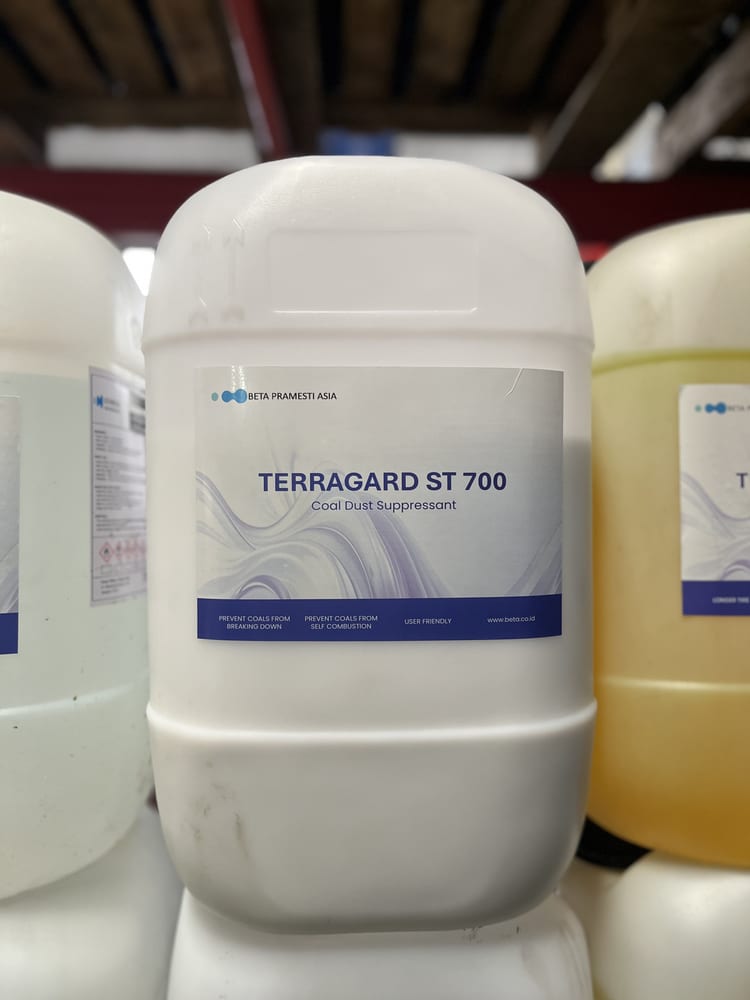
A coal dust suppressant is a chemical added to spray water to wet and bind coal dust at its source: conveyor transfer points, crushers, loading, and stockpile surfaces. Coal dust is hard to wet with plain water, so wetting agents help the water penetrate faster. PT Beta Pramesti Asia supplies TERRAGARD ST 700 for conveyors and stockpiles in Indonesia, with dust-source assessment and site trials.
Updated: 12 November 2026.
This page is part of TERRAGARD dust suppressants for mines, which compares dust control on haul roads, stockpiles, conveyors, and crushers.
Where should a coal dust suppressant be applied?
A coal dust suppressant should be applied where handling creates or releases fine particles, not simply across the whole site. Common control points include crushing and screening, conveyor transfers, loading and unloading, exposed stockpiles, and material movement. The objective is consistent coverage at the source without creating excessive moisture, runoff, slippery surfaces, or an unacceptable effect on the coal’s next process.
Respirable dust needs particular attention. NIOSH states in its 2024 black lung guidance that respirable dust is generated during coal extraction, transport, and processing, and that controlling exposure is essential. The U.S. EPA distinguishes PM10 and PM2.5 by particle size; visible dust observations alone therefore do not replace appropriate workplace and environmental monitoring.
| Control point | Typical dust mechanism | Application approach to review | Site data needed |
|---|---|---|---|
| Crusher or screen | Fresh fines released by impact and vibration | Targeted spray before or at the release point | Throughput, particle size, enclosure, nozzle position, and water pressure |
| Conveyor transfer or chute | Free fall, impact, and air displacement | Fine spray or foam with coverage focused on the material stream | Belt speed, drop height, transfer geometry, wind, and available mounting space |
| Stockpile | Wind erosion and repeated surface disturbance | Surface treatment or crust-forming program where compatible | Exposed area, rainfall, wind, pile turnover, drainage, and reclaim method |
| Loading and unloading | Material drop and vehicle or loader movement | Triggered spray at the active loading zone | Cycle time, flow variability, equipment movement, and overspray risk |
| Haul road | Vehicle-generated road dust rather than coal-process dust | A separate road-dust treatment and maintenance plan | Road material, traffic, grade, rainfall, drainage, and grading schedule |
For unpaved mine roads, use the dedicated hauling road dust suppressant page. The treatment mechanism, traffic load, and performance checks differ from coal stockpile and conveyor applications.
If the issue has moved from dust prevention to a hot spot or burning coal, review TERRAGARD FX 900 coal fire suppressant as a separate fire-response scope.
What is TERRAGARD ST 700 and how is it used?
TERRAGARD ST 700 is a coal dust suppressant emulsion. Its data sheet lists application through conveyor sprayers, including crusher units and barge loading systems, and manual spraying at truck loading and unloading points, stockpiles, or barges.
| Parameter (data sheet) | Value |
|---|---|
| Form | Milky white emulsion |
| Specific gravity (25°C) | 0.95–1.10 g/cm³ |
| pH (neat) | 6.0–8.0 |
| Conveyor transfer point | 0.2–1% dilution in water; 60–100 litres of solution per 10–20 tonnes of coal |
| Stockpile | 0.2–1% dilution in water; 2–3 litres of solution per m³ of stockpile surface area |
| Storage | Dry, ventilated premises protected from direct sunlight; inadequate conditions or prolonged storage may reduce performance |
| Packaging | 200-litre PE drum |
These figures are starting points for trial planning. Worked example: at a transfer point carrying 500 tonnes per hour with a ratio of 60 litres of solution per 10 tonnes, solution demand is 3,000 litres per hour; at 0.5% dilution that equals 15 litres of ST 700 per hour. The final ratio and dilution are set from dust and material-moisture measurements on site.
How is the suppressant programme selected?
Product selection starts with the control objective and the way coal moves through the plant. A program may prioritise rapid wetting of hydrophobic fines, longer surface binding, residual control between applications, or compatibility with crushing, blending, transport, combustion, and customer specifications.
The assessment should cover:
- Material: coal rank, fines fraction, surface moisture, temperature, and any product-quality limits.
- Dust source: transfer geometry, drop height, belt speed, crusher duty, stockpile turnover, and wind exposure.
- Application system: available water, pump pressure, flow control, nozzle or foam equipment, automation, and maintenance access.
- Site constraints: rainfall, drainage, runoff containment, vehicle interaction, corrosion concerns, and chemical storage.
- Performance criteria: baseline and treated dust measurements, coverage, water and product consumption, reapplication interval, and effect on downstream handling.
A site trial should compare the baseline and treated condition under similar operating and weather conditions. The result is stronger when dust readings, throughput, water use, chemical consumption, spray coverage, and operator observations are logged together.
What should you send us for a quotation?
- Layout of the control points: conveyor, transfer point, crusher, loading, or stockpile.
- Coal throughput (tonnes per hour) and fines data if available.
- Current spray equipment, pump pressure, and water availability.
- Photos or videos of dust release and weather conditions.
- Coal quality limits for the next process or buyer.
- Delivery location.
What does Beta’s dust-control scope include?
PT Beta Pramesti Asia can review the dust source, operating data, application points, water constraints, and desired performance before defining a trial. A project may include product selection, dilution and feed planning, spray-point review, trial criteria, operator guidance, and performance monitoring. Final dosage and application frequency must follow site data and trial results rather than a universal rate.
Coal dust suppressant is one layer of control. It does not replace source enclosure, extraction or ventilation, housekeeping, equipment maintenance, exposure monitoring, PPE, fire protection, or the site’s statutory safety and environmental controls. Read also how to manage dust on coal stacks, see our mining chemicals references, and the broader mining chemical range for adjacent mine applications.
Frequently asked questions about coal dust suppressants
Is water alone enough to control coal dust?
Water can provide short-duration control when it reaches and wets the particles, but hydrophobic fines, evaporation, wind, and repeated handling can reduce persistence. A chemical program may improve wetting or binding, subject to compatibility and trial evidence.
Can one suppressant be used for stockpiles, conveyors, and haul roads?
Not automatically. These areas have different dust mechanisms, contact times, traffic, drainage, and durability requirements. Each application point should be assessed before using the same formulation or dilution.
What data is needed for a site assessment?
Prepare the control-point layout, coal throughput and fines data, photos or video of dust release, weather exposure, water quality and availability, existing spray equipment, operating schedule, downstream quality constraints, and any baseline dust measurements.
How do I request a coal dust suppressant trial?
Send the site data, target control points, baseline evidence, and required trial window through the Beta contact page. The technical team can then define the trial method and measurements needed for a defensible comparison.