

Industry: Brewery | Process: Packaging
At the packaging end of a brewery, the margin for error is razor thin. Even low levels of spoilage microbes can ruin batches as beer moves through fillers, crowners and conveyors. Beer spoilers such as Lactobacillus and Pediococcus — lactic acid bacteria adapted to low pH, hops and ethanol — are still the headline problem and account for about 70% of beer spoilage incidents (pmc.ncbi.nlm.nih.gov), with recalls to match (a U.S. brewery recalled product in 2016 due to Lactobacillus contamination, per hygiena.com).
That risk has elevated sanitation — clean-in-place (CIP, automated cleaning without disassembly) plus no‑rinse sanitizers — to a central control on the packaging line. In Indonesia, breweries operate under HACCP/ISO 22000 food-safety systems (PT Jobubu Jarum achieved ISO 22000/HACCP in 2023, per indonesiannews.co) and general manufacturing rules: BPOM guidance requires stainless-steel, cleanable contact surfaces, closed lines that support CIP, and production water that meets potable standards (id.scribd.com; id.scribd.com; id.scribd.com).
Routine environmental monitoring is the other pillar: rapid ATP testing (adenosine triphosphate, an energy molecule present in living cells) and periodic microbiological sampling confirm cleaning effectiveness (hygiena.com).
Beer spoilage organisms and risk
Lactic acid bacteria — especially Lactobacillus and Pediococcus — thrive despite beer’s defenses, triggering sour or buttery off‑flavors and turbidity (pmc.ncbi.nlm.nih.gov). The 2016 U.S. recall illustrates the financial stakes (hygiena.com). That’s why fillers, canning lines and crowners are treated as critical control points.
CIP design and cleaning steps
Breweries rely on CIP: a warm-water pre‑rinse, followed by a hot (50–70 °C) alkaline caustic wash at 0.5–2% NaOH to saponify proteins and fats, a hot acid rinse (commonly 0.5–2% nitric/phosphoric blend) to dissolve beerstone and neutralize alkali, and a final sanitizer flush (micetcraft.com; asianbeernetwork.com). Many add cold rinses between steps as needed. The cycle follows Sinner’s circle — balancing chemical strength, temperature, mechanical action (flow turbulence) and time (christeyns.com) — and targets turbulent flow (≥1.8 m/s) to scour pipes (christeyns.com), with high‑impact spray balls or rotary jets for vessel coverage (christeyns.com).
Open‑plant cleaning (spray/foam) tackles exteriors and conveyors; CIP is reserved for internal surfaces like tanks, pipes and fillers (christeyns.com; christeyns.com). Conveyors are commonly treated by intermittent sprays or continuous sanitizer dosing rather than internal CIP. Design supports sanitation: Pascal’s law prevents dead legs, and tanks/lines should be stainless 304/316 (non‑porous, non‑reactive) per BPOM (id.scribd.com), with closed systems (“pipa tertutup”) that are CIP‑equipped (id.scribd.com).
Water demand is a known pain point: modeling shows CIP can consume a significant portion of total process water in industrial breweries (researchgate.net). Counterflow rinses and reuse of final rinse water cut both water and wastewater, and some plants deploy hot water at 90–95 °C for 15–20 minutes or low‑pressure steam (121 °C, 20 psi, ~30 minutes) to “sterilize” lines — effective but energy‑intensive and seldom routine (micetcraft.com).
No‑rinse sanitizer: Peracetic acid (PAA)
As a final step, breweries increasingly favor no‑rinse oxidizers. PAA (a mixture of hydrogen peroxide and acetic acid) is a powerful oxidant with E° ~1.8 V, denaturing proteins and lipids, with activity against Gram‑positive and Gram‑negative bacteria, yeast, molds, spores and phages (pmc.ncbi.nlm.nih.gov; asianbeernetwork.com). It remains active at low temperatures down to 0–5 °C and across pH 1–7.5 (asianbeernetwork.com; micetcraft.com), is less corrosive and more environmentally benign than bleach (micetcraft.com), and is described as “a powerful disinfectant even at low temperatures” that is “effective against all microorganisms, including spoilage organisms, pathogens, and bacterial spores” (micetcraft.com).
Lab work shows even ≈10 ppm PAA can deliver multi‑log kills: 10 ppm for 10 minutes at 25 °C produced ~3.3–5.9 log reductions of S. aureus and Salmonella biofilms on stainless steel (pmc.ncbi.nlm.nih.gov). In practice, many dose around 100–400 ppm (0.01–0.04%) as a final sanitizing rinse for fillers and kegs; concentrated formulations (often 1–5% PAA) are diluted to working strength. PAA decomposes to acetic acid, water and oxygen, so equipment is typically drained rather than extensively rinsed — although many still perform a final sterile‑water rinse with an air purge (micetcraft.com).
Downsides: a pungent vinegar odor, corrosivity at high concentration, and the need for adequate ventilation at large doses (micetcraft.com). Some rubbers or coatings can degrade, though PAA is compatible with stainless. Many breweries have moved away from bleach‑based disinfectants in favor of PAA (micetcraft.com).
No‑rinse sanitizer: Stabilized chlorine dioxide
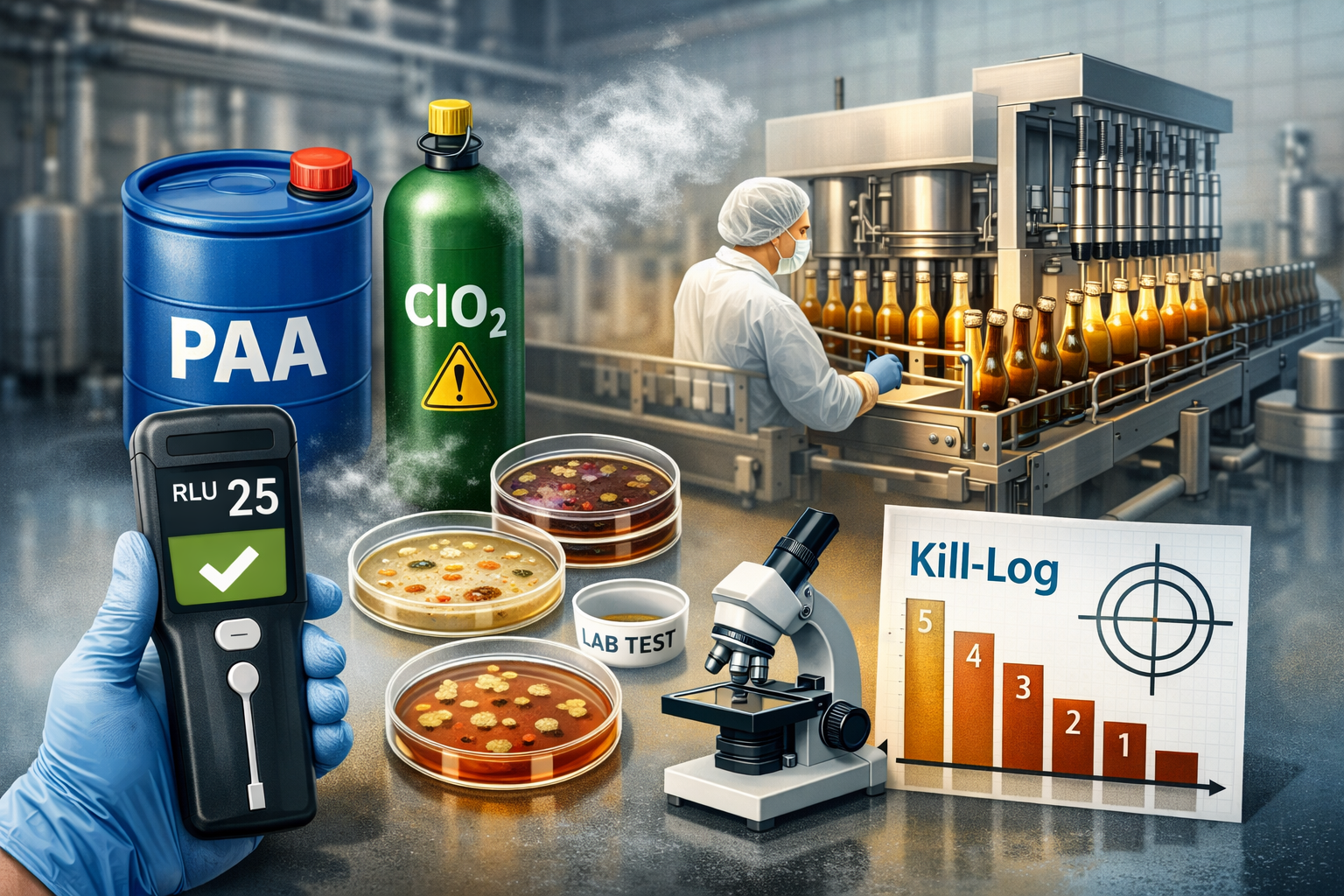
Chlorine dioxide (ClO₂, typically generated by acidifying sodium chlorite) is a strong oxidizer with E° ≈ 1.5–1.7 V. It rapidly kills bacteria, yeast, viruses and molds, with efficacy at low ppm. Case experience in breweries shows broad control of Lactobacillus/Pediococcus at ~50 ppm in equipment and even below 1 ppm in water (safrax.com). Dosing 0.5 ppm ClO₂ to incoming bottle/crown rinse eliminated detectable microbial load entering the filler, and conveyor sprays maintained at ~1 ppm cut slime formation (safrax.com; safrax.com).
ClO₂ remains effective over pH 4–10, does not form chlorinated organics, and — crucially for brewers — does not impart off‑flavors or chlorophenols; unlike bleach, ClO₂ in water can strip phenolic anomalies and forms only chloride/bicarbonate ions (solenis.com). By contrast, even 1–2 ppm hypochlorite is detectable by taste and is not recommended without careful rinsing (solenis.com). Typical use cases include final spray/rinse at 0.5–2 ppm with seconds of contact, CIP of tanks/pipes at 20–50 ppm for 10–20 minutes, and conveyor or packing‑line sanitizing. A case note highlights effective kill at 50–100 ppm while maintaining a minimal or non‑existent flavor profile (solenis.com), usually followed by only an air purge (solenis.com). Handling is strict: sodium chlorite precursors and generators must deliver controlled dosage.
Verification: ATP and microbiology
Cleaning verification is non‑negotiable. Rapid ATP testing provides immediate hygiene checks: after cleaning/sanitizing a filler or conveyor, QA swabs surfaces or rinse samples and reads relative luminescence units (RLU) on a handheld luminometer. Each facility validates its own “clean” threshold (often 10–50 RLU, depending on swab type and sensitivity). Trending matters: consistently low RLUs signal effective cleaning; spikes or drift can flag biofilm or a CIP failure. Note that ATP is not a bacterial count — one study found only a weak correlation (R≈0.24) between RLU and aerobic plate counts (aricjournal.biomedcentral.com) — but it is highly useful for routine monitoring because feedback arrives in seconds to minutes.
ATP is complemented by microbiology. Weekly plates on selective media such as MRS agar with antibiotics to enumerate lactic acid bacteria, Rogosa SL or Raka‑Ray agar for Lactobacillus/Pediococcus, and universal beer agar for broader yeasts/bacteria confirm cleaning removed spoilers below detection (hygiena.com; hygiena.com). Viable‑plate detection limits are ~10²–10³ CFU/mL (hygiena.com). Any detectable LAB/yeast triggers a purge, re‑sanitization and investigation (e.g., a gasket). High‑risk sites — filler nozzles, valve seals, crowners, bottle washers — demand extra attention; many lines schedule daily or weekly shutdowns for full cleaning and disinfection. Environmental swabs (floors, drains) serve as preventative checks. Water and CIP solution tests (peroxide residuals, ClO₂ residual, pH/conductivity) confirm the cycle ran as intended.
Operational trends and water use
The food and beverage sanitation market is expanding — from about $12.2 billion in 2020 to about $14.9 billion by 2025 — with beverage growing fastest and Asia‑Pacific leading regionally (marketpublishers.com; marketpublishers.com; marketpublishers.com). Internally, breweries report that shifting from bleach/iodophor to PAA/ClO₂ can cut cleaning time and water use. One craft brewery automated low‑ppm ClO₂ sprays on its filler every hour and saw “significantly reduced” microbial counts and “increased production efficiency” (safrax.com). Conveyor dosing at 1 ppm eliminated slime and odors, reducing manual washdowns (safrax.com), and periodic PAA rinses at 100–200 ppm have been credited with eliminating biofilm and preventing lacto by >5 logs even on cold‑fill lines (micetcraft.com; pmc.ncbi.nlm.nih.gov).
Quantifiable outcomes include extended shelf life and fewer reworks. With strict sanitation, spoilage incidents commonly drop to near‑zero versus occasional spoiled runs under lax cleaning. Optimizing CIP — for instance, by counterflow rinses or spraying over flooding — can slash CIP water by 30–50%, and modeling suggests diligent CIP design could even enable energy recovery from wastewater (researchgate.net).
Regulatory frameworks and benchmarks
In Indonesia, BPOM’s Good Manufacturing Practice modules (modeled on Codex) specify smooth, non‑absorbing, stainless‑steel contact surfaces and mandate sanitization protocols; closed piping must be CIP‑capable and production water must be potable (id.scribd.com; id.scribd.com; id.scribd.com). Export‑oriented breweries often align with EU Biocidal Regulations and NSF/ANSI or 3‑A Sanitary Standards for CIP chemical usage.
Benchmarks in practice: stainless steel 304/316 product contact surfaces (id.scribd.com) — in many food‑grade contexts delivered via 316L components such as stainless steel housings — CIP systems with auto‑dosers for caustic/acid/sanitizer (often implemented with a dosing pump), documented SSOPs (sanitation standard operating procedures), and validated cleaning via ATP and microbiological data. Indonesian brewers like PT Jobubu Jarum (“BEER”) publicly highlight ISO 22000/HACCP certification as evidence of robust FSMS (food safety management systems) (indonesiannews.co).
Best‑practice checklist and metrics
The data‑backed approach for QA managers is consistent: deploy oxidizing no‑rinse sanitizers (PAA, ClO₂) at validated concentrations to deliver >4–6 log kill on spoilage flora (pmc.ncbi.nlm.nih.gov; safrax.com); verify every clean cycle with ATP swabs and periodic culturing; and track metrics over time (mean RLU per swab, percentage of samples with 0 CFU). Pre‑defined triggers — any RLU over target, or any positive LAB culture — should launch corrective action. Procedure fidelity matters: accurate PAA/ClO₂ dosing (again, an application for a dosing pump), timely filter changes, and full spray coverage.
In practice, the combination of technical controls (CIP design, sanitizer chemistry) and monitoring controls (ATP, plating, water tests) under HACCP/FSMS has delivered fewer recalls or spoilage runs, longer shelf life, and more efficient line operations. Industry reviews note that pairing potent oxidant sanitizers with sound verification yields the “highest standards” of brewery hygiene (micetcraft.com; solenis.com).
Sources: brewing sanitation literature, CIP and hygiene guidelines, and case studies (asianbeernetwork.com; safrax.com; hygiena.com; id.scribd.com; id.scribd.com; christeyns.com; pmc.ncbi.nlm.nih.gov; marketpublishers.com; researchgate.net; solenis.com; micetcraft.com; aricjournal.biomedcentral.com; pmc.ncbi.nlm.nih.gov).