

Industry: Fertilizer_(Ammonia_&_Urea) | Process: CO2_Removal
Ammonia and urea plants lean on amine scrubbers (solvent units that chemically absorb acidic gases) to pull CO₂ from reformer or synthesis gas. Much of this equipment is carbon steel — and it faces aggressive corrosion from CO₂ (forming carbonic acid), H₂S, oxygen, and amine decomposition byproducts. High CO₂/H₂S loadings, hot rich amine, and dissolved O₂ all elevate iron dissolution. In one set of fluoroalkylamine lab studies, uninhibited carbon steel in 5 kmol/m³ MEA (monoethanolamine) at 0.55 mol CO₂/mol and 80 °C corroded at ~4.3 mm/y; even “mild” conditions (turbulence, lean‑rich flow) delivered several mpy (mils per year) (IntechOpen; DigitalRefining).
Key drivers include acidity and hydrodynamics (UR, rate ∝ acidity), turbulence/velocity, and temperature. Elevated film temperatures in the reboiler accelerate amine breakdown into heat‑stable salts (HSS: non‑volatile acid salts such as formates and acetates) — keeping bottoms below ~120–130 °C is a recurring guidance (DigitalRefining; Oil & Gas Process).
Carbon‑steel exposure and process drivers
Excess CO₂ in the lean amine — often a sign of under‑regeneration — prevents barrelite scale formation and accelerates absorber‑zone corrosion (DigitalRefining Q&A). In practice, operators watch lean loading and circulation closely: rich loadings above ~0.45 mol/mol trigger recirculation to protect steel surfaces (DigitalRefining Q&A).
Materials strategy matters. Without inhibitors, literature shows carbon steel corrodes readily, whereas selective use of stainless or duplex alloys in the hottest sections (regenerator bottoms, piping) cuts risk (StudyLib; see also cautionary notes — “very corrosive if NH₃ builds,” and SOHIC cracking in rich amine — in DigitalRefining Q&A). One handbook adds an all‑steel amine plant is only viable if regenerator temperature is kept low and gas loading controlled (StudyLib).
Prudent controls include pH management (neutralizing amines for overhead condensate), flow management — avoiding >2 m/s in piping (DigitalRefining Q&A) — and preventing two‑phase flow. Regular monitoring (LPR probes; thickness) is standard. Thermal reclamation removes HSS; a striking lab datapoint shows that adding just 10,000 ppm sodium formate to an “inhibited” MEA solution shot steel corrosion from ~0.54 to 5.7 mm/y (IntechOpen). With process discipline — stable lean loading, controlled temperatures, proper phase separation — baseline corrosion can be held well under 1 mm/y before inhibitors are even applied.
Specialized inhibitors and measured efficacy
Because carbon steel is economical, specialized inhibitors are deployed to protect it. Historically effective metal‑salt packages — now often restricted — include sodium metavanadate + antimony tartrate at ≈0.05–0.1 wt% in 15–30% MEA with ~90–95% inhibition, and blends of CuCO₃, glycine, alkali thiocyanate, Mn, Ni/Bi oxides reaching ≈99% (IntechOpen). Such formulations have cut mild‑steel corrosion to below ~1 mpy (0.03 mm/y) (IntechOpen). Quaternary ammonium or alkylbenzyl chloride compounds (e.g., dodecylbenzyl chloride + alkyl pyridine + Ni salts) have achieved ~93% IE in DEA (diethanolamine) plants (IntechOpen).
Modern regulations push non‑toxic approaches. Film‑forming amines (long‑chain alkyl/polyamine derivatives) adsorb as a hydrophobic, water‑blocking layer (LubeTech; Kurita America). Industrial filming‑amine blends dosed at ~200–1000 ppm have produced nearly negligible carbon‑steel corrosion — on the order of 0.03 mpy at pH ~7.8 (Kurita America). Research into “green” organic inhibitors (aromatic sulfonates, heterocycles) reports 85–92% efficiency. Srinivasan et al. showed that 1–3 g/L of 2‑ or 3‑aminobenzenesulfonic acid in 5 M MEA at 80 °C and 0.55 CO₂ reduced corrosion from ~4.3 to ~0.5 mm/y (≈87–89% IE) (IntechOpen). Notably, sulfolane (an aprotic sulfone) maintained ~90%+ performance even at 10,000 ppm chloride or formate, while some aminobenzene sulfonates lost efficacy as formates built up — underscoring that HSS removal must accompany inhibitor use (IntechOpen; IntechOpen).
Plants often standardize on multi‑component packages (phosphates or silicates, film amines, trace borates). In practice, a robust corrosion inhibitor regime sees hot‑lean/regenerator steels routinely at <0.1 mpy (≈0.0025 mm/y), versus >1 mpy without protection.
Dissolved oxygen and condensate pH control
Oxygen scavengers — sulfite/bisulfite, hydrazine, or organics like hydroquinone — remove dissolved O₂ and secondary oxidants (Oil & Gas Process). Plants commonly deploy oxygen/H₂S scavengers for this duty.
Overhead condensate pH is adjusted using neutralizing amines (e.g., ammonia, cyclohexylamine) to stay in a safe range; operators typically specify a neutralizing amine as part of standard amine‑unit chemistry.
Process control: temperature, velocity, loadings
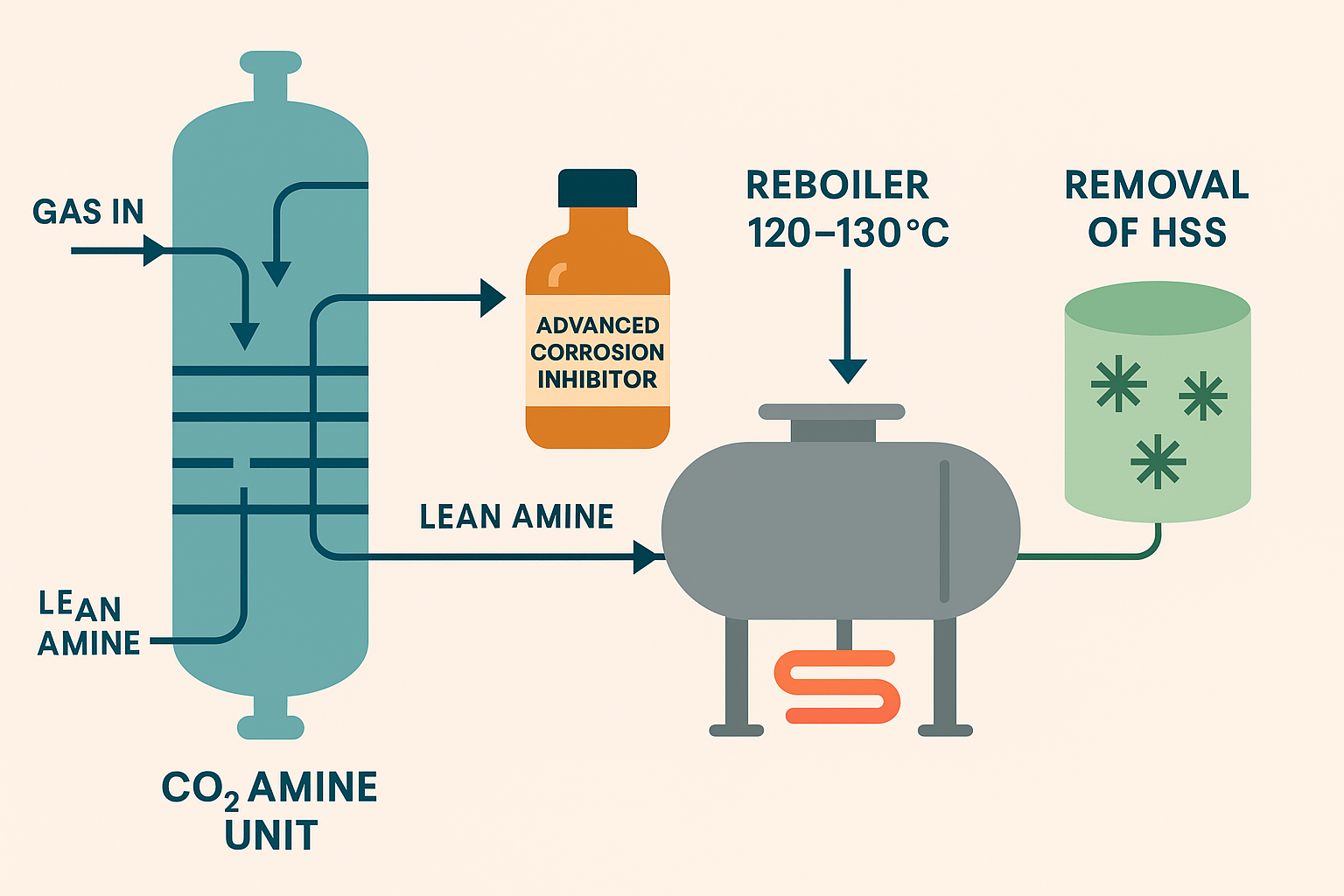
Temperature: corrosion accelerates strongly with heat (Oil & Gas Process; DigitalRefining). Plants limit reboiler bottoms to ≲120–130 °C (for 3–5 bar steam). Excess film temperatures (>135 °C) drive several deleterious paths; to manage pinch issues, operators turn to cascaded reboilers or vacuum boosters, and use quench exchangers or cooler thermostats to avoid thermal runaway.
Velocity and phase: Sulzer guidelines note <6 ft/s (~1.8 m/s) in rich/lean piping, with proper liquid levels and demisters to prevent entrainment; two‑phase flow or slugging is avoided via tuned valves and flash drums (DigitalRefining Q&A). Earlier guidance to avoid >2 m/s in key circuits also stands (DigitalRefining Q&A).
Lean/rich loadings: If lean CO₂ rises beyond ~0.15 mol/mol, operators boost reboiler duty — one Sulzer chemist notes that higher steam amperage “should reduce CO₂ in the lean amine” and restore iron carbonate stability (DigitalRefining Q&A). Lean loadings of 5–10% CO₂ are common targets. Foaming is handled with foam inhibitors and antifoams, though chronic foam often signals high HSS or particulates that must be cleared (filtration and reclaimer).
Heat‑stable salt (HSS) buildup and removal
HSS — formates, acetates, glycolates, sulfonates — are the chronic long‑term threat. They accumulate in the loop and “lower bulk pH, conductivity and corrosion,” driving foaming, capacity loss, and steel attack when they “build up beyond tolerable limits” (DigitalRefining). Even low ppm levels significantly worsen corrosion: the 1 wt% formate (10,000 ppm) case above negated an inhibitor by raising corrosion ≈10× (IntechOpen).
Removal options include continuous blowdown/purge of lean amine (~0.5–2% of inventory per day) with make‑up solvent, thermal reclamation (vacuum distillation of a slipstream), and ion‑exchange or electrodialysis. Cutting‑edge electrodialysis has removed ~70% of accumulated HSS in minutes (MDPI), pointing to future cost savings. Plants that prefer resin‑based purification typically deploy ion‑exchange to strip anionic HSS. In any case, maintaining HSS ≤ a few % of amine mass is recommended; vendors often reckon HSS above ~3% (w/w) as an urgent trigger for reclamation (Scribd).
Field outcomes and planning benchmarks
Pre‑/post‑inhibitor comparisons show large gains. One refinery case (MDEA, methyldiethanolamine) extended corrosion allowance life from ~2 to ~10 years after adopting a vanadate‑free inhibitor blend (no public figures). Lab benchmarks include a 1000 ppm aromatic inhibitor at ~87% IE (IntechOpen). A related operating note: adding 1 g NaOH to convert HSS to stripping conditions (free HCOOH) can “regenerate” part of the solvent — a reminder of HSS desorption chemistry (Scribd). Emerging ion‑exchange/electrodialysis purification can remove 50–70% of HSS in minutes (MDPI).
Combined, robust inhibitors and disciplined operation routinely deliver carbon‑steel corrosion under 0.1–0.2 mm/y (Kurita America; IntechOpen). From a planning perspective, pulling average corrosion down from ~1 mm/y to ~0.1 mm/y doubles equipment life — from ~10–12 to >100 years — and slashes maintenance outages. In Indonesia — where ammonia/urea capacity (~7.8 Mt/y) is expanding and sustainability mandates are rising (ERIA) — investment in modern inhibitors and tight process control is a regulatory and economic necessity.
All recommendations above — inhibitor selection, reboiler limits, and HSS purge rates — are intended to be built into standard operating procedures and monitoring plans for reliable, cost‑effective CO₂ removal in the fertilizer plant. Sources: peer‑reviewed studies and industry literature underpin every figure and claim (see IntechOpen; DigitalRefining Q&A; DigitalRefining; ERIA).