

Industry: Brewery | Process: Packaging
In beer packaging, oxygen is the spoiler. Industry accounts now put modern filling pickup at ~20 µg/L (micrograms per liter) versus ~150 µg/L a generation ago (foodprocessing.com.au), and guidelines for the finished beer call for ultra‑low headspace DO (dissolved oxygen) — <50 ppb (0.050 mg/L, milligrams per liter) (studylib.net). The expert consensus is blunt: “avoiding or reducing oxygen pickup is the most important step in achieving the longest possible flavor stability” (asiafoodjournal.com).
What it takes is ruthless control of every interface with air — from bright‑beer tanks (BBTs, the maturation/serving tanks before packaging) to filler headspace and final sealing — plus data‑driven troubleshooting that quantifies where the oxygen is getting in.
Critical oxygen ingress points and targets
Control starts upstream. Bright tanks are kept under a constant CO₂ blanket at the beer’s carbonation pressure; any pressure drop or gas exchange (for example, during acid clean‑in‑place, CIP) will admit O₂. KHS notes that bright tanks are generally kept under inert gas during cleaning, and CO₂ cleaning requires acid‑only CIP to prevent stripping the blanket (asiafoodjournal.com). All pipes and hoses from BBT through the filler are lidded under CO₂, because stagnant liquid or air pockets become major O₂ sources.
At the filler, pre‑filling purges are pivotal. Bottle fillers typically evacuate the neck under vacuum and inject CO₂ to flush remaining air; skipping this leaves 100% O₂ in the headspace (asiafoodjournal.com) (studylib.net). In cans, high‑velocity CO₂ sprays and foam‑breakers purge air, but a misadjusted jetter or reflux valve can leave excess headspace oxygen. After filling, capping or can‑seaming must not draw air in; weak seals or contaminated capping heads are a known ingress path. On draft, crevice and gasket ingress matter too: even ~1 mg/day of O₂ can enter a keg via permeable hoses and seals during service (themodernbrewhouse.com).
Best‑practice lines monitor DO at each stage. Typical bright (pre‑fill) beer DO is only a few µg/L, and total pickup during filling is kept to roughly 20–50 ppb (studylib.net) (foodprocessing.com.au), with finished product targets of <50 ppb (studylib.net).
Deaerated water for push and rinse
Deaerated water — water degassed to ~0.02–0.05 mg/L O₂ — is the quiet workhorse for pushing product and final rinsing. After each CIP cycle, the filler and transfer lines are often flushed before beer is run; if ordinary tap water (typically several mg/L O₂ when unheated) is used, it leaves dissolved oxygen behind. BBT/Corosys notes deaerated water is used for “pushing out the pipe to the bottle filler, [and] the last rinsing step after cleaning” (bbt.corosys.com).
In practice, vacuum‑column or thermal stripping units remove O₂ and can even enrich CO₂ in the water. A cold vacuum‑degasser can produce water with ≪0.05 ppm O₂ and ~2.0 g/L CO₂ (bbt.corosys.com), while a hot‑stripping unit yields <0.02 mg/L (20 ppb) O₂ (bbt.corosys.com) (scribd.com). The CO₂‑rich, chilled water also helps prevent foaming when it contacts beer.
The math is stark. Pushing out the filler with regular water at 25 °C (≈8 mg/L O₂) versus deaerated water at 2 °C (~0.02 mg/L) reduces incoming O₂ by ∼99.75%. With deaerated water, the final line pressure is then pure CO₂ or CO₂‑saturated water, so when beer follows it stays oxygen‑free. Well‑designed “Derox”-style systems routinely achieve 20–50 ppb O₂ (bbt.corosys.com) (scribd.com), ensuring neither rinsing water nor push‑liquid becomes an oxygen source. On the utilities side, these degassing skids are typically integrated with supporting equipment for water treatment, where supporting equipment for water treatment helps the line operate reliably.
Counter‑pressure filler design and operation
Modern fillers are engineered for gentle, low‑oxygen filling. The gold‑standard is counter‑pressure (isobaric) filling: the container is first evacuated by vacuum, then purged with CO₂, and only then filled under pressure (asiafoodjournal.com). KHS’s “hollow probe” bottle filler, for instance, draws a vacuum, pulses in CO₂, and then opens for fill (asiafoodjournal.com). Because the bottle is already at CO₂ pressure, liquid entry is smooth and laminar, avoiding splashes and foaming.
The results are measurable: oxygen pickup on the order of 20 ppb at ≈160 g/hL CO₂ usage has been reported (asiafoodjournal.com), and broader industry reporting notes ~20 µg/L is achievable today versus ~150 µg/L historically (foodprocessing.com.au). Key features include bottom‑up filling over inert gas; real‑time pressure control to match beer’s saturation pressure; and foam‑breakers or under‑cover gassing to scrub O₂ from rising bubbles (studylib.net). Can lines often inject CO₂ through the fill tube, use a bubble‑trap to catch splashes, and overlay a CO₂ blanket (studylib.net).
Settings matter as much as hardware. A nozzle set too fast or too slow either entrains air (splashing) or wastes throughput; breweries adjust to leave headspace that’s nearly pure CO₂ (ideally <0.1% O₂). Efficiency gains can coexist with low O₂: by optimizing the purge‑to‑fill ratio, OeTTINGER Brewery reportedly halved CO₂ use (from ~220 g/hL to ~110 g/hL) while limiting pickup to ≈40 ppb (asiafoodjournal.com). Mature operations aim for <50 ppb in filled product (studylib.net); with advanced filler design, even <20 ppb has been reported (asiafoodjournal.com).
DO meter calibration and point‑by‑point troubleshooting
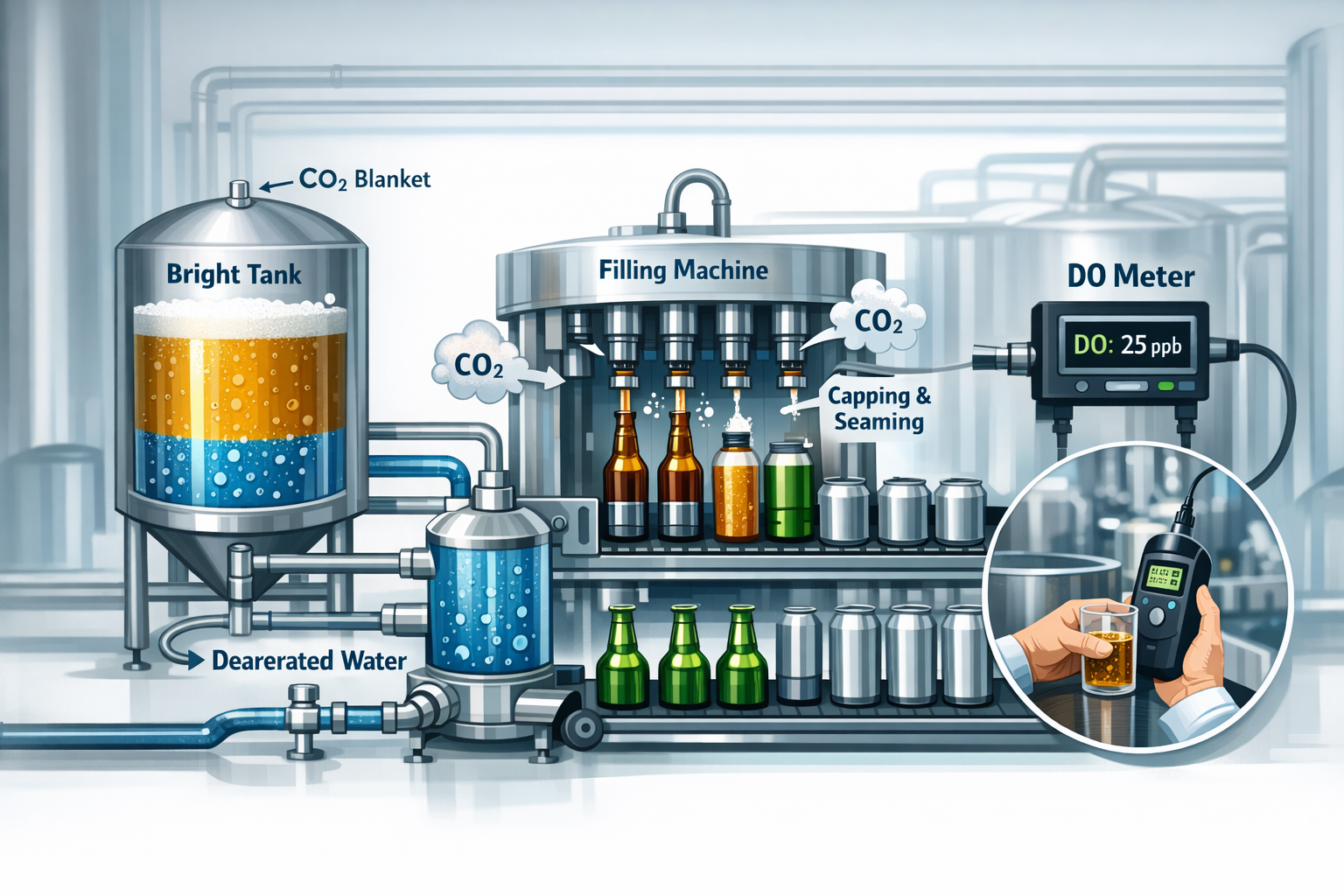
A calibrated DO meter (dissolved oxygen meter) turns guesswork into a map of ingress. Accuracy hinges on frequent calibration using a zero‑O₂ standard and a 100% O₂ standard. Guidance recommends zeroing with high‑purity N₂ (nitrogen) rather than technical CO₂, which often contains impurities (craftbrewingbusiness.com). The probe should be mounted horizontally in a still fluid; air bubbles or vertical mounting can skew readings (sensorex.com).
Systematic sampling then pinpoints the problem. Sensorex advises logging DO after fermentation, after maturation (bright tank), and just before filling (sensorex.com). If bright‑tank beer is 5 ppb but filler output is 30 ppb, the filler is adding 25 ppb — a purge‑cycle check is indicated. If pre‑fill beer is 20 ppb but packaged beer is 60 ppb, cap seals or headspace gas are suspect. If SO₂ pushes from 2 to 50 ppb downstream, CIP or rinse water may be to blame. Inline sensors or “sniff ports” on filler outputs enable instant post‑fill sampling; another practical setup is to briefly flush a bottle or can, then transfer that beer into the DO cell to mimic final product. Wherever possible, comparing treated beer (e.g., straight from filtration) to packaged beer shows the loss in quality directly (sensorex.com).
The readings drive concrete fixes: high DO in shipped beer but low in the BBT points to filler purging or O₂‑laden CIP/rinse water; high DO in the BBT points to seals or blanketing pressure. Cutting filler pickup from 60 to 30 ppb after a jetter adjustment becomes a quantifiable win. Targets cited across packaging best‑practice guides (studylib.net) and equipment manufacturer articles (foodprocessing.com.au) provide the benchmarks to measure against.
Industry notes and further reading
Process‑engineering write‑ups on water deaeration (bbt.corosys.com) (bbt.corosys.com) (bbt.corosys.com), SPX APV “Derox” specifications (scribd.com), and packaging operations features (asiafoodjournal.com) (foodprocessing.com.au) detail the technologies and figures above. Instrumentation guides outline calibration and sampling specifics (sensorex.com) (craftbrewingbusiness.com). Industry reports also frame the broader oxygen conversation in brewing (brewer-world.com).