

Industry: Brewery | Process: Bottling_&_Kegging
Every brewer knows the taste of oxygen damage: papery notes, dulled hops, and a beer that seems to age overnight. What’s less visible is where that oxygen actually gets in. The answer, in short: everywhere on the cold side — unless each link in the chain is locked down.
From line pressurization and “gentle” counter-pressure fillers to using deaerated water for push-outs and rinses, the playbook is precise. And it’s measurable. With a calibrated dissolved oxygen (DO) meter, breweries can pinpoint ingress to within a valve, a jetter, or a rinse station.
The stakes are high: even ~0.1 mg/L (100 ppb) dissolved oxygen can trigger off-flavors in light lagers, with dry‑hopped craft beers “especially susceptible to altered taste” at minute O₂ levels (FoodProcessing.com.au).
Critical control points in cold-side transfers
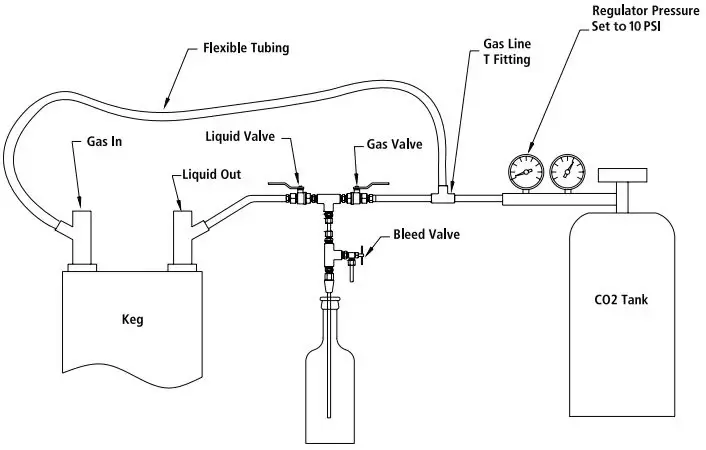
Brewers treat every cold‑side transfer as a potential oxygen exposure. Best practice is to keep lines, valves, and tanks that handle finished beer pressurized with inert gas (CO₂ or N₂) and as short and smooth as possible. The recommendation: push beer by CO₂ pressure rather than pumping or gravity, and keep line pressure just above ambient to collapse air pockets (Brewer‑World).
To prevent air contact at start‑up, transfer lines are often pre‑filled with deaerated water and then purged with CO₂ before beer flows (Brewer‑World; AsiaFoodJournal/KHS). All fittings, gaskets, and seals are checked routinely — even a tiny leak or falling debris can entrain air and raise DO. High flow rates or over‑speed filling are avoided because excessive velocity or turbulence dissolves more oxygen into beer (Brewer‑World).
Cleaning, rinsing, and additive dilution
Post‑CIP rinses can undo an entire day’s good work if the water isn’t low oxygen. Rinse water and any “push” water left on cold‑side equipment are major O₂ sources. That’s why many breweries de‑aerate adjustment or chillproofing water — removing >99% of its oxygen — before any addition (MBAA slides via Studylib; MBAA slides via Studylib).
Filter pre‑coats and additives (e.g., finings) should be mixed in deaerated water; otherwise, a single addition can spike the system with ~10 mg/L O₂ (Brewer‑World; AsiaFoodJournal/KHS).
Container preparation and headspace management
Empty bottles, cans, and kegs are purged of air before fill. Modern bottling heads evacuate each bottle or purge with CO₂ via a hollow‑filler probe as part of counter‑pressure filling — air is removed (vacuum) and replaced with CO₂ so beer flows in under pressure (AsiaFoodJournal/KHS). After fill, many lines “jet” the neck with a high‑pressure sterile water or beer stream to foam up and drive out oxygen; this flushing can reduce headspace O₂ by 90% or more (Brewer‑World; MBAA slides via Studylib).
Line speed is kept within design. Overrunning a filler creates turbulence and can drive 5–10× higher O₂ pickup than intended (Brewer‑World).
Total Packaged Oxygen (TPO) benchmarks
Sealing happens immediately under pressure. Capping machines often inject a small CO₂ headspace before crimping. The final oxygen is TPO (Total Packaged Oxygen = dissolved O₂ + headspace O₂). State‑of‑the‑art lines report striking results: KHS cites ≈20 µg/L (0.02 mg/L) TPO in glass bottles with 160 g CO₂/hl purge gas, or 40 µg/L with only 110 g/hl (AsiaFoodJournal/KHS), while past systems often delivered 150–200 µg/L.
Analyses suggest only 10–20% of final oxygen typically comes from the fill act itself; most oxygen comes from headspace trapped air or downstream ingress (FoodProcessing.com.au).
Packaging mechanics across formats
Bottles rely on crown caps; cans on hermetic seams with under‑cover gassing; kegs on welded walls with gasketed fittings. For cans, “bubble breakers” in conveyor chutes and under‑cover CO₂ gassing during seaming minimize splash and entrapped air (MBAA slides via Studylib).
Kegs require thorough CO₂ purging before fill and slight CO₂ backpressure during filling; afterward, any headspace or blow‑off valve is tightly sealed. Over storage, gaskets or dispensing lines can admit O₂ slowly — for draught, designers calculate that ~1 mg O₂ can diffuse per day through a typical beer line (The Modern Brewhouse) — so minimizing initial O₂ is critical.
Product style sensitivity to oxygen
Style matters. Dry‑hopped and light beers are extremely sensitive. One industry article notes dry‑hopped craft beers are “especially susceptible to altered taste” from O₂ pickup and that even ~0.1 mg/L can produce off‑flavors in light lagers (FoodProcessing.com.au). Dark beers are somewhat more tolerant (oxidation reactions are masked by color/haze), but for lighter, hop‑forward products, tolerance is very low.
Deaerated water systems for rinsing and push-outs
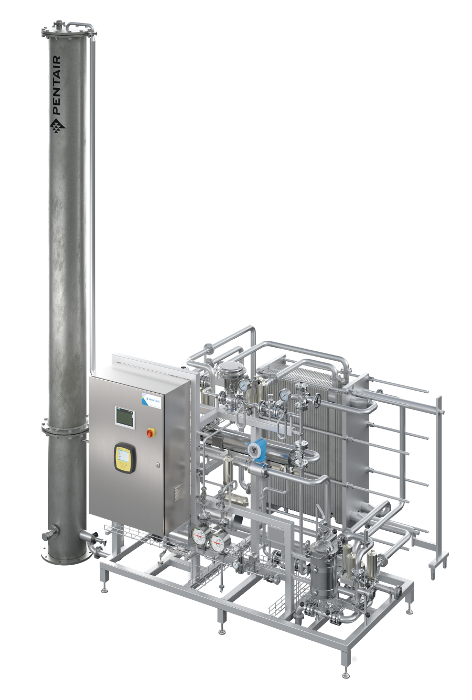
Normal potable water carries roughly 8–10 mg/L dissolved oxygen, which would instantly contaminate any beer it touches. Modern industrial deaerators — often membrane vacuum units — reduce water O₂ to single‑digit ppb (µg/L) levels (Bucher Unipektin). Bucher Unipektin quotes <10 ppb O₂ in deaerated water (Bucher Unipektin).
Deaerated water is used to fill and rinse hoses, filters, centrifuges, and tank lines on the cold side, and it underpins three packaging jobs. First, as push‑out fluid: after a run, residual beer in manifolds or lines is flushed out. If ordinary water were used, it would leave ~10 mg/L O₂; using deaerated water followed by CO₂ expulsion keeps oxygen near zero (Brewer‑World; AsiaFoodJournal/KHS). Second, as final rinse of bottles/cans just before filling: guidance is clear that deaerated water (<0.2 mg/L O₂) is strongly recommended for post‑filter rinses (AsiaFoodJournal/KHS). Third, for chillproofing and adjustment dilutions: “de‑oxygenate adjustment water” and “de‑oxygenate chillproofer water” are standard MBAA notes (MBAA slides via Studylib; MBAA slides via Studylib).
Using deaerated water yields measurable benefits. KHS analysis ties well‑deaerated process water (<0.2 mg/L) to mid‑ppb DO in packaged beer (AsiaFoodJournal/KHS). Replacing normal rinse water with deaerated water can cut potential O₂ pickup by 2–3 orders of magnitude.
There are cost implications: installing a water‑deaerator (vacuum or membrane) adds CAPEX, but lower product losses and longer shelf‑life can pay back the system. One example cites IPA shelf‑life improving from ~1 month to 6 months with better DO control (Imbibe Solutions). Regulators require any water contacting beverage to meet drinking‑water standards, and a deaerator produces microbiologically clean water while solving the O₂ problem; in Indonesia, potable water regulations (Permenkes, SNI for bottled water) emphasize microbial/chemical purity, with DO control treated as a quality issue even if not legally mandated.
Breweries integrating deaeration into broader process‑water management often evaluate membrane‑based platforms such as membrane systems and supporting water‑treatment ancillaries to align packaging‑line rinses and push‑outs with low‑oxygen targets.
Filler design for gentle, low‑oxygen filling
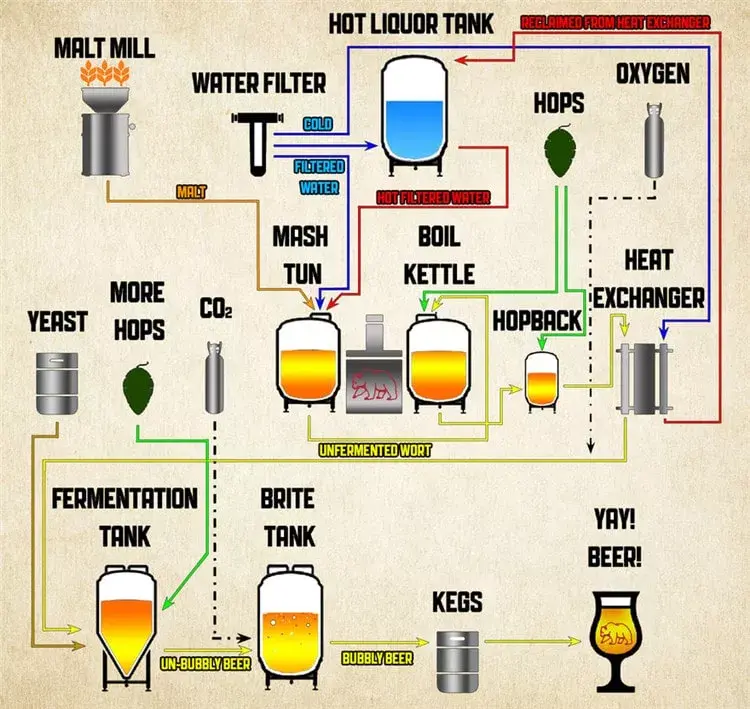
Modern fillers combine vacuum evacuation, counter‑pressure fill, gentle product paths, and headspace purge. In practice, the sequence is: seal, evacuate to vacuum, purge with CO₂, admit beer under slight overpressure matched to carbonation, bleed excess gas, and avoid foam breakouts. KHS reports that such hollow‑probe systems deliver ~20 µg/L TPO in bottles at 160 g CO₂/hl purge gas, and 40 µg/L at 110 g/hl — far better than older machines (AsiaFoodJournal/KHS).
Jetting/fobbing devices shoot sterile water or beer onto the surface in the neck to force uniform foaming and expel headspace air (Brewer‑World; MBAA slides via Studylib). Speed control matters: fillers should not run faster than designed or turbulence will spike oxygen (Brewer‑World).
Cans are seamed under an inert atmosphere with under‑cover gassing to minimize oxygen in the annulus (MBAA slides via Studylib). Bubble breakers and flow guides reduce splash as cans enter the seamer (MBAA slides via Studylib). Depending on product needs, plants use CO₂ or in‑house nitrogen (PSA/molecular sieves) for inerting (FoodProcessing.com.au). KHS notes modern designs can achieve ultra‑low DO while using less CO₂ than prior systems (AsiaFoodJournal/KHS).
When all controls are optimized, the fill contributes only a small fraction of total oxygen — analyses put it at 10–20% of the final TPO, with the rest from trapped air or in‑leakage (FoodProcessing.com.au; AsiaFoodJournal/KHS).
DO meter setup and calibration
A dissolved‑oxygen (DO) meter is the troubleshooting backbone. Accuracy at low levels matters, so calibration starts with an oxygen‑free solution (e.g., sodium sulfite or vacuum‑degassed water) to set 0 mg/L; air calibration alone is insufficient when targeting <0.1 mg/L (Atlas Scientific). After a zero, verify linearity in air or with a known standard and perform a two‑point or multipoint calibration (0% and 100% saturation). If equipment or lines are opened to air during cleaning, recalibrate before new measurements; keep the probe clean and wet (store in O₂‑free solution) for stability (Atlas Scientific).
Stepwise measurements along the line
Sampling proceeds like a detective story. Measure beer in the brite tank (the input DO), then check: post‑rinse water (if it shows >0.5 mg/L, it’s a red flag), filler output (divert a bottle’s worth into a sealed cup; good fillers can show <0.02 mg/L in the liquid under ideal conditions, per FoodProcessing.com.au), and finished package.
For packaged product, one approach is to pour beer into a flask, purge with N₂, shake to equilibrate, and measure DO. This “Umfrage” method (described by Uhlig and Vilachá) correlates headspace O₂ with DO under gas equilibrium (FoodProcessing.com.au). Some plants use integrated TPO analyzers; others rely on handhelds.
Targets, anomalies, and fixes
Common craft targets: finished beer DO below ~50 ppb (0.05 mg/L) (Atlas Scientific; MBAA slides via Studylib). If brite‑tank beer reads 0.003 mg/L and filler output is 0.020 mg/L, the filler contributed ~0.017 mg/L. If rinse water is 5 mg/L (typical tap water), that alone adds tens of ppb — unacceptable.
Diagnosis flows from the pattern:
- Excess DO in rinse/push water: check water treatment and deaerator operation; even 1 mg/L water can raise beer O₂ by ~1 ppb per liter per liter.
- Filler issues: inspect valves, caps, seals; verify vacuum pump performance and CO₂ plumbing/pressures. Insufficient pre‑pressure lets air bubble in as valves open.
- Line leaks: a loose fitting or faulty weld can draw air; kegs or blind flanges can leak slowly.
- Machine speed/agitation: if DO tracks higher with speed or certain formats, reduce speed to test.
- Headspace gas: non‑zero equilibrated readings indicate trapped air; increase purge time or cover‑gas flow during sealing.
Record and trend results in a logbook or MES; graph DO against time or rate to spot subtle issues (e.g., a gradual rise as a CO₂ tank depletes and entrains air). Inline real‑time DO sensors add visibility, but even per‑shift spot checks enforce control. As BrewOps notes, “incorporating DO measurement at critical stages allows brewers to control oxygen exposure” (BrewOps).
If a batch runs high, additive scavengers (ascorbic acid, sulphites) might compensate — but they are a crutch compared with process control. The durable fix is data‑driven: adjust filler CO₂ pressure, replace a gasket, or enhance the deaeration unit and retest until the numbers move.
Why the details add up to shelf life
Well‑deaerated process water, disciplined container prep, and gentle, isobaric filling mean the fill itself contributes only a small portion of TPO; most oxygen is headspace or in‑leakage (FoodProcessing.com.au). In practice, the combination of deaerated water (<0.2 mg/L for rinses), membrane deaerators achieving single‑digit ppb (Bucher Unipektin), and modern fillers delivering ~20–40 µg/L TPO at 110–160 g CO₂/hl purging (AsiaFoodJournal/KHS) is the backbone of flavor stability.