

Industry: Aquaculture | Process: Hatchery_&_Larval_Rearing
In aquaculture hatcheries, the weaning window is where margins live or die. Live feeds like rotifers and Artemia are nutrient-rich and highly palatable, yet expensive and inconsistent. Formulated “microdiets” (finely ground, nutrient-dense feeds often at 50–60% protein) promise scalability—but for years, survival lagged well behind live feed regimes. In larval haddock, for instance, microdiets delivered just 2–5% survival versus 20–25% on live feeds (ResearchGate)).
That gap is narrowing. Today’s microdiets are enriched, better bound, and deployed via automated feeders or co‑feeding regimes. The through-line across the literature: precise formulation plus earlier, longer co‑feeding can unlock both survival and growth—provided a few specific nutritional and physical hurdles are cleared.
HUFA and phospholipid targets
Larval stages require long-chain highly unsaturated fatty acids (HUFAs: DHA 22:6n‑3, EPA 20:5n‑3, ARA 20:4n‑6) and phospholipids (PLs; membrane-forming lipids) for cell membranes, vision/neurological development, and eicosanoid signaling. Reviews note that HUFA deficiency “may impair growth, reproduction and survival” (PMC)).
In practice, live feeds are often enriched with microalgae or emulsions to boost HUFA and PL content. The payoffs are visible in trials: scallop larvae given a high‑HUFA microalgal diet (2.6× HUFA vs a low‑HUFA diet) showed ~64% higher respiration and dramatically stronger immune responses, enabling control of Vibrio pathogens and ultimately improving growth/survival (PMC)).
Phospholipids are just as pivotal. Senegal sole larvae on a high‑PL microdiet grew ~1.2–1.3× larger in the first week than fish on a low‑PL feed; the low‑PL diet caused excess intestinal lipid vacuoles, while high‑PL maintained normal energy balance—echoing broader findings that marine fish larvae “require high levels of dietary PL” for optimal growth and survival (PMC)).
Formulators aim to emulate natural prey: microdiets often target 5–15% of total lipids as PL (e.g., krill oil as a model). Hatchery protocols in seabream now enrich Artemia for >18 h (2 g DHA/kg Artemia, 0.2 g/kg rotifers) to drive DHA into the PL fraction of live feeds (Springer). The economic read‑through: HUFA‑ and PL‑balanced diets shorten weaning and reduce deformities, directly boosting yield.
Immunostimulatory additives in early life
Larval immunity is underdeveloped. Coating starter diets or live feeds with immunostimulants can multiply survival without changing feed intake or water quality—by priming innate immunity (e.g., lysozymes, complement). In turbot, a yeast β‑glucan (MacroGard®) applied at 0.5 g/L via rotifers trebled first‑feeding survival: ~22.8% versus ~7% in controls (ScienceDirect).
A Bacillus probiotic mix delivered roughly 2–2.5× higher common snook larval survival and ~20% higher post‑transport survival (PMC). In crustaceans, chitin/glucan supplements (e.g., chitosan, β‑glucans) are routinely used to prime shrimp immunity. Although specific data in very young larvae are limited, the empirical trend is consistent: β‑glucans, nucleotides, and pro/prebiotics improve survival by tens of percent in measured trials (ScienceDirect; PMC). Indonesian hatcheries should note that the KKP regulations broadly allow natural additives; finished feeds with β‑glucans or probiotics are typically acceptable if sourced from food‑grade materials.
Accurate application matters when enriching live feeds or coating microdiets; dosing infrastructure that delivers repeatable rates helps translate lab gains to production (for example, accurate chemical dosing via a dosing pump).
Attractants to accelerate intake
Newly weaned larvae often ignore dry feed unless it “smells right.” Chemical attractants—amino acids, protein hydrolysates, fish solubles—can double or triple uptake. Coating larval diets with 5% krill hydrolysate boosted ingestion ~2× in perch and whitefish; adding a soluble krill fraction to tank water yielded a 200% increase versus controls (ResearchGate). In practical terms, larvae fed attractant‑coated dry feed ate nearly as much as those on live Artemia.
Non‑essential amino acids are potent cues. In juveniles, adding 2% fish protein hydrolysate (rich in glycine, alanine, proline, etc.) increased feed intake and growth (SciELO; SciELO). One study notes glycine and proline from copepod prey invoke strong behavioral feeding responses in marine larvae. Commercial attractants (krill meal, squid hydrolysate, betaine blends) are now common in microdiets; a plant‑protein microdiet with fish solubles or hydrolyzed blood meal saw gain‑rate increases on the order of 20–30% versus untreated controls (SciELO).
Formulation guidance from trials: incorporate 1–3% attractant—krill meal or liquid fish protein for marine fry, or synthetic appetitives (amino/organic acids) for freshwater—because these additives can cut time to full artificial feeding and improve feed conversion, offsetting their cost.
Binders, microencapsulation, and leaching control
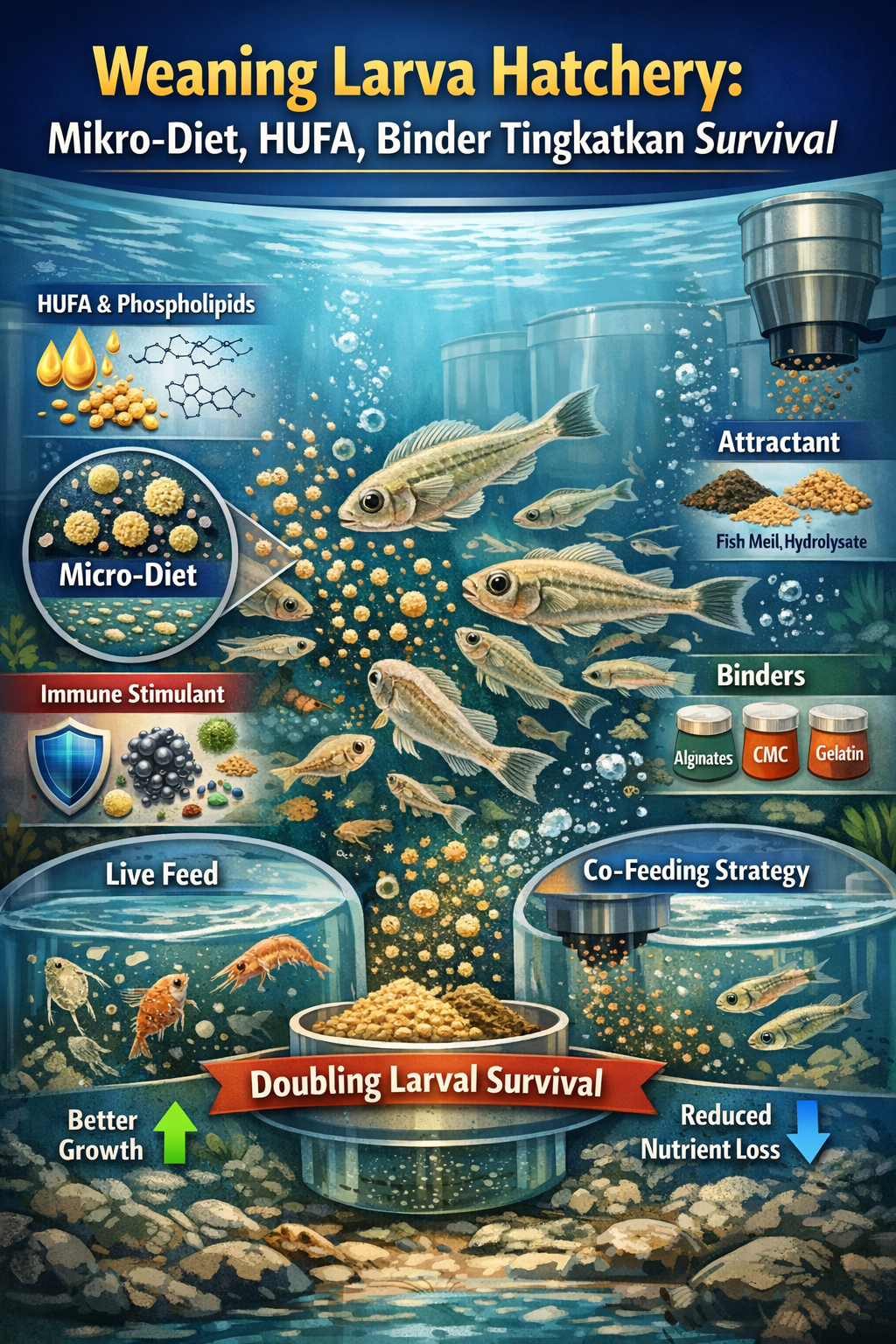
Microdiets must stay intact long enough for larvae to strike; otherwise soluble nutrients leach and water quality suffers. Target stability is ≥90% dry‑mass retention after 1 hour immersion (NCBI). Comparative tests show why: microbound diet (MBD) particles can virtually disintegrate within 5 minutes, while a thick‑walled microencapsulated diet (MED) lost <7% mass after 60 minutes (ResearchGate).
Binder selection and dosage matter: moist pellets with 5% carrageenan/CMC retained significantly more dry matter than those with 3% binder (NCBI). Among tested binders, proteinaceous zein showed the lowest nutrient leaching in larval decapod feeds—likely due to its hydrophobic matrix (ResearchGate). Common mill choices include alginate or gelatin for microbound diets—gelled via acid or enzymes (ResearchGate)—and carrageenan/CMC for pellets.
Good binding keeps nutrients in the feed and out of the water; too‑strong binding can slow digestion. One review advises, “practically, binders that can be digested and assimilated are chosen,” among them starches and gelatins (NCBI). Because poor binding leads to wasted protein (effluent) and lower growth, well‑bound microdiets generally improve feed efficiency.
Where effluent management is part of hatchery utilities design, pretreatment choices and disinfection can intersect with feed decisions. For example, ultrafiltration is used as pretreatment to RO and for drinking‑water applications from surface waters/ground (ultrafiltration), and ultraviolet systems deliver a 99.99% pathogen kill rate without chemicals at low operating cost (ultraviolet).
Cofeeding protocols and enzyme development
Rather than an abrupt switch, many programs co‑feed live feeds and microdiets, and newer evidence favors starting microdiets earlier and continuing longer. In gilthead seabream, larvae switched to a commercial microparticle (ProStart) at 3 days post‑hatch (dph), with continued cofeeding, developed digestive enzymes earlier and ultimately reached higher body mass and lower deformity rates than siblings weaned at 15 dph; simply doubling Artemia “failed to compensate”—only the microdiets drove growth benefits (Springer; Springer).
The measured outcomes include increases in aminopeptidase and chymotrypsin activity and higher dry weight for early cofeeding groups; delayed weaning produced stunting and higher deformity rates (Springer). In larval shrimp, full Artemia replacement with microdiets has been achieved commercially—survival and growth matched live feed for species like Penaeus monodon once optimized. The message: advanced feeds plus adapted protocols can transform hatchery performance.
Quantitative implications for formulators
Across peer‑reviewed trials, each additive type delivers measurable gains: HUFAs/PLs can yield ~20–30% faster early growth (PMC); immunostimulants have multiplied survival by 2–3× (ScienceDirect; PMC); attractants have doubled or tripled feeding rates (ResearchGate; SciELO). Binders that achieve 90+% stability (NCBI) outperform poor binders that approach near‑zero.
Practical composition guidance from the literature: include ~2–5% HUFA sources (fish or algal oils) and 5–10% high‑grade phospholipid (e.g., marine lecithin) in microdiets; add >1% attractant (krill meal, amino acid blend) and >3% moisture‑stable binder; apply immunostimulants such as β‑glucan at ~0.5 g/L via live feed enrichment on a prophylactic basis—especially in high‑density weaning. Facilities adopting enriched, stabilized microdiets in early cofeeding protocols report higher larval throughput. Conversely, failing to address these factors typically yields high mortality even when apparent intake is adequate (e.g., Indonesian grouper larvae reached 22.3 mm by 35 days yet “high mortality” persisted; Jurnal UNTIDAR).
Closing the loop with data
The literature converges: targeted inclusion of HUFAs, PLs, immunostimulants, attractants, and digestion‑compatible binders consistently improves survival and growth (PMC); ScienceDirect; ResearchGate; ResearchGate; Springer). When designing or scaling a weaning feed, the papers argue for quantitative benchmarking—e.g., survival gains from β‑glucan + probiotic versus control, or intake gains from attractants—so ingredient costs are tied to measurable weaning success. Regulatory frameworks (in Indonesia and elsewhere) generally permit natural additives and additives listed for animal feeds, enabling implementation in commercial settings (ScienceDirect; PMC).
Sources: authoritative reviews and recent trials underpin these conclusions—see PMC); PMC; PMC; ScienceDirect; PMC; ResearchGate; SciELO; ResearchGate; NCBI; Springer; Jurnal UNTIDAR.