

Industry: Brewery | Process: Clean
Beerstone isn’t just a housekeeping headache. Even a thin coating (≈1 mm) can dramatically impair heat transfer (≈40% loss) and harbor spoilage organisms (orlichem.co.za). The deposit is a tenacious scale composed of calcium oxalate crystals bound in a proteinaceous matrix (morebeer.com).
Chemically, calcium ions (Ca2+ from hard water) react with oxalate anions (from grain and hop acids) to form solid CaC2O4, which precipitates on cold or high‑pH surfaces (beerbrewerguide.com) (morebeer.com). Small amounts of CaC2O4 are widespread, but in beerstone they coalesce into a visible layer that is highly insoluble and adherent (merryn.dineley.com) (morebeer.com). Build‑up is accelerated by cooling and fermentation (lower temperature, higher pH) and by rough or unpassivated surfaces that provide nucleation sites — passivation is the protective oxide layer that stabilizes stainless steel (beerbrewerguide.com) (morebeer.com).
Chemistry and solubility of beerstone
Acid detergents are the only effective class of cleaners for dissolving the inorganic component of beerstone (calcium oxalate). Strong mineral acids protonate and solubilize the oxalate mineral layer. For example, phosphoric acid reacts with calcium oxalate to yield soluble calcium and oxalate species, while nitric acid both dissolves the scale and oxidizes organic residues (beerbrewerguide.com) (morebeer.com). Sulfuric or hydrochloric acid will dissolve CaC2O4, but they are extremely corrosive and unsafe on stainless steel (morebeer.com) (morebeer.com).
Breweries conventionally use blends of phosphoric and nitric acids: phosphoric provides buffering and allows hot solutions without rapid fuming, while nitric provides strong acidity, oxidative power, and a passivating oxide film on stainless steel (morebeer.com) (solenis.com). Clean‑in‑place (CIP, a circulation method that cleans equipment without disassembly) typically runs acid concentrations around 0.5–2% (v/v) and elevated temperatures (50–80 °C) to accelerate scale dissolution (solenis.com) (yolongbrewtech.com).
One common recipe is a 0.5–1.0% H3PO4/HNO3 solution at 40–60 °C for 10–20 min for acid CIP after caustic cleaning (yolongbrewtech.com). Concentrations or durations must be higher for heavy beerstone; severely encrusted tanks may need near the upper safe limits (e.g., 2% nitric/phosphoric for 30–60 min) (morebeer.com). Higher acid strength or heat increases dissolution rate but also increases risk of corrosion (especially if oxygen is present) and cost of neutralization. In all cases, solution pH is kept very low (pH ≤2) to drive the reaction, and nitrates/oxalates remain soluble. After acid cleaning, an aggressive rinse to neutral to prevent acid residues is essential (yolongbrewtech.com).
Whole acids versus nitro‑phosphoric blends
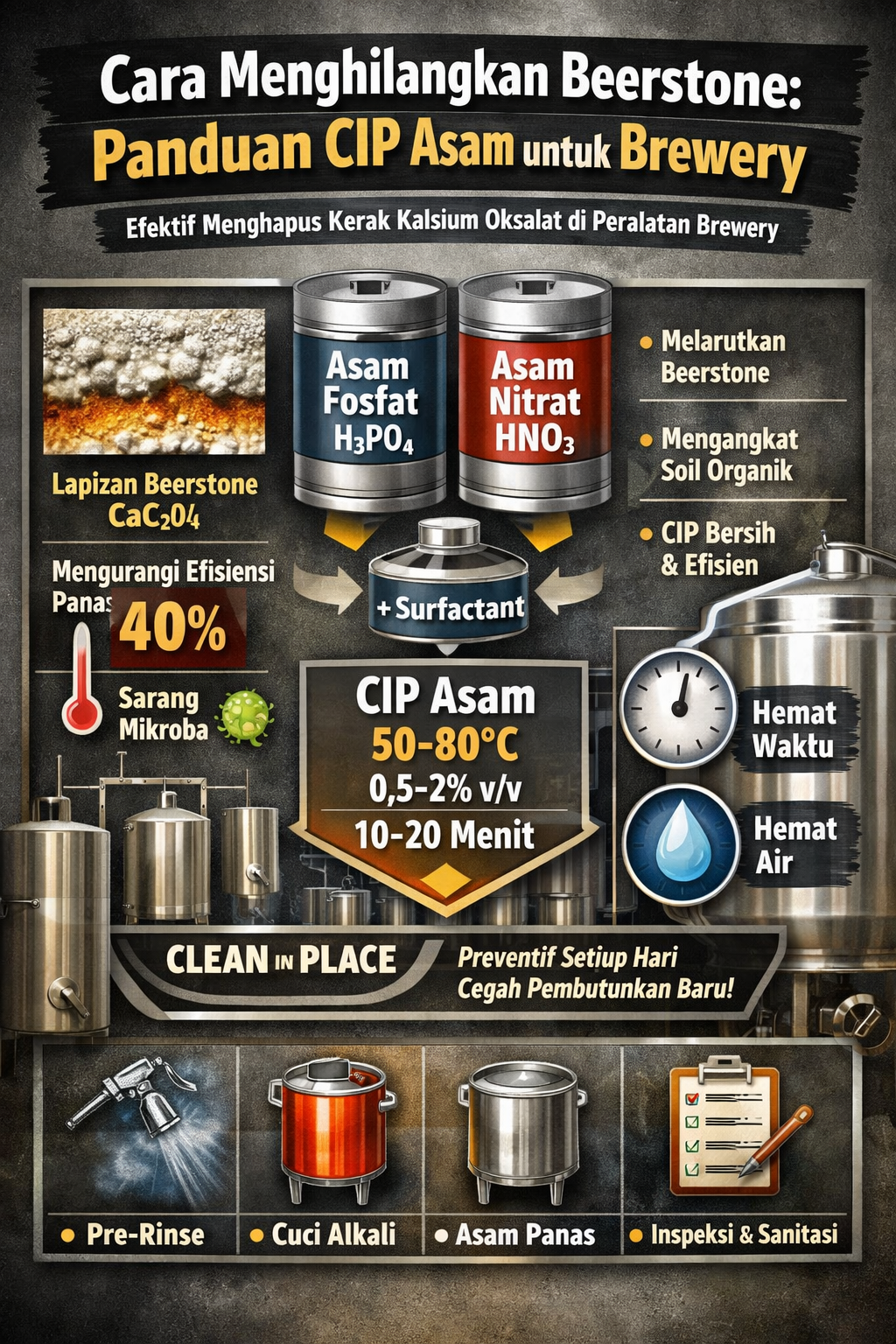
Pure phosphoric acid dissolves calcium oxalate scale and passivates surfaces, but lacks oxidative action on the protein binder (twchemicals.home.blog) (beerbrewerguide.com). Pure nitric acid is more powerful — it hydrolyzes proteins and oxidizes organic matter as it de‑scales — but it fumes above 60 °C and is more aggressive to equipment (twchemicals.home.blog).
Hence, nitro‑phosphoric blends are standard: nitric acid “loosens” the protein‑impregnated stone, while phosphoric acid maintains solution strength and passivation at hot CIP temperatures (morebeer.com) (twchemicals.home.blog). In practice, formulations like Birko’s Acid Brite (H3PO4‑rich) are used on the hot side and Ultra Niter (HNO3‑rich) on the cold side, with the guideline “harder water demands more nitric acid to remove and prevent beerstone” (solenis.com). Citric or acetic acid CIP cleaners exist but are milder; they are mainly used for routine maintenance or on copper/brass surfaces, not as a primary beerstone remover (orlichem.co.za) (beerbrewerguide.com).
One‑step acid cleaners with surfactants
Modern practice increasingly favors formulated acid CIP detergents that combine multiple acids with surfactants and chelating agents. These “one‑step” acid cleaners can simultaneously dissolve mineral scale and lift organic soils, reducing the need for separate caustic and acid steps. For example, A‑CIP (SISBrew) is a “blend of nitric and phosphoric acid and low‑foaming surfactants” designed to solubilize beerstone, milkstone, and other inorganic deposits (sisbrew.com).
In one academic case study, a proprietary low‑foam acid cleaner (combining HNO3/H3PO4 with organic acids and surfactants) lifted protein “soils” while dissolving hard‑scale, replacing two separate wash cycles (food-safety.com) (food-safety.com). The surfactants lower surface tension and emulsify oils/proteins, effectively “trapping” organic residues in solution (morebeer.com) (food-safety.com).
Programs like DeLaval’s One‑Step Acid (OSA) have documented strong results. Substituting a single acid‑surfactant wash for traditional two‑step cleaning cut CIP time and water by large margins; one pilot reduced a 15 min acid wash to 9 min with comparable cleanliness — saving 6 min per cycle (∼10 h of CIP time per 100 cycles) and 360 gal per cycle (∼36,000 gal/day) of rinse water (food-safety.com). Economically, eliminating a separate acid rinse step can save on average ~$50 per CIP circuit per day (7‑day week operation) (food-safety.com). In practice, one‑step acid cleaners often also include sanitizers (e.g., Birko’s OxyStrike merges nitric acid with peracetic acid) to both dissolve scale and kill microbes in one pass (biosanpaa.com).
Preventive CIP and water control
Preventing beerstone deposition requires a consistent CIP and maintenance program. All vessels and lines that contact wort/beer — especially fermenters, brite tanks, kegs, and heat exchangers — should undergo daily CIP after use. A typical preventive CIP recipe might include: warm pre‑rinse (5–10 min), hot caustic (1.5–3% NaOH, 20–40 min at 60–75 °C), rinse, then hot acid (0.5–1.0% H3PO4/HNO3, 10–20 min at 40–60 °C), followed by a final rinse and sanitizing step (yolongbrewtech.com). One example protocol from industry advises 20–40 min in 1–4% alkali then 20–40 min in 0.5–1% acid (morebeer.com) (yolongbrewtech.com).
Crucially, cleaning solutions must be fresh and at working strength (monitor via titration or conductivity), and equipment should be completely drained and aired dry at cycle end (micetcraft.com) (yolongbrewtech.com). Water treatment — softening or ion exchange to reduce Ca/Mg — limits scale formation; in practice, this can include installing a softener to remove calcium and magnesium ions to prevent scale formation, or specifying a complete ion exchange system for hardness control.
Key maintenance measures include timely removal of solids and yeast, and CO2 purging before caustic cycles (to avoid vacuum formation and wasted caustic). Surfaces should be inspected regularly for any nascent deposits and passivation tested (residual iron should be minimized). Monitoring cleaning effectiveness — e.g., ATP bioluminescence (a rapid cleanliness assay) or microbial swabs — can verify no film remains; modern systems have raised ATP “clean” pass rates above 95–98% after optimized CIP (yolongbrewtech.com). Maintaining working strength during circulation is supported by accurate chemical dosing equipment such as a dosing pump.
Any visible beerstone should be aggressively treated (using high‑end concentrations or manual scrubbing) to restore a clean baseline; after heavy removal, maintenance cycles can often be done with milder chemicals. Preventive programs should also control process parameters: minimizing metal/oxalate loads, avoiding overly high dilution water hardness, and avoiding excessive hold‑ups of wort. Ensure all cleaning agents are fully neutralized and rinsed. When adhered to, these steps keep beerstone formation at bay and maintain optimal hygiene and heat transfer (even 1 mm of scale can degrade heat exchange by ~40%) (orlichem.co.za).
Keywords: beerstone, calcium oxalate, CIP, phosphoric acid, nitric acid, surfactant, beer hygiene, preventive maintenance (morebeer.com) (twchemicals.home.blog).
Sources: Authoritative industry and technical sources have been consulted, including brewing process guides (morebeer.com) (yolongbrewtech.com), chemical supplier recommendations (solenis.com) (solenis.com), and peer‑reviewed brewery sanitation literature (orlichem.co.za) (food-safety.com). All figures and claims are supported by cited data.