

Industry: Brewery | Process: Milling_&_Mashing
Brewing water hardness ions play key roles in mash conversion. Calcium is especially important. “In the mash, calcium is essential for the stabilization of α‑amylase… without Ca²⁺, α‑amylase is rapidly destroyed at normal mashing temperatures” (murphyandson.co.uk). In practice, brewers typically aim for 50–150 ppm Ca²⁺ in the mash water (ppm = parts per million; a concentration unit) (horiba.com). Classic hard brewing waters – e.g. Burton – reached 200–300 ppm Ca (homebrew.stackexchange.com) (horiba.com).
Extra Ca²⁺ also lowers mash pH by precipitating wort phosphates: Ca²⁺ + (phosphate) → Ca‑phosphate (solid) + H⁺, which helps drive the mash pH into the optimal 5.2–5.5 range for enzymes (pH = acidity/alkalinity scale) (murphyandson.co.uk) (horiba.com). In contrast, β‑amylase does not require added Ca²⁺ and is inhibited by very high Ca²⁺/Mg²⁺ (β‑amylase = maltose‑producing enzyme; α‑amylase = starch‑liquefying enzyme). Laboratory data show that barley β‑amylase is significantly inhibited only at high ion levels (e.g. Ki≈13 mM Ca²⁺, Ki≈18 mM Mg²⁺) (researchgate.net) – levels far above typical brewing water. Thus normal brewing Ca²⁺ (≪500 mg/L) slightly slows β‑amylase at most.
Calcium and magnesium in mash enzymes
Ensure at least ≈50 ppm Ca²⁺ in the mash for α‑amylase stability (horiba.com) (homebrew.stackexchange.com), and avoid extreme hardness that could inhibit β‑amylase (researchgate.net). Magnesium behaves similarly but more weakly. It too forms precipitates (Mg‑phosphate) and so lowers pH (though magnesium salts are highly soluble, so its pH effect is modest) (brewingforward.com). Brewers usually find ~10–30 ppm Mg²⁺ (from malt) is enough; excessive Mg (>40 ppm) can impart harsh bitterness (brewingforward.com). Mg²⁺ is primarily tapped for yeast nutrition (many yeast enzymes need Mg²⁺), but for starch conversion its role is secondary.
Gypsum versus calcium chloride dosing
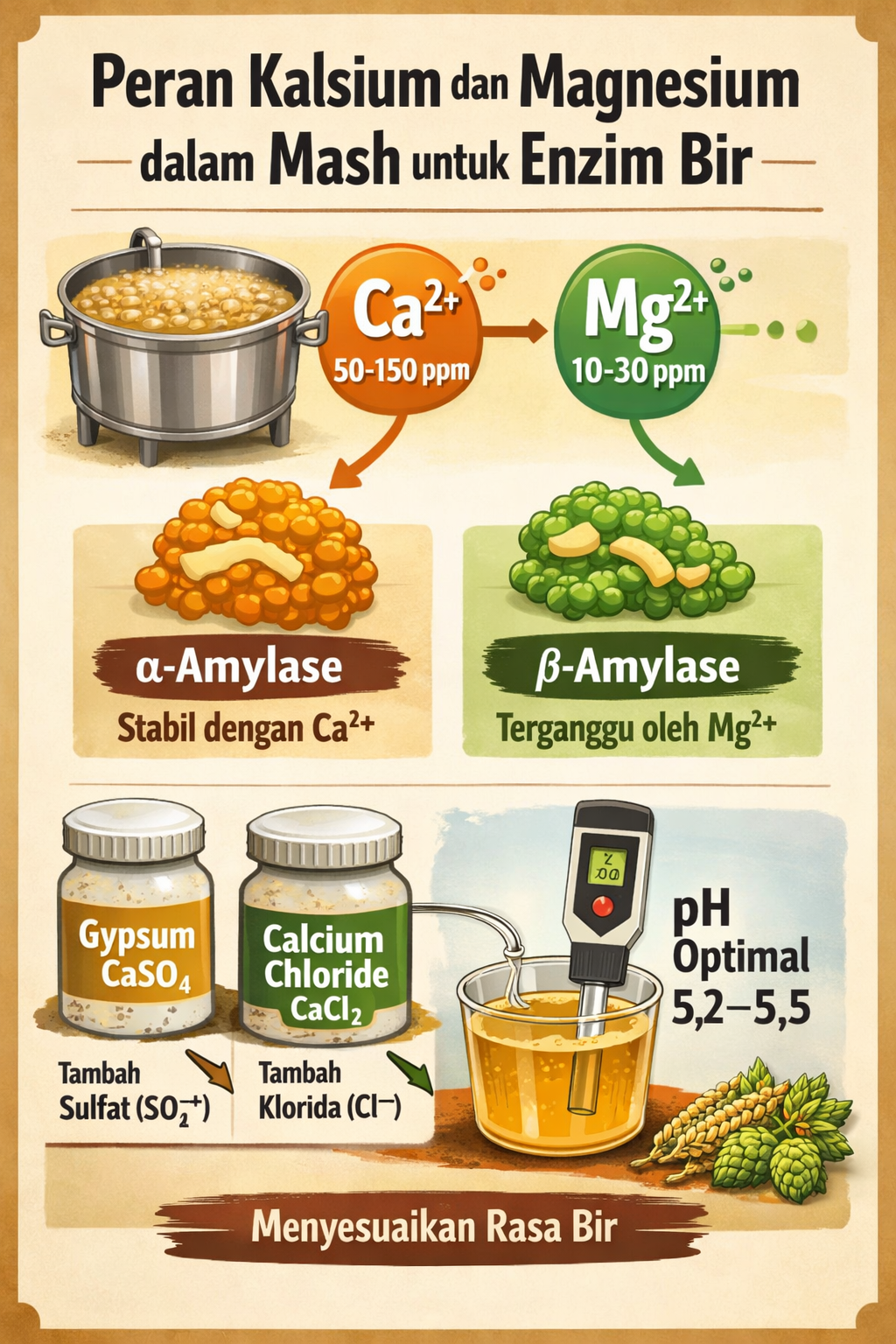
To hit target Ca²⁺, brewers add calcium salts in the mash. The two common salts are gypsum (CaSO₄·2H₂O) and calcium chloride (CaCl₂·2H₂O). Both raise Ca²⁺ levels, but bring different anions that affect flavor and pH. Gypsum adds sulfate (SO₄²⁻) along with Ca²⁺, which accentuates hop bitterness and dryness (murphyandson.co.uk). For example, ~1 g gypsum per gallon of water supplies ≈61.5 ppm Ca²⁺ and 147.5 ppm SO₄²⁻ (brewersupporter.com) (roughly 16 ppm Ca²⁺ and 38 ppm SO₄²⁻ per liter). Brewers use gypsum to increase hardness and sulfate for pale ales/IPAs.
CaCl₂ adds chloride instead: ~1 g CaCl₂ per gallon gives ≈72 ppm Ca²⁺ (and similar Cl⁻ rise) [typical literature value]. Chloride enhances malt sweetness and fullness (murphyandson.co.uk). In practice, brewers balance these salts to achieve the desired SO₄²⁻:Cl⁻ ratio for style. (E.g. ~2:1 SO₄:Cl for very bitter/hoppy beers, vs ~1:2 for malty beers (murphyandson.co.uk)). Both salts simultaneously help mash acidity: added Ca²⁺ will precipitate more malt phosphates and push mash pH toward ≈5.3 (murphyandson.co.uk) (horiba.com), which maximizes enzyme activity.
Salts are added to the mash or kettle (not to sparge water; sparge water = grain‑rinse water) so they mix into the enzyme zone. Note: don’t use chalk or lime (CaCO₃ or Ca(OH)₂) for mash adjustment – they are poorly soluble in wort (brewingforward.com). (Acid dosing or carbon filtration is used instead if extreme alkalinity must be cut.) Breweries that dose acids often rely on an accurate dosing pump for tight control, while carbon filtration aligns with the use of activated carbon to remove unwanted tastes and chlorine.
Mash pH and enzyme performance
The net effect of Ca²⁺ and Mg²⁺ is to bring mash pH into range. Optimal α‑amylase and β‑amylase activity occurs around pH 5.2–5.5 (horiba.com). In practice, modern laboratories and industry see best starch conversion when mash pH is ≈5.2 (at the lower limit of the range) (horiba.com). Brewers measure and adjust mash pH (often with salts plus food‑grade acids like lactic/phosphoric) because a 0.1–0.2 pH unit deviation can markedly change enzyme rates. For example, an overly high pH (>5.8) slows α‑amylase. Data‑backed brewing practice (and Horiba technical guidelines) recommend targeting pH≈5.2 precisely “for improved enzyme activity leading to optimal conversion” (horiba.com).
Style targets and ion profiles
Brewers tailor ion profiles (Ca, Mg, SO₄, Cl, alkalinity) to beer style. Tables and software give specific targets. The Brewfather app recommends (in ppm):
Light lagers/Pilsners: Ca ≈50–75, alkalinity <50, SO₄≈25–50, Cl≈25–50; soft water is ideal (docs.brewfather.app). Hoppy pale ales/IPAs: Ca ≈75–150, alkalinity <50, SO₄≈150–300, Cl≈50–100 (high SO₄:Cl ratio) (docs.brewfather.app). Malty beers (Munich, Bock): Ca ≈50–100, alkalinity 50–150, SO₄≈25–75, Cl≈50–100 (higher Cl:SO₄) (docs.brewfather.app). Dark beers (Stout/Porter): Ca ≈75–150, alkalinity 100–300 (to neutralize roast acidity), SO₄≈50–150, Cl≈50–150 (balanced or Cl‑slanted) (docs.brewfather.app). Wheat/Belgian beers: Ca ≈50–100, alkalinity 50–100, SO₄≈10–30, Cl≈50–100 (very low SO₄ for soft profile) (docs.brewfather.app).
These match historical exemplars. Murphy & Son list classic “bitter” (pale ale) water as ~170 ppm Ca, 15 ppm Mg, 25 ppm bicarbonate, 200 ppm Cl, 400 ppm SO₄ (∼2:1 SO₄:Cl) (murphyandson.co.uk) – very hard, high‑sulfate. By contrast Pilsner style water had only ~50 ppm Ca, 10 ppm Mg, 25 ppm HCO₃, 10 ppm Cl and SO₄ (murphyandson.co.uk) (very soft). Brewers build towards these targets by calculating salt additions: each gram of gypsum or CaCl₂ yields tens of ppm Ca and SO₄/Cl as needed (brewersupporter.com).
Operational notes and base water
Brewers often first ensure a clean, potable water base (Indonesian brewing water must meet drinking standards, e.g. Permenkes regulations) (murphyandson.co.uk) and then plan mineral additions. Brewers use water reports plus calculators (e.g. Bru’n Water, Brewfather) to quantify salt additions. Measured outcomes include mash pH, attenuation and fermentability: for example, a properly acidified Ca‑rich mash will hit conversion efficiency nearly 100% under infusion conditions, whereas an unadjusted high‑alkalinity water can stall enzymes and leave starch unconverted (lower extract, higher viscosity). Adjusting Ca and Mg precisely (with gypsum/CaCl₂ and occasionally Epsom salt) is thus a data‑driven tool to maximize starch conversion and achieve targeted beer flavor profiles (murphyandson.co.uk) (horiba.com).
Key parameters in summary
Optimizing α/β‑amylase activity in the mash means controlling mash pH (≈5.2), ensuring adequate Ca for α‑amylase stability, and tailoring sulfate vs chloride to style. Typical enzyme‑preserving mash Ca²⁺ is ~50–150 ppm (horiba.com), Mg²⁺ is ~10–30 ppm, and the SO₄:Cl ratio ranges from ≈2:1 in dry pale beers to ≈1:2 in full‑bodied malts (murphyandson.co.uk) (docs.brewfather.app).
Sources: Industry and academic brewing resources were used. Key data come from Murphy & Son brewing technical articles (murphyandson.co.uk) (murphyandson.co.uk), Horiba’s brewing water guide (horiba.com) (horiba.com), and brewing chemistry references (e.g. Comrie, Palmer, Evans) compiled by BrewingForward and Brewfather manuals (docs.brewfather.app) (docs.brewfather.app) (docs.brewfather.app). The effects of ions on enzyme kinetics are documented in enzyme studies (researchgate.net) and brewing handbooks (horiba.com). All ion figures and salt addition calculations are drawn from these sources (brewersupporter.com) (murphyandson.co.uk), with Indonesian potable‑water standards observed as needed (murphyandson.co.uk).