

Industry: Aquaculture | Process: Solid_Waste_Removal_&_Sludge_Treatment
In recirculating aquaculture systems (RAS, closed-loop systems that reuse water), sludge builds fast — on the order of 1 L per 1 kg feed at a feed conversion ≈1.2:1 (vfa.vic.gov.au). Stored or poorly stabilized, it emits malodors including hydrogen sulfide (H₂S), ammonia (NH₃), volatile fatty acids, and mercaptans — with H₂S often exceeding 10 ppm, a highly noxious level.
With global aquaculture now ~130–190 million tonnes/year and growing (reuters.com) (apnews.com), odor control is a frontline operational issue for farms, hatcheries, and RAS facilities.
This guide compiles proven options — chemical additives, biological air filtration, ventilation design, and sludge stabilization — with measurement-backed outcomes and design notes drawn from wastewater and agricultural practice.
Baca juga:
Hot Break di Kettle: pH 5,2, Ca²⁺ & Carrageenan Pangkas Haze 10×
Chemical oxidation and electron‑acceptor dosing
Nitrate/nitrite dosing supplies an alternate electron acceptor to anaerobic bacteria, preventing sulfate reduction to H₂S. In practice, a nitrite/nitrate blend cut peak H₂S at one treatment plant from ~10–15 ppm down to <1 ppm (wwdmag.com). Dosing is commonly metered to maintain a low residual — e.g., ~1 ppm NO₃⁻ in sludge filtrate (wwdmag.com) — because the nitrite/nitrate mix “stops hydrogen sulfide generation by replacing the oxygen that anaerobic bacteria would otherwise strip from sulfate,” a mechanism documented in municipal wastewater systems (wwdmag.com). For consistent control, many operators pair this approach with metering via dosing pumps.
Hydrogen peroxide and other oxidants
Hydrogen peroxide (H₂O₂) directly oxidizes H₂S: H₂O₂ + H₂S → S + 2H₂O. The chemistry is effective globally for sulfide control (nepis.epa.gov) (nepis.epa.gov), and can be injected as 30–50% solution with simple pump kits (nepis.epa.gov). Typical design costs are moderate — EPA cites ~$11,000–15,000 for a small system (nepis.epa.gov). Dosing can be continuous or pulsed to quench H₂S spikes.
pH elevation and chlorine oxidation
Raising pH with sodium hydroxide or lime reduces sulfide volatility (shifts H₂S → HS⁻) and can “shock” sulfide‑producing biofilms; a one‑time raise to pH ≈10 eliminated filamentous slime layers, with days before H₂S rebuilt (nepis.epa.gov). Chlorine (bleach/chlorination gas) and hypochlorite likewise oxidize H₂S to sulfate and are effective when sulfur compounds dominate odors (nepis.epa.gov). Where onsite generation is preferred, plants pair dosing with electrochlorination systems.
Iron salts and sulfide precipitation
Ferrous and ferric salts bind sulfide ions as insoluble iron sulfides, preventing H₂S. EPA data show FeSO₄ addition can cut dissolved sulfide by 100% when dosed at ~4–6 mol Fe per mol sulfide (Table 3‑20) (nepis.epa.gov). FeCl₃ also co‑precipitates odoriferous organics and phosphates; dosing is often inline ahead of storage.
Additives and masking agents
Commercial bio‑cultures or enzyme preparations that “mask” odors show mixed results. Reviews favor biological air treatment (biofilters; see below) over masking agents because many additives have limited efficacy in practice (mdpi.com).
Chemical outcomes and dosing economics
Measured outcomes are large: continuous nitrate dosing in Johnstown, PA, brought atmospheric H₂S from >10 ppm to nearly zero (<1 ppm) (wwdmag.com). Across industries, oxidant dosing (peroxide, peroxide+air, permanganate) routinely eliminates >90% of H₂S in vent streams (nepis.epa.gov), and sodium hydroxide injections have restored sulfide‑free conditions within hours (nepis.epa.gov). Cost‑effectiveness varies, but dosing is typically <$50–100 per cubic meter of sludge treated.
Biofilters for exhaust air treatment
Biofilters (packed beds of compost/wood chips treating exhaust) absorb and biodegrade odorants via aerobic microbes. They excel on H₂S and NH₃: removal often exceeds 90–95% for H₂S and reaches ~80–96% for ammonia under design conditions (mdpi.com) (mdpi.com). One study reported >99% H₂S removal at 10–30 ppm inlet concentrations (mdpi.com).
Design is straightforward: 1–2 m deep beds sized by mass loading; media moisture around 40–60%; manage pressure drop and channeling by replacing/mixing media. Reviews note robust performance on fluctuating loads and heterogeneous VOCs after acclimation (mdpi.com) (mdpi.com). Example: a Dutch municipal sludge gas biofilter moving 5,000 m³/h typically requires ~500 m² of media for 95%+ H₂S removal. Operating costs are low (no chemicals; low fan energy), but success depends on capturing odorous air and directing it to the bed.
Biofilters can work stand‑alone or as polishing steps on chemical scrubbers. Well‑planned units treat 100–1,000+ m³/h of vent air; pilot tests should define size.
Ventilation and containment design (ACH targets)
Containment first: cover open sludge tanks/holding basins with sealed domes or flat covers to capture odors, as advised for gravity thickeners (nepis.epa.gov). Provide manways for access while minimizing leaks (nepis.epa.gov). An exception is “fresh and aerobic” sludge, but storage rarely meets that bar.
Ventilation next: sludge processing spaces and tanks should run at 10–20 ACH (air changes per hour, full room air volume replacements per hour) to dilute H₂S/NH₃ to safe levels (nepis.epa.gov). For example, a 100 m³ tank area needs 1,000–2,000 m³/h airflow for 10–20 ACH. Inlet fans supply clean air; exhaust fans pull odorous air to treatment.
Treat the exhaust: covered sludge vessels should route air to a biofilter, a chemical scrubber, a flare for H₂S, or an activated carbon scrubber — EPA practice is that “exhaust air must undergo suitable treatment prior to discharge” (nepis.epa.gov). For polishing streams, operators often specify activated carbon in the treatment train.
Safety matters: H₂S is flammable at >4.3% and toxic (OSHA 8‑hr PEL = 10 ppm; IDLH = 100 ppm). Sensors/alarms, explosion‑proof fans, and discharge stacks meeting local codes are standard practice. For anaerobic digestion, keep biogas headspace on separate piping to a flare or scrubber rather than venting to ambient.
Data note: ventilation plus chemical controls keeps indoor H₂S near zero; after nitrate dosing in Johnstown, workers reported the “air is much more tolerable” with H₂S <1 ppm (wwdmag.com). Ventilation is a passive control: up to 80% odor reduction comes from dilution and flow control before any treatment.
Baca juga:
Hot Break di Kettle: pH 5,2, Ca²⁺ & Carrageenan Pangkas Haze 10×
Sludge stabilization via anaerobic or aerobic digestion
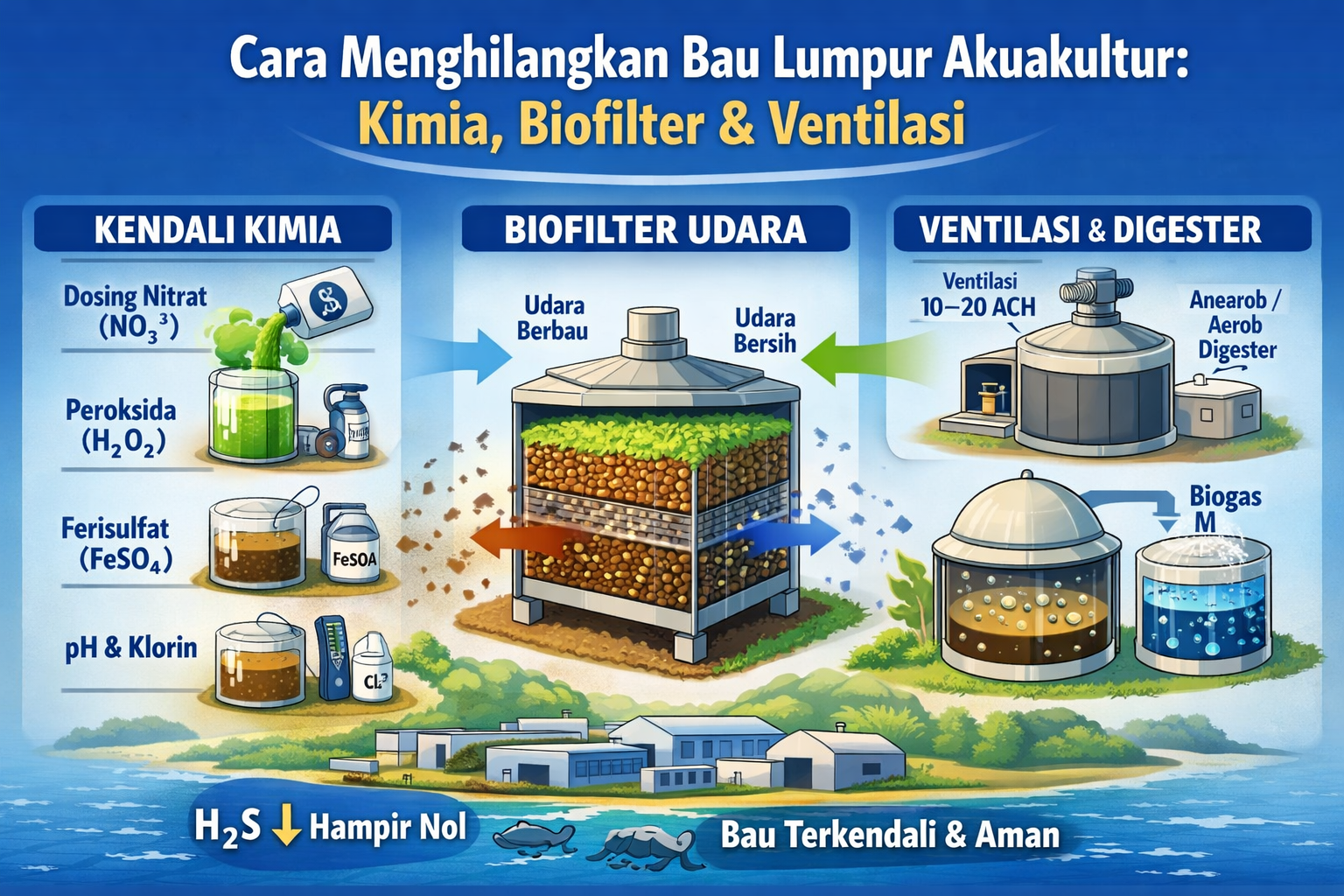
Stabilization removes the odorous precursors — volatile fatty acids, sulfides, ammonia — by converting them to biogas or fully oxidized products. In anaerobic digestion (AD), a four‑stage process (hydrolysis → acidogenesis → acetogenesis → methanogenesis) destroys ~40–60% of volatile solids (mdpi.com). Digesters must be sealed with gas collection, and H₂S scrubbers (turf filters, chemical absorbents) are typical; without treatment, headspace and dewatering areas can reach very high odor activity values (one survey reported ~32,000 in a dewatering room; pubmed.ncbi.nlm.nih.gov). With gas cleanup, the net odor emission is captured oil‑like, not foul.
Digestate (the solids leaving AD) is far more inert; field experience (EPA, industry) indicates properly digested sludge does not spontaneously go septic if briefly exposed. For sludges that have undergone aerobic digestion (similarly after AD), “odor generation is likely only if stored for >2 hours” (nepis.epa.gov).
Aerobic digestion/composting mineralizes organics under warm, aerated conditions; extended aeration (long SRT >20 days) converts proteins to ammonia (nitrified to nitrate), fats to CO₂, and sulfides to sulfate. Well‑aerated sludge emits only earthy, low‑odor emissions during treatment; odors spike only if aeration ceases or piles go anaerobic (EPA notes fully aerobic stabilized sludge emits negligible odor if not held long; nepis.epa.gov). Many facilities implement this via anaerobic and aerobic digestion systems or extended‑aeration basins related to activated‑sludge practice.
Odor reduction efficacy is substantial: stabilization typically reduces odor units by an order of magnitude versus raw sludge. Aerobic composting sites can exhibit very high odor values during active phases (up to 9,000 OU), which drop sharply after maturation, whereas raw sludge piles can exceed 10,000 OU (pubmed.ncbi.nlm.nih.gov). In practice, eliminating “raw” putrescible material cuts odor output by ~50–90%.
Operationally, RAS facilities may combine sludge with municipal plants or run on‑site digesters. AD produces biogas that can offset energy costs; aerobic systems may need heat to maintain >20°C for hydrolysis. Post‑digestion biosolids still need dewatering and covered storage to avoid residual odor, but the stabilized solids crumble rather than smell like decay, enabling safer handling and potential reuse. Indonesian context: no widely published national odor limits, but environmental regulations (e.g., AMDAL procedures) require waste treatment; biogas digestion is gaining traction in Asian aquaculture (e.g., shrimp hatcheries) to meet waste and energy goals. Properly operated digesters aligned with Ministry of Environment effluent and sludge guidelines implicitly keep odor low.
Baca juga:
Standar CIP RO Efektif: Pulihkan >90% Flux & Tekan OPEX Fouling
Measured outcomes and control layering
Chemical dosing: studies and plant reports commonly cite 80–100% reduction in targeted odor compounds — nitrate dosing cut H₂S spikes by >90% (wwdmag.com); peroxide/peroxide+air/permanganate routinely deliver >95% sulfide removal in vents (nepis.epa.gov). Sodium hydroxide has restored sulfide‑free conditions within hours in EPA reports (nepis.epa.gov).
Biofilters: bench and field trials show overall odor abatement >90%, with H₂S removal >95% across varied inlet loads and NH₃ typically 80–96% (mdpi.com) (mdpi.com).
Ventilation: 10–20 ACH prevents significant odor build‑up; in well‑ventilated spaces paired with nitrate dosing, H₂S held to <1 ppm (wwdmag.com). Capturing and treating exhaust enables near‑total odor capture.
Stabilization: converting sludge to stabilized biosolids reduces residual odor precursors by ~40–60% (volatile solids destruction) and changes odor character from foul to earthy. With AD plus scrubbers, H₂S in emissions is effectively zero because gas is cleaned; aerobic treatment stops new H₂S from forming. Combined with covered, short‑term storage, post‑digestion sludge emits orders of magnitude less odor than raw sludge.
Data sources and design notes: ACH targets, cover guidance, and chemical control data are drawn from EPA design manuals and case reports (nepis.epa.gov) (nepis.epa.gov) (nepis.epa.gov) (nepis.epa.gov) (nepis.epa.gov) and plant experience (wwdmag.com). Biofilter performance metrics are drawn from peer‑reviewed reviews and pilots (mdpi.com) (mdpi.com) (mdpi.com) (mdpi.com) (mdpi.com). These benchmarks support decisions on chemical dosing, exhaust treatment, and whether to stabilize sludge biologically.