

Industry: Aquaculture | Process: Grow
In aquaculture ponds, soft, low‑alkalinity water (< 20 mg/L as CaCO₃) is a recipe for stress and lost production—daily pH can lurch from 6 to 10 in poor ponds (thefishsite.com) (thefishsite.com).
Across species, the sweet spot is well‑documented: total alkalinity (TA) around 75–175 mg/L as CaCO₃ and calcium hardness around 75–250 mg/L deliver stable pH and growth (FAO) (thefishsite.com). As a practical rule, ponds with TA or hardness below ~20–25 mg/L often benefit from treatment (FAO) (thefishsite.com).
Managers are leaning on basic titrations and measured mineral additions to get there, and the gains are tangible: limed, fertilized carp ponds holding hardness ~100 mg/L have produced significantly higher fish yields than unlimed controls (ResearchGate).
Water quality targets and testing
Alkalinity (the water’s buffering capacity against pH change, expressed as mg/L CaCO₃) and hardness (primarily dissolved calcium and magnesium, also as mg/L CaCO₃) set the chemical foundation. Best productivity generally occurs at TA ~75–175 mg/L and Ca hardness ~75–250 mg/L (FAO) (thefishsite.com).
Daily pH monitoring—dawn versus mid‑day—catches diel swings (day/night cycles) that signal weak buffering. For TA, a simple 0.1 N HCl titration with methyl orange is standard; on a 100 mL sample, 1 mL of the acid equals 50 mg/L as CaCO₃ (FAO) (FAO). Hardness is measured by EDTA titration or basic kits. Target values vary by species: many fish need TA ≥ 50–75 mg/L, while penaeid shrimp—especially in low‑salinity culture—benefit from higher alkalinity (≥100 mg/L) and calcium, plus sufficient potassium (K⁺) and magnesium (Mg²⁺) (FAO) (Global Seafood Alliance) (Global Seafood Alliance).
In Indonesia—where acid sulfate soils are common—extension guidance flags TA or hardness below ~20 mg/L as a driver of daily pH swings and reduced productivity (ISW). Testing protocol: collect surface water (avoid muddiness) and titrate a 100 mL sample to the methyl‑orange endpoint (FAO) (FAO). For ionic balance in shrimp, managers also test K⁺ and Mg²⁺ by lab or portable probe; in Indonesia, university and government fisheries labs can analyze soil pH (6″ cores) and water chemistry for precise liming recommendations (FAO) (FAO).
Agricultural limestone for alkalinity
Purpose: agricultural limestone (crushed CaCO₃) neutralizes acidic pond soils and raises both water alkalinity and calcium hardness, buffering pH swings (FAO) (thefishsite.com). Upon dissolving, CaCO₃ reacts with carbon dioxide in water: CaCO₃ + CO₂ + H₂O → Ca²⁺ + 2HCO₃⁻, releasing calcium and bicarbonate that increase TA and supply Ca for fish physiology (Global Seafood Alliance). Because CaCO₃ solubility is limited by CO₂, the maximum TA from CaCO₃ alone in equilibrium fresh water is ~60 mg/L (Global Seafood Alliance), so multiple limings are often needed to sustain higher TA.
When to lime: liming is indicated if soil pH < 6.5 or water TA < 25 mg/L (FAO) (FAO). Ponds with evening pH below ~6.5 or > 1.0 pH‑unit diel swings also need treatment (FAO) (FAO).
Rates and application: roughly 10 kg of CaCO₃ per hectare‑meter (ha‑m; a unit of pond water volume equal to one hectare area times one meter depth) raises TA by ~1 mg/L. Raising +50 mg/L in a 1 ha pond 1 m deep is on the order of 500 kg CaCO₃. In practice, farmers add hundreds to thousands of kg per hectare depending on severity. For very acidic water (pH 4–6), FAO suggests ~500–1250 kg/ha quicklime (CaO) on dry soil; crushed limestone (CaCO₃) at 1–2× similar weight is typical (since CaO is ~1.8× CaCO₃ by neutralizing power) (FAO). A common rule of thumb is ~1.5–2× the lime rate used on nearby cropland (thefishsite.com). One source suggests 1000 kg/ha of fine agricultural limestone can raise alkalinity by roughly 50–100 mg/L, depending on existing acidity and mixing (FAO) (FAO).
Application is uniform—broadcast over the bottom or diluted and dispersed. Fine, crushed lime (mesh < 60) reacts faster (Global Seafood Alliance) (thefishsite.com). If the pond is full, incremental doses are safer: for CaO or slaked lime (Ca(OH)₂), the recommended daily dose is ≤ 200 kg CaO/ha with careful pH monitoring (keep pond pH < 9.5) (FAO). Agricultural limestone (CaCO₃) dissolves slowly and can be applied in larger batches; even then, total liming above TA ≈ 50 mg/L has limited effect as excess precipitates as CaCO₃ at pH ~8.3 (thefishsite.com).
Effect and outcomes: liming stabilizes and raises pH while supplying Ca²⁺ (vital for osmoregulation and crustacean shell hardening) (thefishsite.com), accelerates organic matter breakdown, and detoxifies Al/Fe via hydroxide precipitation (FAO). Critically, higher TA improves fertilizer response: without lime, added phosphate binds irreversibly to muddy sediments; liming frees it back into water, boosting plankton and fish food (thefishsite.com). In Indonesia’s coastal ponds, liming between crops is routine; Ca/Mg compounds raise pH, Ca, Mg and prevent toxic Al/H losses (ISW).
Gypsum for hardness adjustment
Purpose: gypsum (CaSO₄·2H₂O) raises hardness (Ca²⁺) without strongly increasing alkalinity or pH; it adds calcium and sulfate ions but does not neutralize acidity. It’s used when calcium or sulfate deficiencies exist—e.g., brackish ponds or soft freshwater ponds targeting ≥75–100 mg/L Ca (thefishsite.com).
Effects: dissolved Ca²⁺ supports fish bone/scale development and crustacean shell extrusion (thefishsite.com). Sulfate raises ionic strength modestly; in acid soils gypsum can flocculate clays and precipitate Fe/Al. Side effect: gypsum precipitates phosphate. In ponds rich in orthophosphate, added Ca²⁺ forms calcium phosphate that settles; in one controlled study, gypsum applied to ponds with high alkalinity but low initial Ca hardness rapidly removed dissolved PO₄ and reduced phytoplankton growth (Taylor & Francis).
Application: gypsum is broadcast like lime. Because it is only slightly soluble (~2–3 g/L), it does dissolve relatively well in ponds. One practical aim is to match hardness to alkalinity; for example, some treatments “equalize hardness and alkalinity” (~150 mg/L) using gypsum (Taylor & Francis), though exact dose depends on initial water volume and Chu₂ requirement. As a rough estimate, 10 kg gypsum/ha‑m raises Ca hardness by only a few mg/L (gypsum is ~29% Ca by mass), so hundreds of kg/ha are common; waters with hardness < 20 mg/L might receive 500–1000 kg/ha. Re‑test water; gypsum does not raise pH, so alkalinity is managed separately (e.g., with limestone or bicarbonate).
Ionic balance in low‑salinity culture
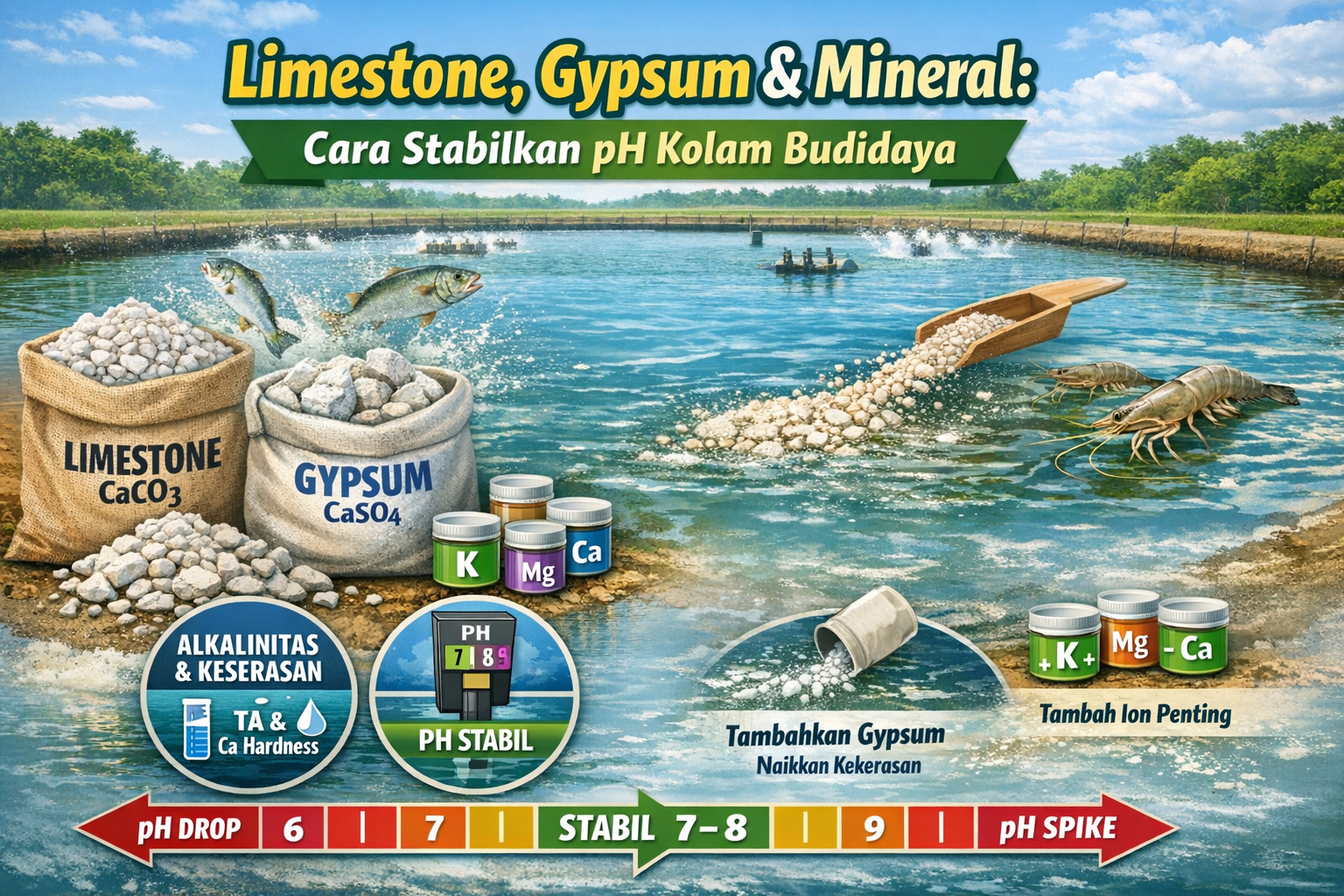
Sodium bicarbonate (NaHCO₃, baking soda) is a fast‑acting alkali; it dissolves readily (~10 g/L), yields bicarbonate instantly, and raises both pH (to ~8.3) and TA—useful when a rapid buffer is needed (e.g., ammonia spikes or heavy algal respiration). In high‑intensity shrimp recirculating “biofloc” systems, periodic additions (hundreds of kg/ha) maintain pH and TA without abrupt swings (Global Seafood Alliance). Note: NaHCO₃ adds sodium; overuse can overshoot pH, so dosing is gradual with monitoring.
Potassium (K⁺) salts (KCl, K₂SO₄): in low‑salinity shrimp ponds, K⁺ is often far below need. Seawater ion ratios (Na:Mg:Ca:K = 27:3:1:1) imply K should be ~50–100 mg/L even at 5–10 ppt salinity (Global Seafood Alliance). Field cases report that raising K⁺ from < 1 mg/L to ~50 mg/L with KCl transformed ponds from major shrimp mortality to normal survival (Global Seafood Alliance). Muriate of potash (KCl) is ~50% K by weight (Global Seafood Alliance). Typical practice is to supplement on the order of 10–50 mg/L K (e.g., ~20–100 kg/ha of KCl) initially, then adjust via tests.
Magnesium (Mg²⁺) salts (MgSO₄, MgCl₂): magnesium supports enzyme function and stability; soft waters often sit at only a few mg/L. Epsom salt (MgSO₄·7H₂O) or MgCl₂·6H₂O are used to correct deficits; Epsom provides ~10% Mg by mass (Global Seafood Alliance). Adding 100 mg/L Epsom delivers ~9 mg/L Mg²⁺. Mg²⁺ also helps reduce nitrite toxicity in fish; many shrimp farms dose to reach ~10–20 mg/L Mg in culture.
Sodium chloride (NaCl): even in freshwater culture, small salt additions (e.g., 0.1–0.5 ppt or ~200–1000 mg/L) are often used; salt reduces stress, supports osmotic balance (benefitting carp, catfish, and nitrite mitigation). In shrimp, chloride helps stabilize ion ratios. Typical salt additions range from 5–20 g/L in shrimp hatcheries to a few kg/ha in ponds.
Application protocols and monitoring
Assessment is routine: soil pH (core sample) and water chemistry are measured before each crop. If soil pH < 6.5, pond bottoms are dry‑limed. If water pH swings or TA < 25–50 mg/L, liming is scheduled. If calcium hardness is very low, gypsum or CaCl₂ is considered in addition to lime. For ionic balance in shrimp, K and Mg are tested. Accurate, staged dosing is common practice; operators often pair measured additions with an accurate chemical dosing pump for consistent treatment.
Application proceeds in stages: a single 500–1000 kg/ha agricultural limestone application is common at filling or early crop when water is shallow. For ongoing maintenance, smaller weekly doses (100–200 kg/ha) can keep TA stable. For quicklime/hydrated lime (fast reacting), fractional daily applications (e.g., 100–200 kg/ha/day) are used with pH monitoring (≤ 200 kg CaO/ha/day; keep pond pH < 9.5) (FAO). For NaHCO₃, several hundred kg/ha at once is customary in high‑density systems when needed (Global Seafood Alliance). For K/Mg salts, increments are applied (e.g., split doses) with re‑tests between additions. Many farms use simple mixers, pumps, and distribution gear—part of standard supporting equipment for water treatment—to disperse slurries uniformly.
Monitoring post‑application is explicit: water is re‑sampled after 6–24 hours for pH, TA, hardness. If mid‑day pH exceeds ~9.0, additions are halted (acid such as vinegar may be used to adjust). Managers keep pH well below 9.5 to avoid fish kill (FAO). In very green/turbid waters where gypsum is used, phosphate levels are tracked when possible, since shifts may occur. Records of before/after chemistry and biomass are maintained; for instance, gypsum has been documented to clear water yet slightly lower plankton yield and fish biomass versus untreated ponds (Taylor & Francis), while liming to maintain hardness ~100 mg/L in fertilized ponds delivered significantly higher fish yields (ResearchGate).
Safety and regulations: protective gear is used for caustic additives (lime, salts). Local discharge rules in Indonesia may limit suspended solids or nutrients; conditional water conditioners are usually not directly regulated. Overdosing is avoided; excessive alkalinity/hardness can precipitate minerals and waste amendments. Follow‑up maintenance is routine—especially on acid soils and after heavy rains—with monthly or per‑crop testing guiding additions. Stocking a complete range of water and wastewater chemicals simplifies on‑farm response during the crop.
Target ranges and indicative dosages
Recommended targets: TA ~75–150 mg/L CaCO₃ (minimum 25 mg/L) and calcium hardness ~75–250 mg/L (FAO) (thefishsite.com). Adding ~10–20 kg CaCO₃ per ha‑m raises alkalinity ~1–2 mg/L. To boost pH/TA quickly, NaHCO₃ (≈ 820 mg HCO₃⁻ per g) is very effective (Global Seafood Alliance). If K⁺ is < 20 mg/L in shrimp ponds, supplement to ~50–100 mg/L (e.g., ~100–200 kg/ha KCl) to avoid losses (Global Seafood Alliance). Calculating dosages: 1 kg KCl in 10,000 L adds ~50 mg/L K; thus, 20 kg/ha of KCl in a 1 m pond (10,000 m³) yields +100 mg/L K. After adding any chemicals, thorough mixing and 6–24 h equilibration precede re‑testing.
Resources such as FAO manuals and SRAC fact‑sheets provide detailed liming tables and methods (FAO) (thefishsite.com). Each recommendation here is supported by these sources (details in inline citations).