

Industry: Cement | Process: Cement_Grinding
Cement is one of the world’s hardest decarbonization problems — responsible for roughly 7–8% of global CO₂ emissions, mostly from clinker calcination (Reuters). In Indonesia alone, industry capacity sits at ~117–120Mt/yr (Global Cement).
Grinding is the energy hog: roughly 40% of cement’s energy (~110 kWh/t) is consumed in clinker grinding (NBM&CW; ResearchGate). The right mill chemistry — tiny amounts of organic additives — is changing the math: less power per ton, more throughput, and stronger cements (GCP Applied Technologies; NBM&CW; Sika).
That strength is the gatekeeper to cheaper blends: higher limestone or slag levels without the usual performance penalties — a direct path to lower production costs and lower CO₂ per ton.
Chemical mechanisms and mill physics
Grinding aids are typically polar organics — alkanolamines, glycols, glycol ethers — dosed at 0.01–0.5% of clinker mass (NBM&CW; Cement Products). By adsorbing on fresh cement particle surfaces, they neutralize electrostatic charges and steric forces, reducing particle agglomeration and improving powder flowability (GCP Applied Technologies; NBM&CW).
The physics is straightforward: less clumping means less void‑filling in the mill, enabling higher mill filling and throughput at lower power per ton (GCP Applied Technologies; GCP Applied Technologies). Even 0.01% of a strength‑enhancing aid has been shown to raise machine output significantly (Cement Products), while less coating of liners and separators lets the separator deliver finer product more efficiently (GCP Applied Technologies; GCP Applied Technologies).
In practice, liquid additives are sprayed into the mill feed (clinker + gypsum + SCMs, where SCMs are supplementary cementitious materials such as slag or fly ash) or dosed in water at controlled rates (NBM&CW; Cement Products). Controlled injection can be managed with accurate chemical dosing, for example via a dosing pump.
Hydration pathways and strength enhancement
Beyond easing grinding, many formulations are explicit strength enhancers. Alkanolamines such as triethanolamine (TEA) and triisopropanolamine (TIPA) accelerate hydration; a common mechanism is iron chelation in C₄AF (the ferrite phase), which increases its dissolution and the exposed surface area of alite C₃S (the main early‑strength clinker mineral), promoting faster C–S–H gel formation and more carboaluminates (Sika (MMR); Sika (MMR)). In combination, grinding aids and enhancers help deliver a finer, denser cement with a more reactive hydration profile (Sika (GBR); Sika (MMR)).
Performance data are broad‑based. In tests on 23 different OPCs (ordinary Portland cements) from North America, Latin America, and Europe, adding ~0.005–0.02% by weight of an early‑strength enhancer (HES) in the mixing water raised 1‑day compressive strength by up to ~21% in 83% of cements (Cement Products). When those OPCs were blended with 30% slag, 20% fly ash, or 15% limestone, a 0.01% dose of the same additive “substantially increase[d] the early strength” of the blended mixes (Cement Products).
Laboratory studies report similar magnitudes: certain “additive compositions” in cement milling increased initial (1‑day) strength by 15–25% (ResearchGate; ResearchGate). Higher dosage increased early strength and fineness until a point. Late strength (28‑day) gains are also documented: Sika’s LS series is marketed to reduce unit kWh/t and enable composition optimization while maintaining properties, with clinker‑factor reductions and CO₂ cuts (Sika). Suppliers note an extra ~100 cm²/g of Blaine fineness (a specific surface area metric) is typically needed to offset a 1% limestone addition — a penalty mitigated by enhancers (Sika (GBR)). Early and late enhancers are often used together or formulated in one product.
Clinker substitution and PLC limits
Limestone is abundant and cheap, but replacing clinker dilutes strength unless mitigated. Up to ~5% limestone can improve strength via filler effects and nucleation (denser packing, faster hydrate precipitation) (Sika (GBR)). Standards experts concluded that PLC (portland‑limestone cement) containing 15% finely ground limestone achieves equivalent concrete strength and durability to OPC (Sika (GBR)).
Past this, plain PLC typically weakens unless ground much finer: about +100 cm²/g Blaine per extra 1% limestone (Sika (GBR)). Tailored performance enhancers lift this ceiling. Sika reports that above ~15% limestone, PLC normally sees weakening and workability issues, but their additives extend limestone content in PLC by counteracting those effects (Sika (MMR)). In practice, cements with 20–35% limestone (CEM II/B‑LL in Europe) are now common; EN 197‑1 allows up to 35% limestone, and several European countries report >60% market share for PLCs (Sika (MMR); Sika (GBR)). In North America, ASTM introduced Type IL (limestone cement) at 5–15%, based on findings that 15% PLC behaved like OPC (Sika (GBR)).
Process breakthroughs and case examples
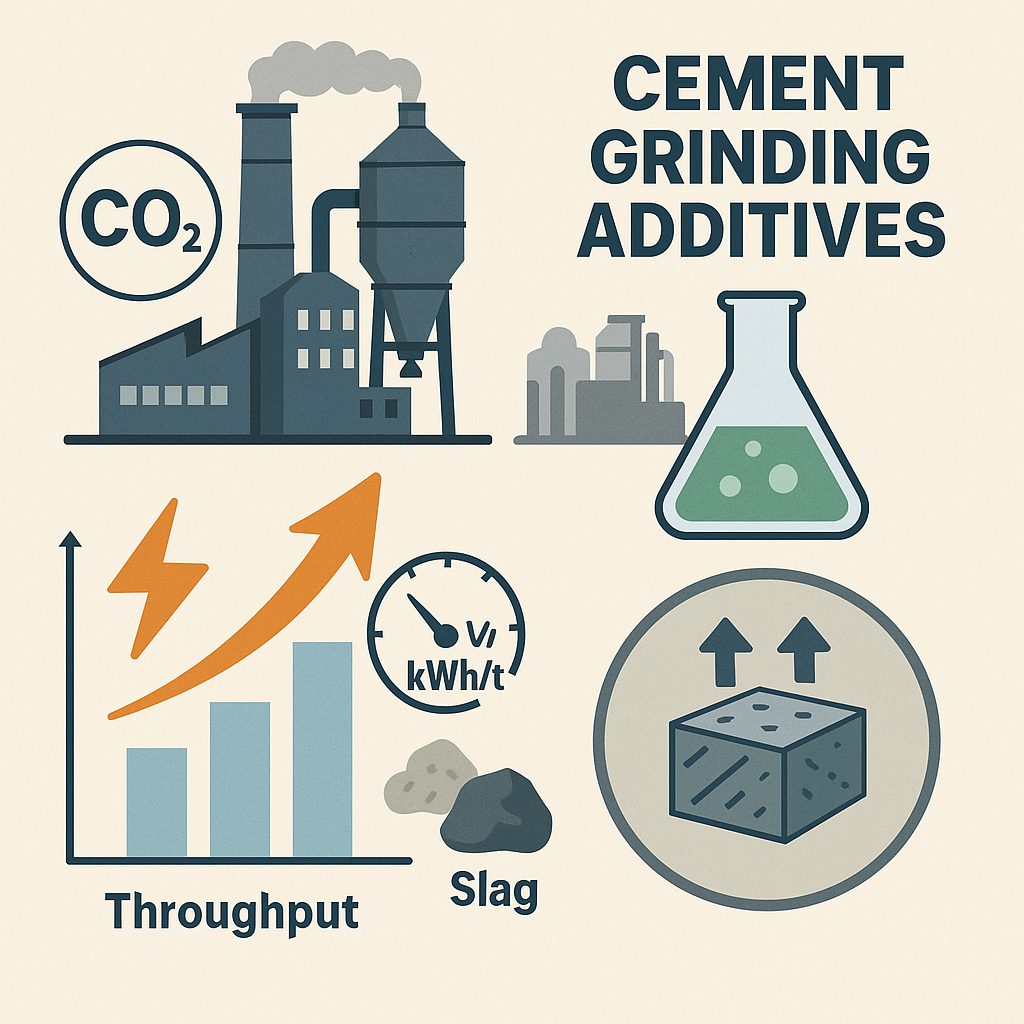
With strength enhancers, producers can dial up slag and limestone. Some concrete users have made 30–50% slag cements using hydration boosters, and Cemex’s “clinker micronisation” process — ultra‑fine clinker blended to specification — claims up to 50% lower clinker content with equal strength (Global Cement). Press reports note that for every 50% clinker reduction, concrete producers saw similar strength — implying roughly stable strength per cement content (Global Cement).
Quantified performance and economics
Plants report higher mill throughput — often 10–20%+ — on existing separators and motors, plus higher Blaine fineness at constant energy (NBM&CW; Sika). Grinding aids also deliver slightly higher early strength at a given fineness, enabling clinker replacement with filler without missing strength targets; Sika indicates these LS additives reduce kWh/t and clinker factor (and therefore CO₂) (Sika).
Economically, the lever is large. Clinker is typically the single biggest cost component of cement, often >50% of variable cost. Replacing 10% clinker with limestone or slag cuts raw‑material spend and carbon costs; as a rough gauge, it can lower embodied CO₂ by ~50–100 kg/t (OPC clinker emits ~800 kg CO₂/t). Grinding efficiency gains compound the benefit: even a 5–10% drop in kWh/t can save on the order of $1–2 per ton in electricity.
Market signals echo the shift. Analysts expect the cement grinding aids market to grow strongly (6–8% CAGR) as producers seek efficiency and sustainability (Digital Journal; LinkedIn). A recent report projects the global market at ~$9.6 billion by 2028 (from $4.2 billion in 2022) (Digital Journal), with Asia‑Pacific (including Indonesia) the fastest‑growing region amid strong demand and CO₂ targets (Digital Journal).
Plant implementation and control parameters
Implementation is straightforward at the mill inlet. Additives are compatible with ball mills and VRMs (vertical roller mills) (Sika; Sika) and tuned by trial in the ~0.005–0.1% range by cement weight (the HES tests used 0.005–0.02% active) (Cement Products). Suppliers market lines such as SikaGrind ES 2156 for the cement grinding process (Sika). The paper notes liquid additives are sprayed or dosed in water at controlled rates, and that “bicarbonate spray or controlled injection” is used; overdosing can increase gypsum dehydration or cause sulfate imbalance, so formulations aim to protect setting behavior.
Fineness, dosage, and mix design need to move together. For example, raising limestone from 5% to 15% typically demands much higher fineness — on the order of ~100 cm²/g Blaine per additional 1% limestone; the guidance notes the mill “should be set to grind ~1000 cm²/g higher Blaine (or use additives) to sustain strength” (Sika (GBR)). Regular lab testing of 1‑, 7‑, and 28‑day compressive strength at each blend is advised. Rheology (flow behavior) should be monitored: many enhancers — especially those containing polycarboxylate components — improve concrete flow, offsetting any workability loss from extra fines (Sika (GBR); Sika (MMR)).
Standards and market context in Indonesia
Indonesia’s mandatory cement standards were recently formalized in Minister of Industry Regulation 26/2024; these specify performance classes by cement type, with SNI physical tests for compressive strength, setting time, and soundness (WTO Center). Any new formulation — for example, CEM II with 20% limestone plus enhancer — must meet those requirements. The performance data above indicate this is readily achievable while pushing SCM content upward.
With capacity near 120Mt/yr and utilization dynamics in flux (Global Cement), Indonesian producers can target 15–20% limestone or 30–40% slag, using additives to maintain strength. Each percentage point of clinker removed brings measurable cost and emissions savings.
Bottom line
Cement grinding aids and performance enhancers are a proven lever: ~15–25% gains in 1‑day strength in lab and field programs (Cement Products; ResearchGate), 10–20%+ throughput improvements, and the ability to substitute 15–35% clinker with limestone or GGBFS while meeting performance targets (Sika). In a sector carrying 7–8% of global CO₂ (Reuters), the economics and sustainability case are aligned — and the market for these chemistries is scaling fast (Digital Journal; LinkedIn).