

In coal mine water treatment, resilience is designed, not hoped for. The plants that stay up use heavy‑duty equipment, automation with remote oversight, and an on‑site inventory that turns breakdowns into brief swaps — all locked into a disciplined O&M plan.
Industry: Coal_Mining | Process: Wastewater_Treatment
At modern coal operations, one failed pump can mean days of lost production. One expert warning is blunt: if a process suffers an “uncontrolled breakdown … would cost millions of dollars and weeks to ramp up again” (wmfts.com). That’s why the most reliable mine water treatment plants are built around heavy‑duty, corrosion‑tolerant components; N+1 redundancy; industrial IoT (Industrial Internet of Things) and SCADA (Supervisory Control and Data Acquisition); and a shelf of critical spares backed by a rigorous operations and maintenance regimen.
The payoff shows up in uptime, compliance and cost. With the right investments, coal‑mine plants consistently hit effluent targets — e.g., reaching pH≈6.1 and low iron/total suspended solids (Fe/TSS) as required (researchgate.net) — and save hundreds of thousands per month in water costs (watercareinnovations.com).
Heavy‑duty pump design and redundancy
Resilience begins with equipment that’s built for mine conditions. Modern peristaltic “hose” pumps handle very dense slurries — up to 80% solids by weight — while retaining 100% volumetric output under variable speed control (wmfts.com). They avoid internal seals (no external water flush) and contain leaks safely, reducing failure risk (wmfts.com).
Under similar conditions, conventional centrifugal pumps often need 50–60% more motor power for the same flow (wmfts.com) and are prone to seal failure and leaks that create safety hazards (wmfts.com). Critical pumps should be belt‑ or forklift‑movable for rapid swaps; use corrosion‑resistant wetted parts — high‑Chrome or polymers — to withstand acidic, metal‑rich water (engineeringnews.co.za); and feature built‑in diagnostics such as automatic shut‑off on hose wear. Heavy‑duty designs with reinforced bearings, flanges, and safety cages maximize uptime (wmfts.com). As one expert notes, “the Heavy Duty pump… guarantees maximum uptime and a continuous production process” (wmfts.com).
N+1 redundancy — duty and standby pumps in parallel with duplicate control trains — is the backbone of resilient design. If a primary pump fails, the standby takes over. Without a spare, “an uncontrolled breakdown … would cost millions of dollars and weeks to ramp up again” (wmfts.com). In practice, mines also plan backup power (generators) and bypass capabilities to avoid full shutdowns. Together, these choices cut unplanned downtime and extend plant life, with direct economic impact (wmfts.com; scielo.org.za).
- Key measures: thick‑slurry‑capable pumps (e.g., peristaltic up to 80% solids (wmfts.com)); heavy‑duty corrosion‑resistant materials; redundant (duty+standby) pump trains; fail‑safe seals and containing housings (wmfts.com; wmfts.com).
- Benefits: lower energy use — e.g., 40–50% lower power vs. centrifugal for the same flow (wmfts.com) — fewer leaks, and sharply reduced downtime costs (avoiding a single pump failure can save days of lost production) (wmfts.com; scielo.org.za).
Automation, SCADA, and remote oversight
Automation and real‑time monitoring are now table stakes for reliability. Industrial IoT sensors plus SCADA provide continuous views of flows, chemistry, and equipment status (researchgate.net; pmc.ncbi.nlm.nih.gov). Wireless sensor networks (WSNs) track pH (acidity/alkalinity), conductivity, turbidity, and flow at key points, feeding automated control that adjusts chemical dosing and pump speeds (researchgate.net; watertechonline.com). Acid addition, for example, is governed by PID (proportional‑integral‑derivative) loops to hold effluent pH tightly at ~7.8–8.0 in a legacy mine scheme (watertechonline.com), often delivered by an accurate dosing pump.
Connectivity extends that control. 5G or satellite links and cloud analytics let centralized operations centers supervise multiple sites in real time (pmc.ncbi.nlm.nih.gov). “Intelligent mining” couples IoT sensors with AI analytics to predict maintenance needs and optimize dosing strategies (pmc.ncbi.nlm.nih.gov; pmc.ncbi.nlm.nih.gov), and reviews conclude this approach “minimizes unplanned downtime, reduces repair costs, and enhances overall system reliability” (pmc.ncbi.nlm.nih.gov).
One U.S. mine remediation plant shows the model: a distributed SCADA (Opto SNAP PAC) monitors thousands of I/O points and automatically adjusts pH, turbidity, and flow based on sensor inputs (watertechonline.com; watertechonline.com). Its distributed architecture means that even if a central controller fails, remote “brain” nodes keep dosing streams independently (watertechonline.com). Outcomes include faster alarm response (SMS alerts), adaptive control during storms, and data logging for benchmarking.
Quantitatively, IIoT‑enabled predictive maintenance on mining pumps uses vibration, temperature, and power‑consumption analytics to detect faults before failure, extending equipment life and cutting unscheduled stoppages (pmc.ncbi.nlm.nih.gov; pmc.ncbi.nlm.nih.gov). Moving from manual oversight to IoT/AI control delivers more resilient and cost‑effective operations (pmc.ncbi.nlm.nih.gov; pmc.ncbi.nlm.nih.gov).
On‑site critical spare parts
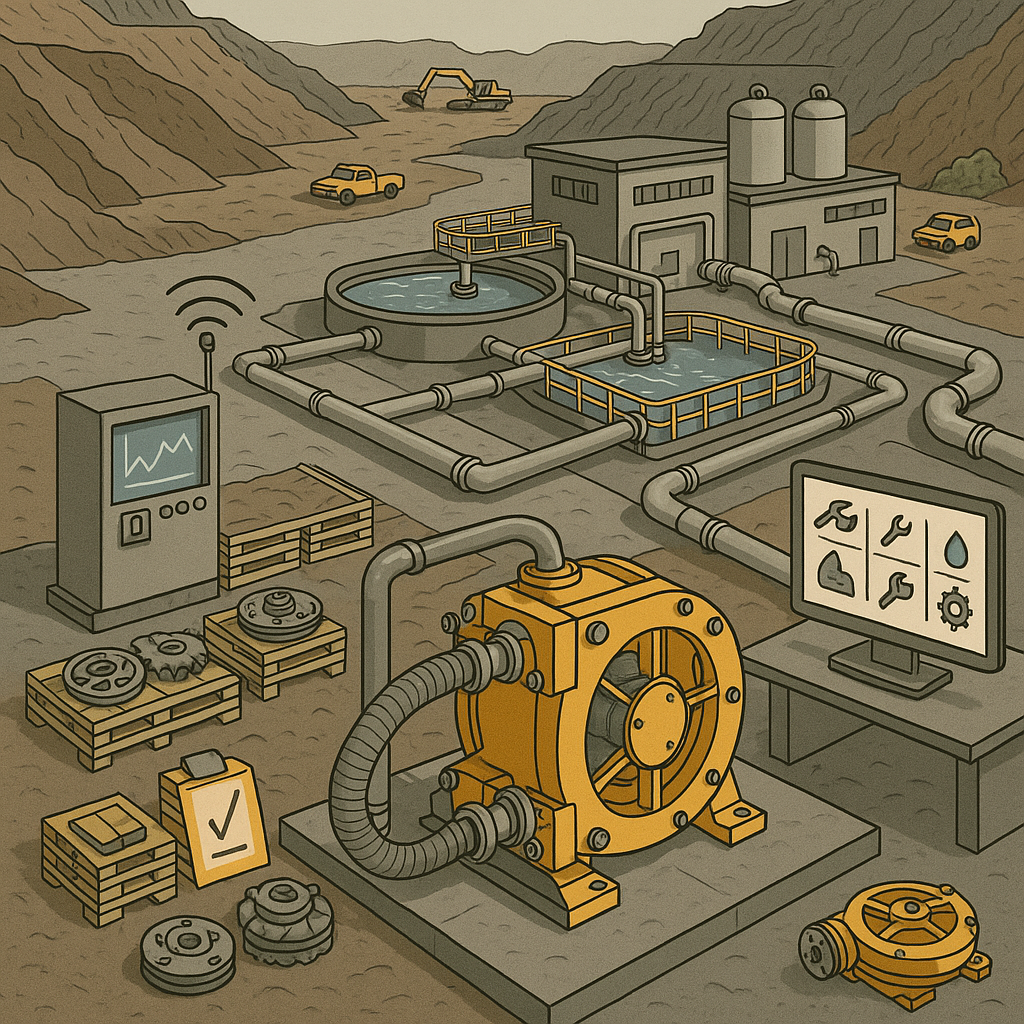
Resilience also sits on the shelf. Plants identify long‑lead or single‑source components — PLC modules, specialized sensors, proprietary pump wear parts, membranes, custom valves — and keep at least one spare on site. In mining, maintenance costs can be 35–50% of total project costs (pmc.ncbi.nlm.nih.gov), so even a day waiting on a bearing is expensive. Industry experience is consistent: stoppages get worse when spares are missing. As the pump expert warns, when the duty unit fails the backup should take over; if the standby fails, “you have a serious problem,” because an uncontrolled breakdown can take “weeks to ramp up again” at a cost of millions (wmfts.com).
The rule of thumb is N+1 stock for critical items. If a pump is unique, keep at least two spare pump packs (impeller, casing, motor). In remote Indonesian mines, foreign shipment lead times of 6–12 weeks make an on‑site cache essential. Consumables should be stocked beyond minimum consumption rates — for example, keeping filter cartridges and ion‑exchange resins on hand alongside reagent chemicals — and robust inventory management with forecasting and reorder alerts helps avoid gaps. Every day saved by an on‑site spare avoids lost production; each day of downtime can represent hundreds of thousands of dollars in revenue (wmfts.com; pmc.ncbi.nlm.nih.gov). Many plants formalize this with vendor‑managed inventory for fast‑moving parts and a dedicated store of water treatment parts and consumables.
- Key actions: maintain duplicate critical pumps, blowers, and controllers; create a parts list and rotate stock; consider vendor‑managed inventory for constant resupply.
- Goal: eliminate “deadstock” delays so probable failures are recoverable within hours by swapping to a spare; reliability rises when repairs aren’t bottlenecked by parts availability.
Comprehensive operations and maintenance plan
Long‑term reliability is formalized in an O&M plan. It documents all equipment (with P&IDs — piping and instrumentation diagrams), lists routine tasks, and schedules them by calendar or operating hours. Preventive and predictive maintenance are merged: monthly inspections of pump seals and coupling alignment, quarterly filter‑media replacement, and annual overhauls of ion‑exchange and membrane skids — for example, membrane systems that require periodic servicing.
Predictive methods — vibration sensing, thermography, motor‑current analysis — spot incipient failures before process upsets occur (pmc.ncbi.nlm.nih.gov). Reviews find that integrating predictive analytics and IoT into pump maintenance “minimizes unplanned downtime, reduces repair costs, and enhances overall system reliability” (pmc.ncbi.nlm.nih.gov). Preventive tasks — lubrication, seal changes, calibration checks — backstop the program; routine leak/cleanliness checks and bearing re‑greasing are called foundational (pmc.ncbi.nlm.nih.gov).
Training and documentation matter. Operators know emergency procedures (e.g., switching to backup pumping) and basic electronics troubleshooting. The plan includes performance metrics (pumped/treatment volume, downtime hours), records of alarms and maintenance actions, and periodic audits. Regulators expect demonstrable compliance; Indonesia’s mining effluent limits (e.g., MoEF 1347/2022) require continuous monitoring. Shifting from reactive to predictive maintenance “is a defining feature of intelligent mining,” improving resilience and cost‑effectiveness (pmc.ncbi.nlm.nih.gov; pmc.ncbi.nlm.nih.gov).
- Plan elements: a CMMS (computerized maintenance management system) to schedule planned work; defined spare‑part lists; safety checklists; review of manufacturer recommendations; emergency action steps.
- Outcomes: well‑executed O&M can typically double equipment availability; benchmarked mines that adopted predictive maintenance saw multi‑day failures cut to hours (pmc.ncbi.nlm.nih.gov). A plant averaging 95% uptime versus 80% effectively saves months of shutdown per year.
Performance, compliance, and cost outcomes
Combined, rugged equipment and smart controls let plants adapt to surges in flow or feed chemistry and avoid lengthy outages. Field data highlight the payoff: with proper investment, a coal‑mine treatment plant can meet quality standards (pH≈6.1 and low Fe/TSS as required (researchgate.net)) and save hundreds of thousands per month in water costs (watercareinnovations.com). Maintenance often represents 35–50% of project costs in mining (pmc.ncbi.nlm.nih.gov), so the combination of intelligent monitoring and preventive upkeep is a direct hedge against regulatory fines and euprosotic delays.
Key takeaways: investing in durable, high‑capacity pumps and controls; deploying real‑time sensor/SCADA networks; maintaining a complete spare‑parts cache; and executing a thorough preventive/predictive maintenance schedule are evidenced strategies. Together they underpin a treatment plant that meets April’s Indonesian regulations and delivers the consistency and uptime needed for cost‑effective coal production (researchgate.net; pmc.ncbi.nlm.nih.gov).
Sources: Recent peer‑reviewed and industry studies of mining water systems were used for figures and recommendations (pmc.ncbi.nlm.nih.gov; wmfts.com; pmc.ncbi.nlm.nih.gov; pmc.ncbi.nlm.nih.gov). Indonesian mine data are from PT Adaro case studies (researchgate.net) and national regulations. Additional technical insights were drawn from pump manufacturer analyses and water‑industry case reports (wmfts.com; watertechonline.com). Detailed citations appear inline.