

Industry: Semiconductor | Process: Photolithography
Semiconductor photolithography (including immersion lithography) runs on water so pure that even a single microscopic particle can ruin a finished chip (www.axeonwater.com). Industry roadmaps and standards bodies—SEMI, ASTM, ITRS/IRDS—therefore set extreme targets for ultrapure water (UPW): resistivity around 18–18.2 MΩ·cm at 25 °C; total organic carbon (TOC, a measure of oxidizable organics) far below 1 ppb; dissolved gases such as O₂/N₂ down near single‑digit ppb; and essentially zero particles or microorganisms (www.mks.com) (sst.semiconductor-digest.com).
In practice, specs look like this: resistivity >18.18 MΩ·cm; TOC <1 μg/L; O₂ <10 μg/L; and fewer than 30 particles per liter above 0.05 μm (patents.justia.com). SEMI guidance for particles calls for <0.3 particles/mL at 0.05 μm (www.mks.com), with aspirational targets around ~10 particles/mL ≥10 nm, and microbial counts below detection (≤1 CFU/100 mL) (patents.justia.com) (www.mks.com). In immersion lithography specifically, even tiny organics matter because water’s absorbance at 193 nm is ~0.01/cm and worsens with trace contaminants (sst.semiconductor-digest.com).
Contaminants and measurement targets
Typical photolithography UPW metrics include: resistivity >18–18.2 MΩ·cm (www.mks.com) (patents.justia.com); TOC <1 ppb (often ≪1 ppb), with prolonged UV/oxidation plus ion exchange pushing TOC into the single‑digit ppt (parts per trillion) range (sst.semiconductor-digest.com) (www.xylem.com); and dissolved oxygen (DO) <5–10 ppb (sst.semiconductor-digest.com) (www.mks.com). Other ions/metals are effectively at ppt levels—e.g., SiO₂, B, Na each <0.01–0.05 μg/L (patents.justia.com). Monitoring uses resistivity meters, TOC analyzers, laser particle counters, and microbial assays in real time.
From bulk treatment to final loop
Bulk UPW production—often anchored by reverse osmosis (RO) and electrodeionization (EDI)—feeds a point‑of‑use (POU) recirculation loop that “polishes” water just before the lithography tool. Many facilities standardize on integrated membrane systems upstream and then tailor the final loop for lithography’s last‑meter purity.
At this stage, engineers sequence ultrafiltration (UF), UV sterilization/oxidation, vacuum degassing, and POU filters, with a small recirculation pump and either a mixed‑bed or EDI polisher to hold resistivity. The order matters, as UV generates dissolved gases that must be removed before water hits the tool.
Ultrafiltration polishing (10 kDa class)
After bulk RO/EDI, a UF module—typically tangential-flow hollow fiber around ~10 kDa molecular weight cut‑off (MWCO) and ~0.01 μm nominal pore size—strips out colloids, bacteria, and high‑molecular‑weight organics that survive earlier steps (www.mks.com) (sst.semiconductor-digest.com). In practice, water is often microfiltered (~0.2 μm) before this pass, and POU UF is deployed at each tool to ensure <0.05 μm particles are removed (www.mks.com). Lithography loops commonly use compact ultrafiltration skids for this polishing duty.
UV sterilization and TOC oxidation
High‑power UV provides a chemical‑free dual action. A 185 nm source generates hydroxyl radicals that oxidize TOC to CO₂ and H₂O, while a 254 nm source inactivates bacteria/viruses with ≈3‑log kill (about 99.9%) (www.xylem.com) (www.xylem.com) (www.xylem.com). Industry data show 185 nm UV reducing TOC from ppb into the sub‑ppb realm, with one vendor’s curve showing ~50 ppt down to <10 ppt at moderate flow (sst.semiconductor-digest.com). Because UV creates O₂ gas, it is placed before the final degasser. Purpose‑built ultraviolet units for UPW use quartz sleeves and ozone‑scavenging designs.
Two‑stage vacuum degassing
Dissolved and entrained gases are flagged as a “key contaminant” in immersion lithography (sst.semiconductor-digest.com). Designers apply membrane contactor degassers in two stages: first, a conventional unit before UV to remove most feed gas (high efficiency >75%); second, a PTFE/Teflon® degasser after UV to scrub UV‑generated O₂ with ultra‑low leaching, albeit at ~40% efficiency compared to a conventional device (sst.semiconductor-digest.com).
Together these bring DO to <5–10 ppb (sst.semiconductor-digest.com) (www.mks.com). Notably, Table 3 in Clarke et al. shows the Teflon degasser cutting metal ions by an order of magnitude versus a conventional unit (sst.semiconductor-digest.com).
Point‑of‑use final filtration
Immediately upstream of the tool, replaceable fine filters—typically 0.02–0.05 μm made from inert polymers such as PES, PVDF, or PTFE—catch any remaining particles/microbes with ≈99.99% retention. One example: a 0.03 μm all‑PTFE quick‑change cartridge with LRV (log reduction value) >2.5 at 0.03 μm, i.e., >99.7% removal (sst.semiconductor-digest.com). 0.02 μm PVDF cartridges are used similarly (sst.semiconductor-digest.com), and loop hardware downstream (quartz/sapphire faces, flowmeters) remains inert. By design, no particle >0.1 μm should pass this barrier (www.axeonwater.com). Facilities rely on cartridge filters here and schedule frequent changeouts (weekly or per wafer‑lot) to avoid breakthrough, with consumables programs to keep replacements on hand.
Recirculation, ion control, and stability
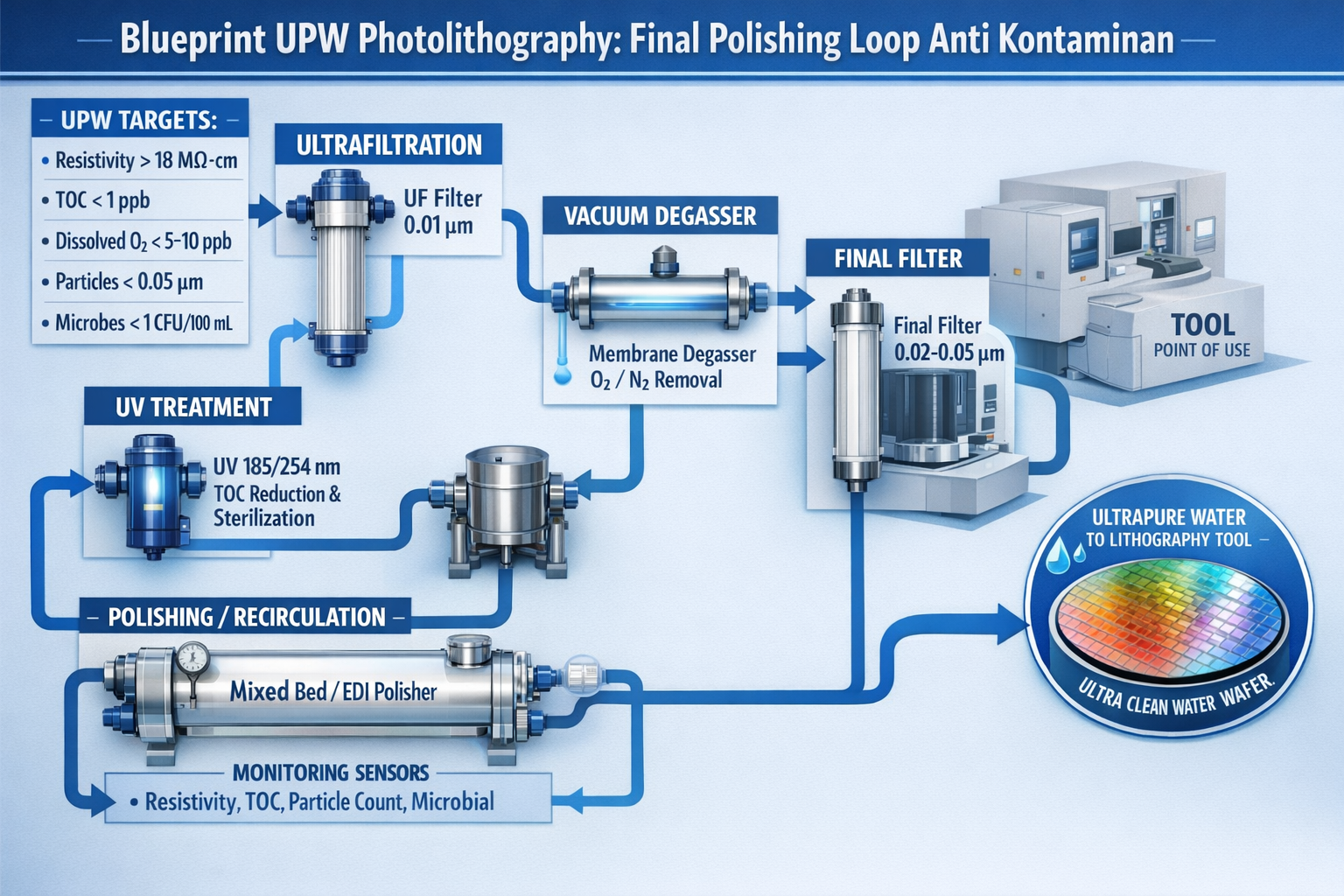
The POU loop recirculates continuously through a small pump. Even when bulk UPW arrives at 18 MΩ·cm, resistivity can creep down via contact with piping or absorption; a POU polisher—either a compact EDI module or a small mixed‑bed resin—refreshes ions back to ppt levels. Temperature control at ±0.1 °C and stable, turbulent flow are built in to keep refractive index and density constant at the immersion lens.
Published implementations show the approach works: UV + ion exchange routinely drive TOC below 1 ppb and often <50 ppt (sst.semiconductor-digest.com), degassing brings DO to ~1–5 ppb (www.mks.com) (sst.semiconductor-digest.com), and particle counts trend to effectively zero as feed and filtrate counts equalize in steady state (sst.semiconductor-digest.com).
Measurable outcomes and monitoring
Each barrier in the loop lends itself to control charts. A 0.05 μm filter should yield <0.01 particles/mL (≥0.05 μm), UV systems aim for >90% TOC removal per pass, and resistivity should sit at ≥18 MΩ·cm. Tracking particles/mL, CFU (colony‑forming units) counts, and TOC in ppt validates performance, noting that bacteria detection at these levels pushes current test limits (www.mks.com). From a business perspective, maintaining these purity levels ties directly to yield and fewer defects; contaminant control in UPW is cited as critical to realizing the ≈$10k value per wafer (www.axeonwater.com).
Water usage and cost context
Fabs are heavy water users under tight specs. A typical 200–300 mm fab (~20,000 wafers/month) consumes ~2,000–3,000 m³/day of UPW (www.mks.com), while one case of 40,000 wafers/month drew ~18,000 m³/day (id.genesiswatertech.com). Producing UPW typically takes ~1.4–1.6 m³ of municipal water for each 1.0 m³ of UPW, consistent with RO recovery around 60–70% (id.genesiswatertech.com).
The global UPW for semiconductors market is on the order of $1.9–2.5 billion/year, growing ≈3% annually (semiconductorinsight.com). By comparison, the chip industry is ≈$500 billion/year (www.axeonwater.com), making UPW systems a notable capital line item. Many facilities deploy robust RO trains, such as brackish‑water RO, to drive bulk purity before the final polishing loop.
Regulatory and local notes
No Indonesian standard specifically defines UPW purity; fabs operating there adhere to international benchmarks (18 MΩ·cm, <1 ppb TOC, etc.) and install the same polishing hardware. Municipal feed water—often harder or more turbid—must be pretreated appropriately, while local discharge rules (PP82/2001, etc.) govern effluent. The ultra‑clean design described here also helps minimize harmful effluent.
Engineering checklist for the final loop
Best practice is a redundant, validated, continuously monitored loop using UV sanitizers with concurrent oxidation, UF, certified POU filters, and degassing barriers in series (sst.semiconductor-digest.com) (sst.semiconductor-digest.com). Data from deployments—UV oxidation to the ppt regime and POU filters achieving LRV >2.5—show the design is effective (sst.semiconductor-digest.com) (sst.semiconductor-digest.com).
UPW engineers size units for lithography flowrates typically ~5–20 L/min and specify inert materials—Teflon (PTFE) and quartz are common in UPW service—to minimize leaching. Many tie the POU loop back to an upstream EDI train via EDI or a resin‑based mixed‑bed polisher for resistivity control and use RO‑based bulk systems upstream, with the polishing steps detailed above ensuring only virtually contaminant‑free water, by SEMI/ASTM standards, reaches the lens.