
A data‑dense QC plan—tracking chemistry from high‑pressure acid leach to tankhouse—keeps nickel cathode purity at ≥99.80% while pushing ~96% recovery. Here’s how operators monitor every gram and volt to stay on spec.
Nickel SX‑EW (solvent extraction and electrowinning) runs more like a laboratory than a mine. Plants chase primary nickel cathodes of ≥99.80% Ni (ASTM B39 grade) with only trace impurities (Fe, Co, Cu ≤0.02–0.15%)—a standard “now enforced by commodity exchanges and buyers” (standards.iteh.ai). To meet it, the process targets very high nickel recovery—integrated laterite flowsheets report ~96% Ni recovery (www.tieiextraction.com).
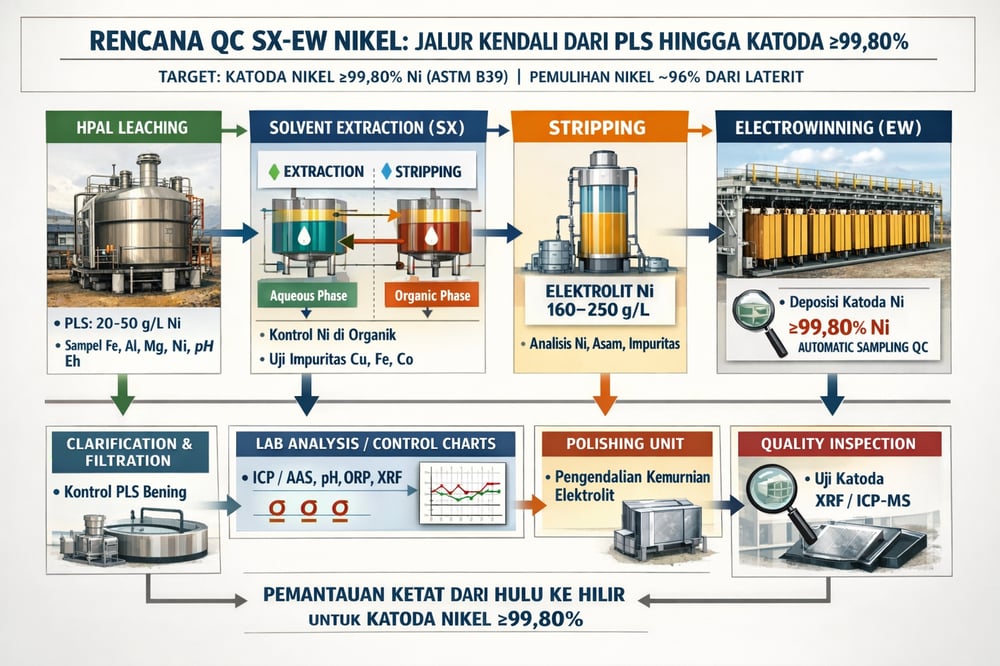
This quality control plan follows the stream—from HPAL (high‑pressure acid leach) through SX and stripping to EW—detailing the chemical and physical parameters to monitor and the sampling and analysis needed to keep nickel on spec.
Leach solution composition and clarity
After HPAL, the pregnant leach solution (PLS) carries dissolved Ni and Co alongside by‑products. HPAL yields on the order of 20–50 g/L Ni (and a few g/L Co) in the PLS, with substantial impurities: iron, aluminium, manganese, and very high magnesium (from the magnesium silicate matrix) (nickelinstitute.org). After neutralization and CCD washing, “the solution contains primarily nickel and cobalt with minor Zn, Cu, alongside more significant amounts of iron, aluminium, and manganese, with a substantial concentration of magnesium” (nickelinstitute.org). Fe often >1–5 g/L in the PLS demands tight control because iron contaminates SX.
Key setpoints: track Ni and Co concentrations (targeting full recovery), total Fe and Al (minimized via Fe/Al hydroxides/jarosites precipitation in leach tailings), pH, and Eh. Leach pH is typically extremely low (pH<0, high acid) but rises to ~1 after neutralization; overly high pH (>2) can precipitate Ni and reduce yield. Redox potential (Eh) is kept high (oxidative) to prevent sulfide formation; online ORP probes are standard. Suspended solids (TSS) in the filtered PLS should be <50 mg/L to prevent organic phase fouling, a target supported by settling equipment such as a clarifier (removes suspended solids with 0.5–4 hour detention time). Typical PLS Ni grades for large HPAL plants are in the tens of g/L (for instance, 25–30 g/L Ni has been reported in commercial operations), with final leaching yields around 90–96% Ni (www.tieiextraction.com).
Sampling is frequent: composite or grab PLS samples (after filtration) hourly; analyze Ni, Fe²⁺/³⁺, Mg, Al, Ca, Zn, Cu by ICP‑AES or AAS after acidifying. pH and ORP are logged continuously; lab titrations quantify free acidity (g/L H₂SO₄). Suspended solids are measured gravimetrically. Inline protection in acid service can use steel filter housings (high pressure steel housings up to 150 PSI for industrial applications), while pH control benefits from an accurate dosing pump for acid/base addition.
Solvent extraction ratios and organic health
The SX plant employs an organophosphorus (e.g., LIX, Cyanex) or chelating extractant in a kerosene/diluent to purify and concentrate Ni. Aqueous:organic (A:O) flow ratios and contact stages are held to achieve >95% Ni transfer to the organic, often ~1:1–2 (v:v) in continuous mixers. A buffer column or scrub stage strips co‑extracted impurities (e.g., Cu, Fe) using dilute acid. Level meters and PLC interlocks protect against flooding or short‑circuiting.
Feed control matters: aqueous pH around 1–2 (adjusted by dilution and acid/addition) stabilizes extraction. Co‑elements (Cu, Zn, etc.) should be <100 mg/L (ideally <10 mg/L Cu) because even trace Cu can accumulate on the organic and contaminate Ni plating; online Cu monitors (e.g., Instrumenal methods or test strip kits) flag breakthrough.
Loaded organic is sampled for Ni loading (g/L in organic). Circuits aim for ~150–300 g/L Ni (extractant/design dependent); in practice, commercial plants often run ~50% volume extractant and end‑of‑stage Ni loading ~10–20% (w/w) Ni. Periodic titrations determine extractant concentration (e.g., by denitration) and Ni loading; drying an aqueous sample checks free diluent content. Phase separation time (T80 <1 min) confirms coalescence. Efficient Ni extraction depends on maintaining ~30–50 °C and stable organic potency; on‑line pH meters in raffinate and strip circuits and density meters (to detect entrainment) are recommended. Josh: Adjust flows if Ni distribution ratio drifts. Regular scrub liquor tests target scrub liquor Ni <1 g/L.
Sampling each shift across extraction and strip stages—analyzing Ni, Co, Mg, Fe by ICP or spectrophotometry—keeps the circuit on trend. Small “packet” organic samples can be centrifuged and analyzed for organic vs aqueous yields; phase purity is checked by loss‑on‑ignition. Control charts track Ni in loaded organic and stripped electrolyte.
Stripping chemistry and electrolyte prep
Stripping with strong acid produces the high‑grade electrolyte feeding EW. Nickel concentration should be maximized: stripped electrolyte targets are typically 40–60 g/L for workshop, low‑power plating baths, but industrial EW baths run much higher—160–250 g/L Ni as sulfate—for efficiency. Watts plating baths use 240–300 g/L NiSO₄ (www.substech.com). Ni is monitored by ICP and titration (dimethylglyoxime) at least daily; recycle streams may be used to hold the range.
Acid concentration is dual‑purpose: after stripping, sulfuric acid is often recycled to leach or burned; in the final plating electrolyte, acid content and pH (typically pH 3–4 in Watts baths, www.substech.com) are critical. For Ni EW, acid must be high enough (often >150 g/L H₂SO₄) to maintain conductivity but not so low pH that hydrogen evolution waste increases. Regular titration determines H₂SO₄ (mg/L) and free acid; sulfate and chloride build‑up (e.g., from NiCl₂) are monitored.
Temperature and additives are set tightly: stripped solution is stored and heated (usually ~50–65°C) to improve plating. Boric acid (30–45 g/L as in Watts baths, www.substech.com) is added consistently as a buffer. Thermostatic heaters hold temperature with alarms if >±2°C deviation, since deposit morphology is sensitive to temperature (blog.emew.com). Electrolyte conductivity—typically a few hundred mS/cm—can be measured online as a proxy for composition.
Impurity control is decisive. Any copper, cobalt, iron, or chloride in the plating bath is dangerous: copper (E° +0.34 V) will plate preferentially, contaminating Ni cathodes and spoiling current efficiency (blog.emew.com). Weekly (or as needed) ICP/MS aims for Cu <1 ppm, Fe <10 ppm, Co and Mn <10 ppm, and Cl⁻ typically <100 ppm. If impurities rise, operators turn to cementation (Zn dust to remove Cu/Ni), ion‑exchange polishing, or bleed‑sidestream SX; polishing can be delivered by ion exchange systems and tuned with the right ion‑exchange resin.
Electrowinning metrics and cathode audits
In the tankhouse, current efficiency (CE) and cell voltage anchor performance. CE—calculated daily from deposit mass vs theoretical Faraday yield—should be >90%. Copper EW targets 92–95% CE (scielo.org.za), and similar values are sought in Ni EW. Low CE signals parasitic hydrogen evolution or short‑circuits. Cell voltage, monitored in real time, should stay near design (e.g., 2.4–2.7 V per cell); creeping voltage hints at resistant films or failing cells.
Current density is kept within design—e.g., 20–50 A/ft² in plating terms (≈40–150 A/m²), balancing rate and deposit quality (www.substech.com). Controls adjust amperage as electrolyte volume changes; supply voltage/current fluctuations are logged and charted, as spikes or dips may reflect switchgear or pump issues needing maintenance.
Cathode quality control is routine. Visual checks scan for nodules, pits, or discoloration; thickness is verified by gauges or weight per area. Chemical analysis (XRF or wet‑chemical) of cathode shavings confirms Ni purity (target ≥99.8%) and quantifies impurities (ASTM B39 limits). Grain structure and stress may be checked via lab bend tests. If impurities (e.g., Cu, Co) exceed LME Nickel specs (Fe+Co ≤0.15%, Cu ≤0.04%, standards.iteh.ai), upstream contamination becomes the focus.
Electrolyte balance closes the loop: daily mass balance tracks nickel lost/gained. On each shift, operators measure Ni concentration remaining in electrolyte. Ideally Ni only leaves solution onto cathodes; if it drops too low, make‑up Ni sulfate is added. Volume tracking controls concentration. Current, voltage, and bath chemistry data are logged in a SCADA/data historian.
Sampling frequency and analytical QA/QC
A formal sampling plan underpins representativity and accuracy. Aqueous streams—PLS, raffinate, strip liquor, bleed—are sampled via automated or manual ports, filtered (0.45 μm) in‑line to remove solids, then split: one acidified (e.g., with HNO₃) for metals by ICP, another neutralized for anion analysis (sulfate, chloride). Organic samples (≈50 mL) are withdrawn, stripped with yellow reagent and titrated, or digested and run by ICP to determine Ni loading; Karl Fischer or drying checks organic purity (no entrained water). Protecting instrumentation with a fine cartridge filter (removes 1–100 micron particles) helps keep lines clean before lab prep.
Short‑cycle parameters (pH, ORP, density) are measured continuously or hourly. Full assays (Ni, Fe, Co, major cations) follow typical intervals: PLS every 1–4 hrs; SX streams every shift; EW electrolyte once per shift; cathode samples on production batches. In one study, 6,516 cathode electrolyte samples (250 mL each) were collected over 6 months (≈2‑hour intervals) to enable statistical control (scielo.org.za)—illustrating the level of rigor feasible.
Laboratory controls require QC standards and replicates. Methods include ICP‑OES (metals), ion chromatography (Cl⁻, SO₄²⁻), titrations (Ni by DMG, H₂SO₄ by hydroxide), and XRF/AA for metal analyses. A certified reference nickel standard (for final cathode) verifies product purity accuracy.
Process control charts track key metrics—Ni electrolyte ppm, pH, cell voltage, FG Ni purity—using Shewhart methods. Ion balances or current efficiency trends detect drift. In a copper EW plant, statistical control of cell‑voltage “hotspots” improved current efficiency by 5.4% (saving ~74 t of cathode in 1.5 months) (scielo.org.za). Deviations beyond ±3σ trigger root‑cause analysis and corrective actions (e.g., adjusting flow rates, cleaning electrodes, recalibrating reagents).
Documentation closes the loop: every sample is logged (time, location, conditions) for ISO9001‑type traceability; results feed daily operational reports; regular internal or third‑party audits check adherence.
Standards compliance and environmental limits
Final nickel cathode must meet international and national standards. ASTM B39 specifies ≥99.80% Ni with strict impurity caps (standards.iteh.ai). Indonesia’s regulatory framework emphasizes local value‑addition and strict environmental controls (www.researchgate.net). Ministerial Regulation (Permen LH No.9/2006) limits Ni discharges in effluent to 0.5 mg/L (nikel.co.id), indirectly demanding >99% Ni recovery into product—another reason QC vigilance never lets up.
Figure: A simplified SX‑EW flowsheet (leach → SX → strip → EW) illustrating key streams for sampling and analysis. (nikel.co.id) (standards.iteh.ai) Nickel product and environmental standards: Indonesian law (Permen LH 09/2006) caps Ni in effluent at 0.5 mg/L, while LME/ASTM specs require ≥99.80% Ni with Fe/Co ≤0.15% in cathode.
Each element of this plan is data‑driven: process setpoints and alarms are informed by lab trends, and production decisions (e.g., when to adjust SX O:A ratio or change cathodes) are made based on quantified outcomes (e.g., current efficiency, yields). By rigorously measuring chemical/physical parameters and analyzing trends, the SX‑EW plant can operate in control, consistently producing specification‑compliant nickel.
Sources: hydrometallurgy reviews and company reports (nickelinstitute.org) (www.tieiextraction.com) for leach/SX chemistry; plating data (www.substech.com); electrowinning guidelines and case studies (blog.emew.com) (scielo.org.za); and regulatory references (nikel.co.id) (standards.iteh.ai).
