

Industry: Desalination | Process: Post
Consumers expect piped water to be odorless and tasteless — and in Indonesia, that’s the law. National rules (Permenkes 492/2010) require no detectable taste or smell in drinking water (pdfcoffee.com).
Global guidance is similarly blunt: even harmless substances must stay below thresholds that most people find objectionable (www.ncbi.nlm.nih.gov; guidelines.nhmrc.gov.au). Taste thresholds include 0.3 mg/L for iron, 0.05 mg/L for manganese, and 250 mg/L for chloride (guidelines.nhmrc.gov.au).
Hydrogen sulfide (H₂S) — the classic “rotten egg” odor — is detectable around 0.05 mg/L (guidelines.nhmrc.gov.au). Earthy–musty culprits like geosmin and MIB (2‑methylisoborneol) register with most people near 0.01 mg/L (www.ncbi.nlm.nih.gov; guidelines.nhmrc.gov.au). And nuisance contaminants frequently breach aesthetic guidelines: a U.S. survey found over half of sampled wells had at least one constituent above its secondary (non‑health) standard (www.usgs.gov).
That’s why desalination plants typically add a post‑treatment “polishing” step to strip off volatile and adsorbable compounds — the difference between compliant and convincing (pdfcoffee.com).
Aeration for volatile odor removal
Aeration (air–water contact to strip dissolved gases and volatile organic compounds, VOCs) is a low‑cost way to knock out taste/odor at the finish line. For desalinated water, the main targets are hydrogen sulfide (H₂S), carbon dioxide (CO₂), and trace VOCs.
Under aeration, H₂S — detectable around 0.05 mg/L — is driven out and oxidized to sulfate (guidelines.nhmrc.gov.au). One plant installed a forced‑draft aerator (12 ft² cross‑section at 225 gpm, ~17 m³/h·m²) and oxidized 1.9–2.7 mg/L Fe(II) along with all detectable H₂S to non‑detectable levels (www.westechwater.com; www.westechwater.com).
After aeration plus filtration, iron fell below 0.3 mg/L and H₂S dropped to below detection, comfortably inside aesthetic thresholds (www.westechwater.com). Aeration also removes CO₂, lifting pH and eliminating a sour or “flat” taste.
In practice, plants use cascade showers or packed‑tower aerators sized for sufficient air contact time, often running with dissolved oxygen (DO) above 6 mg/L. Design data from the same loading (~17 m³/h per m² contact surface) show >90% H₂S removal, meeting the 0.05 mg/L guideline (www.westechwater.com; guidelines.nhmrc.gov.au). Chemical inputs are minimal (just oxygen) and maintenance is low.
Where iron and manganese also ride along, a combined aeration plus manganese filter has eliminated H₂S odor and satisfied EPA aesthetics in U.S. service (www.westechwater.com). Utilities pairing aeration with a manganese media bed, such as a manganese greensand filter, align with that field experience.
By contrast, granular carbon alone often reduces H₂S only to ~0.3 mg/L unless aeration or oxidation comes first (www.canada.ca).
Activated carbon adsorption polishing
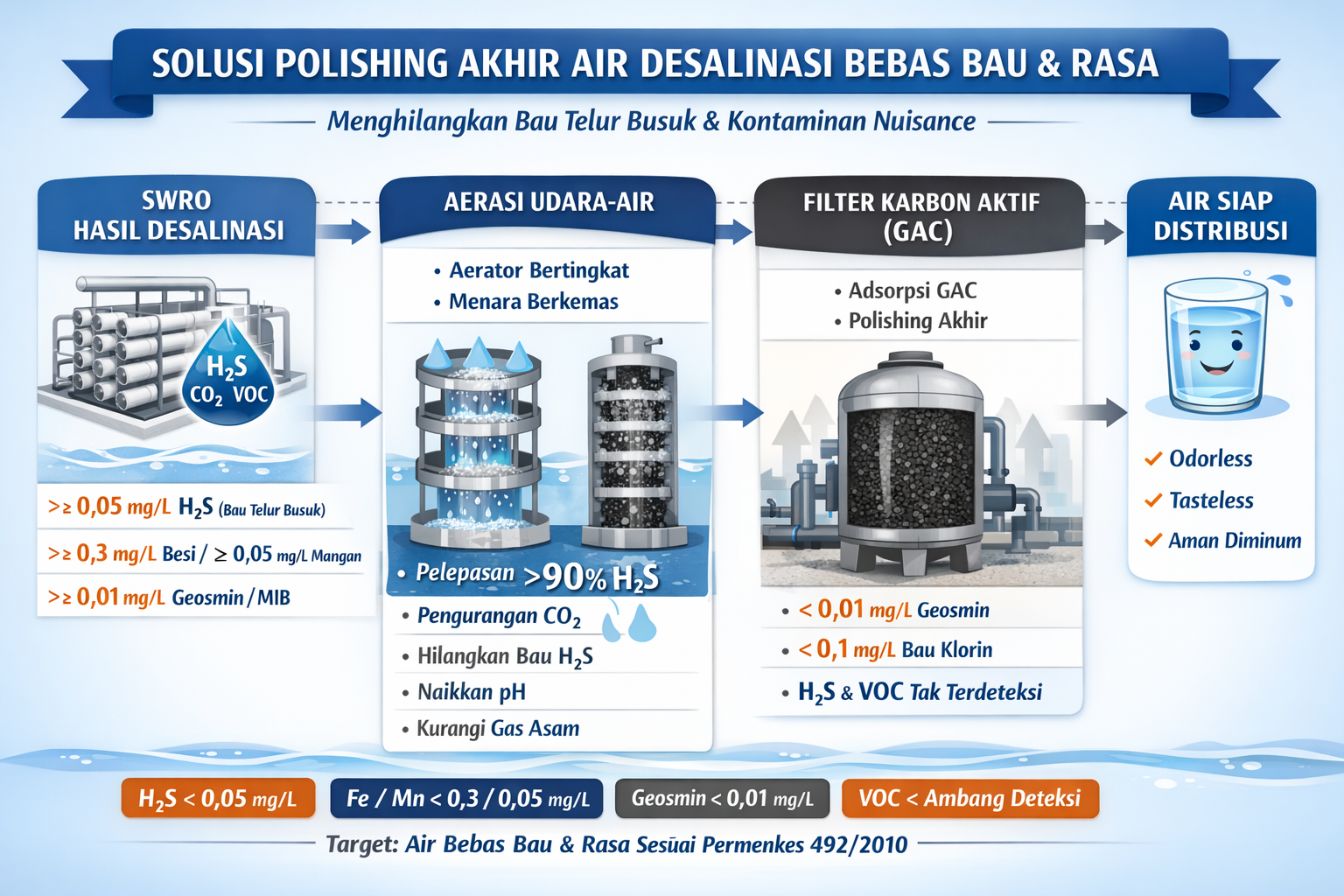
Activated carbon adsorption is the industry’s go‑to finishing step for taste and odor. Granular activated carbon (GAC) beds adsorb a wide range of organics and halogens — including chloramines, trihalomethanes (THMs), fuel oxygenates like MTBE, and algal metabolites — and can be deployed as activated carbon filters in the final stage.
GAC also strips residual disinfectant; free chlorine imparts taste/odor around ~0.1–0.5 mg/L (guidelines.nhmrc.gov.au). Bench‑scale work shows properly sized GAC — empty bed contact time (EBCT, the notional residence time of water in the carbon bed) of ~10–15 minutes — can remove geosmin and MIB even when natural organic matter competes for sites (www.ncbi.nlm.nih.gov; guidelines.nhmrc.gov.au).
Full‑scale pilots using five sequential GAC filters cut H₂S from 0.02–0.7 mg/L to below detection (~0.01 mg/L) (www.canada.ca; www.canada.ca). Notably, those studies used coconut‑shell GAC with DO above 4 mg/L to catalyze oxidation (www.canada.ca).
In desalination service, utilities commonly install GAC vessels as the final polishing step. Resulting concentrations can meet sensory thresholds — for example, geosmin near 10 ng/L (10 nanograms per liter) (guidelines.nhmrc.gov.au) — and reduce measurable VOCs and taste/odor precursors to negligible levels. Post‑carbon, indices like Threshold Odor Number typically fall near zero.
Operationally, GAC needs periodic backwashing and media change‑out or regeneration; when scheduled correctly, filter runs from weeks to months remain economical. When rapid response is needed for algal events, powdered activated carbon (PAC) dosing is a complementary option (PAC) used upstream of fixed beds.
Taste and odor troubleshooting guide
Even with strong post‑treatment, complaints happen. A structured response keeps the system on track.
- Document the complaint precisely (“chlorine‑like,” “earthy,” “metallic,” “flat”). A sudden or strong change should trigger investigation (www.ncbi.nlm.nih.gov).
- Sample and analyze at the plant outlet, distribution nodes, and the tap. Targeted tests:
- H₂S (“rotten egg”): methylene‑blue test with LOQ ≈0.02 mg/L. If present above 0.05 mg/L, ensure aeration/oxidation; consider raising DO or adding permanganate (guidelines.nhmrc.gov.au; guidelines.nhmrc.gov.au).
- Iron/Manganese (metallic taste): check against ~0.3 mg/L and 0.05 mg/L taste limits, respectively. If elevated, increase aeration/filtration capacity or add iron‑removal media (guidelines.nhmrc.gov.au).
- Chlorine odor: verify free and total chlorine. A “bleach” smell above ~0.1 mg/L indicates over‑chlorination or back‑contamination; reduce the dose or install post‑carbon to remove residual (guidelines.nhmrc.gov.au). A downstream activated carbon bed is a standard fix.
- Musty/earthy notes: suspect geosmin/MIB or chlorophenols. GC‑MS (gas chromatography–mass spectrometry) or sensory panels may be needed; if confirmed, add/replace GAC and check for raw‑water blooms (www.ncbi.nlm.nih.gov; guidelines.nhmrc.gov.au).
- Flat or “aggressive” taste: highly pure water low in calcium/magnesium can taste flat. Remineralize (e.g., add CaCO₃ to raise hardness to ~60–100 mg/L); while beyond odor control, this addresses “bland” complaints (www.chunkerowaterplant.com).
- Chemical/sewage odors: screen for organics (VOCs, amines). A severe foul odor can indicate biofilm or intrusion in distribution; flush mains and disinfect/clean biofilm.
- Operational checks: confirm aerators and carbon beds are not fouled; verify pH, alkalinity, and ORP (oxidation–reduction potential); inspect distribution for stagnation that can generate sulfides or chlorophenols. Periodic flushing may be required.
- Regulatory and sensory standards: agencies such as WHO advise investigating any significant change (www.ncbi.nlm.nih.gov). Many utilities use sensory panels and standardized tests (wqa.org) and track complaint frequency; taste/odor is consistently a top customer concern (surveys often find it accounts for a large fraction of public complaints).
Quantitative outcomes and compliance
Polishing with aeration plus carbon keeps desalinated water within acceptability limits — odor‑free and tasteless per Permenkes 492/2010 (pdfcoffee.com). Aeration at practical loadings can strip >90% of H₂S and bring it under the 0.05 mg/L guideline (www.westechwater.com; guidelines.nhmrc.gov.au). GAC can drive many odorants down to non‑detectable concentrations (~0.01 mg/L for H₂S in pilots) (www.canada.ca).
Together, these polishing steps address the subtle sensory cues that make desalinated water not just safe, but acceptable to the public — with equipment choices ranging from fixed GAC vessels to flexible dosing of powdered activated carbon, and iron/manganese control via manganese greensand media, depending on what the data show.