

Industry: Aquaculture | Process: Feeding_Systems
In fish and shrimp farming, the economics are stark: feed typically represents 50–70% of production costs (researchgate.net). Yet spoilage and nutrient loss can quietly erode that investment, with waste losses reaching the tens of percent (fliphtml5.com).
The physics of moisture and heat drive most of the damage. Ghana’s CSIR storage guidance calls for “cool and dry” conditions—below 20 °C and 70% relative humidity (RH, the percent of moisture in the air) (scribd.com). That is easier said than done in humid tropics: Jakarta’s mean monthly RH sits around ~80% (weather-and-climate.com).
Temperature swings amplify the problem. As one soy‑meal guideline puts it, “cooler temperatures are best, although actual ambient temperature is less important than minimizing extreme changes” (fliphtml5.com). When heat and humidity creep up, insects flourish at 26–37 °C and fungi accelerate above ~25 °C and 85% RH (fao.org; fao.org).
Storage environment parameters
Under RH >75% (typical of humid tropics), FAO experts warn that feed moisture will rise over time, so storage periods should be kept short compared with temperate zones (fao.org). For sensitive ingredients, cold storage at ≤–20 °C has been recommended in some guidance (fao.org), though most tropical farms rely on ambient cooling or short‑term storage.
Practical site design matters: shade from sun and rain, good ventilation without condensation‑prone drafts, and a leak‑free roof (all emphasized in a fish feed storage manual) (scribd.com). Routine monitoring with temperature and RH sensors in the feed house is a simple control that helps avoid extreme changes (fao.org).
Feed moisture and water activity
Most extruded pellets are dried to ~10–12% moisture (fliphtml5.com) to hold water activity (aw, a measure of “available” water for microbial growth) low—ideally aw < 0.72, a threshold that suppresses mold germination (kemin.com). In climates like Jakarta’s, with mean RH ~80% (weather-and-climate.com), sealed storage becomes critical to keep aw down.
No sanitation protocol can truly eliminate fungal spores in bulk feed; the main strategy is avoiding conditions that allow extreme temperature or moisture changes (fao.org). That matters because common storage molds can produce mycotoxins (toxic fungal metabolites) such as aflatoxin, which are harmful to fish and can accumulate in their flesh (fao.org).
Mold inhibitor preservatives
Feeds often include mold inhibitors—organic acids or their salts (e.g., propionic, sorbic, benzoic acids; calcium‑propionate; calcium‑sorbate)—that reduce aw and prevent spore germination. FAO lists these among “generally recognized as safe” feed preservatives (fao.org; fao.org). In practice, feed mills sometimes add blends of propionate/sorbate salts at ~0.1–0.5% to counter mold, with the caveat that such additives are relatively expensive and most common in higher‑moisture or semi‑moist diets (fliphtml5.com).
Achieving aw below ~0.72 is a consistent target across industry guidance (kemin.com). Sanitation around feed stores—removal of debris, weeds, and runoffs, and securing opened bags to block pests—further reduces risk (scribd.com; scribd.com).
Antioxidant additives and nutrient preservation
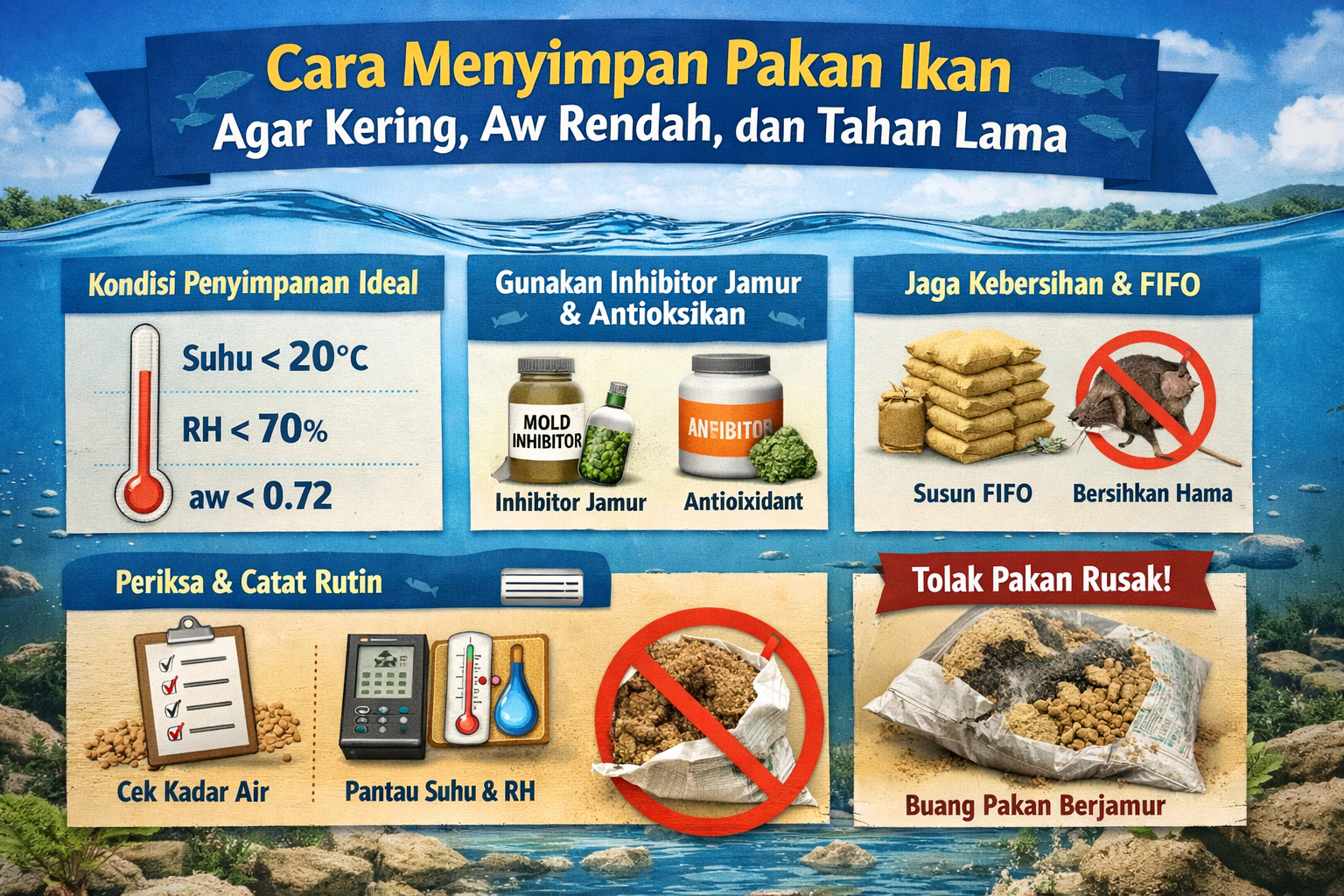
Fish feeds, rich in highly unsaturated oils, are prone to rancidity that degrades vitamins and fats (fao.org). Common antioxidant additives include ethoxyquin, BHT (butylated hydroxytoluene), and BHA (butylated hydroxyanisole) (fao.org). Ethoxyquin has historically been effective, but the EU banned it in 2017 (eur-lex.europa.eu), so many companies now rely on BHT/BHA (allowed up to 200 ppm—parts per million—each in finished feed) or natural tocopherols (vitamin E) and plant extracts (fao.org).
Quantified outcomes underscore the benefit. In one study, 150 ppm ethoxyquin roughly halved Vitamin A loss over four months (–23.6% with antioxidant vs –48.2% without) (fao.org). Experimental bioactive extracts also reduced lipid peroxidation by ~17–20% during storage at 4 °C (pmc.ncbi.nlm.nih.gov). Effects are time‑limited: antioxidant activity declined by ~18–30% over four months in one trial (pmc.ncbi.nlm.nih.gov), making rotation and use before expiry essential.
Consistent preservative inclusion at mill scale depends on accurate chemical dosing; many processors specify equipment such as a dosing pump to maintain target inclusion rates.
Feed management checklist (delivery to feeding)
- Delivery inspection: upon receipt, feed type, manufacturer batch, and expiry are verified; bags/crates are checked for damage or moisture. Samples are measured for moisture (target ≤10–12% moisture) or water activity if instruments are available; any visible mold, musty odor, or excessive fines leads to rejection or return. Delivery date and lot are recorded (fliphtml5.com).
- Immediate storage: feed is transferred indoors into a dedicated, dry warehouse (not used for other purposes or sleeping quarters) and kept off the floor on pallets, with ~10 cm clearance from walls (scribd.com; scribd.com). Roof integrity and shielding from sun and rain are confirmed (scribd.com). Ventilation prevents heat buildup without creating drafts that condense on cool surfaces. Ambient conditions are targeted below ~20 °C and 70% RH (scribd.com), using fans or coolers if available.
- Stacking and hygiene: bags are stacked uniformly to maintain first‑in‑first‑out access; older bags are not crushed by newer ones. Surroundings are kept clean—debris, spilled grain, weeds, and standing water are removed, as these attract insects and rodents. Floors are swept and waste is emptied regularly; daily inspections for pest signs are conducted (scribd.com).
- Bag management: opened bags are tied tightly when not in use to block moisture and pests; small amounts are kept in metal or thick plastic containers. A rodent control program (traps or bait stations) is maintained; periodic insect fumigation is carried out if infestation is noted, using methoprene or approved fumigants in line with regulations (scribd.com; scribd.com).
- Inventory and rotation: all stocks are labeled with arrival date; FIFO (first‑in‑first‑out) is used. On‑farm quantities are kept modest to ensure use before expiry. Periodic nutrient testing can monitor “shelf life”; even after three months under good conditions, feeds in one trial still met nutritional specs, though potency declines faster in heat/humidity (fliphtml5.com). Consumption tracking flags anomalies such as unexpected mold losses.
- Feeding equipment: feeding buckets and bowls are stored indoors or under cover—never left at the mercy of the weather—and cleaned/disinfected daily with detergent and potable water before and after use; any spilled feed on floors or pond edges is removed immediately (scribd.com).
- Record‑keeping: logs of deliveries, usage rates, and storage conditions (temperature and RH readings) are maintained; spoilage incidents are recorded. Feed waste and fish performance data are reviewed to adjust storage or feeding practices.
The payoff is direct: less spoilage and higher nutrient integrity, with immediate impact on growth predictability and margins. In humid climates especially, short storage periods and stable, dry conditions are the front line of risk control (fao.org).