

Industry: Desalination | Process: Reverse_Osmosis_(RO)
Across the last decade, roughly 11,825 new reverse osmosis units—adding about 25×10^6 m³/d of capacity—have come online worldwide, much of it on brackish sources rich in calcium, magnesium, silica and sulfates (researchgate.net) (researchgate.net). That chemistry is a recipe for scale—sparingly‑soluble salts like CaCO₃ and CaSO₄ that choke membrane trains—unless plants dose antiscalants and use software to get the numbers right.
Scaling minerals deposit on membranes as concentrates rise, driving flux down and differential pressure up, and forcing more frequent cleanings (lautanairindonesia.com) (onlinelibrary.wiley.com). Scale‑free operation is now the prerequisite for running high‑recovery brackish-water RO and seawater RO economically.
For plant teams, the workflow now looks data‑driven: input full water chemistry, simulate concentrate composition and saturation indices, pick an antiscalant chemistry tailored to the limiting salt, and dose to push all indices safely negative. Then verify on skids before full‑scale. In practice, the workhorse chemistries are organophosphonates and polycarboxylates—deployed as membrane antiscalants and metered with an accurate dosing pump.
RO scale species and saturation modeling
Typical inorganic scales in RO include calcium carbonate (calcite/aragonite), gypsum (CaSO₄·2H₂O), calcium fluoride, barium/strontium sulfate, silica (colloidal or polymerized SiO₂), and metal precipitates (iron/aluminum hydroxides) (lautanairindonesia.com). Limestone‑like CaCO₃ forms when Ca²⁺ and HCO₃⁻ concentrate above solubility—common in alkaline feeds—while gypsum readily nucleates as recovery climbs (researchgate.net) (onlinelibrary.wiley.com). Silica tends to scale as polymeric SiO₂ at high pH or ionic strength and is notoriously irreversible. Barium and strontium sulfates have K_sp ≈10⁻¹⁰ and can be decisive in inland brines. One Gran Canaria groundwater study flagged SiO₂ and CaCO₃ as the dominant risks (researchgate.net).
Operators often start with saturation indices (SI = log IAP/K_sp). Legacy indices—Langelier and Stiff–Davis—can mislead because they ignore or mis‑treat ionic strength and complexation; Langelier adjusts pH/alkalinity only, and Stiff–Davis is calibrated on seawater but fails in many brackish cases (membranechemicals.com) (membranechemicals.com). At high recovery, concentrate TDS can reach the thousands of mg/L, and concentration polarization at the membrane further raises local ion activities. Rigorous chemical thermodynamics—PHREEQC or similar—captures this; one PHREEQC‑based study simulated concentrate build‑up and computed SI for major salts at different recoveries (sustainenergyres.springeropen.com) (sustainenergyres.springeropen.com).
Antiscalant mechanisms and effects
Chemical antiscalants work by threshold inhibition (binding scale‑forming ions like Ca²⁺ and Fe³⁺ at sub‑stoichiometric levels), crystal distortion (adsorbing on nuclei and disrupting lattice growth so particles are irregular and non‑adherent), and dispersing action (stabilizing fines so they don’t agglomerate and stick) (lautanairindonesia.com) (lautanairindonesia.com) (lautanairindonesia.com). In practice, that means a few mg/L can forestall crystallization even under supersaturation, preserving flux and ΔP between clean‑in‑place cycles (CIP; periodic chemical cleaning of membranes).
Phosphonate, polymer, and other classes
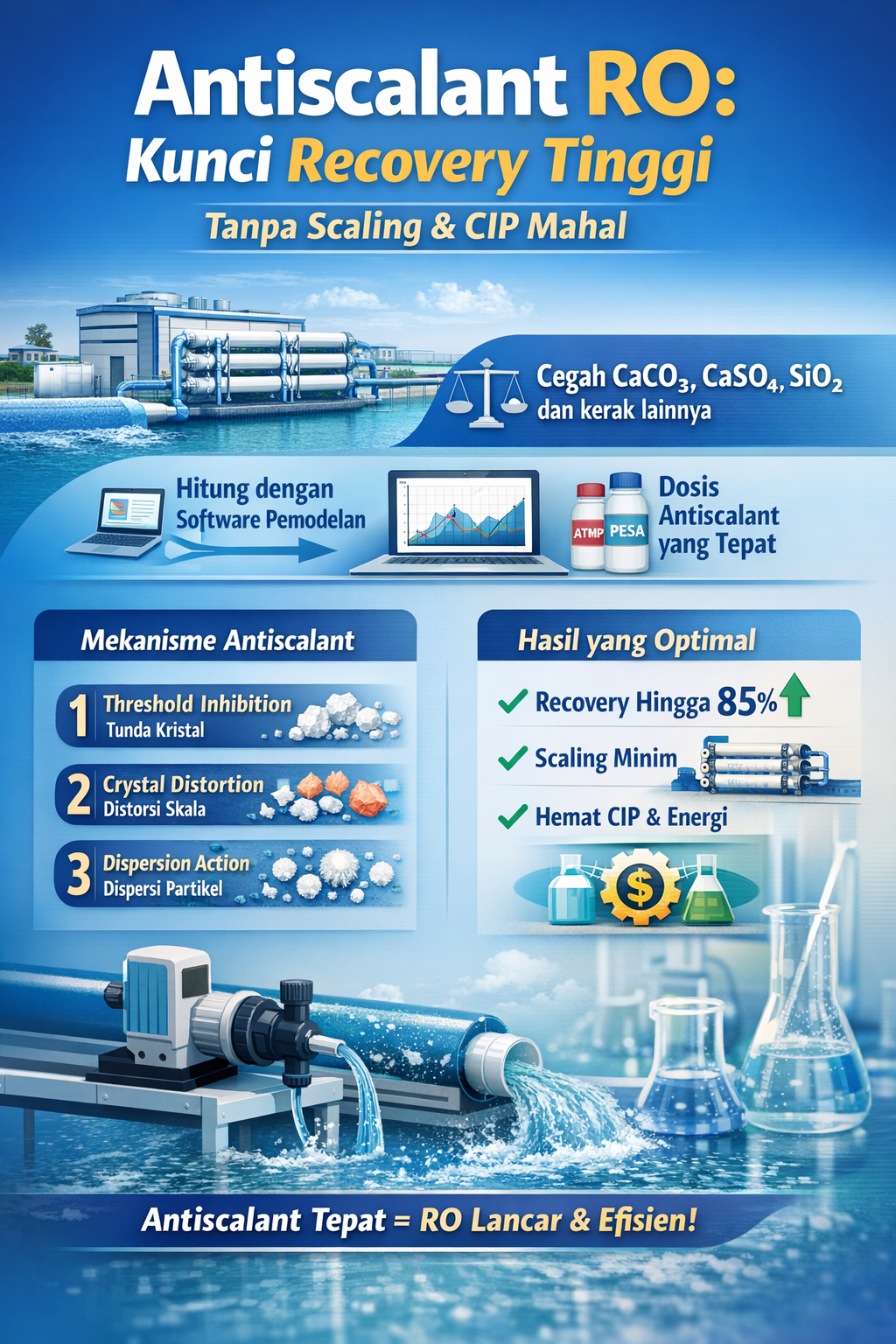
Organophosphonates—ATMP (aminotris(methylene)phosphonic acid), HEDP (1‑hydroxyethane‑1,1‑diphosphonic acid), NTMP (nitrilotris(methylene)phosphonic acid), PBTC (2‑phosphonobutane‑1,2,4‑tricarboxylic acid)—are widely used for threshold inhibition and strong calcium chelation (onlinelibrary.wiley.com). They inhibit CaCO₃, CaSO₄, BaSO₄, SrSO₄, CaF₂, and metal hydroxides effectively. In a comparative study at 0.5 mg/L, ATMP delivered near‑complete (≈100%) gypsum inhibition, while HEDP or PBTC were much less effective at the same dose (onlinelibrary.wiley.com). Another test found ATMP‑rich formulations adsorbed quickly and outperformed pure NTMP for CaCO₃ control (pmc.ncbi.nlm.nih.gov) (onlinelibrary.wiley.com). Trade‑offs: poor biodegradability and phosphorus loading raise eutrophication concerns, and many countries regulate phosphorus discharge—a push behind “green” alternatives (onlinelibrary.wiley.com).
Polymeric inhibitors—polyacrylic acid (PAA) and copolymers like maleic–acrylic acids—deliver both threshold and dispersant effects, with low‑molecular‑weight (≈1500–3000 Da) grades showing strong performance. In gypsum tests, a maleic–acrylic copolymer (MA‑AA) and polyepoxysuccinic acid (PESA) each gave ≈100% inhibition at 0.5 mg/L, nearly matching ATMP (onlinelibrary.wiley.com). Biodegradable options—polyaspartate (PASP) and PESA—showed broad efficacy; under NACE conditions their gypsum control was comparable to ATMP and considerably better than ordinary PAA, and they also inhibit calcite effectively (onlinelibrary.wiley.com) (onlinelibrary.wiley.com).
Other agents—phosphate builders (e.g., hexametaphosphate) and simple chelants (EDTA, nitrilotriacetate)—have been phased out in RO practice due to instability and nutrient release (lautanairindonesia.com) (onlinelibrary.wiley.com). Specialized organic acids (citric, gluconic) can assist in light‑scale or as supplementary chelants (lautanairindonesia.com), but they don’t match phosphonate/polymer performance at high TDS. Market reality: modern products are proprietary blends—phosphonate plus polycarboxylate and dispersants/biocides—tailored to scale profiles. One catalog, for instance, offers a “CAS” antiscalant for high‑CaSO₄ brackish water, an “SI” product for high silica, and a broad‑spectrum “MP” grade (genesysro.co.za). These map to what operators buy as membrane antiscalants.
Efficacy by scale type
Calcium carbonate (CaCO₃): ATMP and low‑MW polycarboxylates are strong performers. ATMP‑bearing inhibitors have shown near‑100% calcite prevention in NACE protocol screenings, while HEDP or generic polyacrylate needed higher dose to catch up (pmc.ncbi.nlm.nih.gov) (onlinelibrary.wiley.com).
Calcium sulfate (gypsum): Modern antiscalants suppress gypsum efficiently. At 0.5 mg/L, MA‑AA and ATMP completely stopped crystallization, while HEDP or PBTC delivered only ~40% inhibition under the same conditions; at 3 mg/L, even HEDP/PBTC reached full inhibition (onlinelibrary.wiley.com). “Green” PESA/PASP at 0.5 mg/L achieved ~90–100% inhibition, placing the relative ranking at equal dose as MA‑AA ≈ ATMP ≈ PESA/PASP >> NTMP > HEDP ≈ PBTC (onlinelibrary.wiley.com) (onlinelibrary.wiley.com).
Silica (SiO₂): A kinetically‑driven fouler, less responsive to conventional ionic inhibition. Polycarboxylate/dispersants can extend induction time; one bench study using acrylic‑ or polycarboxylate‑based inhibitors at 1.5–2.5 mg/L slowed precipitation across 60–300 mg/L SiO₂ in RO brines (researchgate.net). High‑silica feeds often warrant silica‑specific formulations or upstream removal; ion‑exchange is a typical upstream tool (ion exchange systems). The Silica Kinetics Index (SKI) has been proposed to better capture thermodynamics and rapid polymerization kinetics (membranechemicals.com).
Barium/strontium sulfate: Extremely insoluble and difficult. A recent study needed 160 mg/L of a tailor‑made polymer to achieve ~89% BaSO₄ inhibition at pH 7 and 70 °C (mdpi.com). In RO trains, barium is often removed by ion exchange or via sodium replacement using a softener, because relying on antiscalant alone at normal mg/L dosing is unreliable.
Other precipitates: Phosphonates help with CaF₂ and metal hydroxides (Fe/Al). Calcium silicate may appear at high pH; phosphonates again help. Broad‑spectrum blends—often phosphonate + polymer—target simultaneous risks.
Software to predict scaling and dose
Geochemical simulators like PHREEQC and OLI compute saturation indices across minerals. One study used PHREEQC v3.7.3 to calculate SI for CaCO₃, gypsum and others in the concentrate stream from field analyses (mdpi.com). If SI > 0, scale is predicted. These tools capture ionic strength, complexation, and temperature; they can iterate evaporation/recovery scenarios. PHREEQC can also be coupled inside process simulators (e.g., in SysCAD) to compute RO stream chemistry dynamically (help.syscad.net).
RO design simulators fold chemistry into process design. DuPont’s WAVE (free) integrates ultrafiltration, RO and ion‑exchange into a single model, reporting salt rejection, permeate quality and flagging scaling warnings or recovery limits (dupont.com). That mirrors how operators specify RO, NF, and UF systems and pretreatment like ultrafiltration or ion exchange around scaling constraints.
Dedicated antiscalant tools go further. AWC’s PROTON® takes detailed water chemistry and membrane design inputs and predicts scaling for about 50 salts, then iteratively computes the inhibitor type and dose to keep each species below saturation (membranechemicals.com) (membranechemicals.com). It models concentration polarization and membrane flux to produce “optimum” doses for NF/RO systems (membranechemicals.com), and introduces indices like the Calcium Carbonate Nucleation Index (CCNI), which corrects LSI for complexation and ionic strength (membranechemicals.com), and the Antiscalant Precipitation Index (API) to flag when calcium–antiscalant salts would precipitate at a given dose (membranechemicals.com). The value is scenario testing—e.g., “what if recovery is 85% with 4 mg/L of Genesys CAS?”—before touching a valve.
Workflow and field validation
The practical sequence is consistent across plants: gather full ion analysis (Ca, Mg, Na, Cl, SO₄, HCO₃/alkalinity, pH, temperature, SiO₂); simulate concentrate composition at target recovery and check SIs; pick the antiscalant type for the limiting salts; iterate dose until all key SIs are safely negative (modern tools automate this and report mg/L active); then verify with lab jar tests or pilot skids (e.g., NACE tube tests, induction‑time assays) before scaling up (membranechemicals.com). Doses are delivered with a calibrated dosing pump and trended alongside flux, ΔP and salt rejection.
Dose ranges, monitoring, and constraints
In service, antiscalant doses typically fall in the low mg/L range—often 2–5 mg/L, climbing toward ~10 mg/L for high‑risk feeds. One case used 2.5 mg/L of a phosphonate blend to run at 75% recovery, moving to ~4 mg/L for 85% recovery (onlinelibrary.wiley.com). In very soft water (3–5 meq/L hardness), raising dose from 3 to 7 mg/L had no measurable impact—scale rates were negligible across the board (researchgate.net).
Operators confirm dosing adequacy by steady permeate flux, stable salt rejection, and longer intervals to fouling. Any unexplained rise in ΔP or drop in recovery suggests under‑dosing; adding an anecdotal 1–2 mg/L “safety margin” is common, though excessive dosing wastes chemical and can raise organics. Modern software tempers that with API warnings if the inhibitor itself might precipitate (membranechemicals.com). When cleaning is due, specialized membrane cleaners restore performance between CIP cycles.
Environmental and regulatory constraints matter. Antiscalant residues exit with the brine; most do not pass RO membranes significantly. For drinking‑water RO, only NSF/ANSI‑60–listed formulations should be used, and some commercial products are explicitly certified for potable service (genesysro.co.za). In Indonesia, treated drinking water must meet SNI (e.g., <0.05 mg/L P). Because organophosphonates carry phosphorus, dosing and discharge should be checked against local rules. Concentrate management remains subject to general limits (e.g., BOD/COD/metals) and may require treatment or reuse planning.
Operating summary and watchlist
The evidence points to a clear split: phosphonate‑based products (especially ATMP‑containing) are generally best for Ca‑Mg‑sulfate waters; polycarboxylates excel for mixed salts and silica. Controlled tests and field trials show orders‑of‑magnitude differences among chemistries—ATMP vs. NTMP, PESA vs. simple PAA—so software‑led selection matters (onlinelibrary.wiley.com) (onlinelibrary.wiley.com). Modeling tools—PHREEQC, PROTON, WAVE—quantify scaling potential and, crucially, dose. Teams enter raw brine data, identify limiting scales (positive SIs), then step dose in the model until all SIs are negative. Lab or pilot validation then locks the recommendation.
Key parameters to monitor are hardness, alkalinity, sulfate, silica and pH—drivers of saturation risk. Trends like rising HCO₃⁻ or TDS herald the need for more inhibitor. Best practice keeps the “saturation ratio” for each salt below unity; tied to a model, operators can predict whether, for example, adding 3 mg/L of a phosphonate will permit 80% recovery without CaCO₃ or CaSO₄ fouling. Combining chemical treatment with good pre‑filtration and cleaning protocols yields the most reliable operation.
Selected sources and further reading (inline above; all URLs preserved): researchgate.net researchgate.net lautanairindonesia.com lautanairindonesia.com onlinelibrary.wiley.com researchgate.net pmc.ncbi.nlm.nih.gov pmc.ncbi.nlm.nih.gov mdpi.com genesysro.co.za researchgate.net sustainenergyres.springeropen.com sustainenergyres.springeropen.com membranechemicals.com membranechemicals.com membranechemicals.com membranechemicals.com membranechemicals.com help.syscad.net dupont.com mdpi.com lautanairindonesia.com genesysro.co.za.