

Industry: Brewery | Process: Boiling
Wort boiling is the single most energy‑intensive brewhouse step (ResearchGate). In conventional systems roughly 8–12% of the wort volume is evaporated over a 1–1.5 hour boil (ResearchGate), New Food Magazine), requiring roughly 44–46 kBtu per barrel (kBtu/bbl; heat content per US beer barrel) — about 11.5–12 kWh per hectolitre (kWh/hl) of steam (ResearchGate)).
For context, brewhouses typically use on the order of 18–22 kWhₜₕ per hectolitre of beer produced, out of ~50–60 kWhₜₕ/hl total plant usage (The Free Library). Fuel accounts for ≈38% of U.S. brewing production cost (ResearchGate). Indonesia’s industrial sector is under pressure to cut such energy use: audits find 10–30% savings potential and new ministerial rules increasingly mandate energy management in manufacturing (ESDM, ESDM).
Atmospheric kettle baseline
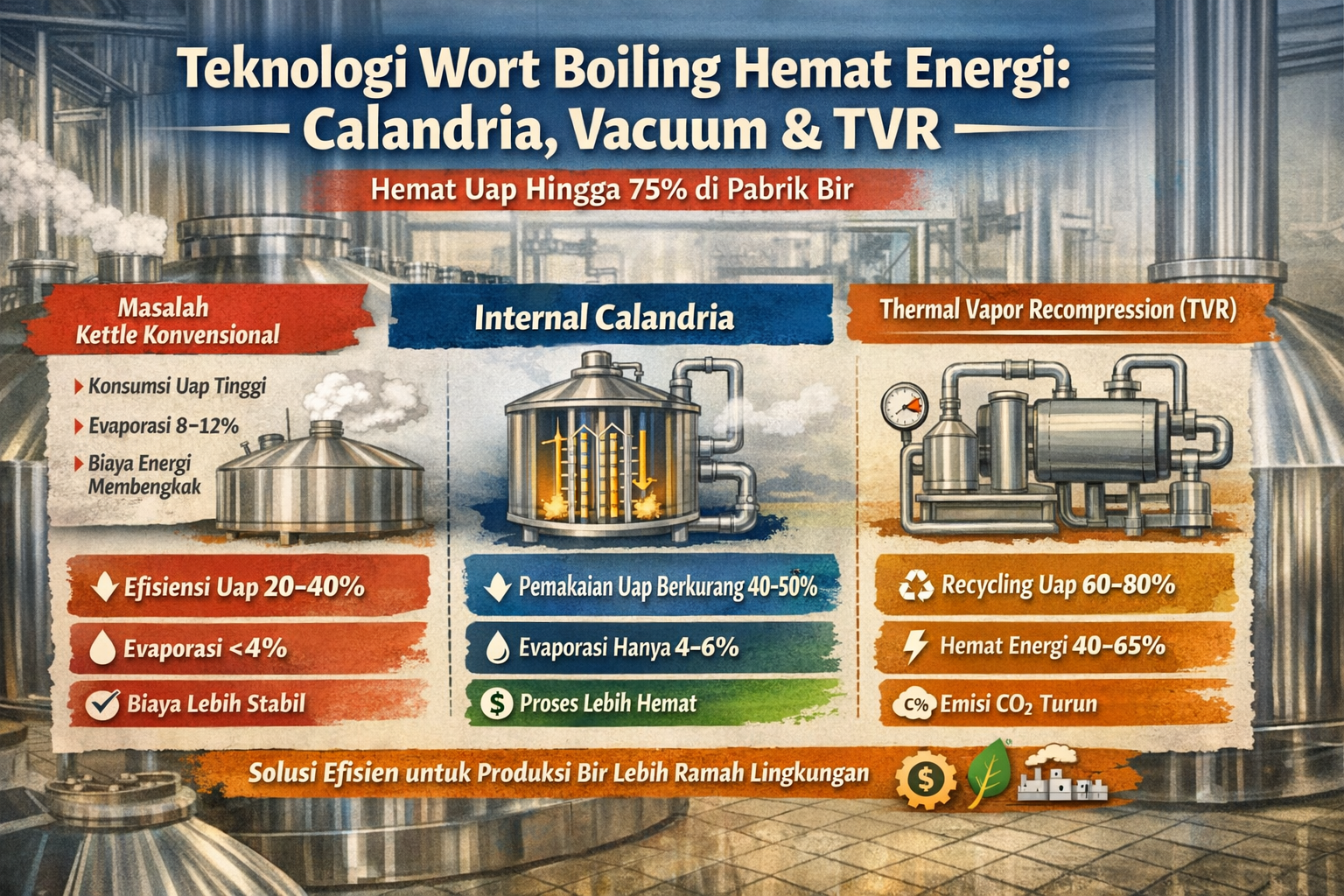
The classic wort kettle uses an internal steam coil or jacket and boils at essentially atmospheric pressure. Steam at ~0.6–1 bar heats the wort to 100 °C; no vapour is recovered. Typical evaporation is ~8–12% over 60–90 minutes, and steam demand is ~11–12 kWh/hl (ResearchGate)). In practice this “thermosiphon” design (natural circulation driven by density differences) can suffer pulsating flow when colder wort slugs enter the coil and local overheating on the tubes, leading to fouling and frequent cleaning (New Food Magazine). It also wastes all latent heat in the boil vapour and leaves the cold wort (≈74 °C) un‑preheated, so upstream may require higher steam pressure and longer boil. Conventional kettles are simple and robust but incur the industry’s baseline steam bill (ResearchGate, ResearchGate)).
Internal calandria heat exchange
Modern internal calandria systems (calandria: a tube bundle heat exchanger inside the kettle) refine the classic design. “Wortifier” configurations pump wort through vertical tube bundles at all fill levels to ensure uniform thin‑film boiling (Banke, New Food Magazine). These eliminate coil “pulsing” and minimize thermal stress. Suppliers advertise very low evaporation rates (<4%) and correspondingly low steam use, while improving wort quality (better volatile removal, less dimethyl sulfide/DMS, more stable foam) (Banke). Circulating pumps and deflectors ensure wort flows gently over internal coils so steam pressure can be reduced (often to ≈0.1 MPa) and energy transfer becomes more even (Banke, New Food Magazine). Independent reports note reduced cleaning frequency (e.g. >30 batches between CIP/clean‑in‑place) and “low energy requirements” (Banke). For medium‑sized breweries (≥200 hl batches), internal calandrias are now common: minimal capex versus a kettle, low incremental maintenance, and effective operation on low‑pressure steam (Brewery Beer Equipment, Banke).
External calandria circulation
External calandria (kettle‑boiler) systems transfer the boil outside the kettle via plate or shell‑and‑tube exchangers; wort is pumped through at high velocity (e.g. 8–10 turns per hour) and returned to the kettle (Microbrewerysystem). Circulated under pressure, boiling can occur at higher temperature (e.g. 107–110 °C) and much faster. One supplier reports that an external heater can shorten boil time by ~20–30% vs a steam coil, implying similar steam savings (Microbrewerysystem). Required steam pressure is often only ~0.3 MPa, lower than for static coils (Microbrewerysystem). Trade‑offs include a recirculation pump (extra electricity use) and the need to avoid excessive shear on the wort (Microbrewerysystem). In practice, by boosting heat transfer area and shrinking the vapor headspace, external calandrias often yield 20–30% or more reduction in boil energy for the same evaporation and allow more flexible batch sizing. Some breweries combine an internal coil with a small external/forced‑boiler to handle high‑throughput brews (as in the Hofbrauhaus Wolters case noted below).
Wort preheating and heat recovery
A major trend is to preheat wort using recovered vapour heat. Plate heat exchangers can raise 72 °C wort toward 95–98 °C using hot water generated by condensing boil vapours (New Food Magazine). Vapour condensate is stored (~78 °C) and then re‑heated by subsequent brew vapours, creating a closed heat loop. This “energy recovery” approach — seen in systems like Rolec ESS or Kaspar Schulz “GentleBoil” — can cut new steam needs dramatically. Thermosyphon calculations show that halving evaporation (from ~12% to ~6%) on a 500 hl brew yields on the order of 6.8 GJ saved per batch (New Food Magazine). Even accepting a typographical “MJ” in the source, the point is ~1900 kWh per brew (New Food Magazine). In effect, these adaptations lower the wort pre‑boil temperature gap and recycle latent heat, often recovering well over half of the vapour energy. Today, advanced brewhouses target total wort evaporation <4–8% (New Food Magazine, ResearchGate).
Low‑pressure and vacuum boiling
Another strategy is low‑pressure wort boiling (including vacuum boiling). Vessels rated to ~0.6 bar (≈113 °C) can boil with far less driving force. “Dynamic” low‑pressure systems (commercial since the mid‑1990s) typically require only 4.5–6% wort evaporation to achieve quality lager beer (ResearchGate). Under these regimes, steam use falls to roughly 26–28 kBtu/barrel (~7–7.5 kWh/hl) — about a 40–50% reduction versus atmospheric boiling (ResearchGate). Since much of the vapour is condensed (and can be recycled to lauter water or CIP), effective heat utilization can be high (ResearchGate). Where conditioning is required before reuse, options include a condensate polisher. Such systems best suit plants doing many brews per day (when capex is justified). In summary, low‑pressure/vacuum boiling greatly cuts required steam and allows VOC (volatile organic compound) recovery, albeit with larger vessel cost.
Vapor recompression options
Vapor recompression recycles the boil vapour itself as heat. Thermal vapor recompression (TVR; steam‑jet ejector using live steam) entrains and compresses boil vapour with high‑pressure steam (typically 6–18 bar) (ResearchGate). The vapour rises to ~0.1–0.4 bar overpressure, effectively recycling its enthalpy. About 60–80% of the vapour is re‑introduced to the boil heater while ~20–40% is condensed for hot‑water recovery (per industrial designs) (ResearchGate). Roughly 30–35% of radiation heat can be returned as process hot water (ResearchGate).
TVR units are relatively low‑maintenance and scale‑independent (one steam jet can handle large output) but they do require high‑pressure steam and large heat‑exchanger surfaces (ResearchGate, ResearchGate). They also generate excess condensate “waste” water (since wort volatiles condense) that must be reused or treated (ResearchGate), where supporting equipment for water treatment may be required.
Mechanical vapor recompression (MVR; motor‑driven blower or compressor) boosts vapour to ~0.3–0.4 bar and recycles essentially all vapours to reheat the wort, with no steam lost (unlike TVR which vents a fraction) (ResearchGate). A pilot study (using an internal calandria plus automated controls) showed MVR cut steam demand by ~40% (ResearchGate): fuel for wort boiling and mashing fell from ~44–46 kBtu/barrel down to ~27 kBtu/barrel (≈6.7 kWh/hl) (ResearchGate). Electricity use is modest (e.g. ~0.02 kWh/barrel tested), so net savings are almost as large as steam reduction (ResearchGate). Drawbacks include capital intensity and complexity; case reports note high noise, vibration and maintenance costs for compressors, and the high electrical power draw can produce peak‑demand charges (ResearchGate).
In practice, breweries have achieved large cuts with recompression. The Steinecker “Merlin” evaporator (an external MVR‑like system) claims total wort evaporation ≈4% and 65–75% lower fuel use (ResearchGate). Independent analysis found Merlin reactors ran at ~22 kBtu/barrel (≈5.5 kWh/hl) versus 36 kBtu for a conventional kettle — and with thermal storage they reached ~12 kBtu/barrel (ResearchGate). Even TVR systems like Huppmann’s report roughly 26–28 kBtu/barrel usage (ResearchGate). The headline takeaway: vapor recompression can halve or better the steam required, at the expense of substantial machinery.
Cost–benefit and payback windows
These technologies differ widely in cost and ROI. Upgrading a traditional boil to an internal coil is relatively inexpensive (tens of thousands of USD) and yields quick minor savings (mainly by enabling gentle boils and slightly lower steam pressure). External calandrias or additional wort heaters require more ($10–50K) and save ~20–30% on boil steam, so payback may occur in 2–5 years depending on brew volume and fuel cost. Example: Hofbrauhaus Wolters (25 hl batches) retrofitted an internal “Jetstar” coil plus new condenser and wort preheater, cutting boil evaporation from ~10% to 5%. The €400K retrofit was projected to pay for itself in ~3 years via heat and electricity savings (Campden BRI). Plate‑preheating systems often have paybacks in 2–4 years.
Thermal vapor recompression is cheaper to install than mechanical: a single steam ejector costs on the order of $30–100K, plus piping, but operates on existing steam. Reported MTB (Mean Time to Break‑even) is short (often ~2–3 years) once vapor condensate is recycled into heating and preheating (ResearchGate, ResearchGate). Steam jet compressors may only add a few percent to fuel use (as high‑pressure consumption) while slicing the new‑steam requirement by roughly half. Mechanical recompression systems cost far more (likely $100K–300K or more) but generate larger savings (~40–60%). One analysis noted MVR O&M was ~2–7% of its capital cost annually, reflecting power use and upkeep (ResearchGate). With electricity comparatively cheap in Indonesia vs fuel, MVR payback can still be attractive if steam is very costly. Published examples suggest that large breweries can recover VR upgrades in 2–5 years.
Outcomes, trends, and compliance
Moving from a plain atmospheric kettle to modern technology can reduce boiling steam by roughly 10–75%, depending on system choice. Internal coils and external heaters typically cut steam use ~20–40%. Low‑pressure/vacuum boiling and heat‑recovery preheaters further cut it to ~4–7 kWh/hl (ResearchGate, ResearchGate). Vapor recompression cases demonstrate ~40–65% savings (e.g. 11 kWh/hl down to as low as 3–6 kWh/hl) (ResearchGate, ResearchGate). Each percentage point of steam saved translates to direct fuel cost savings (and CO₂ reduction). Given that Indonesia’s brewers face high energy prices and stricter efficiency mandates, even conservative upgrades (e.g. a new condenser and wort preheater) will likely pay off rapidly (ESDM, ESDM).
Data snapshot for planning
Consider a 100 hl batch losing 10% to boil (10 hl evaporated). At 3.6 MJ/kg latent heat, that is ≈36 GJ (10 GWh) per batch; halving it saves ~18 GJ. At an Indonesian boiler gas cost of ~$4–8/GJ, one batch saves ~$70–150. Over a year of 2000 batches, that’s $140–300K saved; a $100K–300K investment then pays back in a few years. In an actual case, Hofbrauhaus Wolters computed that cutting boil losses from 10% to 5% saved enough heat that a €400K upgrade would break even in ~3 years (Campden BRI). Similarly, Steinecker reports that reducing total boil vapour from 8% to 4% saves almost 6.8 GJ per 500 hl brew (New Food Magazine). These and other published analyses confirm that breweries upgrading to internal/external calandrias or vapor recompressors typically see payback in the range of 2–5 years as steam bills fall.
Bottom line for brewhouses
Traditional atmospheric kettles are simple but waste a large fraction of wort heat. Internal and external calandria designs can improve boil uniformity and shave 20–30% off steam use (Microbrewerysystem, Banke). Advanced schemes — preheaters, low‑pressure boiling, and thermal/mechanical vapor recompression — are more costly but can cut steam consumption by ~40–75% (ResearchGate, ResearchGate). Breweries in Indonesia must weigh these costs against fuel prices and regulatory pressures: given current trends, even large‑capex options often pay back within a few years through energy savings, reduced emissions, and compliance with energy‑management mandates (Campden BRI, ESDM).