

Industry: Aquaculture | Process: Wastewater_Treatment
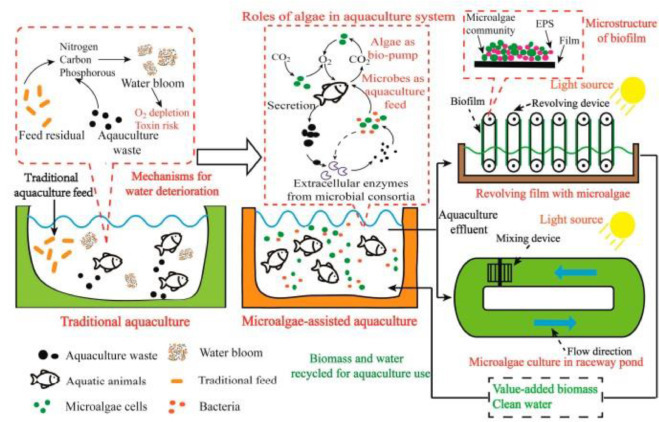
For farms pushing big volumes of dilute effluent, the choice often comes down to hectares or horsepower. Natural and semi‑natural systems — settlement ponds, stabilization lagoons and constructed wetlands — lean on gravity settling, plant uptake and microbial activity rather than blowers and membranes. Studies show they can remove most suspended solids and some organics, but nutrient removal is modest.
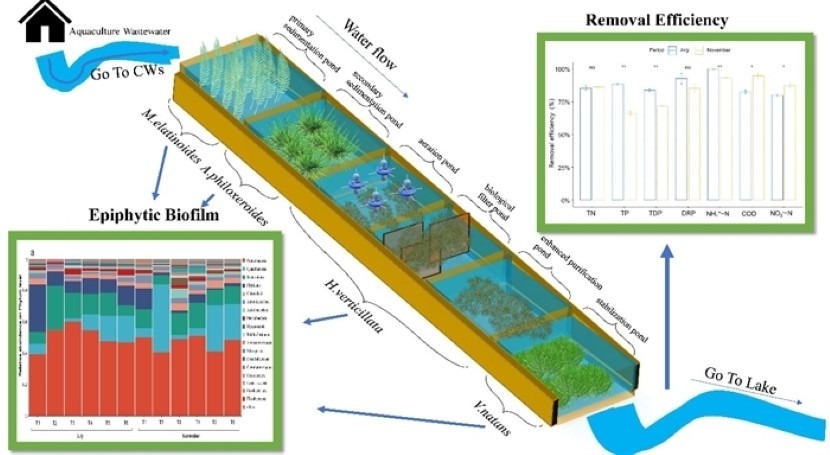
Settlement (clarification) ponds designed for a hydraulic retention time (HRT, how long water stays in the basin) of about 2–3 days can cut total suspended solids (TSS) by up to ~88%, yet remove only 10–31% of total nitrogen (TN) and 15–55% of total phosphorus (TP) (onlinelibrary.wiley.com). Free‑water–surface wetlands typically achieve 50–80% TSS removal (www.mdpi.com) and ~30–70% cuts in BOD or COD (biological/chemical oxygen demand), but inorganic nutrient removal per unit volume is much lower. One review reports wetland TN removal ranging from negative (net release) up to ~64%, mostly due to net settling (onlinelibrary.wiley.com).
Even under high loading, a mesocosm study found only 64–66% ammonia‑N removal, ~5–15% NOx removal, and 55–66% TSS removal (www.researchgate.net). Tabrett et al. (2024) put it bluntly: established emergent‑plant wetlands “are highly efficient in removing particulate organic matter, suspended solids and microbial pollutants, but less efficient at removing nitrogen and phosphorus” (onlinelibrary.wiley.com). In some cases, wetlands even release nutrients as accumulated organic matter or leaf litter decomposes, boosting ammonia or phosphate in the outflow (onlinelibrary.wiley.com) (onlinelibrary.wiley.com). Overall, constructed wetlands often remove only <10% of the incoming N load in permanent biomass (onlinelibrary.wiley.com).
Mechanical treatment performance and targets
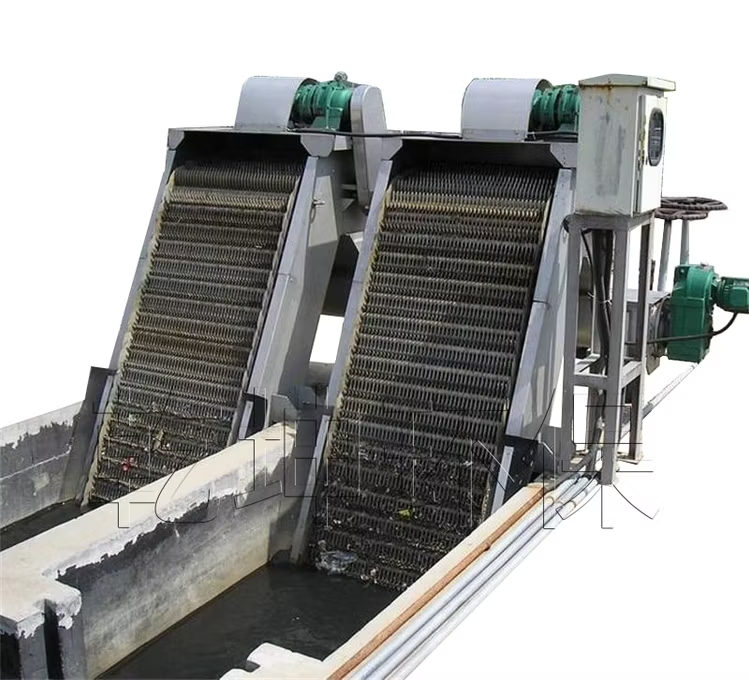
High‑intensity mechanical plants — think aerated lagoons, activated sludge, and moving‑bed bioreactors — are built for higher nutrient removal and far greater treatment intensity. Well‑designed systems handling similar influent loads typically achieve >90% removal of suspended solids and organic BOD, and 70–90% of TN and TP, especially when nitrification/denitrification (microbial conversion of ammonia to nitrogen gas) or chemical phosphorus precipitation stages are included.
Dedicated aquaculture biofilters and membrane bioreactors (MBRs, biological treatment combined with ultrafiltration) can drive NH₄‑N and NOx‑N to near zero, whereas wetlands often leave appreciable residuals. Direct comparative aquaculture studies are scarce, but one engineering review notes wetlands remove <10% N under many conditions, whereas conventional plants typically remove the bulk of nitrogen. Where plants specify process steps, farms often look at compact units such as a moving‑bed bioreactor for denitrification or a membrane bioreactor when reuse‑grade polishing is required.
Chemical P‑precipitation requires controlled chemical feed; in practice that means dosing units, often addressed with a dosing pump. Flexible batch operation is common in intensive setups; sequencing options such as a sequencing batch reactor (SBR) are frequently considered alongside biofilters.
Footprint and operating cost trade‑offs
The trade‑off is largely land versus capital and energy. Stabilization ponds and wetlands are land‑hungry but run on little energy beyond pumps and need only manual maintenance such as occasional dredging or vegetation harvest. Tabrett et al. report that a 2–3 day retention in ponds — requiring about 10–25% of pond area for dedicated settling basins — yields only modest TN (15–25%) and TP (~35%) removal (onlinelibrary.wiley.com). Mechanical clarification is a related unit process in compact plants; farms considering tanks may evaluate a clarifier when moving away from earthen basins.
Constructed wetlands typically need even larger footprints. A community wastewater guideline suggested ≈14.5 m² per m³/d treated (i.e., treating 1,000 m³/day could take on the order of 1.5 ha of wetland) (www.researchgate.net). In an aquaculture pilot, a shrimp‑pond system used a wetland at ~8.6% of pond area and still saw only ~60% TSS removal (www.researchgate.net). In practice, full effluent polishing may demand several hectares of wetland per hectare of production pond. By contrast, a mechanical treatment plant for the same flow might occupy only a few hundred square meters of equipment and building per hectare of production.
Costs follow accordingly. Wetlands have low capital — essentially excavation, liner/gravel, and plants — and negligible energy costs, with minimal labor. In municipal‑scale comparisons, constructed wetlands can cost much less to operate; one analysis found O&M about 60% lower than for activated sludge (e.g., ~€12 vs. €30 per person‑equivalent‑year) (www.researchgate.net) — though aquaculture scales differ. Mechanical plants have high CAPEX (tanks, blowers, membranes, dosing units) and much higher OPEX (electricity, chemicals, skilled operators). Intensity drives costs: adding nitrification/denitrification raises costs steeply. In practice, a mechanized aquaculture WWTP may cost tens of thousands of USD per 1,000 m³/d of capacity (including civil works and process units), whereas an equivalent wetland might cost only a few thousand per hectare of wetland, plus the opportunity cost of land.
Decision framework tied to land and limits
Farm managers end up balancing land availability, treatment targets and costs within local regulations. If a site has abundant spare land (≤1/10 of water surface) and modest discharge limits (for example, regulators allow >20–30 mg/L TN and similar TSS), extensive systems can be effective. A series of settling ponds and/or constructed wetlands can meet basic goals at low operational cost. Dedicating ~10–15% of pond area to a wetland (or settlement basins) can remove ~60–80% of TSS (www.mdpi.com) and a significant fraction of BOD; however, nutrient limits remain the constraint.
If land is scarce or standards are stringent (e.g., TN <10 mg/L, TP <1 mg/L, or specific numeric BOD/TSS caps), intensive treatment is likely needed. Mechanical or hybrid systems — aerated tanks, biofilters and compact reactors — can reliably polish nutrients to low levels. Pre‑treating effluent in a small settlement pond or algal tank, then sending clarified water to a compact bioreactor is a common compromise. For nutrient polishing stages, some farms evaluate packaged processes such as nutrient‑removal trains integrated after primary solids removal.
Hybrid approaches are common. Even with a mechanical plant, a pre‑clarification basin can dramatically cut solids loading on downstream units. Conversely, a constructed wetland can be followed by a small dose of aeration or carbon if modest further polishing is needed. Integrated multi‑trophic add‑ons (e.g., filter‑feeding shellfish or plants in effluent channels) can contribute modest nutrient removal, but are supplementary. Where internal recirculation is high, farms also consider compact biological cores (for example, a moving‑bed bioreactor) to reduce external discharges before any final polishing.
Regulatory context is decisive. Operators should first check local effluent standards (for example, Indonesian regulations under PP 22/2021) for limits on BOD, TSS, nitrogen or phosphorus. If required limits are below what passive systems can reliably achieve, planning must include advanced treatment. Otherwise, a cost–benefit analysis should compare the lower O&M of wetlands with the higher CAPEX of mechanical plants, scaled to the farm’s water flow and budget. Where reuse‑grade polishing is needed, compact units such as a membrane bioreactor are often shortlisted; where batch flexibility helps manage variable loads, a sequencing batch reactor is another option.
Sizing cues and practical trains
Design wetlands for 1–3 day retention (~10–25% pond area; TN ~15–25%, TP ~35% removal at 2–3 days) (onlinelibrary.wiley.com), accept that wetland TN and TP removal tends to be only a few tens of percent, and plan for the possibility of nutrient release from accumulated organic matter (onlinelibrary.wiley.com). Where footprint must be minimized or limits are tight, plan a compact biological core sized to the daily flow; batch or continuous modes can be selected depending on operations.
In practice, many farms use a tiered scheme: coarse settling → wetland or algae pond → final treatment (if needed), tailoring the system to their land budget and regulatory targets. When chemical phosphorus removal is part of the plan, controlled addition via a chemical dosing pump is a standard fit‑up within compact plants.
Source notes and citations
Data and ranges cited above are drawn from authoritative reviews and studies of aquaculture effluent treatment, including Tabrett et al. (2024) (onlinelibrary.wiley.com) and related literature on ponds, wetlands and treatment efficiencies (www.mdpi.com; onlinelibrary.wiley.com). Additional context comes from a community wastewater wetland sizing guideline (≈14.5 m² per m³/d) (www.researchgate.net), a shrimp‑pond pilot using a wetland at ~8.6% of pond area with ~60% TSS removal (www.researchgate.net), and O&M cost comparisons showing wetlands at ~€12 vs. ~€30 per person‑equivalent‑year (www.researchgate.net). A broader review of aquaculture impacts and flows is also referenced (www.sciencedirect.com).