

Industry: Aquaculture | Process: Grow
In warm, nutrient‑rich grow‑out ponds, harmful algal blooms (HABs) of cyanobacteria (blue‑green algae) are a double hit: they consume oxygen at night and drive high pH by day, triggering diurnal dissolved oxygen (DO) crashes and ecosystem stress (globalseafood.org). Off‑flavor compounds (geosmin, MIB) and toxins such as microcystins reduce feeding, suppress immunity, and can kill fish or shrimp (globalseafood.org) (pmc.ncbi.nlm.nih.gov).
Globally, HABs are estimated to cost aquaculture operations millions of dollars annually (pmc.ncbi.nlm.nih.gov). In Indonesia and elsewhere, rising nutrient runoff and climate factors are increasing bloom frequency, sharpening the need for reliable, stock‑safe control.
Copper-based algaecides: dose, safety, constraints
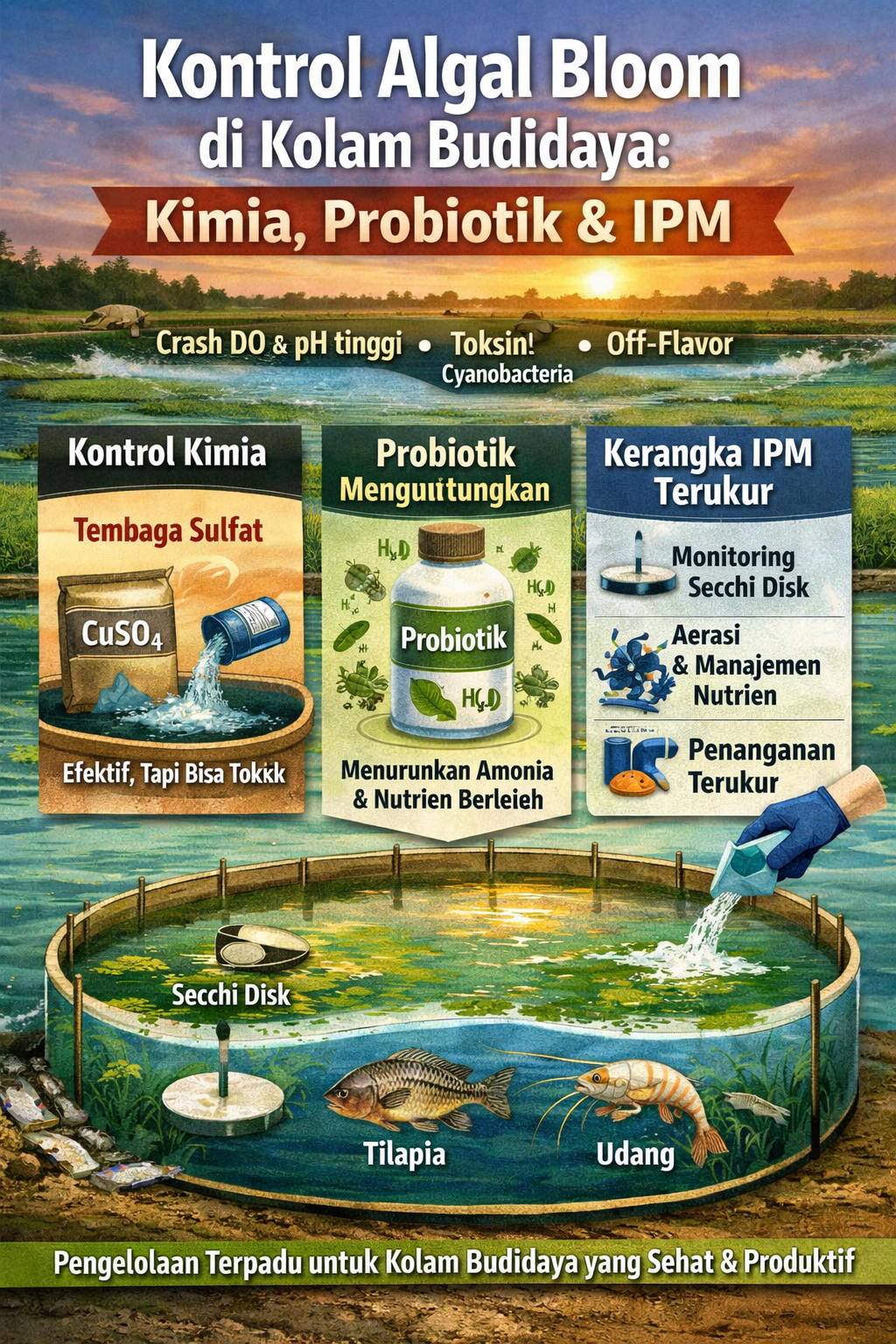
Copper sulfate (CuSO₄·5H₂O) remains the most common algaecide in ponds because it is inexpensive and effective against cyanobacteria. Typical application rates are 0.8–1.2 g CuSO₄ per m³ (≈0.2–0.3 mg Cu²⁺/L), which reduces cyanobacterial biomass while sparing green algae in many cases (globalseafood.org) (globalseafood.org).
At this dose, the initial free copper concentration (≈0.1–0.3 mg/L) is on the order of 10–30% of the 96h‑LC₅₀ (lethal concentration for 50% of organisms over 96 hours) for juvenile shrimp (globalseafood.org). In one study, continuous exposure of Litopenaeus juveniles to 0.35 mg Cu²⁺/L (≈1.4 mg CuSO₄/L) yielded 100% survival, whereas 0.88 mg/L (3.5 mg/L CuSO₄) caused complete mortality in six weeks (globalseafood.org). Tolerance varies by species and life stage: tilapia (3 g) show a 96h‑LC₅₀ ≈ 8 mg Cu²⁺/L (globalseafood.org), while shrimp nauplii are far more sensitive (LC₅₀‑24h ≈ 10–15 µg/L Cu²⁺) (globalseafood.org).
Water chemistry strongly modulates copper toxicity: acidity and low carbonate hardness increase toxicity; in soft, low‑alkalinity ponds (common in some inland shrimp farms), even low doses can accumulate free Cu²⁺ quickly, whereas in hard or saline waters the same dose is partially inactivated (globalseafood.org). A Secchi disk (a simple transparency disk) is often used to guide dosing: at 15–25 cm transparency, ~0.8–1.0 g/m³ CuSO₄ is typical for bloom control, whereas very turbid water (<10 cm) may require 1.5–2.0 g/m³ (globalseafood.org). Best practice includes a small‑scale bioassay with pond water and a few stocked animals to confirm a safe working concentration beforehand (globalseafood.org) (globalseafood.org).
Repeated copper use carries tradeoffs. Microcystis populations can become copper‑tolerant, evolving 4–12× higher tolerance over successive treatments (globalseafood.org). Copper also binds to sediments and organic matter, accumulating in pond soils and effluents over time, with potential harm to benthic fauna (pmc.ncbi.nlm.nih.gov). And doses high enough for green filamentous weeds can suppress beneficial planktonic algae; copper sulfate is generally more potent against cyanobacteria, requiring ~5× lower dose than for green algae (globalseafood.org).
Regulatory status differs by country. Indonesian aquaculture guidelines (2013 ASEAN) permit copper sulfate in ponds, subject to species restrictions, while other algaecides such as malachite green are prohibited (doczz.net). Accurate application is a technical control point; operators often rely on a dosing pump to meter CuSO₄ solutions evenly at pond scale.
Peroxide-based oxidizers: selective cyanobacteria knockdown
Hydrogen peroxide (H₂O₂) is a fast‑acting oxidizer that selectively attacks cyanobacterial cell walls and rapidly degrades to water and oxygen—leaving no toxic residues (edis.ifas.ufl.edu). In studies, Microcystis blooms were ≈65% reduced in vitro by ≈7 mg/L H₂O₂, and pond trials saw ~43% fewer Microcystis cells after 1 hour at 7 mg/L (pmc.ncbi.nlm.nih.gov). Notably, these treatments spared other algae and caused no observable gill damage in tilapia or giant tiger prawn in those ponds (pmc.ncbi.nlm.nih.gov) (pmc.ncbi.nlm.nih.gov).
Effective concentrations reported are 4–20 mg/L; above ~10 mg/L, rapid oxygen release raises a risk of gas bubble disease, so field applications are typically ≤10 mg/L (pmc.ncbi.nlm.nih.gov). Ponds often need repeat treatments—weekly or biweekly—to suppress recurring blooms (pmc.ncbi.nlm.nih.gov). Solid peroxide compounds such as sodium carbonate peroxyhydrate provide time‑release H₂O₂ for filamentous blue‑green mats at pond edges. Potassium permanganate (KMnO₄) at 2–5 mg/L also oxidizes organics and algae but is more often used as a disinfectant than a selective algaecide.
The net effect of peroxide treatments is high (O₂ ↑, microcystins ↓, bloom crash) with minimal stock risk; tilapia and shrimp in treated ponds showed no behavioral stress in reported trials (pmc.ncbi.nlm.nih.gov) (pmc.ncbi.nlm.nih.gov). Peroxide products are legal in many countries (e.g., FDA‑approved Perkins® in the U.S.), but local Indonesian fishery authorities may require permits even though H₂O₂ is essentially benign.
Beneficial bacteria (probiotics): nutrient competition
Biological control uses “good” microbes to stabilize water and indirectly suppress blooms by nutrient competition. Common probiotics include Bacillus spp., Nitrospira/Nitrosomonas (nitrifying bacteria), Pseudomonas, Rhodopseudomonas, and lactic acid bacteria; they are added to ponds or feeds as single strains or consortia. In shrimp ponds, a commercial Bacillus blend and a multi‑species bacterial mix significantly lowered NH₃ and heterotrophic bacteria levels while raising DO and pH (pmc.ncbi.nlm.nih.gov). Over 8 weeks, supplemented ponds showed an inverse relationship of NH₃ versus beneficial bacteria count (TVC, total viable count) and had significantly higher mean DO and pH than controls (pmc.ncbi.nlm.nih.gov).
A recent “synbiotic” trial—combining a probiotic consortium of sulfur‑oxidizing bacteria with a plant‑based prebiotic—dramatically reduced ammonia‑N, nitrite‑N, and phosphate‑P to nearly zero, lowered Vibrio/Aeromonas counts, and preserved beneficial phytoplankton; treated ponds yielded 625 kg more shrimp biomass than baseline (link.springer.com). For field deployment, many farms opt for a starter bacteria to establish Bacillus‑led communities and then dose a nitrifier‑supporting regime to keep ammonia consistently low.
Mechanistically, Bacillus spp. favor aerobic breakdown of organics in higher‑hardness waters, converting carbon largely to CO₂ rather than biomass and boosting nitrification, which reduces nitrogen available for algal growth (pmc.ncbi.nlm.nih.gov). Some strains produce algicidal compounds; many bacteria (including certain Pseudoalteromonas and Vibrionaceae) can directly inhibit algal cells, with one screening finding over half of 41 marine bacteria strongly inhibited the red‑tide alga Pavlova lutheri (pmc.ncbi.nlm.nih.gov). Proponents claim mixed Bacillus/Nitrobacter/Pseudomonas inocula can skew communities away from cyanobacteria, although field evidence is mixed (pmc.ncbi.nlm.nih.gov). To sustain these microbial communities, some operations supplement with a tailored bacterial nutrient to optimize growth and treatment efficiency.
IPM framework: monitoring and thresholds
An integrated pest management (IPM) approach combines monitoring, preventative husbandry, biological buffers, and judicious chemical use. Monitoring anchors decisions: Secchi depth readings, chlorophyll meters, and plankton counts set triggers. A Secchi disk reading below 15–20 cm or a rapid chlorophyll spike can signal intervention thresholds.
Routine pond practices—limiting excess feed, ensuring adequate aeration, and maintaining balanced N:P (nitrogen‑to‑phosphorus) ratios—reduce nutrient loading and preempt blooms. These husbandry controls are the low‑cost baseline for risk management.
IPM framework: biological and physical tools
Biological controls form the first line: sustaining a “green‑water” community with benign algae (via judicious fertilization of green taxa) and stocking grazers such as Daphnia spp., tilapia, silver carp, grass carp, or filter‑feeders like mussels can keep phytoplankton in check (pmc.ncbi.nlm.nih.gov). Polyculture and integrated multi‑trophic systems recycle nutrients naturally; routine probiotic additions (weekly or biweekly) have shown steady DO improvements and reduced nitrite/ammonia in trials (pmc.ncbi.nlm.nih.gov) (link.springer.com).
Physical techniques—paddlewheel aerators, shading screens, and clay/dispersants—are preventive tools when bloom risk rises (for example, post‑fertilization). Ultrasonic devices are emerging to disrupt algal buoyancy (the specific mechanics are beyond this scope).
IPM framework: targeted chemical response
When blooms occur, spot treatments limit whole‑system shocks. Cyanobacterial scums respond to low‑dose copper or peroxide; herbicides such as diquat or flumioxazin may be used on filamentous weeds in some programs. Application protocols follow trial evidence: dispersion with “good mixing” is needed, and fish behavior should be closely observed during treatment (pmc.ncbi.nlm.nih.gov). Whenever copper is applied, buffering alkalinity or applying lime afterward helps neutralize pH swings and bind excess Cu (as suggested by [67], using TA/100 to set dose).
Example IPM plan: tilapia pond scenario
Pre‑stocking, water tests show moderate nitrate but high phosphate and scant plankton. The pond is limed to the mid‑8s pH (which inhibits cyanobacteria) and seeded with select green algae. A probiotic blend is applied at 0.01–0.03 g/m³ every 10 days to nitrify waste. By day 15, green algae bloom with Secchi ~30 cm. By day 25, turbidity drops to 12 cm and the water hue shifts green/muddy (cyanobacteria surge). A 7 mg/L hydrogen peroxide application is made across the pond; within 2 hours, cyanobacteria die back by ≈50% (pmc.ncbi.nlm.nih.gov). DO dips slightly but rebounds by the next day. Green algae re‑establish from survivors. Probiotics are continued, and minimal copper sulfate (e.g., 0.8 g/m³) may be used if blooms recur—calibrated first by small‑scale tests of shrimp tolerance.
Across cycles, adaptive management is the lever: biological methods are the default; chemicals are corrective tools. Data targets such as unionized ammonia <0.1 mg/L and Secchi >20 cm keep choices objective. In Indonesia, this aligns with BMPs that limit harmful chemical inputs per ASEAN guidance (doczz.net).
Sources: Recent aquaculture and environmental science studies and guidelines support the practices described here (globalseafood.org) (globalseafood.org) (globalseafood.org) (pmc.ncbi.nlm.nih.gov) (pmc.ncbi.nlm.nih.gov) (link.springer.com) (pmc.ncbi.nlm.nih.gov) (globalseafood.org) (pmc.ncbi.nlm.nih.gov) (edis.ifas.ufl.edu) (globalseafood.org) (globalseafood.org) (globalseafood.org) (doczz.net) (pmc.ncbi.nlm.nih.gov) (pmc.ncbi.nlm.nih.gov). These provide quantitative dose guidelines and documented outcomes (for example, percent algal reductions and fish survival rates) essential for decision‑making. All statements above are drawn from peer‑reviewed literature and industry advisories to inform best practices in aquaculture pond management.