
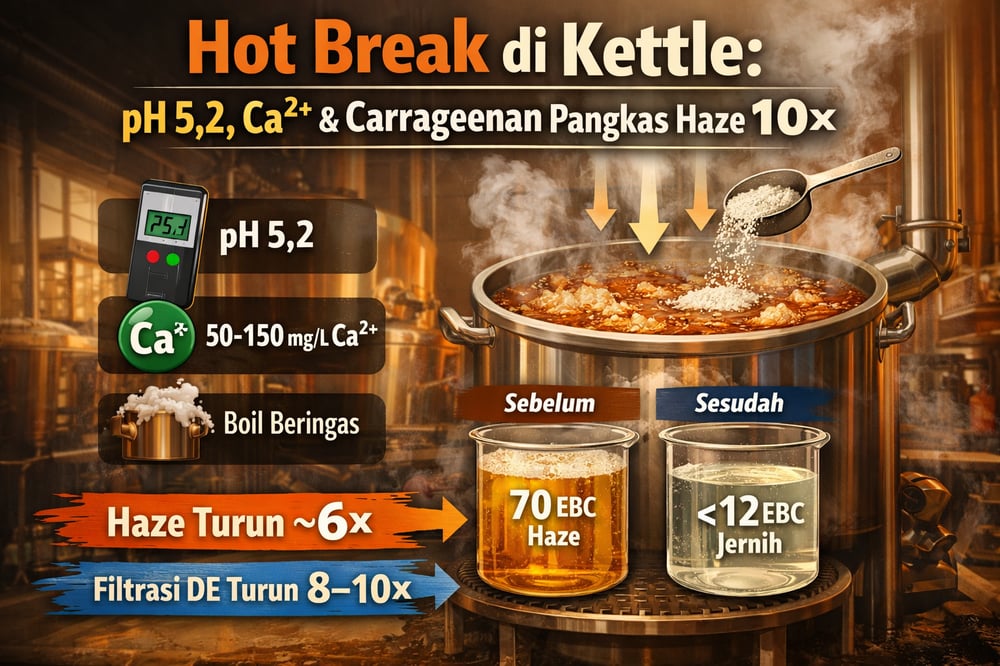
Hot break is chemistry, not luck: dial wort pH to ~5.2, keep calcium in the 50–150 mg/L pocket, run a vigorous 60–90 minute boil, then let carrageenan do the heavy lifting. The payoff can be a 6× haze reduction and up to 8–10× lower filter aid use.
During wort boiling, proteins and tannins form insoluble complexes known as hot break (hot trub). Those clumps have to get out for beer clarity and stability. The size and quantity of that break swings with small shifts in wort chemistry and boil conditions, with wort pH around 5.2 (room‑temperature measure) consistently emerging as the sweet spot for strong coagulation without severely impairing hop utilization (crispmalt.com) (forum.homebrewersassociation.org).
Brewing scientists point to why: as pH moves toward a protein’s isoelectric point (the pH where net charge is near zero; ~4.9 for most malt proteins), solubility drops and coagulation accelerates (braukaiser.com). Calcium (Ca²⁺) helps by reacting with malt phosphates and polyphenols, releasing H⁺ and acidifying the wort while cross‑linking proteins—both effects that stiffen the break (goodbeer.solutions) (crispmalt.com) (byo.com).
Then there’s physics: a rolling boil—high heat input, robust convection, strong turbulence—drives denatured proteins and tannins together so they collide and agglomerate. As one data source puts it: “Trub formation is helped by the vigour of the boil, the rate of energy added, [and] the duration of the process – essentially the evaporation rate!” (crispmalt.com)
Hot‑break chemistry and targets
Proteins lose charge as pH falls toward their isoelectric point (~4.9), which enhances coagulation (braukaiser.com). Brewers therefore often target boil pH near 5.2 (room‑temperature measure) because it maximizes break formation without severely impairing hop utilization (crispmalt.com) (forum.homebrewersassociation.org). In practice, wort pH drops about 0.1–0.2 units over 60–90 minutes—e.g., from ~5.8–5.9 down to ~5.6–5.7—driven by calcium–phosphate precipitation and related reactions (crispmalt.com) (braukaiser.com).
Lowering boil pH further (via acids or Ca²⁺ salts) grows flocs but can reduce hop bitterness (byo.com). One brewing expert frames it bluntly: the “best possible hot break” shows up when kettle pH reaches ~5.1–5.2 before finings (forum.homebrewersassociation.org), matching industry guidance that trub‑formation pH is ≈5.2 (crispmalt.com). At pH ~5.4, flocs are smaller and wort haze rises.
Wort pH: small shifts, big gains
Data‑backed practice converges on a cast‑out wort pH ≈5.2 (±0.1), monitored in the 5.1–5.3 range through the boil (crispmalt.com) (forum.homebrewersassociation.org). Brewers often acidify slightly or use calcium to reach this. Increasing brew pH to 5.4–5.6—common if water is untreated—tends to give smaller flocs and hazier wort.
Quantitatively, sources summarized at byo.com and braukaiser.com note that boil pH ~5.3 yields moderate coagulation, while dropping to ~5.1 can produce larger flocs; raising kettle pH (e.g., with baking soda) substantially reduces trub formation. The typical pH drop of ~0.1–0.2 units (for instance, 5.8→5.6) is itself helpful for coagulation (crispmalt.com).
Calcium concentration: cross‑linking and acidification
Divalent cations, especially Ca²⁺, materially enhance break formation by reacting with wort phosphates to form insoluble calcium phosphate, freeing H⁺ and lowering pH (goodbeer.solutions) (crispmalt.com). High‑calcium water (e.g., 100+ mg/L Ca) leads to noticeably darker wort (more Maillard browning) and a faster pH drop.
Brewers typically aim for ~50–150 mg/L Ca²⁺ in the mash/wort; at these levels, Ca–phosphate precipitates boost protein coagulation. Murphy & Sons describe calcium as having an almost “chicken and egg” effect on protein precipitation in both mash and boil (goodbeer.solutions). Brew‑Your‑Own concurs that calcium “aids protein aggregation by binding proteins together” (byo.com).
Raising Ca from ~10 to ~100 mg/L can lower mash/wort pH by 0.2–0.5 units (via Ca‑phosphate precipitation) and is associated with firmer trub formation (goodbeer.solutions). Worts with 10× higher Ca²⁺ (10→100 mg/L) tend to finish the boil around pH 5.3–5.4 versus ~5.5–5.6 for very soft water (goodbeer.solutions) (braukaiser.com), and those higher‑Ca worts leave substantially clearer hot wort. A practical illustration: adding 50 mg/L CaCl₂ to maltose solution can lower mash pH by ~0.2, mirroring wort behavior.
Practical guidelines in the literature point to supplying at least ~50 mg/L Ca²⁺, with some operations pushing 100–150 mg/L where pH control or yeast nutrition is needed. Above ~200 mg/L there are diminishing returns, and hop doses can need adjustment due to lower pH (goodbeer.solutions) (crispmalt.com). Magnesium above ~50 mg/L can interfere (Mg‑phosphates are more soluble) and is generally kept low (goodbeer.solutions). The summary advice: calibrate water chemistry so calcium neutralizes wort alkalinity and contributes ~0.1–0.2 pH drop by end of boil (goodbeer.solutions) (crispmalt.com).
Boil vigor and duration: turbulence vs shear
A full, rolling boil with vigorous convection yields more hot break—Crisp Malt ties trub formation to boil vigor, energy input, and duration (effectively the evaporation rate) (crispmalt.com). Stronger turbulence improves mixing of denatured proteins with polyphenols and hop material, hastening flocculation.
Time matters too. Standard recipes (60–90 minutes) produce ample break, but very extended boils—beyond ~90–120 minutes—introduce shear forces that break large flocs into smaller particles, slowing removal (byo.com). Conversely, a weak, simmering boil can cut hot break formation by about 50% (crispmalt.com). Maintaining a vigorous boil also helps form a tighter whirlpool trub cone, improving downstream clarity (braukaiser.com).
In controlled comparisons, doubling boil intensity (e.g., half‑volume strong boil vs. full‑volume simmer) roughly doubled observed lees volume (crispmalt.com).
Kettle finings (carrageenan) mechanism and options
Kettle finings—Irish moss, Whirlfloc tablets, Protafloc granules—are carrageenan polymers (mainly κ‑carrageenan), long negatively charged polysaccharides extracted from red seaweed. Added late in the boil, they adsorb onto proteins and tannin–protein aggregates and create a net‑like lattice that pulls them out of solution (braukaiser.com) (byo.com) (goodbeer.solutions). Lewis & Bamforth sum it up: “carrageenan (e.g. Irish Moss) in the boil does not increase the protein precipitation but it causes formation of larger flocs that settle more quickly” (braukaiser.com).
Types vary. Traditional Irish moss (raw Chondrus) is inexpensive but less potent and needs >10 minutes to extract. Modern tablets blend κ‑ and λ‑carrageenan and dissolve quickly. Purified κ‑carrageenan (e.g., Murphy & Son’s Protafloc) is fully water‑soluble, highly active, requires lower doses, and leaves less sediment (goodbeer.solutions).
Quantified finings impact on haze and filtration
Poreda et al. (2015) dosed 50 mg/L carrageenan at flameout and saw pre‑lagering (sweet beer) haze drop from ~70 to ~12 EBC units (a ~6× reduction) (researchgate.net). After diatomaceous‑earth (DE) filtration, carrageenan‑treated beer filtered with 40 g/hL DE was essentially clear (~1 EBC) versus ~34 EBC for the control filtered at the same high DE dosage (researchgate.net) (researchgate.net). Only ~5 g/hL DE with carrageenan achieved better clarity (<1 EBC) than 40 g/hL DE for untreated wort (researchgate.net).
Industrial notes add that effective kettle clarification can shorten fermentation and storage times by several days thanks to lower yeast/lipid loads (goodbeer.solutions).
Dosing, timing, and mixing parameters
Timing: add kettle finings in the last 10–15 minutes of the boil (commonly at 15 minutes remaining). Earlier additions have little effect because finings can degrade, while right‑at‑flameout additions risk reduced contact during chilling. Large systems often briefly recirculate with the fining solution to ensure contact (byo.com).
Dosage: typical rates are 50–150 mg/L (5–15 g/hL) of active carrageenan. Home brewers often use ~0.75–1.5 tsp (≈3–6 g) per 5 gal (19 L), about 0.1–0.2 g/L (10–20 g/hL) (byo.com). Commercial fermenters generally use 5–15 g/hL; Poreda et al. found 50 mg/L optimal in their malt set (researchgate.net). Starting points from manufacturers such as Murphy & Sons are ~1–2 g/hL. Trials are advisable: too little underperforms; too much wastes finings and can rob head.
Dissolution and mixing: pre‑mix finings in boiled water (about 2–3 L per 100 L wort), then dose while stirring vigorously for 1–2 minutes before completing the boil. Rapid circulation disperses the carrageenan “net” so it can capture suspended solids uniformly.
Where operations standardize additions, accurate chemical dosing supports repeatability; equipment such as a dosing pump can help deliver consistent 50–150 mg/L carrageenan rates or controlled Ca²⁺/acid additions implied by the pH targets above.
Selection notes and compliance
Selection tips: raw Irish moss is cost‑effective but less potent and may leave particulate; tablets (κ + λ blends) dissolve quickly but include fillers; purified κ‑carrageenan (Protafloc/Kappa) is most active, fully soluble, and leaves minimal debris (goodbeer.solutions) (braukaiser.com). Match fining choice to process and style: lagers and blondes where ultra‑clear wort is critical benefit most; some dark or unfiltered styles may omit finings to retain more protein.
Regulatory note: always verify approvals in your market. For instance, “Whirlfloc is not permitted by” the Reinheitsgebot in Germany (braukaiser.com).
Expected outcomes and trade‑offs
Proper kettle fining use yields markedly clearer wort—often within minutes after whirlpool—versus tens of minutes or hours without finings. One study measured ≈90% haze reduction after fermentation with carrageenan (researchgate.net). In practice, kettle finings can allow proportional reductions in cold‑contact times and DE usage; in lab trials, 50 mg/L carrageenan saved over 80% of DE use while delivering sub–1 EBC haze (researchgate.net).
Brewers can also expect final cold‑break volume (the trub cone) to increase by tens of percent and fermentations to finish 1–3 days faster due to cleaner runnings when kettle finings are employed. Still, excessive fining can strip too much protein: high carrageenan levels can generate a fluffy sediment that “leaves behind a lot of wort in the trub” and reduce desirable head‑forming proteins (byo.com). Full hydration and careful scaling remain important. Tracking pH and clarity improvements verifies benefits; if kettle pH is consistently high (>5.4), extra calcium or finings may be indicated.
Bottom line parameters
Wort pH ≈5.2 (post‑boil), ample Ca²⁺ (target ~50–150 mg/L), and a vigorous 60–90 minute rolling boil together foster strong hot break. A small late‑boil dose of carrageenan finings (Irish moss or refined κ‑carrageenan) consolidates coagulates into large precipitates. Published trials show that 50 mg/L carrageenan can cut post‑boil haze from ~70 to ~12 EBC and enable a roughly 10‑fold lower filter aid dose while achieving sub–1 EBC haze (researchgate.net) (researchgate.net). These effects are consistent with detailed brewing science sources (braukaiser.com) (crispmalt.com) (byo.com) (goodbeer.solutions).
