
Nickel miners battling sulfate in acid mine drainage are choosing between reverse osmosis and biological sulfate reduction. Both can hit tough targets; the trade‑offs are energy and brine versus land and electron donors.
On one side, high‑pressure pumps push mine water through dense polymer films, stripping out sulfate ions with ruthless efficiency. On the other, sulfate‑reducing bacteria quietly convert the same contaminant into sulfide, precipitating metals and leaving solids behind. Both camps are making their case in nickel operations where acid mine drainage (AMD, acidic, metal‑rich wastewater from sulfide ore exposure) pushes sulfate into the grams‑per‑liter range.
Reverse osmosis (RO) and nanofiltration (NF)—pressure‑driven “membrane” processes—promise predictable, high removal. Biological sulfate reduction (BSR)—anaerobic conversion of sulfate (SO₄²⁻) to sulfide (HS⁻) by sulfate‑reducing bacteria, SRB—leans on low energy and potential metal recovery. The choice is less about whether they work and more about power price, land, and what to do with the waste stream.
Nickel miners in Indonesia face a regulatory oddity: sulfate is not explicitly limited in Permen LH No. 9/2006 ([nikel.co.id]. In practice, however, general water quality norms and Tier‑1 uses (e.g., drinking, irrigation) effectively demand 300–500 mg/L sulfate (the WHO guideline is ~250 mg/L), pushing operators toward robust treatment.
Cara Menghilangkan Air Bau Lumpur: Kimia, Biofilter & Ventilasi
Membrane sulfate rejection performance
RO physically rejects dissolved ions, including sulfate. Pilot work with commercial RO membranes (Toray BLN) showed 95–96% salt rejection (mdpi.com), and in practice an RO plant fed with 2–3 g/L sulfate can produce permeate below 100 mg/L, often meeting typical 250–500 mg/L discharge targets (scielo.org.za). The trade‑off is a small concentrate stream—typically less than 10% of influent—containing most of the sulfate.
NF, with larger pores, removes less sulfate (roughly 70% rejection, often followed by RO polishing for strict limits; mdpi.com). In nickel AMD service, operators frequently spec modular membrane systems with RO/NF skids; for brackish‑strength feeds (maximum TDS of 10,000), brackish-water RO units are common, with nano filtration as a selective sulfate step when hardness removal at lower pressure is beneficial.
Pretreatment is non‑negotiable. Suspended iron hydroxides and scale‑forming cations foul membranes without robust front‑end barriers. Plants pair dual‑media filtration—such as sand/silica filters—with fine cartridge filters or even ultrafiltration (UF) before RO. Because divalent sulfate teams up with calcium and barium to form stubborn scales (CaCO₃, BaSO₄), operators dose antiscalants; dedicated programs and membrane antiscalants keep recovery rates up, while membrane cleaners restore performance between CIP cycles. Commercial elements from brands like Toray and Filmtec Dupont are widely used in these skids.
RO economics and concentrate handling
RO’s operating cost (OPEX) is dominated by energy and pretreatment chemicals. Literature on mine drainage RO reports OPEX in the hundreds of USD per thousand cubic meters for small pilots, while large desalination RO plants run ~$0.3–$0.6/m³ under ideal conditions. A modeling study of AMD reclamation estimated total CAPEX on the order of USD 30–50/ton (of treated water) and OPEX ~$200–400/kL for full desalination (fine‑tuned by byproduct recovery) (mdpi.com), with figures highly site‑dependent (feed composition, recovery ratio). In practice, full RO treatment (neutralization + multi‑stage RO + concentrate handling) can cost on the order of $0.5–1.0 per m³, depending on power cost and recovery rate. Energy intensity is flagged repeatedly; one section cites electricity at ≈0.05–0.15 kWh/m³, while a comparative summary cites ~1–3 kWh/m³ (both are presented as given; scielo.org.za; mdpi.com).
Brine disposal is the other big line item. Concentrates are routed to evaporation ponds or crystallizers, or trucked off‑site. In South Africa, an RO‑only sulfate step treated ~1.5 g/L gypsum‑saturated AMD to comply with 250–500 mg/L sulfate discharge limits—delivering potable‑quality water but at high utility and operational complexity (multiple stages, high‑pressure pumps, and concentrate handling; scielo.org.za; mdpi.com). A detailed South African study also noted that neutralization alone consumed ~67% of chemical use in sulfate‑removal schemes, a reminder that upstream pH control matters regardless of the downstream technology (scielo.org.za).
Biological sulfate reduction performance
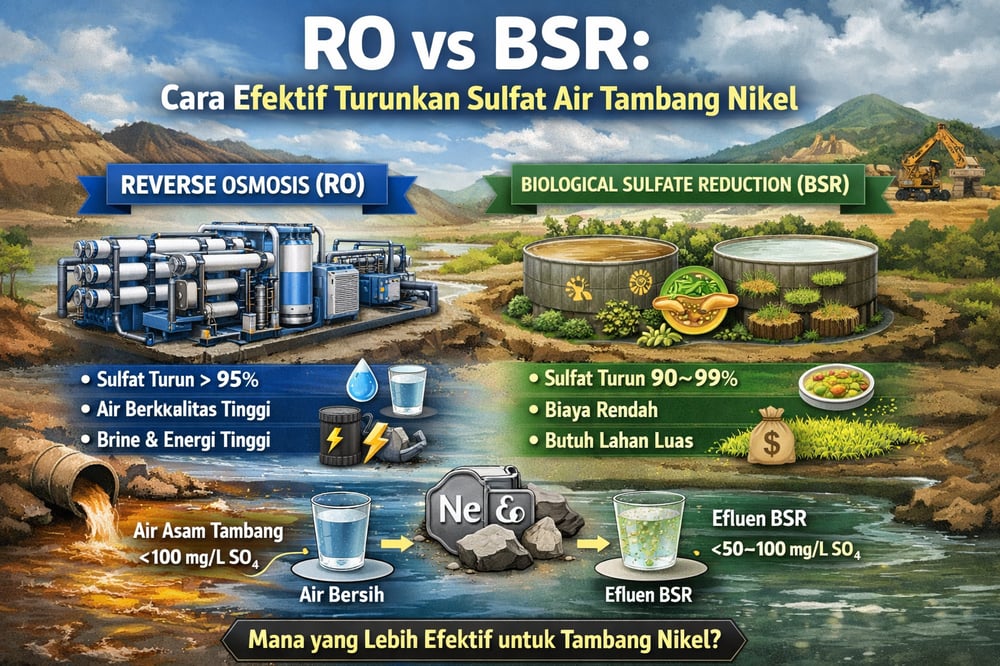
In BSR, sulfate‑reducing bacteria operating under anaerobic conditions convert SO₄²⁻ to HS⁻ using an electron donor (e.g., ethanol, methanol, lactate, or hydrogen). The produced sulfide precipitates metals as sulfide solids or is captured as H₂S and converted to elemental sulfur. Configurations span passive wetlands/pond reactors and active, engineered bioreactors (fixed‑bed or fluidized).
Removal can be near‑quantitative. Bench and pilot studies routinely report 90–99% sulfate removal at steady state. A high‑rate hydrogenotrophic membrane bioreactor (MBfR) achieved 92–97% sulfate removal (1.7–3.7 g S·m⁻³·d) under strong pH control (pmc.ncbi.nlm.nih.gov). Passive ponds with organic media have lower loading rates (e.g., less than 0.1–1 g S/L·d) but can eliminate more than 90% of sulfate over weeks of retention. Effluent from well‑tuned BSR typically lands below 50–100 mg/L sulfate; pH must be neutral, though SRB processing often yields near‑neutral pH naturally.
Active BSR plants resemble conventional biological treatment trains. Sites leverage wastewater biological digestion know‑how with fixed-bed bio‑reactors for controlled residence time, and may seed systems with starter bacteria and tailor donor regimes with nutrient blends. Downstream, primary solids separation via a clarifier allows sulfide sludges to be dewatered and handled as solids rather than saline brine.
RAS Hemat Air: Cara Reuse Air Backwash hingga 96%
BSR costs, byproducts, and land footprint
Passive BSR CAPEX is largely earthworks (lined ponds and simple piping). Operating costs stay low if waste or low‑cost substrates (wood chips, manure, molasses) are available. A South African review estimated passive BSR O&M at ~ZAR 4.5/m³ (≈$0.25/m³) with generic waste carbon; supplementing with higher‑grade donors (molasses, ethanol) raises costs to R7–R11/m³ (≈$0.4–0.6/m³) (scielo.org.za).
For active BSR (Thiopaq®‑type reactors), OPEX is higher, often driven by hydrogen or acetate supply (scielo.org.za). Published estimates put SRB treatment cost at roughly $0.20–0.30 per kg SO₄ removed when using H₂ as donor—about half the cost if using ethanol (0.20 vs. 0.26 USD/kg SO₄) (pmc.ncbi.nlm.nih.gov). Electricity needs are minimal (pumps for recycling, etc.), labor is low, and disposal cost is mainly sulfide sludge, which may contain recovered metals that can offset costs.
BSR trades brine for solids, but it needs space: hundreds to thousands of square meters per megaliter of flow. Passive systems are simple and robust; active units add control but still avoid high‑pressure complexity. Odor control is needed for H₂S off‑gas; enclosed reactors typically integrate gas management.
RO vs BSR: effectiveness and costs
Removal efficiency is not the differentiator. RO can achieve more than 95% removal in a single pass (often more than 98% with two‑pass NF/RO; mdpi.com). BSR can approach 100% with sufficient contact time; the hydrogenotrophic MBfR cited above delivered 92–97% (pmc.ncbi.nlm.nih.gov). Mature passive or active beds have reported similar efficiencies at scale (scielo.org.za; scielo.org.za). BSR effluent may need polishing (e.g., aeration) to convert residual H₂S to elemental sulfur and to remove trace metals.
Capital cost (CAPEX) leans in biology’s favor for passive systems; RO skids carry pressure vessels, high‑pressure pumps, and instrumentation. A medium RO plant (1,000 m³/d) can land at $2–5 million including pretreatment and civil works. Active SRB reactors for multi‑million‑liter capacity can cost at least $1–2 million, typically lower than RO. An ettringite precipitation plant (chemical, with no brine) was noted as lower CAPEX than an RO facility in a South African comparison (scielo.org.za).
Operational complexity also diverges. RO demands trained operators, membrane cleaning schedules, and vigilant pretreatment control. Sulfate removal via RO is well‑understood in municipal contexts but relatively novel as AMD treatment; fewer operators have direct experience. BSR can be simpler (especially passive ponds) but is sensitive to donor depletion and requires H₂S management.
Selection criteria and deployment context
Water quality and flowrate shape the choice. For small flows or modest discharge standards (sulfate in the few‑hundred mg/L range), low‑tech BSR is often preferable due to low cost, especially at remote or closure sites with land availability (scielo.org.za). RO/NF is justified when high‑quality reuse water is required or limits are very strict (e.g., below 50 mg/L), reliably delivering potable‑grade permeate.
Sulfate strength and metals matter. Very high sulfate (several g/L) drives up BSR donor demand and reactor size; RO can handle high strength via staging, but concentrate management gets harder. High metal loads can inhibit SRB or require upstream metal removal—ironically, BSR naturally precipitates metals as sulfides, while RO transports them into the concentrate until precipitation. Where metal recovery is a goal (e.g., Ni, Co), BSR’s sulfide sludge can be an asset (scielo.org.za).
Site and climate tilt the calculus. Tropical conditions (e.g., Indonesia) support year‑round biological activity, aiding BSR. In cold climates or where donor logistics are fragile, membranes may be more reliable. In Indonesia’s wet tropics, RO brine disposal via evaporation ponds is tricky, whereas BSR immobilizes sulfate as solids. Environmental guidance emphasizes waste minimization—Mintek’s cloSURE process, for instance, utilizes manure to reduce operating costs (scielo.org.za).
Hybrid trains and integration
Many flowsheets go hybrid. Conventional lime neutralization first removes iron and raises pH, typically leaving gypsum‑saturated effluent at ~1.5 g/L sulfate (scielo.org.za). From there, either RO/NF or BSR is added to hit the sulfate limit. South African mines have run lime → RO to meet hard discharge limits (scielo.org.za). Where low‑cost donor streams (e.g., waste molasses) are available, a BSR polishing step is cost‑effective (scielo.org.za). When space is limited or sulfate must be minimized scrupulously, RO—sometimes with NF prefiltration—takes the nod.
Quick comparison highlights
- Sulfate removal: RO ~95–99% per pass (mdpi.com); BSR ~90–99% with sufficient retention (pmc.ncbi.nlm.nih.gov).
- OPEX: RO high (electricity ~1–3 kWh/m³; ~$0.5–1/m³). Passive BSR low ($0.2–0.3 per kg SO₄ with H₂; ~$0.3–0.6/m³; R4.5–R11/m³) (pmc.ncbi.nlm.nih.gov; scielo.org.za).
- CAPEX: RO high (pressure vessels, pumps, instrumentation). BSR moderate (ponds/tanks; low‑grade reactors).
- Footprint: RO small (compact skid). BSR large (hectares possible).
- Waste: RO concentrated brine (high sulfate/TDS). BSR sulfide sludge (potential metal recovery) plus minor off‑gas.
- Complexity: RO high (trained operators, pretreatment). BSR low–moderate (sizing/modeling; donor logistics).
- Typical use: RO for high‑purity water/strict limits with available power; BSR for remote legacy sites, large flows, on‑site organic wastes.
Binder & Coating Pakan Akuakultur: Pelet Utuh FCR Turun di Kolam Cepat
Economic signals and bottom line
Economic trends are fluid. Falling costs for renewables‑powered RO and improving bioengineered systems both influence choices. Large nickel projects may prioritize fast start‑up and compact footprint with membranes; long‑lived mines may bank on low OPEX ponds. Market factors, especially high power prices, tilt decisions toward BSR.
In short: RO/NF offers guaranteed, reuse‑grade water—often more than 95% sulfate removal and permeate below 100 mg/L—but at higher energy and with a brine to manage (scielo.org.za; mdpi.com). Biological reduction can match those removal rates at much lower cost and energy but needs land, slower kinetics, and reliable electron donors, producing solids instead of saline waste (scielo.org.za; pmc.ncbi.nlm.nih.gov). Nickel mine planners in Indonesia and beyond will weigh discharge limits, reuse needs, power and chemical prices, and available land to pick the optimal route (scielo.org.za; scielo.org.za).
