

Industry: Brewery | Process: Mashing
Brewers know the slowdown: grains rich in cell‑wall gums—β‑glucans (β‑1,3/1,4‑glucans) and pentosans (arabinoxylans)—thicken the mash and clog lauters. Industry targets keep wort β‑glucan below 178 mg/L, yet un‑treated malts can easily blow past that line. Two Brazilian barley malts germinated just 64 hours produced 320–370 mg/L β‑glucan in wort, versus the 178 mg/L guideline (all via scielo.br; scielo.br).
Wheat and rye bring their own baggage: high pentosan (arabinoxylan) content “creates runoff problems,” and wheat malt “contains particularly high levels of gums and proteins,” which is why a low‑temperature gluten/glucan rest is often treated as mandatory (MoreBeer). The viscosity link is well established: wort viscosity correlates strongly with high‑molecular‑weight (high‑MW) glucans and arabinoxylans, driving sluggish filtration unless addressed (Journal of the Institute of Brewing).
Gums in grist and viscosity drivers
β‑glucans are soluble cell‑wall polysaccharides; pentosans (often arabinoxylans) behave similarly and both increase mash viscosity. Brewers target wort β‑glucan <178 mg/L (scielo.br), but under‑modified or adjunct‑heavy grists can exceed it by a wide margin—320–370 mg/L was measured in two short‑germination barley malts (scielo.br). High‑MW glucans and arabinoxylans show strong correlation with higher wort and beer viscosity (jib.cibd.org.uk).
For wheat malt specifically, low‑temperature rests are widely used because it “contains particularly high levels of gums and proteins,” and its pentosans “create runoff problems” (MoreBeer; MoreBeer).
Exogenous β‑glucanase and xylanase dosing
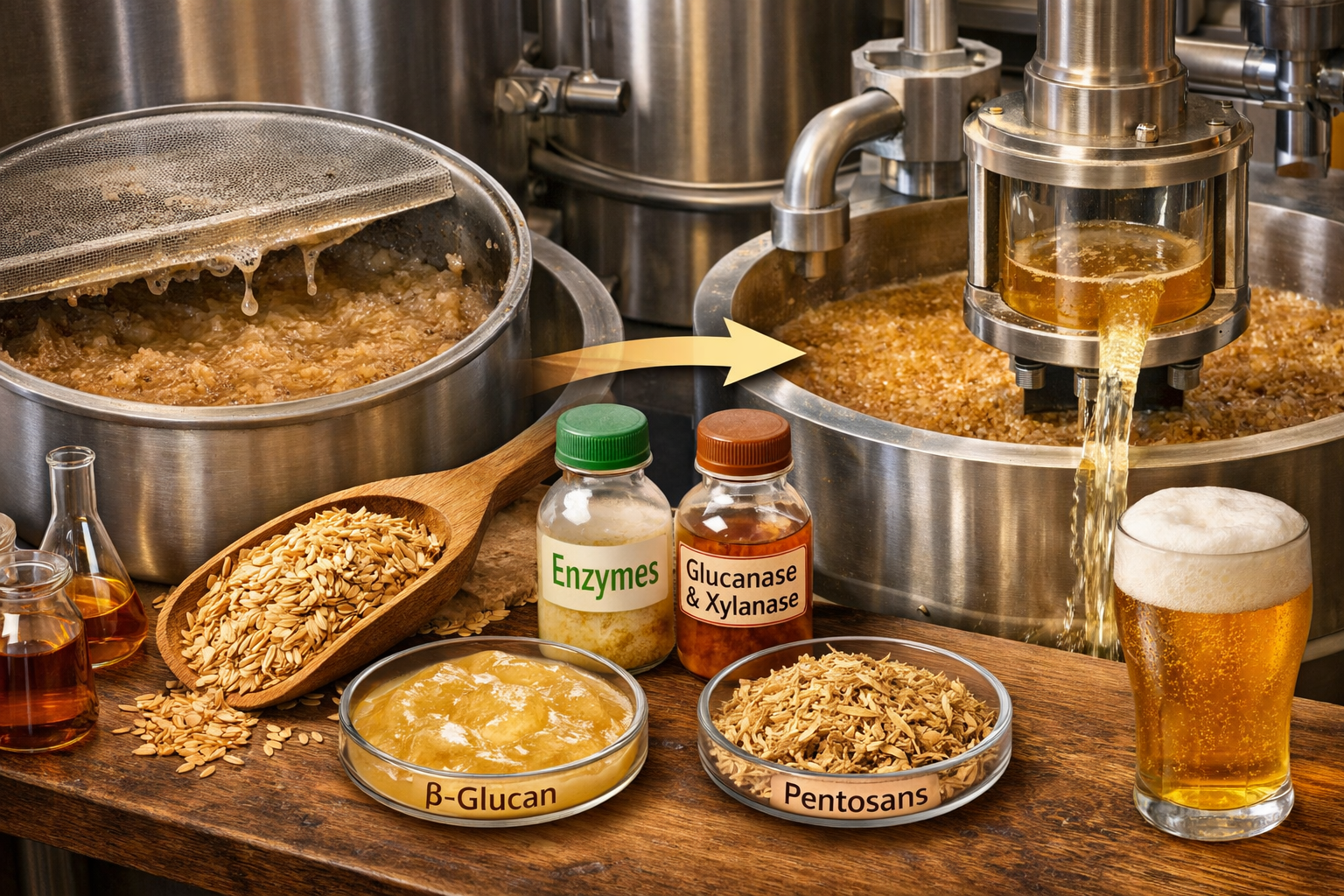
Brewers deploy exogenous enzymes to hydrolyze these gums during mashing. The workhorses are β‑glucanases (endo‑1,3/1,4‑glucanases) and xylanases (arabinoxylanases). A mixed β‑glucanase/xylanase product (Humicola‑derived) approved by U.S. regulators carries a recommended label dose of roughly 1.2–2.5 kg per tonne of grain (~0.12–0.25%), and at these levels it “efficiently breakdown[s] β‑glucans, pentosans, and other gums” (ttb.gov; ttb.gov).
Trials back up the payoff. In one study using 20 BGU/g (an activity unit; high dose) of a Bacillus β‑glucanase, wort viscosity fell from 1.80→1.74 mPa·s and extract rose from 79.3% to 80.5% (about +1.2 points) (scielo.br). A commercial β‑glucanase at 25–50 mg/kg malt reduced wort β‑glucans to ≤178 mg/L—comparable to a fully malted reference—with no adverse effect on beer quality (scielo.br).
Multi‑enzyme “filtration blends” such as Novozymes Laminex®, Kerry Ceremix®, and Gusmer Super 3G® combine β‑glucanase with xylanase and others; increasing dose lowers high‑MW arabinoxylan and β‑glucan in wort and correspondingly decreases beer viscosity (jib.cibd.org.uk). In a controlled Institute of Brewing 2023 study, higher dosages reduced high‑MW pentosans and beer viscosity, though overdosing can raise beer’s ferulic flavor (jib.cibd.org.uk). In adjunct contexts, a sorghum–barley mash treated with bacterial β‑glucanase+amylase (Ceremix) or fungal xylanase (Cereflo) significantly reduced wort viscosity and increased extract versus control (file.scirp.org; file.scirp.org).
Best practice also includes a ~40°C β‑glucan rest to activate both malt and added glucanases; β‑glucanase activity is maximal ~35–40°C and deactivates above ∼50°C (MoreBeer).
Rice hulls as a physical filter aid
Rice hulls—an inert, non‑fermentable husk—are used to “open” the mash bed by creating channels and porosity so wort can flow freely; they are flavorless and unfermentable, contributing no sugars or color (Beer Kit Brewer; Beer Kit Brewer). They absorb only ~5–16% of their weight in water (grains absorb >100%), so mash thickness remains essentially unaffected (Beer Kit Brewer).
Guidance is straightforward: add hulls with the grist before mashing. Typical usage is 1–10% of total grist weight (about 0.23–0.9 kg per 19 L homebrew batch), and adjunct‑heavy worts (wheat/oats/rye >50%) commonly run 5–10% or more (Beer Kit Brewer). In one wheat‑beer experiment even 5% hull (by adjunct weight) was “often recommended” (Springer).
The throughput gains are tangible. In a 50–50 wheat malt/wheat beer grist, adding 100 g rice hull (≈10% of that mash’s dry weight) cut runoff time dramatically: the fastest sachet (coffee‑husk) ran ~10 min per L, rice‑hull samples were next‑fastest, and the hull‑free reference took ~40 min per L—a 3–4× speedup in practical terms (Springer). Rice hulls therefore prevent stuck mashes and maintain high extraction without altering beer properties; oat hulls behave similarly (Beer Kit Brewer; Springer).
Cost–benefit and regulatory context
Enzyme costs are small because dosages are small. Using 2 kg enzyme per 1000 kg grist (≈0.2%) at $10/kg is $20 per 1000 kg grain; in a 10,000 L brew that is $0.002 per liter. Typical label dosing of 1.2–2.5 kg/tonne (ttb.gov) often returns >1% higher extract (about +1.2 points in the study cited) and faster throughput (scielo.br). Preventing even one stuck mash—which can force low‑efficiency recirculation or risk a batch—can justify the enzyme cost.
Regulatory reviews endorse this application: a mixed β‑glucanase/xylanase was approved as GRAS in the U.S., with label dosage up to ~1.2–2.5 kg/tonne and no impact on beer flavor when used as directed (ttb.gov; ttb.gov). Enzyme dosing in practice falls in the ¢0.1–0.5/L range, while rice hull additions are essentially free or very cheap—on the order of tens of cents per kilogram—and at 5% addition add negligible cost per batch; hulls displace virtually no extract (Beer Kit Brewer). In sum, adding rice hulls (¢0.001–0.01/L at typical usage) eliminates stuck‑sparge risk, and enzyme dosing (¢0.1–0.5/L) boosts yield and process reliability; empirical data show these additives shorten lautering time (from ~40 to ~10–15 min/L) and raise yield (extract +1–2%) (Springer; scielo.br).
Sources span peer‑reviewed brewing studies and industry references: scielo.br; scielo.br; scielo.br; jib.cibd.org.uk; Springer; Beer Kit Brewer; ttb.gov (with additional technical guidance from brewing enzyme suppliers).