

Industry: Fertilizer_(Ammonia_&_Urea) | Process: Boiler_Feedwater_&_Steam_Generation
Steam’s most overlooked asset is the liquid it leaves behind. When steam condenses, the resulting condensate (distilled water formed when steam cools) retains sensible heat (temperature energy) that plants can reclaim for the boiler feedtank. Industry guides underscore the point: “intensive” condensate recovery is one of the highest‑ROI measures in steam systems (www.spiraxsarco.com) (www.plantservices.com).
The physics is money‑simple: typical saturated steam leaves roughly 16–20% of its total energy in the condensate (invenoeng.com) (www.forbesmarshall.com). Return that hot, clean water and both heat and water are reclaimed.
Forbes Marshall quantifies the upside: returning condensate from indirect steam processes can cut fuel costs by up to ~20% and eliminate demineralizer and makeup‑water costs; every ~6 °C increase in feedwater temperature from hot condensate yields roughly 1% fuel savings (www.forbesmarshall.com) (www.forbesmarshall.com). One benchmark example: 1 t/hr of returned condensate at 3 bar saves on the order of 136,000 kg of coal per year (and ~247,000 kg CO₂) compared to treating fresh makeup water—about 600 tankers each year (www.forbesmarshall.com).
Condensate return: heat and water
Because condensate is essentially distilled water, each kilogram returned to the feedtank displaces one kilogram of fresh makeup—and the chemical and thermal work that go with it (www.spiraxsarco.com) (www.plantservices.com). Studies note that blowdown makeup rates span 1–20% of feedwater depending on water quality, making each kilogram of returned condensate a direct makeup reduction (www.researchgate.net) (www.researchgate.net).
In practice, benchmarks target very high return rates (≈90%) where direct steam injection is limited (invenoeng.com). One best‑practice guide notes recovering up to ~90% of condensate is feasible in facilities without significant direct injection (invenoeng.com).
Water makeup and case evidence
At Indonesian fertilizer plant PT Pusri, large condensate streams were historically routed to drain. Modeling showed redirecting that condensate to the boiler could sharply cut both makeup water and fuel use, delivering a simple payback of just 0.9 years (jurnal.ugm.ac.id). U.S. plant case studies echo the finding: condensate recovery and steam‑trap fixes delivered up to $335,000/year and 75,000 MMBtu/year savings at one fertilizer site, with ~6.5 months payback (manuals.plus).
Chemicals, emissions, and insulation
Condensate also carries boiler chemicals—returning it means less fresh chemical addition and reduced blowdown volumes, which cuts sewer effluent (invenoeng.com) (www.forbesmarshall.com). A fully insulated condensate return network can pay for itself in energy savings (www.plantservices.com). In Indonesia, boiler design guidelines explicitly assume condensate return—post‑process condensate is “returned to the boiler for reheating” as standard practice (www.researchgate.net).
This also intersects with temperature‑limited effluent. In settings where discharge is often capped at ~40–45 °C, returning and reusing condensate helps avoid high‑temperature wastewater and supports environmental criteria. That aligns with the broader efficiency gains from reducing makeup and chemical use, such as lower consumption of boiler chemicals (invenoeng.com) (www.forbesmarshall.com).
Quantified outcomes and paybacks
In a large‑plant example (44,000 lb/hr steam, $15.30/MBtu fuel, 90% condensate return), recovering condensate raised feedwater temperature by ~157 BTU/lb (British thermal units per pound), saving about 6.23×10^6 BTU/hr—roughly $835,000/year in fuel cost (invenoeng.com)). Case studies regularly report ~1‑year or shorter paybacks (manuals.plus) (jurnal.ugm.ac.id). By comparison, ignoring condensate often shows up as venting: one fertilizer plant cut steam venting and trap losses to save 75,000 MMBtu/yr (MMBtu = million British thermal units) at ~6.5 months payback (manuals.plus). In short, maximizing condensate return can slash fuel bills (~10–20%), cut makeup water by tens of percents, and yield multi-≠ million‑USD savings annually in large plants.
Blowdown losses and recovery potential
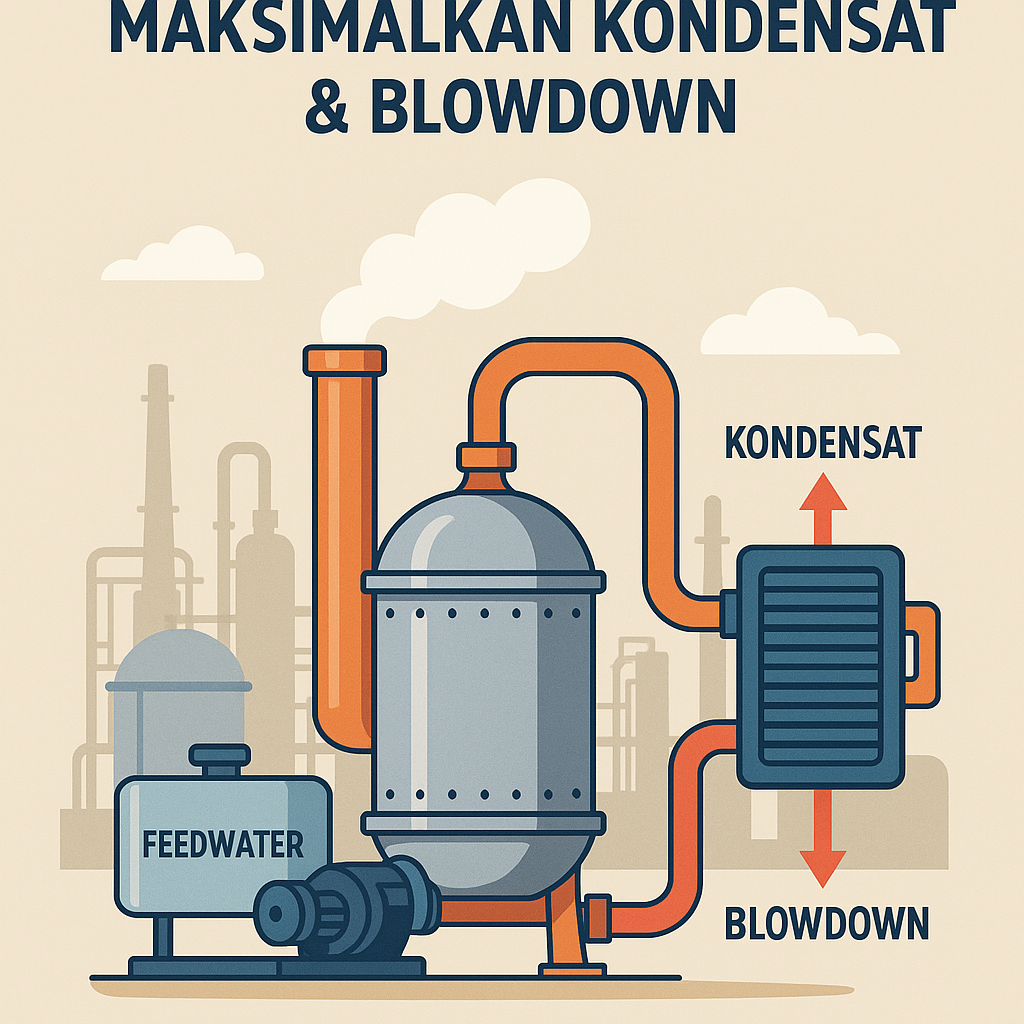
Continuous boiler blowdown (periodic discharge to control dissolved solids) exports hot pressurized water—often at drum saturation temperature of 180–200 °C—along with valuable heat. Rules of thumb: blowdown typically equals ~1–3% of fuel input or 1–20% of feedwater volume, depending on water quality (www.researchgate.net) (www.researchgate.net). For a 420 t/hr (tonnes per hour) superheated boiler, 8.2 t/hr blowdown (2% of feed) corresponds to ~3,511 kW of heat lost if dumped. Heat‑recovery systems can recapture nearly all of it.
Two approaches dominate: flash and heat‑exchanger preheat. A flash vessel (a pressure‑reduction vessel that produces “flash steam” from hot liquid) lets blowdown drop from 10–40 bar to a lower pressure; ~10–20% flashes to steam, the rest exits at ~100–120 °C. The flash steam—pure boiler‑quality—can be fed to the deaerator (a preheater that strips dissolved gases) or feedtank, reclaiming latent heat. The remaining liquid can then pass a heat exchanger to preheat incoming makeup. Spirax Sarco notes a flash vessel alone recovers ~40% of blowdown energy, and a downstream exchanger can drop residual blowdown to ~20 °C while heating makeup water. In effect, 97%+ of blowdown enthalpy can be reused in a combined flash+exchanger system (www.spiraxsarco.com).
Economics and CO₂ impact
Numbers from an ammonia boiler are striking. On a 420 t/hr unit with 8.2 t/h continuous blowdown at 146 bar, a flash separator (€17k) plus a 431 m² heat recuperator (€91k) recover ~3,511 kW. That ~€107.9k investment yields €1.797 million annual savings and repays in ~2 months; the recovered energy equals ~97% of blowdown heat and ~43% of blowdown water, with an estimated ~5,115 t/year CO₂ reduction (www.researchgate.net) (www.researchgate.net) (www.researchgate.net).
Smaller boilers also see meaningful gains. A 6‑t/hr example at 10.5 bar, 2% blowdown (120 kg/hr): flashing 2.9 t/day blowdown at 1.5 bar produces ~338 kg/day of steam, enough to save 7.7 tons of fuel per year (www.forbesmarshall.com). Industry sources cite boiler efficiency improving by several percentage points via blowdown heat recovery; one retrofit reported ~54,000 MMBtu/yr savings (manuals.plus).
Operations, layout, and discharge limits
Recovered blowdown water supplements feedwater, further cutting makeup volume and dovetailing with condensate return; in plants with deaerators at 80–100 °C, capturing 100–120 °C blowdown can lift feed temperature by tens of °C. Practically, any continuous blowdown above trivial rates (e.g., >1% steam) is worth capturing (manuals.plus). Systems typically place the makeup preheater upstream of the boiler feedpump and may involve insulated piping.
Discharge temperature limits often drive design: many countries restrict effluent below ~40–45 °C. Proper heat recovery cools blowdown well below these thresholds while preheating makeup; UK rules cap discharge at 42 °C (www.spiraxsarco.com).
Bottom line for ammonia and urea
Maximizing condensate return and recovering blowdown heat are proven, high‑impact measures in ammonia/urea boilers. Evidence spans peer‑reviewed work and plant case studies: PT Pusri’s analysis projects a <0.9‑year payback from condensate reuse (jurnal.ugm.ac.id); blowdown retrofits reclaim nearly all blowdown energy—~97%—with payback in months in a 420 t/hr case (www.researchgate.net). Across sources, the combined strategies regularly deliver ≳10–20% fuel savings, reduce fresh water needs, lower sewer discharge, and yield ROI ≪2 years (jurnal.ugm.ac.id) (www.researchgate.net).
Sources: A 2013 UGM study of an Indonesian ammonia plant (jurnal.ugm.ac.id); Forbes Marshall and Spirax Sarco technical guides (www.forbesmarshall.com) (www.forbesmarshall.com) (www.forbesmarshall.com) (www.spiraxsarco.com) (www.spiraxsarco.com); an EPA/ENERGY STAR fertilizer‑energy guide (manuals.plus) (manuals.plus); process‑engineering analyses on blowdown heat recovery and Indonesian boiler design practice (www.researchgate.net) (www.researchgate.net) and plant‑system best practices (invenoeng.com) (invenoeng.com)).