
Grow‑out ponds trap most of the feed as waste, choking water quality and yields. New engineering can strip out nearly all sludge fast, while bioremediation keeps ponds “self‑cleaning” during production — and often pays for itself.
Intensive pond aquaculture has a math problem: roughly only ~30% of feed nutrients end up in shrimp or fish; the remaining ~70% settles as sludge made of organic matter (OM), nitrogen (N) and phosphorus (P) (mdpi.com). Field surveys put that loading at up to 84 kg N/ha·yr, 21 kg P/ha·yr and 2,400 kg OM/ha·yr (mdpi.com).
Left alone, this sludge drags down dissolved oxygen (DO), raises biochemical and chemical oxygen demand (BOD/COD) and total suspended solids (TSS), and cuts yields (mdpi.com). In Indonesia, rules such as Permen‑KP 75/2016 require reuse or treatment of pond discharge (maintenance exchange ≈20% daily; harvest drainage ≈16.7% of pond volume), making in‑pond sludge control a compliance and productivity issue (jala.tech) (jala.tech).
Physical removal methods and performance
The traditional playbook is drain and dry, then physically remove or dredge the dried sludge. In‑situ suction (vacuum pumps or siphons) or scrapers can work with water in place. These options trade immediacy for interruption: draining and drying halts production and adds labor/equipment and disposal steps, while siphons/vacuums tend to remove only surface sludge.
Engineering upgrades are changing that calculus. A rotating nozzle “sludge‑removing” platform in shrimp ponds removed 82–99.7% of sludge in 8 minutes (3.2 ton water), leaving <0.33 cm behind; a conventional center‑drain with the same water pulled only ~5% (leaving ~21.1 cm) (agris.fao.org) (agris.fao.org). One estimate suggests advanced equipment can save ~90% of labor cost in one season versus manual removal (agris.fao.org).
Installing copper sludge‑collector outlets in super‑intensive ponds yielded significantly better water quality — lower total ammonia nitrogen (TAN), nitrate and TSS — than standard central drains, and shrimp growth ticked up: harvest from the “sludge‑collector” pond averaged 3.833 kg shrimp vs 3.731 kg in the control (≈8.25% larger average size), with higher survival‑adjusted yields (researchgate.net) (researchgate.net) (researchgate.net).
Net: physics‑based removal delivers immediate, near‑complete elimination and cleaner post‑cleaning water (see very low TAN/TSS in [14]) but requires capital, maintenance, downtime and sludge disposal logistics.
Bioremediation with probiotics and enzymes
A complementary path keeps ponds “self‑cleaning.” Farms dose specialty biological products — probiotic microbes (e.g., Bacillus spp., Pediococcus) and enzyme cocktails (proteases, cellulases) — to digest sludge in situ. The mechanism is bioremediation: beneficial microbes drive heterotrophic decomposition (organic‑carbon‑driven breakdown of wastes) and nitrification (microbial oxidation of ammonia to nitrite/nitrate).
In practice, farmers dose ponds or feed with such probiotics, often alongside molasses or another carbon source; these can align with categories such as starter bacteria cultures and nutrients and targeted biological boosters. Dosing can be integrated with standard chemical‑metering equipment like a dosing pump when managers opt for automated applications.
Evidence is mounting. In 5‑hectare vannamei ponds, a Bacillus‑based probiotic (Sanolife PRO‑W®) and a multi‑species blend (Biomin Aquastar®) delivered significant NH₃ degradation (especially when organic matter was present) versus controls (pmc.ncbi.nlm.nih.gov). Over 8 weeks, both treatments showed dramatically lower un‑ionized ammonia and total Vibrio counts, and higher DO and pH, than untreated ponds (pmc.ncbi.nlm.nih.gov).
The biological toolkit mirrors wastewater practice conceptually — think biological digestion systems designed to accelerate aerobic or anaerobic breakdown — but here it’s deployed directly in the pond to continuously transform wastes into CO₂ and microbial biomass.
Yield gains and water quality effects
Production impacts are measurable. A synbiotic (probiotic + prebiotic) formulation in a commercial shrimp pond delivered an extra 625 kg of shrimp biomass at harvest versus a standard probiotic; at even ~$5/kg shrimp, that is worth ~$3,000 (link.springer.com). The study attributed the gain to stronger reduction of ammonia‑N, phosphates and Vibrio/Aeromonas, plus better pH stability (link.springer.com).
In field practice, Makmur et al. paired probiotics and molasses with their sludge collector; they observed that better microbial management kept TAN/nitrate lower during culture (researchgate.net). Reviews add that probiotics often “improve growth rates and reproduction” in aquaculture, leading to higher yields and thus significantly higher profitability, while boosting immune resilience and cutting disease losses and treatment costs (pmc.ncbi.nlm.nih.gov) (pmc.ncbi.nlm.nih.gov).
Key takeaway: biological additives cannot instantly vacuum out sludge, but routine dosing can lower ammonia/N levels and pathogen loads across the crop, with one trial reporting a roughly 8% gain in harvest size/yield with a better outlet plus bio‑additives and others noting markedly higher yields with optimized microbial mixes (pmc.ncbi.nlm.nih.gov) (researchgate.net) (link.springer.com).
Effectiveness tradeoffs and hybrid practice
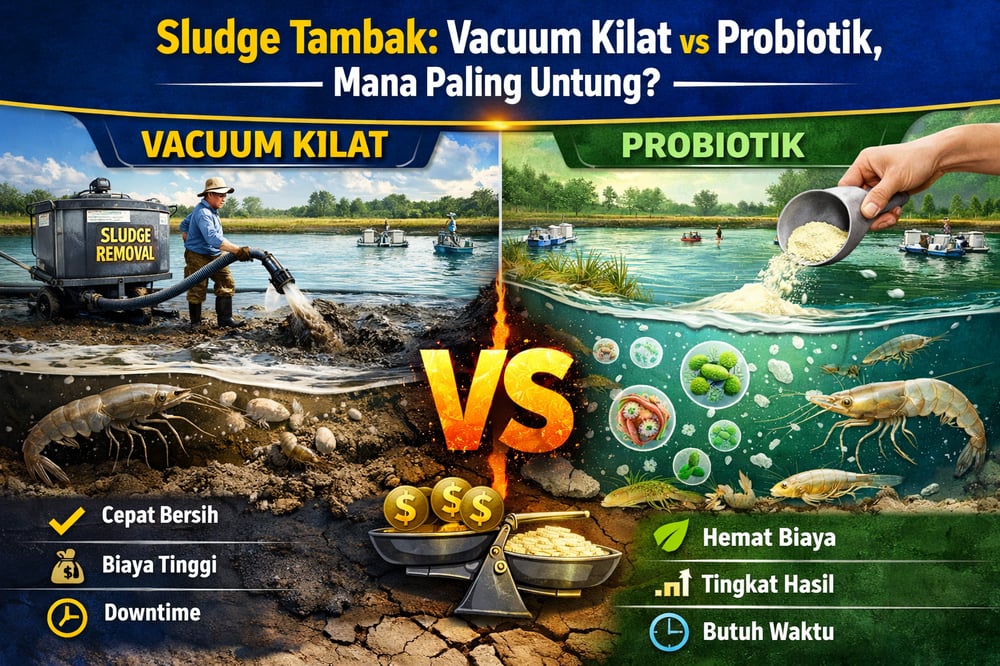
Removal efficiency diverges. Physical methods can remove >90% of settled solids in one operation — the jet‑equipped system reached up to 99.7% — whereas probiotic dosing reduces organic buildup over weeks (agris.fao.org). Biologicals show their power in chemistry and stress reduction: significant drops in NH₃, nitrite and Vibrio, with corresponding rises in pH/DO, after probiotic treatment (pmc.ncbi.nlm.nih.gov).
On production, the sludge‑collector ponds showed slightly higher survival‑adjusted yield (~3.833 kg vs 3.731 kg) (researchgate.net). Biological treatment has logged multi‑hundred‑kg harvest margins in controlled settings (link.springer.com), and even smaller percentage bumps in survival or daily growth multiply over time and acreage.
Water quality converges from different angles. Physical removal leaves near‑pristine water post‑cleaning (see very low TAN/TSS in [14]). Probiotics yield improved averages (lower TSS, TAN, nitrite, nitrate) across the crop, though they often require robust aeration and some waste substrate (e.g., molasses) to work effectively (researchgate.net). In practice, a hybrid approach is common: dose probiotics during culture to keep sludge and nitrogen in check, drain/dredge less frequently (e.g., at end‑of‑crop or when sludge is visible).
Cost–benefit analysis of proactive dosing
Costs for bioremediation products vary by formulation and application rate but often run in the low tens to hundreds of USD per hectare per application cycle; add any carbon source (e.g., molasses) and slight labor for dosing. These are incremental outlays while ponds remain productive.
Physical removal costs stack differently. Manual draining, drying and dredging a 1 ha pond can run a few hundred to over a thousand USD per pond when electricity/pumping and sludge disposal are counted; cleaning days also stop production. Automation can shrink labor and pay back quickly (agris.fao.org), but acquisition is capital‑intensive.
Benefits from bioremediation often dominate. The 625 kg extra shrimp reported above equates to thousands of USD at market prices, and reviews point to 5–10% improvements in survival or feed conversion delivering similar advantages on multi‑ton crops, alongside fewer disease losses and lower treatment spend (link.springer.com) (pmc.ncbi.nlm.nih.gov). Cleaner ponds also make meeting effluent standards easier, potentially avoiding fines (jala.tech).
One illustrative case found the revenue from higher harvest far exceeded the cost of the probiotic regimen (link.springer.com). A rule‑of‑thumb summary from field data: treating a 1 ha shrimp pond with compliant probiotics could cost on the order of $100–200, yet yield an extra 300–600 kg shrimp. At $5–10/kg, that’s $1,500–$6,000 more revenue — a 10–50× return on investment (link.springer.com) (pmc.ncbi.nlm.nih.gov). Leaving sludge unmanaged, by contrast, erodes productivity and eventually forces urgent, disruptive dredging.
Program design and compliance context
The evidence points to an integrated program: use bioremediation chemicals (probiotics/enzymes) continuously or periodically during the crop to suppress sludge formation, and supplement with targeted physical cleaning when thresholds are reached. For Indonesian pond managers, a modest budget allocation for quality probiotic products can reduce the frequency or intensity of costly dredging and help meet the country’s effluent standards (link.springer.com) (pmc.ncbi.nlm.nih.gov) (jala.tech).
For managers standardizing supplies, options often include nutrient supplements designed to optimize bacterial growth, as seen in categories like bacterial nutrients that are paired with probiotics to steady performance across cycles. Each operation should tailor dosing schedules and manufacturers to local conditions, but rigorous field studies report tangible gains from the approach.
Sources: peer‑reviewed studies, reviews and industry reports cited above on pond sludge, probiotics and bioremediation — including agris.fao.org, link.springer.com, pmc.ncbi.nlm.nih.gov, pmc.ncbi.nlm.nih.gov, mdpi.com and jala.tech. All figures and conclusions are drawn from those sources.
