

Industry: Desalination | Process: Pre
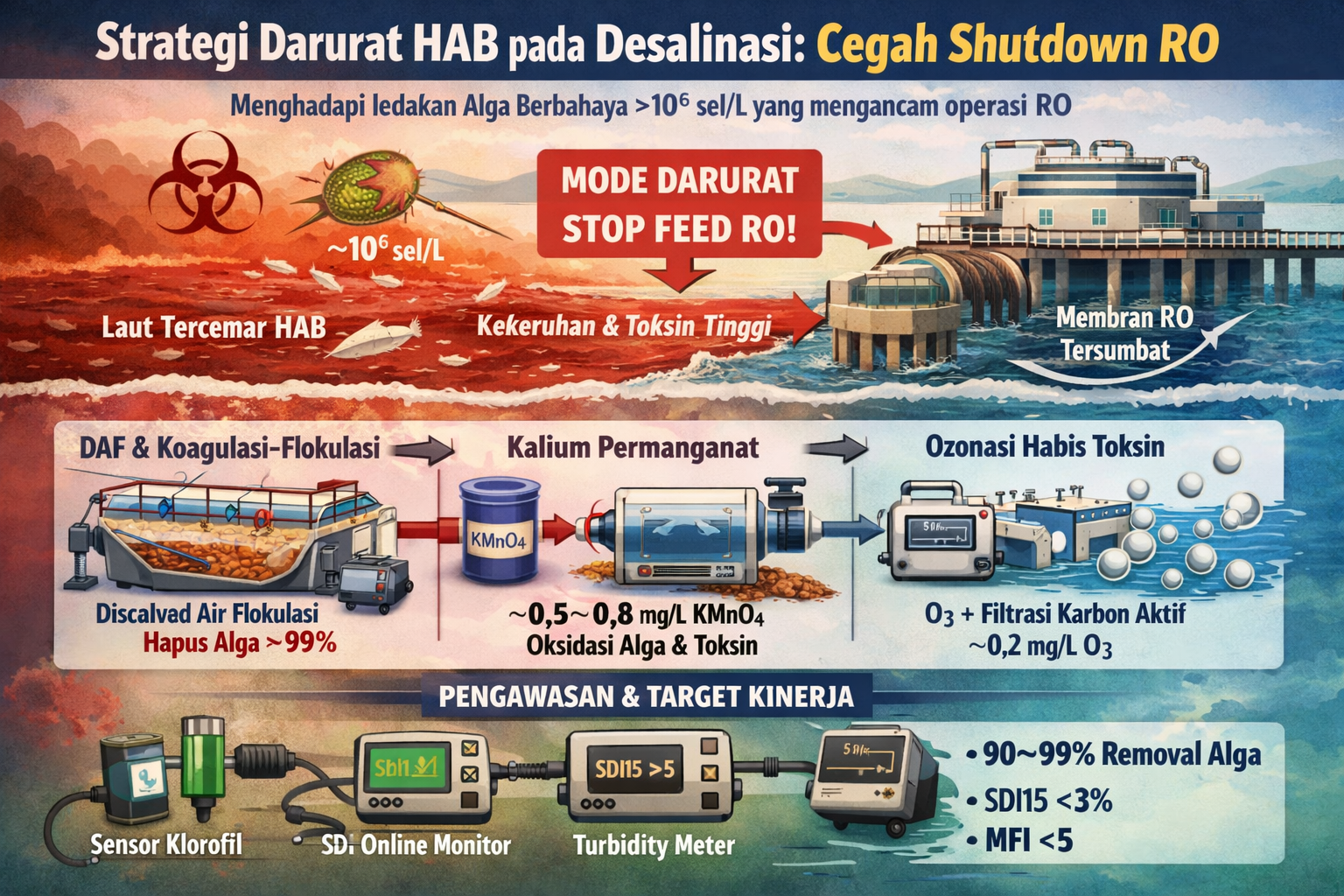
When a bloom hits, the numbers escalate faster than intakes can cope: cell counts often surge above 10^6 cells/L, overwhelming screens and filters and accelerating membrane fouling (Pumps & Systems). During the massive 2008–09 Cochlodinium bloom in the Gulf of Oman, many SWRO (seawater reverse osmosis) plants shut for months; one reported 100% RO membrane replacement after the event (WaterWorld).
Analysts note HAB (harmful algal bloom) incidents are intensifying regionally—even if not rising uniformly worldwide (WaterWorld; WHOI). For operators of SWRO systems, continuous intake monitoring—chlorophyll sensors and online SDI (silt density index) measurements—becomes a first alarm, with sharp rises in turbidity or SDI15 (the 15‑minute SDI rate; %/min) above design thresholds, e.g., SDI15 >3–4, signaling escalation (ResearchGate; ResearchGate). Remote-sensing or early-alert systems (e.g., NOAA HAB forecasts) can also trigger responses.
DAF pretreatment performance
Dissolved air flotation (DAF) attaches microbubbles to coagulated algal flocs so they float for skimming; coagulants such as ferric chloride and flocculants are standard in this step. In the Gulf, large SWRO plants routinely run DAF ahead of media filters when HAB risk rises (WaterWorld). A practical contingency is a stand‑by train—such as a modular DAF unit—that can be online within hours.
Typical designs remove >99% of algal cells during blooms (ResearchGate). At Bahrain’s Al‑Dur plant, a pilot achieved >99% algal removal with DAF plus coagulation (ResearchGate). Kuwait’s Shuwaikh SWRO—using DAF followed by UF (ultrafiltration; a pressure‑driven membrane screen)—held SDI15 below 2.5–3.5 during bloom conditions, versus unacceptable levels without DAF (ResearchGate). Many plants pair DAF with UF pretreatment for stable RO feed quality.
Performance data quantify the gains: adding a DAF stage increased removal of biological fouling potential—BGP (bacterial growth potential)—by ~40% and biopolymers by ~16% over dual‑media filtration (DMF) alone (MDPI). Another study found 65–85% of particulate load was removed in the first filtration stage downstream of DAF (MDPI). Without DAF, dual‑media filtration often fails in blooms—Arabian Gulf plants experienced 100% membrane failure in 2008–09 (WaterWorld).
Effective DAF hinges on coagulant optimization: typical ferric doses run ~0.5–5 mg Fe^3+/L. One dataset showed only ~17% BGP removal with 0.5 mg/L Fe(III) in DAF, versus ~53% BGP removal with higher coagulation plus filtration at 3.6 mg/L Fe (MDPI; MDPI). DAF effluent is typically polished by deep media filters or UF with frequent backwashing to remove residual cells (MDPI; ResearchGate). Sludge rises significantly during blooms; handling requires adequate dewatering and disposal.
Coagulation and flocculation adjustments
Elevated coagulant dosing improves algae removal but generates more sludge. Conventional coagulation at 7.5 mg Fe(III)/L reached ~85% turbidity removal during a bloom, whereas DAF with ferrate (Fe(VI); a strong oxidizing iron coagulant) achieved >99% ATP (adenosine triphosphate; a biomass proxy) removal (ResearchGate). Jar tests early in a bloom help calibrate coagulant needs to hit target SDI15 (~2–3%/min after pretreatment), with doses up to several mg/L Fe as required. In‑situ ferrate has shown almost complete cell removal and 99.99% inactivation at optimized pH, with 88% less sludge than FeCl3 (ResearchGate). Where coagulant aids are considered, polyaluminum chloride (PACl) is sometimes used; in saline water, aluminates can solubilize poorly, so this option is lower priority. Polymer aids such as flocculants (e.g., polyacrylamides) and slower, longer flocculation (reduced mixing intensity, more detention) form denser flocs that DAF or settling removes more reliably.
For dosing reliability during rapid escalations, plants often rely on rugged metering hardware; a calibrated dosing pump helps maintain stable Fe(III) or ferrate feed under changing turbidity.
Media filtration controls
Even with DAF, residual cells persist. Granular media filters—such as sand/silica filters—are typically run with shortened cycles. Evidence shows two‑stage DMF with inline coagulation removes >80% of particulate indices (SDI15) and 94% of MFI (modified fouling index) without DAF, although organic fouling controls—AOC (assimilable organic carbon) and BGP—remain modest at 24–41% under low‑chlorine conditions (MDPI; MDPI).
During a blowout, reduced filter run times (e.g., to <4 hours or until alarms) and an added polishing step—such as an anthracite media bed or UF—are standard options. SDI targets serve as the control point: SDI15 should remain <3%/min post‑pretreatment. If SDI spikes, RO feed pauses until treated water meets specification.
Potassium permanganate pre‑oxidation
Potassium permanganate (KMnO4) is a rapid upstream measure: it oxidizes algal cell walls and yields MnO2 particles that “coat” cells, increasing density for settling or filtration; some toxins are also inactivated (ResearchGate). In Spain (Marbella), dosing ~0.45–0.8 mg/L KMnO4 “greatly improved” performance by eliminating algae and organics, with a slight production cost rise (~US$3–5 per 1,000 m³) (ResearchGate; ResearchGate).
Contingency protocols often start at ~0.5 mg/L KMnO4 for dense blooms, with adjustments by residual color and turbidity. High doses can impart a pink hue or create MnO2 sludge, so application is short‑term with downstream MnO2 removal via DAF or settling. Storage and metering readiness, including ORP (oxidation–reduction potential) or residual permanganate checks, are essential; stable feed is aided by a well‑sized chemical dosing pump. Limitations include incomplete toxin breakdown and possible release of dissolved organics from lysed cells; final permeate is evaluated for Mn (health standards exist, ~0.1 mg/L). In brackish media, KMnO4 generally avoids bromate formation seen with some oxidants.
Ozonation of feedwater
Ozone (O3) dosing can lyse cells and degrade cyanotoxins such as microcystins and cylindrospermopsins. Reviews indicate an O3 residual of ~0.2 mg/L with a few minutes’ contact can fully degrade many common cyanotoxins, though alkaloid toxins like saxitoxin may need higher doses (ResearchGate). Where ozone generators and contactors already exist, dosing can be a quick‑response step; reports often show >90% removal of microcystins (ResearchGate).
Implementation in seawater must manage bromate. Bromide in seawater can be oxidized to bromate, a regulated carcinogen, so designs pair contactors with fast degassing or an activated carbon filter to minimize formation. Pre‑qualified protocols commonly consider 0.5–1.0 mg/L ozone with 5–10 minutes contact for worst‑case toxin loads, with verification that ozone off‑gas remains <0.1 mg/L in effluent to meet discharge standards. Ozone is more expensive than KMnO4 and requires safety controls, but it destroys toxins rather than simply aggregating cells.
Other chemical and process options
Hydrogen peroxide (H2O2) is used in lakes and ballast water and can selectively kill algae by generating reactive oxygen, yet cell lysis can spike toxin bioavailability; some studies show transient increases in epithelial cell toxicity after H2O2 treatment (PMC). If explored, ~5–20 mg/L doses—as in ballast treatments—are piloted first. It is not widely used in seawater pretreatment and may require high doses, making it a last‑resort option at intake basins or ponds.
Emergency chlorination (e.g., 1–2 mg/L free Cl2) lyses and inactivates cells; many plants periodically chlorinate for biofouling control. For HAB response, higher intake doses are followed by bisulfite quenching before RO membranes (MDPI). Drawbacks include rapid toxin release and formation of brominated disinfection byproducts; use occurs only where no other oxidant is available and after confirming dechlorination, often assisted by a dedicated dechlorination agent.
Some operators consider coagulant alternatives or aids, such as quicklime (CaO) or PACl; however, in saline waters aluminates tend to solubilize poorly, and few data exist on CaO for algae. Where PACl is part of the toolbox, supply typically comes as powder or liquid formulations (PAC/ACH coagulants).
Operational triggers and responses
A clear decision matrix aligns plant actions with measurable triggers. Low‑level alert: rising chlorophyll or SDI15 (e.g., >3%/min) indicates pre‑alert. Standard responses include increased backwash frequency and a ~20% raise in coagulant dosing, with closer monitoring.
Moderate bloom (cell counts >10^5/mL): escalation. KMnO4 dosing starts at ~0.5 mg/L, and DAF systems are brought online. Coagulant moves to ~1–2 mg/L Fe^3+. If installed, ozone dosing begins. Cartridge backwashing, where present, is increased; many plants use a high‑surface area cartridge filter as the final barrier. Sampling for algal toxins increases (e.g., microcystin via ELISA assays where relevant).
Severe bloom (visible discoloration, cell counts >10^6/mL): emergency mode. The pretreatment train—coagulation, DAF, and filtration—runs at maximum. RO feed is paused if targets cannot be met (SDI ≥5 or turbidity >5 NTU after pretreatment). If feasible, an alternative source (e.g., deep intake or groundwater) is selected. Intensive cleanings of membranes and filters are scheduled, and regulators are notified.
Quality oversight tightens throughout: product water is checked for residual toxins or high UV254; outcomes are tracked—e.g., “SDI15 reduced from 10% to <3% after KMnO4+DAF”—and all dosage levels, flow impacts, and chemical use are documented for review.
Summary metrics and governance
Contingency targets anchor operations: >90–99% algal removal from incoming water (ResearchGate), SDI15 <3%/min, and MFI0.45 (modified fouling index at 0.45 µm; s/L²) <5 s/L². Online turbidity and ATP sensors help track efficacy. Cost impacts of emergency steps are comparatively minor: KMnO4 at 0.5 mg/L adds only a few cents per m³ (ResearchGate), far less than the cost of outage.
Compliance checks ensure added chemicals and by‑products—Mn, bromate, chlorite, and others—remain below applicable limits (e.g., Indonesian drinking water standards). Combined strategies—DAF, optimized coagulation, and on‑demand oxidants—have restored feed SDI to acceptable levels even during red tides (ResearchGate; MDPI), avoiding catastrophic downtime.
Sources and verification
Peer‑reviewed studies and industry reports underpin these figures. Abushaban et al. (2021) detail pretreatment during blooms (MDPI), Chen et al. (2005) explain KMnO4 mechanisms (ResearchGate), and case histories are compiled in sector guides (WaterWorld; ResearchGate). Monitoring triggers and early warnings are discussed in operations literature (Pumps & Systems; WHOI), and ozone efficacy is summarized in HAB toxin reviews (ResearchGate).