

In solvent extraction–electrowinning (SX–EW), every 0.1% cut in organic-in-aqueous carryover can save tons of extractant a year. The playbook is precise settler design, physical polishing, and ppm-level phase-disengagement additives — all backed by field-tested hydrometallurgy notes.
Industry: Nickel_Mining | Process: Solvent_Extraction_&_Electrowinning_(SX
Effective mixer–settler design is the first line of defense against organic carryover in nickel solvent extraction (SX; selective transfer of metal ions between an organic solvent and an aqueous phase). The goal is simple but unforgiving: create enough residence time for droplets to coalesce and split cleanly, then use polishing hardware and chemistry to finish the job. Plants that do this consistently drive organic-in-aqueous (O‑in‑A) losses from ~1–2% into the sub‑0.5% range, with the knock-on benefits of lower solvent replacement, reduced electrolyzer bleed, and less environmental discharge in regulated jurisdictions (including Indonesia) (www.scielo.org.za); [link.springer.com].
Every 0.1% reduction matters when inventories run to the millions of liters. The tactics below reflect the hydrodynamics, internals, and additives proven in copper SX — a close analog to Ni–Co SX — and widely adopted in industry practice, with sources cited inline.
Settler sizing and residence time
Industry guidance for copper SX (analogous to Ni–Co SX) fixes on a specific settler flux of roughly 4–8 m³/m²·h — volumetric throughput per area — and an organic bed height of ~25–35 cm to slow the flow enough for droplet coalescence (scielo.org.za; scielo.org.za). In one example, with a 32 m‑wide settler and 1000 m³/h total flow, an organic depth of 20 cm yields a linear velocity ≈312 m/h and a rollback time ~3.85 min; at 35 cm depth (≤200 m/h), the time doubles to ~6 min (scielo.org.za).
Such low velocities (100–200 m/h) are critical: higher fluxes and shallower beds dramatically shorten retention time and spike entrainment (scielo.org.za; scielo.org.za). In practice, planners allow several minutes (often >5–10 min) for phase disengagement to minimize O‑in‑A losses.
Flow distribution and mixing shear
Settler internals matter. “Picket-fence” baffles placed just downstream of inlets and upstream of overflow weirs equalize flow and prevent short‑circuiting (911metallurgist.com). Even distribution avoids dead zones where droplets accumulate and emulsions persist.
Operating conditions are equally critical. High‑shear mixing produces very fine dispersions: experiments show organic‑side entrainment rises noticeably with impeller tip speed (911metallurgist.com). Mixer speeds and recirculation should balance mass transfer with coalescence; excessive speed or shear blades — which gave no benefit for organic carryover — should be avoided (911metallurgist.com).
Phase continuity strategy
Which phase is continuous through the mixer–settler (phase continuity) is fundamental. Tests show that when the organic phase is continuous, organic entrainment is drastically reduced (911metallurgist.com). Robinson (1977) reports that running the final extraction and first strip stages with organic continuity “markedly decrease[d]” organic carryover; such stages are often operated organic‑continuous by design (911metallurgist.com).
In contrast, aqueous‑continuous operation tends to trap organic droplets. Circuits are therefore arranged to leave key stages organic‑continuous — for example using O/A ratios (organic‑to‑aqueous flow ratio) or phase‑volume control — to minimize O‑in‑A losses (911metallurgist.com; link.springer.com).
Coalescers and polishing settlers
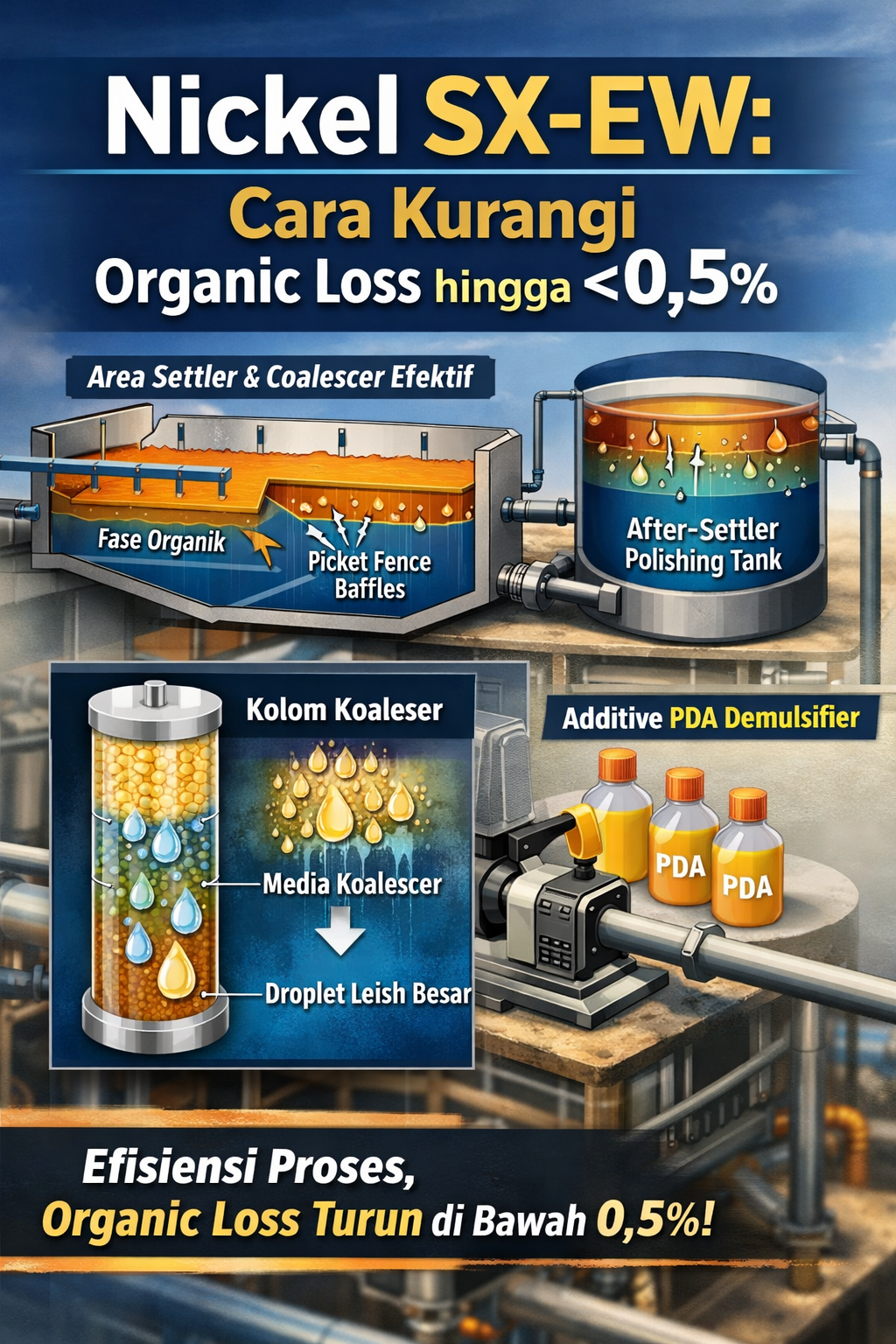
Beyond the primary settlers, coalescing devices and after‑settlers recover entrained organics. Vertical coalescer columns or packed‑bed “coalescing filters” on phase transfer lines use specialized media — hydrophobic polypropylene felts, ceramic plates or PVC meshes — to adsorb tiny droplets, let them grow, then release them under gravity (scielo.org.za; pubs.acs.org). A common approach in copper SX is to pump overflow organics into a small packed column or coalescing chamber; fine aqueous droplets adhere, coalesce into larger drops, and fall to a collection drain (scielo.org.za). Operating these in parallel with the main settler recovers >90% of the dispersed phase; the remaining droplet concentration is greatly reduced in the raffinate.
“After‑settler” tanks (polishing settlers) add residence time via simple gravity tanks downstream of the main overflow. As final raffinate trickles slowly (often over picket baffles or a sloping floor), micro‑droplets rise back into the organic phase. Though rarely quantified in open literature, plants report that a small polishing settler can cut organics in raffinate by a factor of 2–3; in copper plants, hydrocyclone skimmers or coalescing plates also see use. Sloped‑plate modules analogous to stainless plate settlers fit this polishing duty. All such devices share one principle: promote Ostwald ripening/coalescence so very fine mist is largely removed. (In analogous petroleum engineering, coalescing filters routinely achieve >10× improvement in droplet removal when properly designed, pubs.acs.org.)
Crud and solids management
Fines and surface‑active particulates stabilize emulsions; removing them upstream sharpens separation. Treating organic extractants with adsorbents (acid‑activated bentonite) has dramatically improved clarity: in one comparison, untreated organic accumulated ~65% more entrained aqueous — a robust indication of “crud” carryover — than clay‑treated organic (scielo.org.za). Slurry or solids removal (clarifiers, filters) before SX likewise cuts interfacial crud that leads to persistent emulsions.
Plants often insert a gravity stage ahead of SX; for example, a clarifier to drop suspended solids, followed by a fine barrier such as a cartridge filter. The objective is the same as with coalescers: less stabilized emulsion, faster phase break in the settlers.
Phase‑disengagement additives
Chemical additives form the third lever. Two classes are used: demulsifiers/phase‑disengagement agents (PDA) to break emulsions, and clarifiers/crud reducers for the organic phase. Non‑ionic surfactants — often polyoxyethylene or polysorbate‑type — are common PDAs, with typical dosages on the order of 100–600 mg/L in the aqueous phase (patents.google.com). A recent Kemira disclosure reports that adding ~100–300 ppm of a non‑ionic demulsifier cut the aqueous/organic settling time by ≥25% (down to ~70–75 s) (patents.google.com; patents.google.com). Laboratory tests found that common nonionic surfactants — polyethylene glycol sorbitan monolaurate, polyoxyethylene (20) sorbitan monooleate, and polyethylene glycol–polypropylene glycol block copolymers — “effectively reduced the phase disengagement time” (patents.google.com).
In practice, operators feed such additives upstream of the settler; the surfactant migrates to droplet interfaces, reducing interfacial tension or destabilizing emulsions for faster coalescence. A plant‑standard nonionic demulsifier is typically metered with an accurate dosing pump to hold consistent ppm levels. On the crud‑prevention side, adsorbent treatments (e.g., bentonite or silica) remove fatty acids and colloids from spent organic, enhancing coalescence (scielo.org.za).
Other agents — small alcohols like isobutanol, glycol ethers, or dilute fresh organic — have also been tried as washing/co‑solvent steps to strip surface‑active impurities (qualitative description as recorded). If the SX circuit uses an aqueous scrubbing or polishing stage to rinse organic, optimizing that step’s pH and residence time can effectively remove emulsifying salts into washwater, further reducing O‑in‑A. Simply maintaining a clean reagent (replacing “aged” organic periodically, skimming crud) emulates the effect of a constant additive.
Operating targets and payoffs
Combining robust settler design, auxiliary separation, and selective chemical aids routinely targets O‑in‑A entrainment below 0.5%. One RSM‑based study reported ~0.53% organic carryover at optimal conditions (O/A=1, 4 min contact) versus 1.5% under less favorable conditions (link.springer.com). In poorly designed circuits, O‑in‑A loads of ~1–2% are typical, but combined measures can cut that into the sub‑0.5% range (link.springer.com; patents.google.com).
The economics are straightforward: in a multi‑million‑liter SX inventory, every 0.1% reduction in organic loss is significant, saving tons of extractant per year, and lowering downstream electrolyzer bleed and environmental discharge of volatile organics.
Sources: Authoritative hydrometallurgy and engineering reports as cited (scielo.org.za; scielo.org.za; 911metallurgist.com; 911metallurgist.com; scielo.org.za; link.springer.com; patents.google.com; patents.google.com; patents.google.com).