

Industry: Nickel_Mining | Process: Acid_Mine_Drainage_(AMD)_Treatment
In AMD (acid mine drainage) plants, the sludge problem isn’t just big — it’s sprawling. Conventional neutralization yields a dilute ~5% solids slurry. HDS (high‑density sludge) flips that script by recycling solids back into the reactor, routinely hitting 15–70% solids with dry bulk densities around ~1050–1370 kg/m³ (MDPI). Maree et al. estimate ~20 tonnes of HDS per megaliter of AMD neutralized — so a 360 ML/day flow would throw off ≈7200 t/day of HDS (MDPI).
It works by providing abundant nucleation surfaces for gypsum, ferric hydroxides and other metal hydroxides to co‑precipitate — a compacting cascade triggered by sludge recycle (MDPI). The pivot is clear: dramatically less volume to store and ship, and a more stable solid to handle.
HDS recycle and salinity trade‑offs
HDS has scaled. South Africa’s Eastern Basin AMD project commissioned a 1 billion ZAR HDS facility (108 ML/day capacity) in 2016, using staged neutralization — limestone pre‑neutralization followed by lime — and sludge recycle (SciELO). It successfully removed iron and other metals, but the effluent’s soluble sulfate and TDS (total dissolved solids) jumped; conductivity and sulfate downstream increased significantly to “unacceptable” levels, while iron and nutrients dropped (SciELO).
Those salinity impacts are now pushing operators to evaluate secondary desalination. In practice that often means reverse osmosis; brackish‑water units such as brackish‑water RO (maximum TDS of 10000 Reverse Osmosis) are a common fit. Pretreatment matters at this salinity: plants regularly stage ultrafiltration upstream, with systems like ultrafiltration used as pretreatment to RO and for drinking‑water applications from surface and ground sources.
Inside the HDS circuit, solids capture and compaction rely on robust clarification. Mines typically pair reactors with high‑rate clarifiers; equipment like a clarifier (0.5–4 hour detention time) or a compact lamela settler (footprint trimmed by ~80% compared to conventional clarifiers) can anchor the sludge‑recycle loop.
Additives, flocculants, and faster settling
Swapping slaked lime for CKD (cement kiln dust) in HDS can supercharge dewatering. Bench work by Mackie and Walsh (2015) found CKD‑HDS delivered 25–88% lower SVI (sludge volume index) and 2–9× higher percent wet solids and 10–20× higher percent dry solids than lime‑based HDS; settling speed jumped to 1.3 cm/s vs 0.3 cm/s with lime (PubMed) (PubMed). Other wastes (fly ash, slag) have been tested similarly as lime replacements or seed solids to densify AMD sludge (MDPI).
Polymers are routine too. Polyacrylamide addition is common in HDS clarifiers and in geotube dewatering to improve solids capture and compaction (MDPI); mines dose them with metered systems such as a dosing pump for accurate chemical dosing. Where polymer optimization is needed, many operators lean on tailored flocculants to enhance particle settling and clarifier efficiency by 30–50%.
Metal‑bearing residuals and risk classes
There’s a catch: HDS concentrates metals. The residual typically contains gypsum plus amorphous iron (Fe) and manganese (Mn) oxyhydroxides that scavenge trace metals; limestone‑only treatment can leave sludges rich in soluble Mn and Ni (nickel) (MDPI) (MDPI). Under some systems (South Africa), limestone‑HDS has been classed “Type 0” (very‑high‑risk) because Ni and Mn remain soluble, requiring retreatment before landfill (MDPI).
Lime‑based HDS, with higher pH (acidity scale), tends to oxidize Mn to sparingly soluble oxides, reducing Mn solubility (MDPI) (MDPI). Net‑net: HDS is a sludge‑minimization technique — less volume, denser solids — but it concentrates whatever was in solution, so disposal and reuse plans must account for a metal‑rich residual.
Dewatering tech: filter press vs geotubes
Once the HDS loop is done, dewatering is next. A pressure filter press (plate‑and‑frame or diaphragm) squeezes sludge under high pressures (often 40–300 psi), producing the driest cakes of any dewatering method, typically ~35–50+% solids, and even 60+% with additional squeeze or air‑dry cycles (Climate Policy Watcher) (Climate Policy Watcher). Cake thickness often runs 25–38 mm, with batch cycles of 2–4 hours; large presses handle several tons per hour but carry high CAPEX/OPEX with power and cloth washing (Climate Policy Watcher).
Geotextile tubes (geotubes) are the gravity‑driven alternative. Slurry is pumped into permeable fabric tubes, and water drains under gravity; polymer conditioning is typically required to form a permeable filter cake inside the tube (MDPI). Capital costs are low — roughly 10–30% of a press — and installation is simple and scalable. Cakes are wetter, often 30–50% solids; one study found geotubes produced higher percent‑solids than conventional mechanical dewatering for a water‑treatment sludge, with final cakes ~40% solids (MDPI). Tubes excel on large volumes of dilute slurry (a few % solids), filling over hours to days and draining over days to weeks; they demand space and careful management of polymer and filtrate.
Other continuous options include decanter centrifuges (~20–40% cake for flocculated sludges) and belt presses (~20–60% cake). In general, filter presses produce the driest cake (up to 60–80% in fine‑mineral slurries), while geotubes and belt presses yield ~30–50% solids (MDPI).
- Filter Press (Plate Press): Batch operation, high pressure (40–300 psi), cake solids ~35–50+%, very low filtrate TSS, high CAPEX/OPEX, fully enclosed (odor control) (Climate Policy Watcher).
- Geotextile Tubes: Continuous fill/drain, require polymer, cake solids typically 30–50%, effluent clarity managed by precipitation, very low CAPEX, easy scaling, large footprint, longer dewatering time (MDPI).
Result by example: a press can reduce a 5% slurry to a 50% cake — roughly a ~90% volume cut. A geotube might end at 40% solids — about a 3× reduction. Ardila et al. reported geotubes meeting effluent turbidity standards while exceeding mechanical‑dewatering percent solids (MDPI).
Recovering nickel and cobalt from sludge
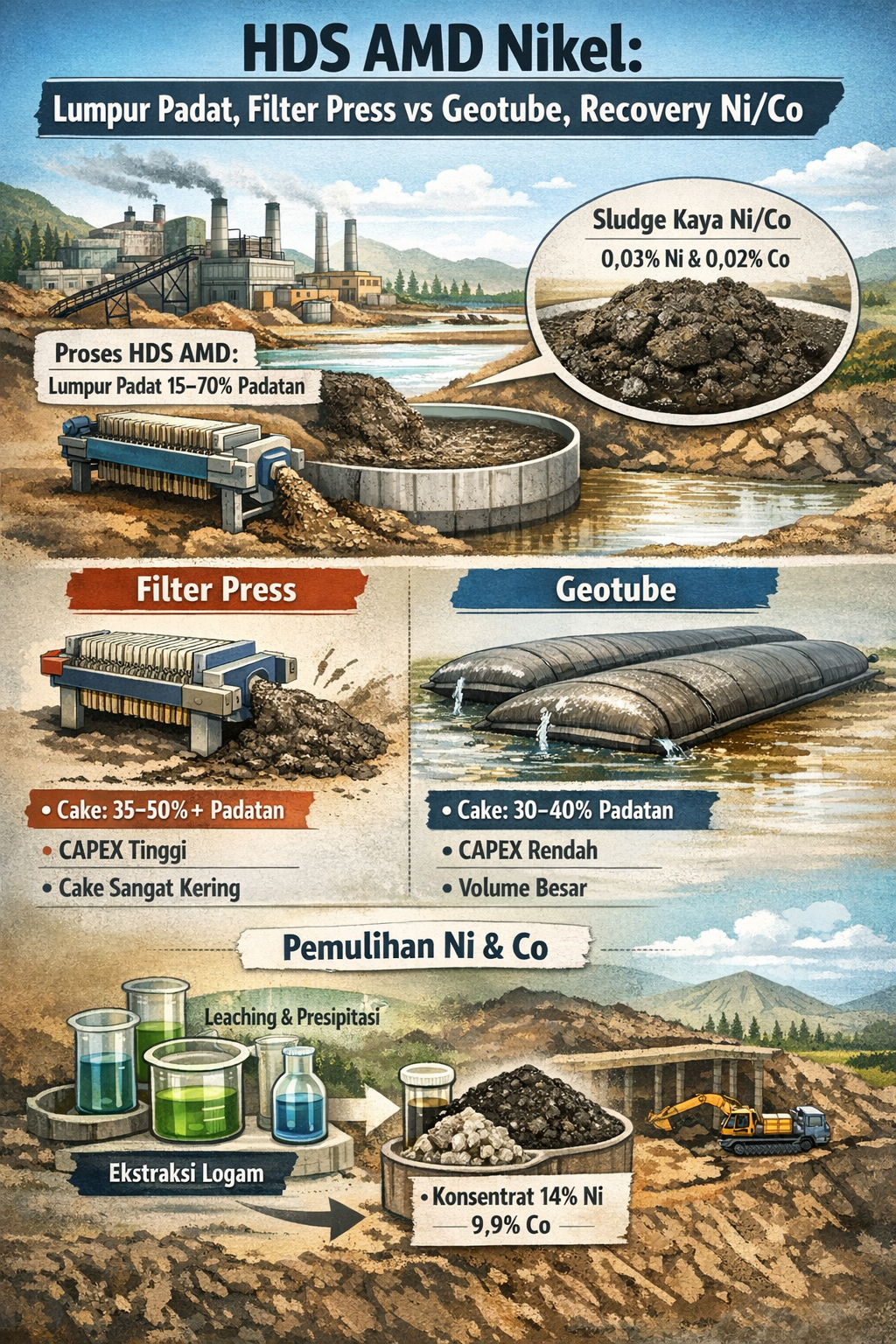
AMD sludge from nickel operations can carry recoverable Ni and Co, though usually at low levels. One study on coal‑AMD reported ~0.03 wt.% Ni and 0.02 wt.% Co (≈300 and 200 mg/kg) in sludge (MDPI). Yet hydrometallurgical flowsheets can concentrate those metals dramatically: the same work produced solid products of ~14% Ni and ~9.9% Co by weight — a hundred‑fold enrichment; the Ni product was a mixed sulfide with 14% Ni and a separate intermediate had ~10% Co (MDPI).
The general approach is two‑step: chemically dissolve metals from the sludge, then selectively precipitate and purify. Acid leaching in H₂SO₄ or HCl solubilizes Ni/Co (plus Fe/Al); iron and aluminum are removed by raising pH, leaving a Ni/Co‑rich liquor. Subsequent pH adjustment or sulfide precipitation can co‑precipitate Co and Ni or separate Mn depending on pH stages; solvent extraction (SX) and ion exchange are also used to purify streams (MDPI). Plants often incorporate ion‑exchange systems for targeted separations, with ion‑exchange resin choices spanning strong/weak cation/anion types.
Published methods (e.g., Agudelo et al.) use sequential reagent additions (NaOH, Na₂S, etc.) to fractionate Co, Ni, Mn and produce multi‑gram yields of Ni/Co sulphides; yields were modest (Ni product 14 wt.% purity from a feed at 0.03 wt.% Ni), but the commodity value can justify treatment at scale (MDPI). Other approaches include high‑pressure oxidation and bioleaching. Economics hinge on sludge composition and volumes, plus reagent and energy costs; in some cases, sludge can be viewed as “mine tailings” for Ni/Co (MDPI).
Regulatory classifications and disposal
Indonesia requires mine operators to treat and settle mine‑affected water on‑site under Ministry of Environment rulings implementing PP 82/2001; treated effluent must meet “baku mutu” discharge limits, and sludge disposal follows solid‑waste norms (NAWASIS). If sludge is classified as hazardous (e.g., due to high Ni or other toxins), it must go to a lined secure landfill.
Internationally, rules vary. In the U.S., EPA’s hazardous characteristics are set by TCLP leaching thresholds; Ni is not on that list, so AMD sludges with Ni often get “non‑hazardous” status (iron and manganese are omitted) (MDPI) (MDPI). Canada and China do list Ni, and limestone‑HDS sludges have been flagged based on Ni leachability (MDPI) (MDPI). In South Africa, strict LCT0 (leachability) limits meant limestone‑HDS was classed Type 0 (hazardous) due to Ni and Mn solubles (MDPI).
The upshot is practical: an Indonesian mine adopting limestone‑HDS could produce sludge around ~300 mg/kg Ni (0.03 wt.% Ni) as reported in coal‑AMD studies (MDPI) — potentially hazardous under some regimes. Any metal‑recovery step not only recovers value but can lower waste classification risks.
Design implications for nickel‑mine AMD
Advanced sludge management for nickel‑mine AMD is coalescing around HDS or equivalent thickening to minimize volume — e.g., ~20 t HDS per ML AMD (MDPI) — coupled with fit‑for‑purpose dewatering and, where viable, metal recovery. On dewatering, filter presses target ~35–50% cake (with potential 60–80% in fine‑mineral slurries) (Climate Policy Watcher), while geotubes commonly land ~40–50% solids in practice (MDPI). On recovery, published routes have yielded Ni concentrates around ~14% by weight from ppm‑level feeds (MDPI).
Plant designers are using those figures to model reagents per kg metal removed, disposal fees per ton of sludge, and the sizing of HDS loops and desalination blocks. Where RO is selected to curb TDS, integrated membrane systems align with industrial water practice. For upstream clarification and recycle control, compact settlers like a tube settler can increase clarifier capacity by 3–4× and reduce footprint significantly.