

Industry: Nickel_Mining | Process: Solvent_Extraction_&_Electrowinning_(SX
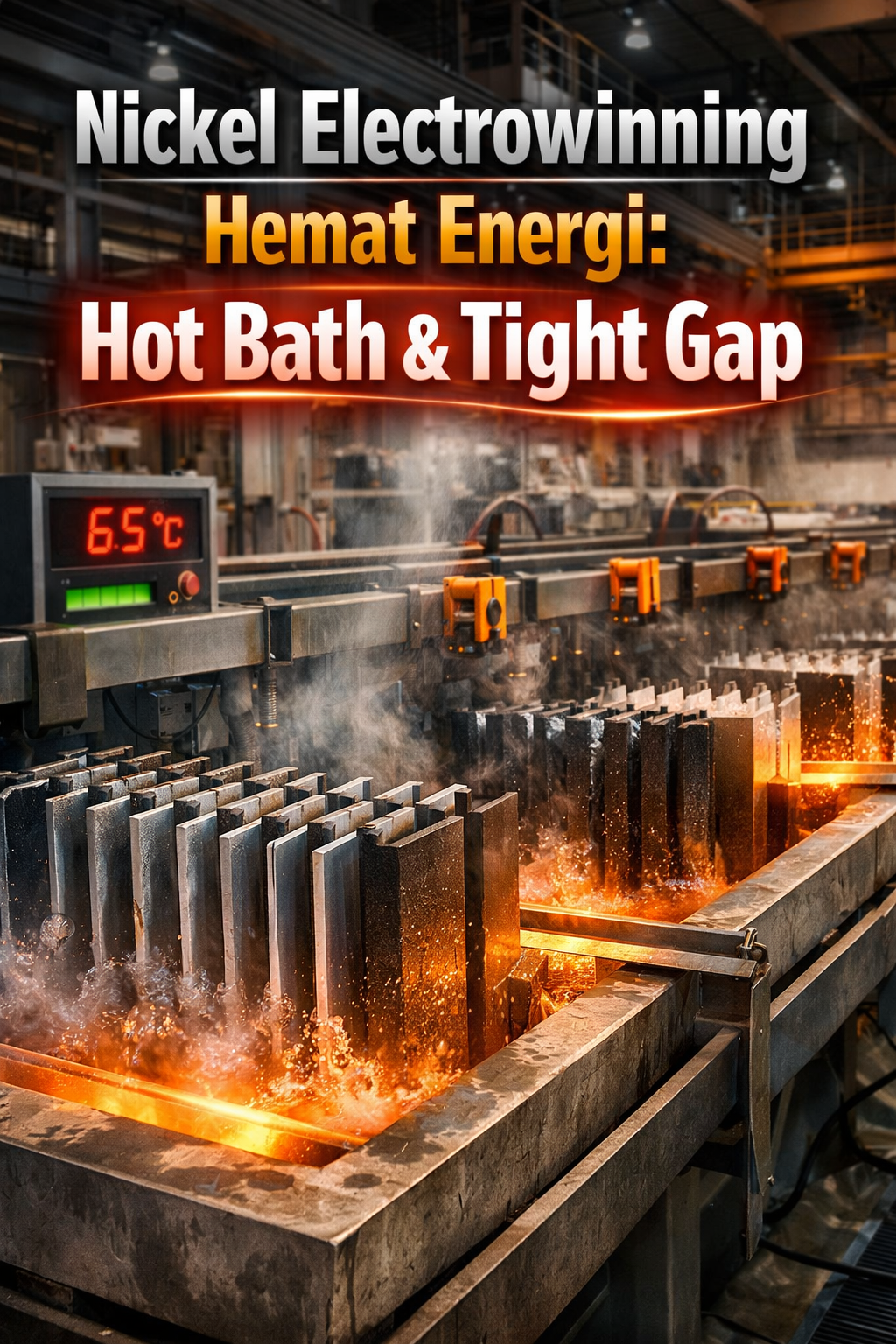
In nickel electrowinning (EW — plating dissolved Ni as solid metal using electricity), the cheapest kilowatt‑hour is the one never bought. Raising electrolyte conductivity, trimming the anode‑cathode gap, and staying in the sweet spot for current density are driving 10–40% cuts in energy per kilogram, according to peer‑reviewed studies and industry data (911metallurgist.com).
The arithmetic scales fast. In a 100,000 tpy plant (≈360 t/day), just 0.5 kW·h/kg Ni saved at $0.05/kWh is roughly $1.6 million per year. That’s why operators are pushing electrolyte temperature to 50–70°C, dosing supporting salts, and swapping legacy lead anodes for modern coatings (911metallurgist.com | www.sterc.org).
Electrolyte conductivity and composition
Higher conductivity slashes resistive voltage loss (IR drop — the voltage consumed pushing current through resistance). Industrial Ni EW baths typically carry 60–100+ g/L Ni and ~5–10 g/L H₂SO₄, plus ~40 g/L H₃BO₃ buffer. Raising Ni from 60 to 135 g/L (≈125%) lifted current efficiency from ~60% to 72% and cut specific energy by ~17% (from 2.25 to 1.86 kW·h/lb Ni) (911metallurgist.com).
Temperature is leverage. Heating an 85 g/L Ni solution from 50°C to 85°C dropped resistivity from 11.2 to 8.0 Ω·cm (≈28%), which — together with more favorable pH — cut Ni energy use by ~40% at fixed current density (current per electrode area, A/m²) (911metallurgist.com). At constant current, raising temperature from 50 to 65°C alone trimmed cell voltage by ~0.25 V (911metallurgist.com).
Supporting salt helps. Dissolving 100 g/L Na₂SO₄ into a Ni–H₂SO₄ bath lowered solution resistivity by ~25% at 65°C, yielding an extra ~0.25 V drop in cell voltage; boosting ionic strength and temperature together cut cell voltage by ~0.5 V (for example, from ~4.8 to 4.3 V), roughly a 10–15% energy saving at constant current (911metallurgist.com | 911metallurgist.com).
Process control matters too. During Ni EW, H⁺ is generated at the anode and consumed at the cathode; if H⁺ builds, hydrogen evolution competes at the cathode, lowering current efficiency. Larger nickel “extraction” per pass (plating more Ni in each pass) drove current efficiency down from ~74% to 59% and raised energy from 1.82 to 2.24 kW·h/lb Ni, pointing to continual electrolyte regeneration and acid balance as priorities (911metallurgist.com). In SX–EW, keeping Ni high and replenishing acid via solvent‑extraction bleed streams mitigates this; accurate additions can be handled with an industrial dosing pump.
Bottom line: maximize bath conductivity (high Ni g/L, sufficient acid/buffer, supporting salt) and temperature. The combined ~0.5 V cell drop roughly halves the ohmic component of the solution loss (911metallurgist.com | 911metallurgist.com).
Electrode spacing and cell geometry
Ohmic loss scales with gap: V = I·R ≈ I·(d/σA), where d is anode‑cathode distance, σ conductivity, and A area. Narrow gaps are therefore crucial. Modern cells run ~1‑inch (~25 mm) spacing; improved agitation via bubble curtains enabled this, lowering energy consumption (www.sterc.org). Gaps of 10–20 mm are common; one 4.5 L lab cell used 13 mm (911metallurgist.com).
The payoff is direct. At 1,000 A/m² and 15 Ω·cm resistivity, halving gap from 0.02 m to 0.01 m reduces IR drop from ~2.0 to 1.0 V. Designs such as “zero‑gap” or flow‑through cells, fluidized‑bed cathodes, rotating cylindrical cathodes, or fine air bubble curtains improve mass transfer, enable closer spacing, and cut voltage — with added mechanical complexity (www.sterc.org | www.sterc.org | www.sterc.org). Each 5–10 mm shaved off can cut IR loss by tens of percent.
Current density operating window
Higher current density (A/m² or A/ft²) boosts throughput but raises overpotentials and often lowers current efficiency via hydrogen evolution. In Bureau of Mines data, raising cathode current density from 15 to 45 A/ft² (≈161 to 483 A/m²) increased current efficiency by only 2–3% but pushed cell voltage from 3.2 to 4.8 V, driving ~50% higher energy use (911metallurgist.com).
Most operations settle in the moderate ~100–300 A/m² range. The economics are stark: each 1 V increase at 2,000 A (20 A/ft² on a 10 m² cell) adds 2 kW — about 17% of a 12 kW baseline. Maximizing efficiency typically means avoiding the far high end unless space or capital is the binding constraint.
Anode and cathode materials
Anodes set the oxygen evolution overpotential. Legacy Pb–Ca can need ~1.5–2 V, while modern dimensionally stable anodes (DSA — titanium or niobium substrates with mixed‑metal oxide coatings such as IrO₂/RuO₂/Ta₂O₅) exhibit far lower overpotentials, often <0.7 V at high current density (www.sterc.org). MMO‑coated Ti anodes are now standard in Ni/Cu EW, improving current efficiency and lowering cell voltage (www.sterc.org).
Cathodes benefit from high surface area and uniform fields. Beyond flat stainless sheets, woven carbon‑fiber felts, reticulated Ni foam, or expanded metal increase effective area. One study using carbon‑fiber cathodes reported ~90% current efficiency with only ~3 kW·h/kg Ni — roughly half the energy of conventional flat‑plate approaches (pubs.rsc.org). Reticulate cathodes are increasingly used; removal mechanics are the main trade‑off. Bipolar/segmented layouts and filter‑press style flow fields improve current distribution and minimize inactive volume, trimming cell voltage by tenths of a volt.
Agitation, membranes, and flow
Agitation governs mass transport and concentration polarization. In an experimental channel cell, turbulent circulation at 2.1 m/s (Re≈40,000) extended the activation‑controlled Tafel region (where current responds exponentially to overpotential) up to 1,400 A/m² for a 5 g/L Ni feed — versus only 200 A/m² at low flow — enabling higher throughput before diffusion limits kick in (www.911metallurgist.com). Plants apply electrolyte recirculation, jet agitation, or fine bubble curtains accordingly (www.sterc.org).
Separators change the acid balance. A diaphragm or ion‑exchange membrane (a selective barrier placed between electrodes; not to be confused with water‑treatment RO/NF/UF membrane systems) can keep H⁺ out of the cathode zone and lift current efficiency. In one comparison at 50°C, a diaphragm cell ran 21% more energy‑efficient (kW·h per pound Ni) than a non‑diaphragm cell; adding 100 g/L Na₂SO₄ to the non‑diaphragm bath closed most of the gap to ≈4% (911metallurgist.com). By 65°C the non‑diaphragm actually used 5–10% less energy than the diaphragm case thanks to higher conductivity; industrial data corroborate that the advantage shrinks at high temperature (911metallurgist.com).
What the numbers add up to
Typical modern Ni EW comes in around 4–5 kW·h/kg Ni (≈2.0–2.5 kW·h/lb) (911metallurgist.com | 911metallurgist.com). Strategic shifts shave more: raising catholyte Ni from 6% to 13.5% (w/v) cut energy by ~17% (911metallurgist.com); heating 50°C→85°C cut ~40% (911metallurgist.com); adding 100 g/L Na₂SO₄ cut resistivity ≈25% and dropped cell voltage ~0.25 V (911metallurgist.com). Together, raising T and adding salt lowered cell voltage by ~0.5 V (≈15% of total voltage) (911metallurgist.com). Advanced electrodes push further: a lab using carbon‑fiber cathodes achieved ~90% current efficiency at ~3 kW·h/kg Ni (pubs.rsc.org).
For Indonesia — rapidly scaling nickel for EV batteries — adopting these efficiency levers reduces both operating cost and grid demand.
Sources and confirmations
Data and trends are drawn from peer‑reviewed hydrometallurgy studies and industry reports, all confirmed by practice: 911metallurgist.com | 911metallurgist.com | 911metallurgist.com | 911metallurgist.com | 911metallurgist.com | 911metallurgist.com | pubs.rsc.org | www.sterc.org | www.sterc.org.