

Industry: Coal_Mining | Process: Extraction
Start with the chemistry: traditional mine charges — ANFO (ammonium nitrate/fuel oil) and ANE (ammonium nitrate emulsion) — are mostly nitrate by weight, often around ~90% [www.researchgate.net] [www.nouryon.com]. Annual use runs to an estimated 17–20 million tonnes (2023 demand ~17 Mt), and that scale multiplies the risks of NOx (nitrogen oxides) fumes and residual nitrate (www.nouryon.com) (www.mining-technology.com) (bme.co.za). Incomplete detonation adds to the load: tests estimate up to ~6% of an ANFO slurry can remain undetonated underground, poised to leach as nitrate, nitrite, and ammonia (www.researchgate.net).
For mines dewatering into sensitive aquifers, the stakes are clear. In one underground mine study, weekly monitoring wells logged nitrate surging from ~7 to 1054 mg/L in mine water after blasting, with nitrite up to ~50 mg/L and ammonium to 145 mg/L [(www.researchgate.net]](https://www.researchgate.net/publication/366122975_Monitoring_of_Blasting_Operations_Techniques_and_Assessment_of_their_Impacts_on_Groundwater_in_the_Context_of_Underground_Mining_Case_of_ROXGOLD_SANU_Burkina_Faso#:~:text=recommended%20thresholds,release%20nitrogen%20into%20the%20environment).
Nitrate-free oxidizers (HPE) adoption
One best‑practice shift is swapping ammonium nitrate for hydrogen peroxide. In hydrogen‑peroxide emulsion (HPE) explosives, peroxide replaces the nitrate oxidizer, leaving essentially no nitrates or ammonia after detonation (www.mining-technology.com) (www.nouryon.com). Industry reports cite performance on par with ANE — equal fragmentation and muck movement — while eliminating NOx/nitrate residues (bme.co.za) (www.nouryon.com).
The carbon math is compelling: HPE production emits roughly 0.23 kg CO₂ per kg of emulsion versus 2.3 kg CO₂ for ANE — a ~90% reduction (www.mining-technology.com) (bme.co.za). Boliden’s Kankberg mine, partnering with Hypex/BME, is trialing HPE detonations that send no nitrates into mine water — an operational change expected to cut mine‑site CO₂ by ~400 t/yr and “significantly decrease the necessity for nitrogen water treatment” (www.mining-technology.com) (bme.co.za). Supplier data likewise highlight >90% CO₂ savings, “zero ammonia” emissions, and “minimal NOx and nitrate” from HPE blasting (www.nouryon.com).
Other low‑nitrate tactics — for example, gas‑phase inhibitors or catalysts added to ANFO to push full decomposition — remain largely in R&D (www.ncbi.nlm.nih.gov) (www.researchgate.net). The immediate, proven step is adopting nitrate‑free emulsions that can virtually eliminate post‑blast nitrate load by removing the nitrate source entirely — leaving water, O₂, and N₂ instead (www.mining-technology.com) (bme.co.za).
Blast design and containment parameters
Design still matters — even with conventional charges. Hole diameter, charge distribution, stemming (the in‑hole backfill that confines the column), and timing govern whether ammonium nitrate fully decomposes. Poor designs — oversized holes, inadequate stemming, wet holes — can hinder complete reaction and generate excess NOx and unreacted nitrate (www.researchgate.net).
Best practice uses adequate stemming, often ~25–50% of hole depth, and smaller, well‑confined charges. In a quarry case study, the plan was revised to 80 mm cartridges and then 105–115 mm holes with ~2 m of gravel/foam stemming, improving confinement in wet conditions (www.mdpi.com). Water incursion was handled by switching from water‑sensitive ANFO to a water‑gel explosive that resists washout (www.mdpi.com).
Timing is a second lever. Staggered delays — ideally via digital initiation — tailor pressure waves to the rock mass so energy doesn’t vent. Controlled multi‑row patterns (proper burden and spacing) reduce fly‑rock and overbreak that can eject unreacted explosive. A long‑term site study reported a 26% drop in explosives use and 18% lower CO₂ per tonne by refining patterns and sequencing (www.mdpi.com). Holistic plans — balancing vibration limits, air‑blast, and production — can simultaneously improve recovery and curb vibrations, noise, fumes, and nitrate runoff (www.mdpi.com) (www.researchgate.net).
Equipment choices also cut risk. Reliable detonators and boosters reduce the odds of misfires that leave pockets of ammonia/nitrate. Electric or shock‑tube initiation under controlled conditions is preferred over legacy fuses. After‑blast, high‑velocity air‑decking charges or controlled venting can capture and direct fumes. Modeling notes that certain charge additives can suppress unintended NOx and NH₃ by 62–85% — but these inhibitors/catalysts remain experimental (www.ncbi.nlm.nih.gov).
Groundwater monitoring architecture
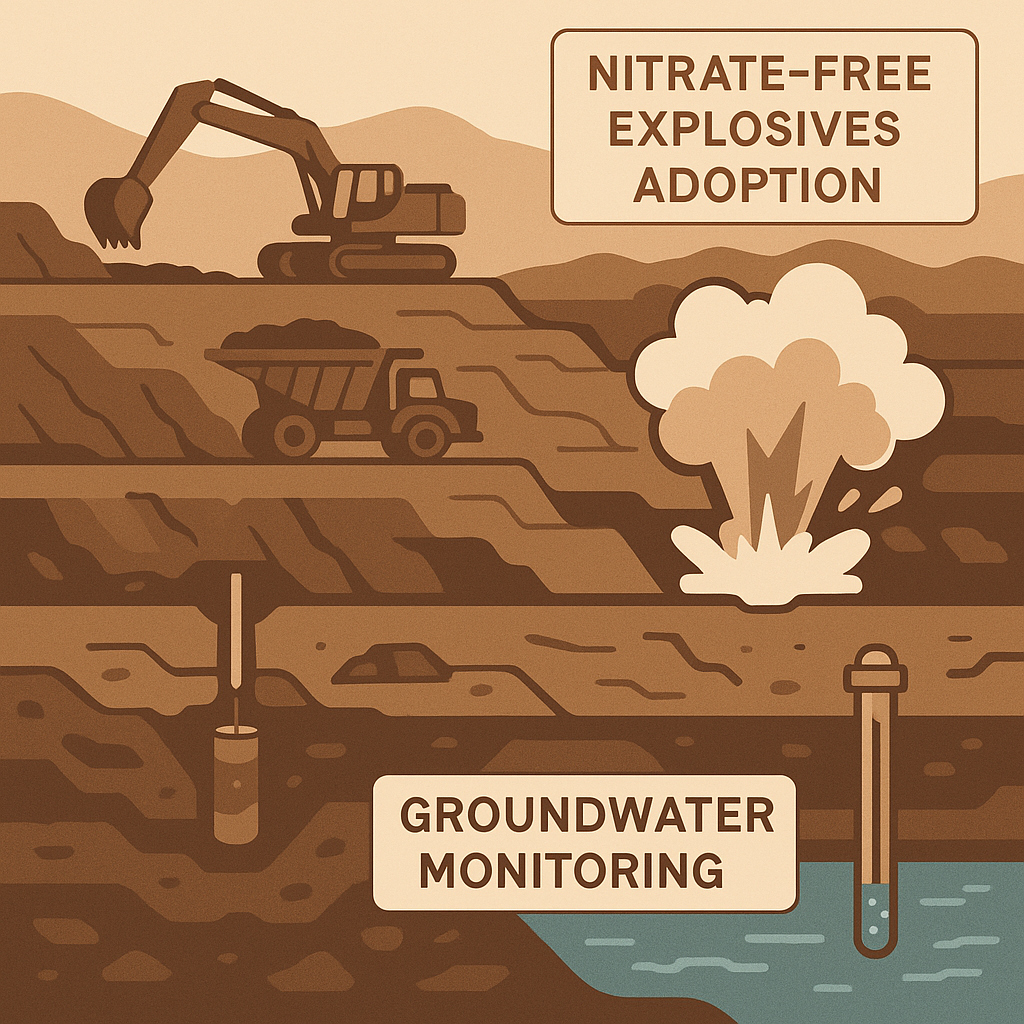
No design is perfect, so monitoring has to be. A network of monitoring wells and piezometers (subsurface water‑pressure/sampling points) around blast zones and downgradient of waste rock/tailings should track groundwater levels and nitrogen species — nitrate (NO₃–N), nitrite (NO₂–N), ammonium (NH₄–N). Sampling frequency is typically regular (e.g., quarterly) and after major blasts or rains; field screens use in‑situ probes or portable spectrophotometers with laboratory confirmation by ion chromatography or colorimetry (geologi.esdm.go.id).
Case data bear watching: weekly mine wells ranging ~7–1054 mg/L nitrate (mg/L = milligrams per liter) post‑blast, with nitrite to ~50 mg/L and ammonium to 145 mg/L, all logged in an underground operation (www.researchgate.net). Sampling nearby domestic wells and surface waters helps detect off‑site impacts. Isotopic “fingerprinting” (δ¹⁵N and δ¹⁸O) can distinguish blast‑derived nitrate from agriculture or sewage — a tool used to trace plumes from blasting sites in New Hampshire, USA (www.researchgate.net).
Seismic/vibration monitors and gas detectors verify containment; drift or elevated fines in water after blasts can hint at overlooked leaks. Baseline sampling before blasting anchors trend analysis. In Indonesia, drinking‑water permits cap nitrate (as NO₃) at 50 mg/L (id.scribd.com), while the WHO guideline is 10 mg/L (as N) or 45 mg/L (NO₃) (www.mdpi.com). Automated data loggers and GIS mapping help spot rising trends early.
Nitrate remediation playbook
First move: contain sources. Mine runoff and dewatering should flow to lined tailings storage or water ponds, not infiltrate off‑site. One case kept mined groundwater on site, routing it to a tailings storage facility (TSF) rather than discharging beyond the boundary (www.researchgate.net).
For water already affected, biological denitrification is a durable, sustainable, and cost‑effective option versus physical/chemical methods: pass nitrate‑rich flows through a bioreactor or constructed wetland to convert NO₃⁻ to N₂ gas (www.mdpi.com). Wood‑chip packed‑bed designs and high‑efficiency tanks can drive nitrate to below detection with proper carbon dosing (www.mdpi.com). Many operators implement fixed‑footprint bioreactors; for suspended‑biofilm approaches, moving bed bioreactors are a fit within a biological treatment train.
Seeding with known denitrifiers (e.g., Paracoccus, Pseudomonas) and optimizing retention time underpins >90% nitrate removal in many designs (www.mdpi.com) (www.mdpi.com). Carbon feed control is routine; accurate metering via a dosing pump stabilizes performance.
Ion‑exchange filtration is a second line of defense: anion‑exchange resins selectively remove NO₃⁻ and can polish to the low mg/L range when needed. Many plants package this in modular ion‑exchange systems sized to peak flows.
High‑spec programs often pair ion exchange with reverse osmosis; brackish mine waters are typically addressed with brackish‑water RO to ensure stringent nitrate residuals for recharge or discharge.
Adsorptive polishing complements these steps. Sites commonly deploy media columns; for organics and taste/odor co‑benefits, activated carbon is the default filter bed in a many‑column setup.
Less common in mining but sometimes applied are chemical routes under alkaline conditions — including precipitation (for example, as calcium carbonate with urea dosing) or reduction — though these are site‑specific. Whatever the train, continuous monitoring during treatment provides verification that discharge targets are consistently met.
Targets matter. Final water should meet Indonesian standards for nitrate (NO₃⁻ ≤ 50 mg/L) (id.scribd.com); many sensitive waters are managed to even tighter ranges (<10–20 mg/L). Source control continues in parallel: if spikes recur, reassess charge quality, water control, and consider increasing inhibitor use or fast‑tracking low‑N technologies. Community liaison or complaint systems help flag off‑site well issues early, a step recommended in best‑practice studies (www.researchgate.net).
Operating costs and compliance signals
Trend data should inform the explosives mix. If trials show HPE reduces water‑treatment burden by eliminating nitrate at source, the capex can be justified by opex and risk savings. In the Boliden case, trimming roughly 400 t/yr CO₂ and “significantly” reducing nitrogen treatment is a quantifiable value signal (www.mining-technology.com). Avoiding compliance breaches — and potential fines or shutdowns — is another decisive factor.
Bottom line: best‑practice blasting blends new oxidizers with precision engineering and diligent follow‑up. Nitrate‑free emulsions and tuned designs can markedly cut the nitrate load per blast (www.mining-technology.com) (www.mining-technology.com). Coupled with robust monitoring to catch leaks and treatment trains sized to local rules, operations can protect aquifers in line with Indonesian water‑quality standards (id.scribd.com) and reduce downstream costs.
Sources: Authoritative studies and industry reports — Mining Technology, MDPI, supplier data, and national standards — underpin the figures and claims above, including: [www.nouryon.com], [www.researchgate.net], [www.mining-technology.com], [bme.co.za], [www.researchgate.net], [www.mdpi.com], [www.mdpi.com], [www.ncbi.nlm.nih.gov], and [id.scribd.com]. All figures and statements are drawn from these cited sources.