

Industry: Landfill | Process: Leachate_Treatment_(Aerobic
Landfill leachate isn’t just dirty; it’s nitrogen-rich. Reports put raw chemical oxygen demand (COD, a measure of oxidizable organics) in the tens of g/L and ammonium nitrogen (NH₄‑N) commonly at 100–2000 mg/L (mdpi.com) (mdpi.com). In Southeast Asia, COD ≈3–6 g/L and NH₄‑N ≈1–2 g/L are typical (researchgate.net) (mdpi.com).
Age matters. “Young” leachate (≤5 years) carries a BOD/COD (biochemical oxygen demand/chemical oxygen demand) ratio around 0.5–1.0, meaning plenty of biodegradable carbon. “Old/stabilized” leachate often sits below 0.1–0.2, signaling scarce readily biodegradable carbon (researchgate.net).
Against that backdrop, Indonesia’s rulebook (Permen LHK P.59/2016) caps total nitrogen (TN) at 60 mg/L, forcing >90–95% reduction when NH₄‑N is ~1000 mg/L (researchgate.net) (mdpi.com). In practice, most uncontrolled Indonesian landfills miss the mark (researchgate.net), underlining the urgency.
BNR architecture: aerobes then anoxics
BNR (biological nutrient removal) couples two zones. First, an aerobic reactor cultivates nitrifiers—autotrophic microbes such as Nitrosomonas and Nitrobacter—to oxidize NH₄⁺ to NO₃⁻ (nitrate). Second, an anoxic zone (no free oxygen) lets denitrifiers respire that nitrate to harmless N₂ gas using organic carbon.
For the aerobic stage, designers target dissolved oxygen (DO) ~2–3 mg/L and a long solids retention time (SRT, how long biomass stays in the system) around 10–15 days to enrich slow-growing nitrifiers (activatedsludgeguide.com) (activatedsludgeguide.com). Bench reactors treating 300–900 mgN/L leachate have shown complete nitrification with very short hydraulic retention time (HRT, the water’s average time in a tank) ≈5 hours by pushing mixed liquor suspended solids (MLSS) to 10–13 g/L, delivering 90–100% ammonium removal (pubmed.ncbi.nlm.nih.gov).
That study hit nitrification rates up to 5.9 gN/L·d (246 mgN/L·h) with a specific rate ~880 mgN/gVSS·d (VSS: volatile suspended solids, the organic fraction of MLSS) (pubmed.ncbi.nlm.nih.gov). In real-world design, a conservative 2–3 gN/L·d at ~10–15 gVSS/L is often assumed under warm tropical conditions. Nitrification acidifies: roughly 4.6 g O₂ per g NH₄‑N is consumed; at NH₄‑N of 1000 mg/L, that’s ≈4600 mg/L O₂ demand. Aeration and buffering keep pH near 7.5–8.0, with pilot operations reporting near-complete NH₄→NO₃ conversion at DO 2–3 mg/L and SRT ≥10 d (pubmed.ncbi.nlm.nih.gov).
Classic activated‑sludge configurations such as activated sludge systems are a natural fit for this aerobic duty, provided DO and SRT are tightly controlled. Ancillary gear for aeration, mixing, and monitoring is typically specified as wastewater ancillaries.
Anoxic zone design and internal recycle
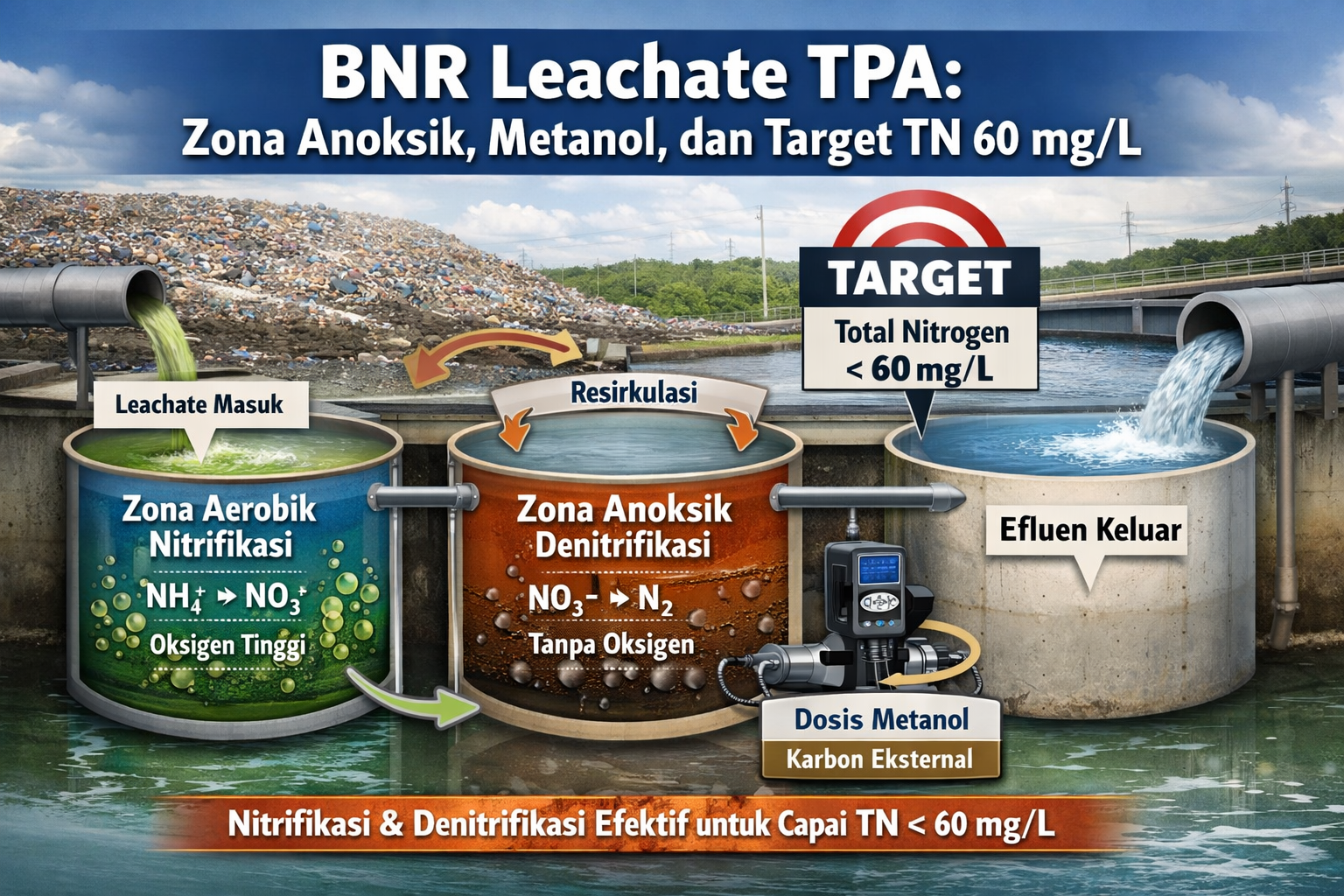
The anoxic stage is where nitrate is turned into nitrogen gas. Operators maintain DO near zero (<0.5 mg/L), and a high recycle of nitrified liquor—often ~100% or more—mixes back into the anoxic zone. Many plants achieve the same effect with time‑phased cycles in SBRs (sequencing batch reactors) (mdpi.com). Denitrifying genera such as Pseudomonas and Paracoccus then use organic carbon to reduce NO₃⁻/NO₂⁻ (nitrate/nitrite) to N₂.
Carbon is the throttle. If the raw leachate brings enough biodegradable carbon, an internal carbon:nitrogen ratio ≥2 may suffice. Mature leachate often does not: with BOD/COD <0.1–0.2, readily biodegradable carbon is negligible (researchgate.net), so external carbon must be added. Methanol is a standard choice: ~2.5–3.0 mg COD (as CH₃OH) per mg NO₃‑N is the typical stoichiometry—about 0.8–1.0 g CH₃OH per g N removed. In lab SBRs, complete denitrification required ~2.4 mg COD per mg N using acetate, and nitrite‑denitrification was reported at 2.4–3.8 mg COD/mgN (scielo.br).
With adequate carbon, reported denitrification rates reach 9–15 mg N/gVSS·h (scielo.br). One Anoxic–Aerobic–Anoxic SBR (A/A/N) achieved >98% TN removal on 1200–2000 mg/L NH₄‑N leachate (mdpi.com), driving effluent nitrate into the low mg/L. To denitrify 1000 mg/L NO₃‑N, dose ≈2500–3000 mg/L COD—roughly 1700–2000 mg/L as methanol (scielo.br). Time‑phased systems such as a sequence batch reactor (SBR) are commonly selected to execute the oxic–anoxic cycles documented in these studies.
Carbon strategy: internal vs. methanol
On young leachates, some internal carbon can be reserved for denitrification. A stream with COD ≈4000 mg/L and NH₄‑N ≈2000 mg/L (C/N≈2) may partially self‑supply denitrifiers. But typical aged leachate clocks BOD below 1 g/L (researchgate.net) (researchgate.net), so external carbon shoulders most of the load: <90% of N removal must rely on it.
Methanol dosing around 2.5 mg COD per mg NO₃‑N generally yields full denitrification at high loads, consistent with 2.4–3.8 mg COD/mgN observed using volatile acids in bench tests; methanol is similar (scielo.br). The advantages are well‑understood dosing—≈1.7 kg CH₃OH per kg N removed—and low biomass yield; downsides are cost and safety. Alternatives like ethanol or waste fermentation products are also used where available. Precise dosing is typically handled with a dosing pump to match stoichiometric demand.
Design targets and operating windows
Combined nitrification/denitrification routinely hits ≥90–98% TN removal in research and practice. A long‑term A/A/N SBR reported >98% TN removal at 1200–2000 mg/L NH₄‑N (mdpi.com), while partial‑nitritation coupled with fermentation/denitrification reached 95% TN removal on ~2000 mg/L influent at nitrogen removal rate (NRR) ≈0.63 kgN/m³·d (mdpi.com). These results place TN well below the 60 mg/L limit in Permen LHK P.59/2016 (researchgate.net).
- Nitrification stage: DO ~2–3 mg/L; SRT ~10–20 d; HRT ~4–8 h for NH₄ ≈500–2000 mg/L; expect ∼90–95% NH₄ removal (pubmed.ncbi.nlm.nih.gov).
- Anoxic zone: DO ~0; recycle ratio ~100% or more; HRT ~1–2 h; provide ~2.5 mg COD (as methanol) per mg NO₃‑N to drive >90% denitrification (scielo.br).
- Effluent goal: TN <60 mg/L. For influent TN≈1000–2000 mg/L, design for ~95% total N removal (mdpi.com) (mdpi.com).
Packaged solutions marketed as nutrient removal systems typically implement this very playbook: aerobic nitrification followed by an anoxic denitrification step and carbon dosing control. In many cases the biological core is paired with standard biological digestion modules and instrumentation under the same scope.
Bottom line and sources
Conventional BNR—an aerobic nitrification stage followed by a carbon‑fed anoxic denitrification stage—can meet stringent nitrogen limits on high‑strength landfill leachate, provided the anoxic step receives enough carbon. For aged leachate, that often means supplementing with an external donor such as methanol to reach the stoichiometric C/N ratio (~6–8 COD/N) required for full denitrification (scielo.br) (researchgate.net). With DO control, SRT control, internal recycle, and carbon dosing, final treatment aligns with regulatory limits.
Sources: Standard values and outcomes are drawn from landfill leachate studies and engineering reviews (researchgate.net) (researchgate.net) (mdpi.com) (pubmed.ncbi.nlm.nih.gov) (scielo.br) (mdpi.com) (mdpi.com).
References: Emalya et al. (2020) Landfill Leachate Management in Indonesia: A Review, IOP Conf. Ser.: Mater. Sci. Eng. 845 (researchgate.net). Kulikowska (2012) Braz. J. Chem. Eng. 29(2): Nitrogen removal via nitrite route (scielo.br). Yalmaz & Öztürk (2001) Water Sci. Technol. 43(3): Ammonia removal in SBR (pubmed.ncbi.nlm.nih.gov). Li et al. (2021) Sustainability 13(11):6236 Advances in Biological Nitrogen Removal of Leachate (mdpi.com) (mdpi.com). Cragg et al. (2023) Processes 11, 2960 Assessment of nitrification/denitrification in leachate (mdpi.com).