

Industry: Desalination | Process: Energy_Recovery_Devices
The parts of seawater reverse osmosis — SWRO — that never make the ribbon‑cutting photos are doing the heavy lifting on energy. In modern energy‑recovery devices (ERDs), alumina ceramics and super‑duplex stainless steels are combining to deliver up to 98% pressure‑exchange efficiency with design lives measured in decades (energyrecovery.com). The catch: those materials only live up to the brochure if the upstream pretreatment keeps abrasive particles and aggressive oxidants at bay.
That matters at scale. One vendor reports ~35,000 rotary pressure exchangers installed worldwide, enabling ~60% reduction of SWRO energy use (energyrecovery.com; energyrecovery.com). In industrial and power plant contexts that lean on sea‑water RO trains, procurement teams are now standardizing around purpose‑built sea water RO systems and ERDs that can run for years without a wrench.
Ceramic internals for pressure exchange
Rotary pressure exchangers (PX) use ceramic components — a pressure‑transfer rotor that spins inside a precision alumina‑ceramic sleeve and endcaps — to move pressure from the brine to the incoming seawater (www.mdpi.com). Alumina (Al₂O₃) is chemically inert in seawater and extremely hard, at ≈15 GPa hardness versus roughly 2–3 GPa for stainless steel, which translates to virtually zero corrosion and very low wear (www.mdpi.com).
In the current PX Q series, a single alumina‑ceramic moving part, with no metal contact, achieves up to 98% pressure‑exchange efficiency and an industry‑leading ~30‑year design life with no scheduled maintenance (energyrecovery.com; energyrecovery.com; energyrecovery.com). The ceramic rotor “slides” on a thin water film inside the ceramic housing, eliminating metal‑to‑metal wear, and field data show almost no efficiency loss or maintenance over decades of operation. These ceramic ERDs maintain full performance even with high‑salinity or chlorinated feed (energyrecovery.com).
Super‑duplex stainless in wetted metals
Where metals are unavoidable — pressure casings, shafts, high‑pressure pumps, or Pelton‑style turbine runners — super‑duplex stainless steels (SDSS) are the default. With roughly equal ferrite/austenite phases and high chromium, nickel, and molybdenum, grades such as UNS S32750/2507 and S31803/2205 deliver PREN (pitting resistance equivalent number) ≈40–50, far outclassing conventional steels in chloride brine (stainless-steel-world.net).
By the mid‑2000s, “super‑duplexes had become the alloys of choice for high‑pressure seawater feed and brine reject pipework” in SWRO plants, and industry surveys show virtually all new desalination builds specify SDSS for feed/brine lines (stainless-steel-world.net). As plants grew from ∼20,000 m³/d in the 1990s to 600,000 m³/d today, that specification became near‑universal (stainless-steel-world.net).
The economics favor reliability: although SDSS material costs ~30% more than 6%Mo super‑austenitic stainless, the alloys avoid the sulfide/chloride attack and crevice pitting that doomed earlier grades — 316L/317L often corroded within years in early trials (stainless-steel-world.net; stainless-steel-world.net). One integrated pump/ERD even used a nitrogen‑alloyed 2205 duplex‑N rotor coated with chromium oxide (Cr₂O₃) in place of ceramic, trading brittleness for toughness while adding a hard, corrosion‑resistant surface (www.mdpi.com). In hydro turbines, similar wear coatings — often tungsten‑carbide or thermal‑spray ceramics — are applied to Pelton buckets to cut sediment erosion (www.mdpi.com).
SDSS and related super‑austenitics such as 254SMO or AL‑6XN remain the backbone for ERD pressure casings, valves, and bearings, where long exposure to hot, saline brine risks pitting or stress corrosion cracking (stainless-steel-world.net).
Pretreatment solids control and metrics
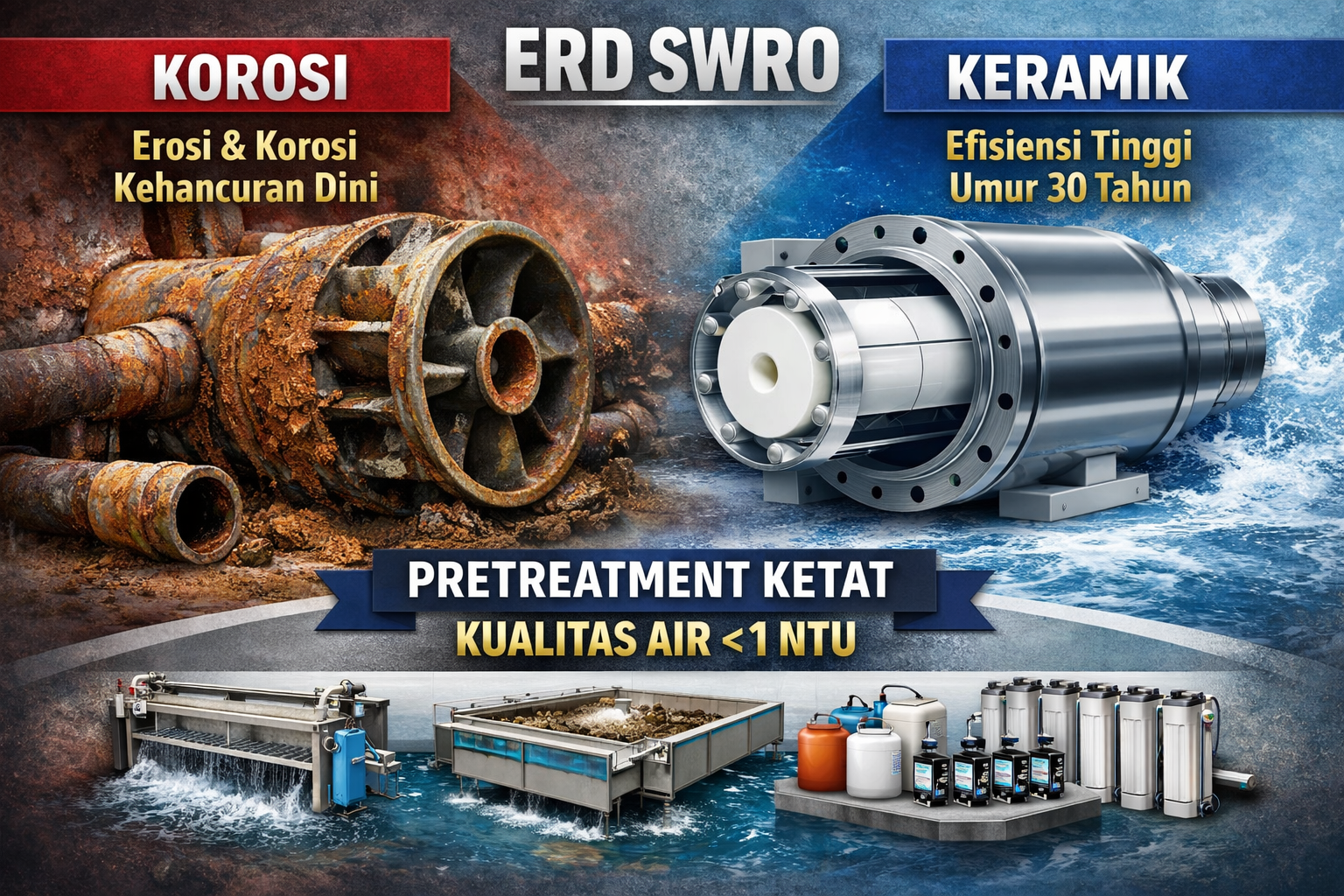
Upstream pretreatment is critically important to protect ERDs from damage. Targets are explicit: turbidity below 0.5–1.0 NTU (nephelometric turbidity units) and SDI15 (silt density index over 15 minutes) below 3, often below 1. Crossflow microfiltration with ceramic membranes has cut Arabian Gulf seawater turbidity from ~12 NTU to <1.0 NTU in practice (www.mdpi.com).
Intakes typically start with coarse screening, often a continuous‑duty unit; an automatic screen keeps debris >1 mm out of the system. Clarification then knocks down solids loads — sedimentation tanks alone will clarify >90% of suspended solids, taking raw water above 30 NTU to under 2 NTU (www.mdpi.com). Plants often rely on a high‑rate unit such as a clarifier to achieve that step.
Many large SWRO facilities, including in the UAE, deploy dissolved‑air flotation to capture microalgae and dense particulates; 16 of 22 large SWRO plants in Abu Dhabi employ DAF for this reason (www.mdpi.com). Where this approach fits, a dedicated DAF stage improves downstream stability.
After clarification, granular beds provide depth filtration; a sand/silica media filter typically captures 5–10 µm particles, with literature noting removal down to ~10 µm (www.mdpi.com). Plants extend bed life by layering an anthracite cap for multi‑media performance.
Polishing is done either with membranes or fine cartridges: coagulation plus ultrafiltration has reduced SDI15 from ~3 to ~0.8 in reported tests (www.mdpi.com). In conventional trains, a final cartridge filter stage captures residual fines before the high‑pressure pump, while many designers now opt for skid‑mounted ultrafiltration to drive SDI lower and more consistently.
Abrasion and chemistry risk management
Quantitatively, thorough pretreatment slashes erosion risk. In poorly treated water, even a few mg/L of sand can severely erode ERD turbines. Field data from sediment‑laden transfer systems show Pelton‑type components wearing on the order of millimeters per year; a Himalayan plant reported Pelton needle/bucket erosion of ~3.4 mm/year, cutting turbine efficiency by ~1.2% (cjme.springeropen.com). ERDs run at similar velocities, so left unprotected they would see comparable wear.
Chemical regimes matter as much as grit. Seawater is typically chlorinated for bio‑control, then dechlorinated — often with sodium bisulfite — because RO membranes cannot tolerate free chlorine; the dechlorination step also scavenges dissolved oxygen, lowering the oxidation potential of the feed from ~+300 mV to ~+100–200 mV (SCE, saturated calomel electrode), which improves stainless‑alloy corrosion resistance (stainless-steel-world.net). Plants standardize chemical dosing hardware; a dedicated dosing pump enables precise pH adjustment, antiscalant addition, and reductant feed.
For dechlorination control, operations teams often specify a packaged dechlorinations agent to keep free chlorine out of the membranes and ERD. Without bisulfite dosing the pyrophosphate coils and membranes would fail, and stainless‑steel wetted steel surfaces would pit. To manage crystallization risks, teams complement this chemistry with targeted membrane antiscalants upstream of the high‑pressure head.
Performance outcomes and CAPEX logic
Measured outcomes align with the materials’ promise. UF pretreatment — via modules integrated into broader membrane systems — halves the frequency of cleanings and doubles element life compared to coarse treatment. One case study found SDI reduced from ~4 to ~0.8 after UF, enabling a >50% drop in membrane replacement cost.
On the mechanical side, ERDs built of ceramic and SDSS and fed by <0.5 NTU water routinely operate for years between service intervals. Skip pretreatment and the opposite happens: coatings or ceramic rotors could wear through within months under heavy sand load.
The financial calculus is straightforward. Investing in pretreatment — typically 5–10% of plant CAPEX — protects ERD assets that can represent 30–50% of plant value (www.mdpi.com) and preserves energy‑recovery efficiency. In practice, data from existing plants confirm that “zero” turbidity pretreatment is essential to achieve the claimed ~97–98% ERD efficiency (energyrecovery.com) without mechanical failures.
Engineers therefore target <1 NTU and SDI<2 in the RO feed; with that level of pretreatment, an ERD built from alumina ceramics and 2507 duplex stainless steel can reliably deliver decades of service in seawater RO (energyrecovery.com; stainless-steel-world.net). High tariffs for SDSS or ceramic parts are quickly recouped by avoiding unscheduled shutdowns.