

Industry: Semiconductor | Process: Cleaning
Semiconductor wet‑process effluent is both variable and aggressive. Streams can be extremely acidic (pH <1 from HF (hydrofluoric acid) or H₂SO₄ (sulfuric acid) cleaning) or alkaline (pH >10 from NH₄OH (ammonium hydroxide) rinses), and carry heavy loads of metals and anions—Cu, Ni, Zn, F⁻, PO₄³⁻, Cl⁻ among them. One US fab reported rinse water at 2,500–3,500 ppm (parts per million) dissolved Cu at pH ~0.8 (Ultra Pure Water). Scale is significant: in Korea, semiconductor processing generates ~177,000 m³/day, ~19.3% of all industrial wastewater (J. Clean. Prod. review).
Discharge standards are stringent—pH typically 6–9, heavy metals often <0.1–1 mg/L (milligrams per liter)—so removal needs frequently exceed 99%. The system below stabilizes flows and strips contaminants in stages to meet those limits, forming the core of a potential ZLD (zero‑liquid‑discharge) strategy.
Flow equalization and pH neutralization
All waste streams feed an equalization tank (to dampen flow/pH swings), with automated mixing and pH probes for tight control (Environmental Nanotechnology, Monitoring & Management). Separate acid and caustic neutralization reactors—continuous or batch—then adjust pH to ~6.5–7.5 (Modutek technical blog; review). Commercial acid neutralization systems add NaOH (sodium hydroxide) or Ca(OH)₂ (calcium hydroxide) to acidic effluent; controllers measure pH and dose alkali to ~7.0 (Modutek).
Continuous‑flow neutralizers handle a few to several hundred gpm (gallons per minute) and auto‑dose to track small process variations (Modutek). Batch neutralizers suit small, variable batches and allow different reagents per batch, with the same pH monitoring (Modutek). Neutralization alone may precipitate some species (e.g., Fe, Al), but most heavy metals require higher pH later; every downstream step is pH‑sensitive, so automated sensors and records are essential (review). Facilities typically pair pH control with accurate chemical feed; metering via a dosing pump helps hold tight setpoints through load swings.
Alkaline precipitation and solids separation
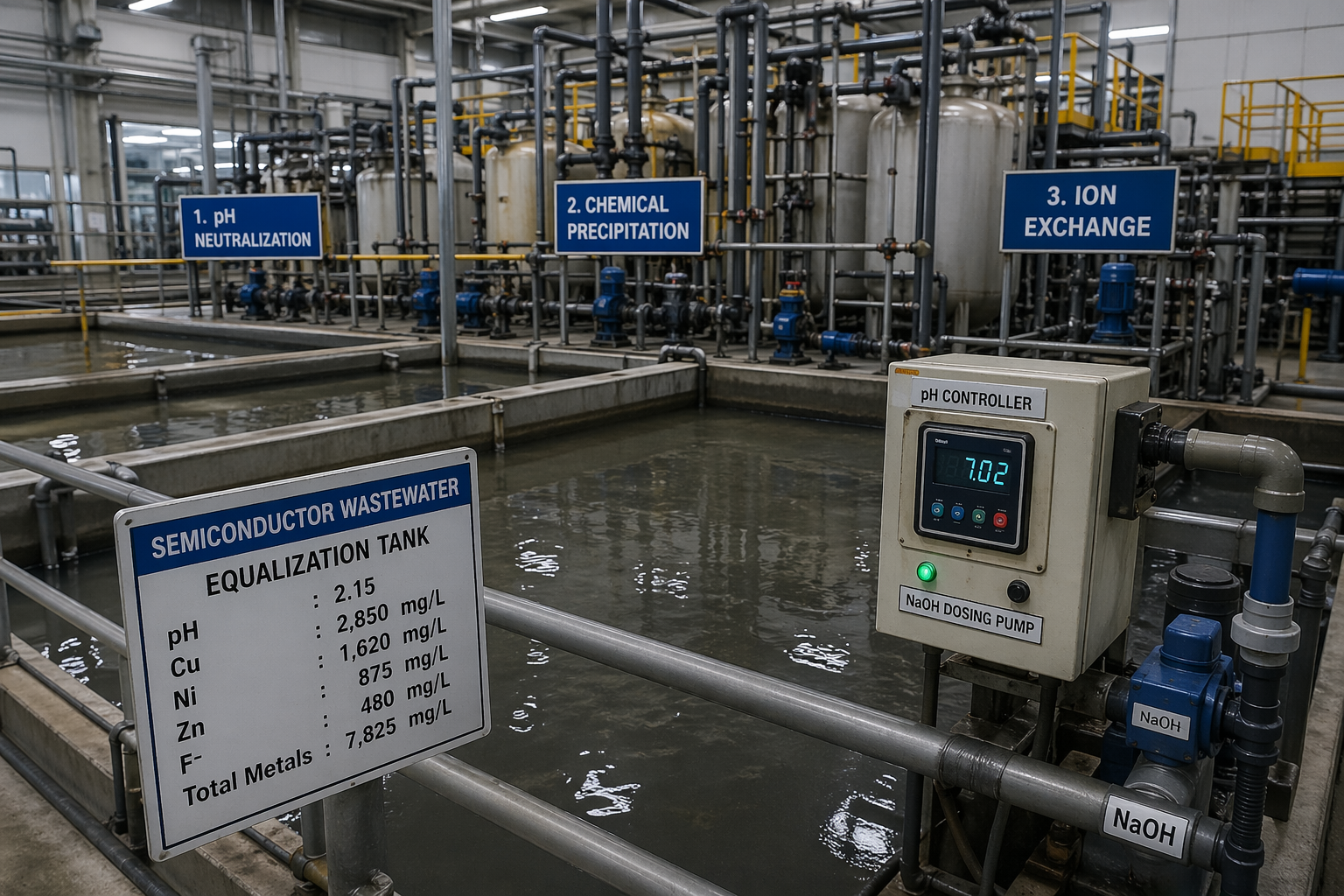
After neutralization, dissolved metals and salts are precipitated chemically. Alkaline precipitation with Ca(OH)₂ or NaOH raises pH to ~9–10, forming metal hydroxides (M(OH)ₓ). Cu²⁺ and Ni²⁺ precipitate as Cu(OH)₂/Ni(OH)₂ at pH ≈8–10; Pb²⁺ and Zn²⁺ around pH 8–9. Ferric salts (FeCl₃) or aluminum coagulants are often dosed to capture colloids and phosphate. Fluoride from HF usage is addressed by adding CaCl₂ (calcium chloride), precipitating insoluble CaF₂; recent work shows >90% removal of high F⁻ (e.g., >400 ppm) under optimized conditions (Taiwan patent; ACS ES&T Water). Other contaminants (silica, organics) may require separate processes.
Coagulation–flocculation is typically paired with precipitation to agglomerate particles; jar tests determine coagulant type and dose. Plants routinely select functional chemicals such as coagulants and, where needed, polymeric flocculants in this step.
Solids are removed by settling or filtration. In a thickener or a clarifier, heavy‑metal hydroxide flocs settle, while dissolved ions <10 ppm remain in the supernatant. Laboratory trials report >99% removal of target metals at the correct pH; one study achieved 99%+ removal of mixed Cu, Ni, Zn at pH ≈10 (IntechOpen). Lead removal >95% was observed using sulfide/carbonate precipitants at pH ≈11 (IntechOpen). In practice, expect >90–95% of heavy metals to be removed here. Sludge volumes can be large—sludge dry solids often several percent of influent mass—so allowance for sedimentation and sludge handling (centrifuges or filter presses) is required; precipitation’s trade‑offs include large sludge volume, strict pH control, and a separate solids‑removal step (IntechOpen; IntechOpen). Effluent leaving this stage should be within pH 6–9 to avoid downstream pH shock.
Ion exchange polishing and regeneration
Residual dissolved ions—trace metals, hardness, ammonia, nitrate—are polished by IX (ion exchange). Typical trains use strong‑acid cation exchangers (Na⁺‑form resins) and/or strong‑base anion exchangers in at least two columns (one in service, one standby/regeneration) (IntechOpen). At this polishing point, metal levels are low (often <10–20 mg/L), which supports resin efficiency. Examples span commercial and natural media: a Dowex HCR‑S resin removed 99.76% of 250 mg/L Cu²⁺ in 1 hour, leaving ~0.6 mg/L (IntechOpen); clinoptilolite and thomsonite zeolites achieved >95% Pb/Cd removal and ~100% Pb/Fe removal at 100 ppm initial solutions in lab testing (IntechOpen; IntechOpen). Engineered resins posted >99% copper removal and 93–99% removal of other metals at moderate concentrations (IntechOpen). After IX, metals can drop to sub‑mg/L levels, often meeting strict discharge limits. Media selection commonly centers on ion‑exchange resins, deployed in two‑column ion‑exchange systems for continuous service.
IX resins must be protected from particulates and co‑precipitation; a filter—such as a cartridge filter—or a softener typically precedes them, and stable pH prevents fouling (IntechOpen; review). Operation is cyclical: a column runs until partial exhaustion, then regenerates with dilute acid or base. Regeneration produces a small spent brine carrying concentrated metals (~1–10% of the original wastewater volume), which is collected for hazardous treatment or metal recovery. Designs include chemical storage for regenerants and safe brine disposal.
Performance, sludge, and costs
Combined precipitation + IX typically removes >99.5% of heavy metals: precipitation handles ≥90–99% of each metal, IX the remainder. In trials, a two‑stage approach reduced Cu from 2,500 mg/L to <0.6 mg/L—99.98% removal—by sequential precipitation/IX (Ultra Pure Water; IntechOpen). Other studies report multimetal effluents treated to below detection limits.
Precipitation generates substantial sludge—often 1–5% w/v of treated water—which is dewatered (e.g., gravity thickening and filter press) and removed, potentially to a Class C (non‑hazardous) landfill if pollutant standards for solids (PSCs) comply. IX adds only small regenerant brines, but they carry concentrated metals and require handling under hazardous rules (IntechOpen).
The economics favor on‑site treatment: trucking untreated semiconductor waste can cost about $15,000 per 4,000 gallons (Ultra Pure Water). Industry trends also point to recovery at even low concentrations and to reuse, driven by stricter standards and water scarcity (review). The staged design here produces clean effluent for discharge or reuse (meeting Indonesian or international limits) while concentrating contaminants into manageable residues; ZLD strategies target >99% water recovery.
Controls and compliance
Automated pH control and flow equalization keep treatment consistent despite variable loads. Under typical conditions, final effluent can comply with stringent standards (pH≈6–9, metals <0.1–0.5 mg/L) after >99% contaminant removal (review; IntechOpen). Implementation hinges on continuously monitoring influent composition, adjusting chemical doses using real‑time analytics, and ensuring safe handling of any hazardous byproducts—an approach supported by industry practice and published reviews (review; IntechOpen; IntechOpen).
Sources
- Semiconductor fab wastewater compositions and flows: Ultra Pure Water; J. Clean. Prod. review
- Acid/alkaline neutralization controls: Modutek; Modutek; Modutek
- Heavy‑metal precipitation fundamentals and efficiencies: review; IntechOpen; IntechOpen
- Ion‑exchange polishing performance and design: IntechOpen; IntechOpen; IntechOpen; IntechOpen
- Fluoride precipitation: TWI499562B; ACS ES&T Water
- Economics and trends: Ultra Pure Water; review
References
- Ultra Pure Water Tech Briefing (2010) — case study: ~2500–3500 ppm soluble Cu at pH 0.8; 4000 gal/4 days; $15k per load; discharge limit ~3 lbs/day.
- J. Clean. Prod. 429 (2023) — ~19.3% of Korea’s industrial wastewater (~177,937 m³/day) from semicon processes.
- Environmental Nanotechnology, Monitoring & Management 17 (2022) 100617 — precipitation widely used; ion exchange pH‑dependent.
- Environmental Nanotechnology, Monitoring & Management 17 (2022) 100617 — trend to metal recovery at low conc.
- IntechOpen (2023) — 99% removal at pH ~10.3.
- IntechOpen (2023) — >95% Pb removal with sulfide/carbonate at pH 11.
- IntechOpen (2023) — IX for trace metals; two‑column operation recommended.
- IntechOpen (2023) — clinoptilolite >95% Pb/Cd removal.
- IntechOpen (2023) — thomsonite ~100% Pb/Fe removal at 100 ppm.
- IntechOpen (2023) — Dowex HCR‑S 99.76% Cd removal @250 mg/L; >99% Cu removal and 93–99% other metals in mixed streams.
- Modutek blog (Oct 2019) — continuous vs. batch pH neutralization; dosing algorithms; monitoring needs.
- IntechOpen (2023); IntechOpen (2023) — precipitation disadvantages: large sludge volume; strict pH control; separate solids removal required.