

Industry: Desalination | Process: Seawater_Intake_&_Screening
At the forebay of a seawater intake, the two-stage screening train—coarse bar racks followed by traveling band screens—sets the tone for plant reliability and compliance. Industry data show roughly 89% of large industrial intake facilities rely on traveling screens for debris control (nepis.epa.gov), and modern vertical traveling-band screens can handle up to ~100,000 m³/hr per channel (www.nsenergybusiness.com).
These gatekeepers protect downstream seawater reverse osmosis trains—think </products/sea-water-ro>—where uninterrupted feed and stable head loss matter. The pairing is deliberate: bar racks grab the bulky trash, while the traveling band screens polish the flow and clean themselves (vdoc.pub; www.hendrickcorp.com).
Two‑stage intake screening train
Primary (coarse) screens are usually fixed bar racks at the intake forebay—widely spaced metal bars (often 50–300 mm apart) built to block large debris such as seaweed and logs (vdoc.pub). Through‑screen velocity (water speed through the screen’s open area) is typically 0.10–0.15 m/s; designers select ~0.1 m/s or less when heavy loads of jellyfish or other organisms are expected to keep vulnerable fauna from slamming into the screen (vdoc.pub).
In practice, bar lengths of 1–3 m per segment are common, and designers size up to ensure about 50% open area remains even after growth of oysters/shells or debris accumulation (vdoc.pub). One review assumes rack open area declines by ~30–50% every 18–24 months, necessitating regular diving or mechanical clearance cycles (vdoc.pub). Many intakes still deploy fixed “manual” rack strategies akin to a </products/manual-screen> approach where simplicity is paramount.
Traveling band screen capacity and automation
Traveling (band) screens serve as the secondary finer screen downstream. These are continuous conveyor screens—chains of heavy‑duty perforated panels with 2–10 mm openings—that move constantly through the water (hubert.nl). As self‑cleaning units, they automatically carry trapped debris and any impinged fish to the surface for removal (www.hendrickcorp.com).
They also permit much higher flow capacities than reciprocating rakes. Modern vertical traveling‑band screens (e.g., the Geiger design) can be 1–4.5 m long in the flow direction, 2.5–7 m wide in span, and handle up to ~100,000 m³/hr per channel (www.nsenergybusiness.com). A static bar rack can only pass flow proportional to its area. An EPA survey confirms the dominance of traveling screens: roughly 89% of large industrial intake facilities use them for debris control (nepis.epa.gov). Fixed bar/wedge‑bar screens occupy larger footprints and require manual cleaning, though with very low power needs. In short, a coarse bar rack guards against bulk trash, and a traveling‑band screen polishes the flow—often delivered today as an </products/automatic-screen> within broader </products/waste-water-physical-separation> packages.
Corrosion‑resistant construction (duplex and super‑duplex)
Seawater is extremely corrosive, and intake screens must be built of robust, marine‑grade materials. Historical experience shows that ordinary steels or low‑alloy 300‑series stainless (e.g., 304/316L) quickly fail in open‑ocean intakes; mid‑1980s SWRO plants using 316L or 317L stainless reported crevice and pitting corrosion at welds and couplings (stainless-steel-world.net). By the 1990s, 6% Mo (duplex) stainless steels were needed for larger systems, but even these experienced corrosion in unbuffered chlorinated seawater (stainless-steel-world.net).
Today’s industry has largely shifted to duplex and super‑duplex alloys for all critical intake hardware. Industry reviews note that all new brine and feed pipework in large SWRO plants (20,000–600,000 m³/d) now “specify the use of SDSS” to ensure longevity (stainless-steel-world.net), as installed SWRO capacity has jumped tenfold since 1990 (stainless-steel-world.net). Super‑duplex grades (e.g., UNS S32750/INV/ or Sandvik SAF 2507) have ~25–28% Cr plus Mo and N, giving them very high seawater resistance; one analysis observes that super‑duplex “is often considered self‑protective against high saline water,” so that even static equipment (like a bar screen) can survive decades without heavy maintenance (ro.scribd.com).
The downside is cost—super‑duplex alloys can be several times the price of 316L—but they reduce lifecycle costs by avoiding frequent replacements. For a bar rack or screen chamber (few welds, large continuous plate), specifying a single alloy (all parts in SDSS) avoids galvanic corrosion. In practice, designers aim for bulk SS304/316 minimal use; piping header manifolds and fasteners are often SDSS or cladded steel. Special materials (e.g., titanium or exotic liners) are rare due to cost, so reliance on thick duplex SS is the mainstream strategy (stainless-steel-world.net).
Structurally, intake screens need heavy reinforcement or framing to resist waves, storms, and debris impacts. Steel supports and rack frames are often heavy‑galvanized or epoxy‑coated, but in practice the alloy of the screen itself determines life. Because maintenance dives in rough conditions are undesirable, most new intakes spend the extra budget on corrosion‑resistant steels up front. In one Saudi 227,000 m³/d SGRO plant (Medina‑Yanbu, 1995), only a 6%Mo type (UNS S31254) stood up reasonably, and today virtually all pipework is SDSS (stainless-steel-world.net; stainless-steel-world.net). That upstream robustness underpins downstream </products/sea-water-ro> performance over decades.
Fish‑return system design and performance
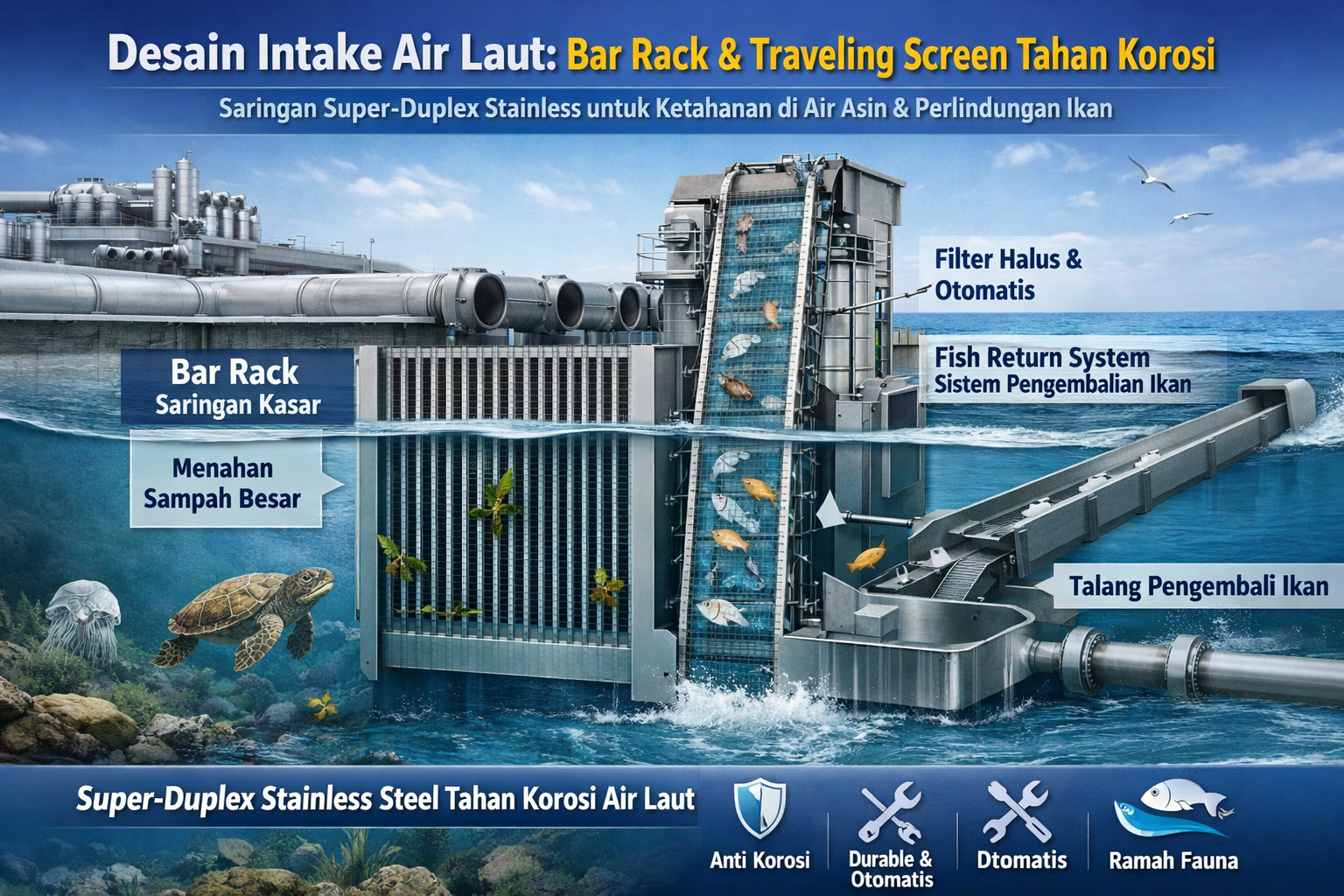
Screening cannot catch every organism, so fish return systems are required to handle impinged fauna humanely. On a typical traveling‑band screen, impinged fish are funneled by the screen belt into small “fish buckets” at the top. These buckets are emptied into a water‑filled gutter or holding tank away from the main debris wash area, then pumped or flushed directly back to open water (www.nsenergybusiness.com; www.hendrickcorp.com).
Key design features include: a separate depression or trough for the buckets so fish are not abraded by wash water, minimal drop height, and a low‑velocity “slip stream” conveyance to the discharge point (www.nsenergybusiness.com; hubert.nl). Bilfinger/Geiger designs deliberately widen the screen frame and add a fish‑gutter so fish are released separately from fine junk (www.nsenergybusiness.com); vendor literature likewise highlights “fish recovery gutters that allow trapped fish to be removed in a gentle and effective way” (hubert.nl).
Performance results are strong. In the lab, a modified vertical traveling screen tested with various temperate fish species—at approach velocities (water speed as it nears the screen face) of 0.3–0.6 m/s—showed ≤5% mortality for all fish (afspubs.onlinelibrary.wiley.com). In practice, designers keep through‑screen velocity low (e.g., 0.15 m/s or below) to match fish swim speeds, so impinged fish are merely held out of flow rather than slammed. The Hendrick Corp. notes that traveling screens carry fish gently to the head of the unit and discharge them “back to their environment” (www.hendrickcorp.com). In short, a well‑designed fish‑return system (bucket + trough + low‑speed discharge) can reliably achieve on the order of 95–100% survival for impinged fish.
Regulatory context and risk management
To meet environmental regulations (e.g., analogous to U.S. EPA 316(b) standards), designers must demonstrate minimal fish mortality. A practical solution is the “fish protection screen” (Drum/Disc or Band screen with fish buckets), which, by separating fish and debris handling, avoids crushing or suffocating the catch (www.nsenergybusiness.com; hubert.nl). Indonesia does not yet have desalination‑specific intake rules, but general fisheries protections would favor these same designs. From a business standpoint, adding a fish‑return system is relatively modest cost compared to the screens themselves, yet it eliminates risk of large fines or mandatory shutdowns due to impingement.
Key data and trends
- Modern large SWRO plants use bar racks followed by traveling screens in almost all cases (vdoc.pub; nepis.epa.gov).
- Bar racks typically use 50–300 mm spacing with ~1–3 m long bars, and are sized so ~50% open area remains under fouling; designers assume open area declines ~30–50% every 18–24 months (vdoc.pub).
- Traveling‑band screens (2–10 mm mesh) self‑clean and can handle 50,000–100,000 m³/hr each, with individual units 1–4.5 m long (flow direction) and 2.5–7 m wide (span) (www.nsenergybusiness.com).
- Conversion to super‑duplex stainless (e.g., SAF 2507) has become standard—one review notes that “almost all new build and expansion projects” specify SDSS piping and structures (stainless-steel-world.net).
- Fish‑friendly traveling screens showed post‑impingement mortality under 5% across species at approach velocities of 0.3–0.6 m/s (afspubs.onlinelibrary.wiley.com).
In practical terms, these outcomes—high debris removal, corrosion‑resistant longevity, and low fish mortality—support the business case for robust coarse/fine screening and materials selection in seawater intakes that feed </products/sea-water-ro> systems, often implemented as automated packages akin to an </products/automatic-screen> layered after a coarse barrier comparable to a </products/manual-screen>.
Sources and design references
Authoritative design manuals and case studies (vdoc.pub; stainless-steel-world.net), industry publications (stainless-steel-world.net; www.hendrickcorp.com), and peer‑reviewed evaluations (afspubs.onlinelibrary.wiley.com) underpin the parameters cited here. References include Byrne & Hicks (2024); Kanth (IDA 2019); Voutchkov (2016); Hendrick Corp. (2018); NS Energy (Bilfinger) 2018; Black & Perry (2014); U.S. EPA 316(b) TDD (2002), among others (stainless-steel-world.net; ro.scribd.com; vdoc.pub; www.nsenergybusiness.com; www.hendrickcorp.com; afspubs.onlinelibrary.wiley.com).