

Industry: Aquaculture | Process: Recirculating_Aquaculture_Systems_(RAS)
In intensive RAS, stocking and feeding generate a steady stream of ammonia (total ammonia nitrogen, TAN) that must be oxidized to less-toxic nitrate by nitrifying biofilters. Ammonia production is roughly 3–4% of feed mass — about 30–40 g TAN per kg feed — so design is driven by the incoming load and the need to remove “new” TAN continuously (globalseafood.org). Toxicity thresholds are tight: operators aim for unionized NH₃-N < 0.05 mg/L and watch species-dependent nitrite sensitivity (globalseafood.org) (globalseafood.org).
Because RAS typically recycles 90–99% of water compared to pond culture, nearly all TAN must be removed biologically (pubs.acs.org). In practice, designs target system TAN (unionized NH₃) < 1–2 mg/L with robust, 24/7 biofiltration.
Load‑driven biofilter sizing
Biofilter sizing is commonly expressed as volumetric nitrification capacity (grams of nitrogen per cubic meter of filter per day, g‑N/m³·d) or as feed load per volume of media. Thomas Losordo recommends sizing moving‑bed biofilm reactors (MBBRs) for 350–500 g‑NH₄⁺‑N/m³·d — roughly 10–14 kg feed per day per m³ of media, given ~3.5% of feed becomes TAN (globalseafood.org).
Temperature, media surface area, and hydraulics matter. In coldwater (8 °C) trout RAS, Suhr et al. measured ~23 g‑N/m³·d in a moving‑bed filter versus 92 g‑N/m³·d in a similarly large fixed‑bed unit; on a per‑surface basis, 0.27–0.46 g‑N/m²·d (orbit.dtu.dk) (orbit.dtu.dk). And because nitrifying biofilters are not meant to remove carbonaceous BOD, solids and organics should be taken out upstream with screens or mechanical filtration to avoid overloading nitrifiers — an application where an automatic screen is commonly deployed.
Moving‑bed biofilm reactors (MBBR)
MBBRs keep millions of buoyant plastic carriers (often HDPE Kaldnes‑type) in suspension by aeration or flow. The format is compact — often tall, robust tanks — with low head loss (10–20 cm) and continuous, gentle biofilm sloughing. Each carrier typically offers 300–800 m²/m³ surface area (globalseafood.org) (globalseafood.org).
Design capacities are reported at 350–500 g‑NH₄‑N/m³·d, aligning with Losordo’s 10–14 kg feed per m³‑filter per day guidance (globalseafood.org). In operation, MBBRs achieve stable nitrification with little head loss and modest oxygen demand, are energy‑efficient (aeration is the main power draw), and mature quickly once seeded. Drawbacks: lower surface area than fluidized sand and some abrasion risk from fines, though carriers are designed to be long‑lived. For packaged systems, vendors position moving‑bed bioreactors for this exact duty.
Submerged fixed/packed beds
Fixed beds hold static media — think plastic rings, cubes, or mats — in upflow or submerged downflow configurations. Static media may provide less surface per reactor volume (Suhr et al. used 200 m²/m³ Bioblocks vs 850 m²/m³ in MBBR carriers), often requiring larger filter volume (orbit.dtu.dk).
Nitrification rates can reach a few hundred g‑N/m³·d. In the 8 °C study, fixed beds averaged ~92 g‑N/m³·d (0.46 g‑N/m²·d), rising to 146 g‑N/m³·d after adaptation, while the MBBR stayed around 23 g‑N/m³·d (orbit.dtu.dk). In warmer conditions, 200–400 g‑N/m³·d is plausible. Pros: mechanical simplicity and no media loss; cons: clogging risk without backwash and rising pressure drop at higher flows. Operators sometimes stage beds for ammonia oxidation (Nitrosomonas) and nitrite oxidation (Nitrobacter). Submerged designs tolerate low flows and can degas CO₂ well if configured as trickling. Equipment makers categorize these as fixed-bed bio reactors.
Fluidized sand reactors
Fluidized beds are continuous upflow reactors that “boil” fine sand (typically 0.3–0.8 mm silica) to create enormous surface area — on the order of 5,000 m² per m³ of bed (globalseafood.org). Their volumetric capacity far exceeds plastic systems (globalseafood.org). In practice, well‑operated units approach 0.5–1.0 kg NH₄‑N/m³·d removal (orders of magnitude above static beds) (researchgate.net) (researchgate.net).
Trade‑offs: higher pump energy to fluidize, attention to bed expansion head, and screens or settling zones to prevent sand carryover. Sand is inexpensive but losses must be replenished. These reactors are sensitive to organic load and can choke or stratify if solids or excess biofilm bridge particles; in warm, high‑organic RAS, operators note potential instability (globalseafood.org). On the upside, high nitrifier biomass and mixing yield rapid startup once seeded. Media choices often start with sand/silica sized for reliable fluidization.
Less‑common options
Rotating biological contactors (RBC) and trickling filters are less common in indoor RAS because they require large area or heavy structural support. Trickling towers can nitrify while aerating, but their large air‑to‑water transfer needs and footprint often suit outdoor pond systems more than intensive RAS.
Media selection and management
Plastic carriers — K1 rings, cylinders, wheels — typically deliver 300–1,000 m²/m³ of surface. Examples include Kaldnes K1 (~500 m²/m³) and bioballs (~600 m²/m³). Plastic is inert, buoyant, and long‑lived, with design life often >10–15 years under proper use (aquasust.com). Studies have found comparable nitrification on certain natural biomedia: Mnyoro et al. measured ≈600 g TAN/m³·d on coconut shell — on par with plastic — suggesting that high‑surface alternatives (e.g., ceramic, recycled materials) can substitute if affordable (orbit.dtu.dk). Activated media such as activated carbon also appear in these comparisons.
Beyond classic fluidized sand, some fixed‑bed designs use sand/gravels in upflow filters if solids are well‑removed upstream. Sand’s surface area (thousands m²/m³) gives unmatched capacity but weight limits its use to fluidized or shallow beds. Emerging low‑cost media — coconut husk, biochar — show promise, with coconut shell reported at 599 ± 16 g‑N/m³·d nitrification in one study; long‑term durability still needs testing (orbit.dtu.dk). Zeolites or pumice can adsorb NH₄⁺ chemically and biologically but are more costly.
All media accumulate biomass. MBBR geometry and motion naturally shear excess film; packed beds require periodic backwash or resting flow. Operators watch pressure drop and dissolved oxygen (DO): a rising head loss flags overload. Downstream of fluidized beds, sand traps or secondary clarifiers help prevent media loss. In normal use, plastic carriers seldom fail for over a decade (aquasust.com).
Startup chemistry and seeding protocol
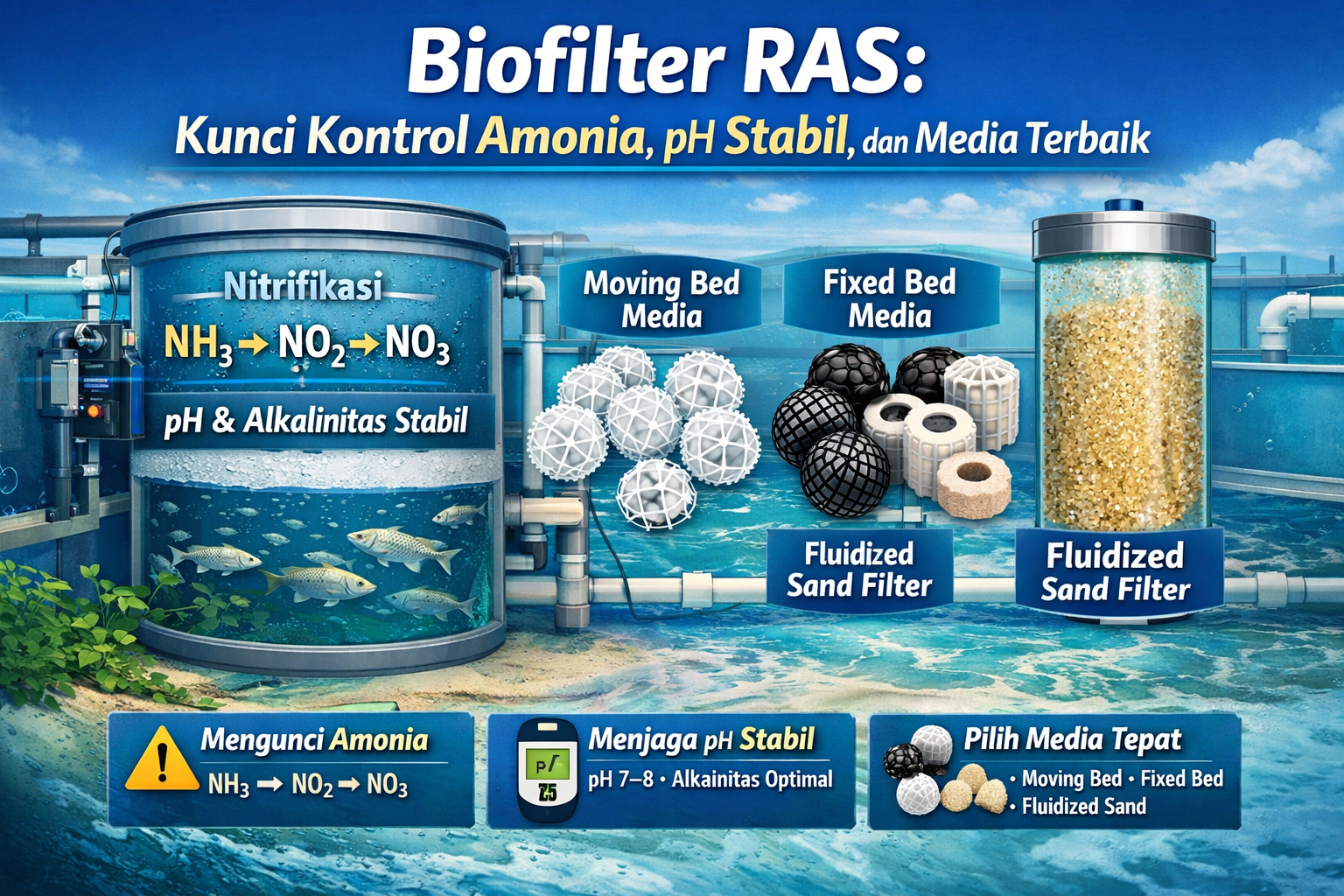
Start with clean, dechlorinated water adjusted to pH ~7–8, and provide carbonate buffer — e.g., sodium bicarbonate — at ~100 mg/L as CaCO₃ equivalent (globalseafood.org). If residual chlorine is present, a dechlorination agent protects the new biofilm. Nitrification consumes alkalinity: 7.14 mg as CaCO₃ per mg‑N oxidized, so buffering is a startup requirement (cwea.org). Some experts report improved Nitrobacter growth when initial alkalinity is 150–200 mg/L; maintaining residual alkalinity of ~70–80 mg/L after nitrification helps keep pH near neutral (globalseafood.org) (cwea.org).
Feed the bacteria with ammonia. Dose clear household ammonia (NH₄OH) or ammonium chloride to raise TAN to ~3–5 mg/L, verifying with test kits (globalseafood.org). As an example, ~60 mL of 10% NH₄OH in 1,000 L produces ~1.6 mg/L NH₄‑N; dose gradually, mix, and re‑measure until the target is reached (globalseafood.org). This level is high enough to show up clearly on test strips but not so high as to cause acute toxicity (0.5 mg/L TAN is a safe ceiling without fish). Re‑dose daily back to 3–5 mg/L as the biofilter consumes TAN. Aerate vigorously to keep DO ≥ 7 mg/L — nitrification slows markedly below ~6–7 mg/L — and run at the intended culture temperature (warmer accelerates growth) (orbit.dtu.dk).
Introduce nitrifying biomass. The most effective seeding is to transfer media from a mature, similar biofilter (matching salinity/temperature). Alternatively, add a commercial starter alongside ammonia; the bacteria still need time and substrate (globalseafood.org) (globalseafood.org). Suppliers position starter bacteria specifically for this step.
Monitor TAN, nitrite, nitrate, pH, and alkalinity daily. Expect an ammonia spike and fall, followed by a nitrite rise and fall, and then nitrate appearance — graphing helps track progress (globalseafood.org) (globalseafood.org). Full cycling typically takes 4–8 weeks (longer in cold water). When TAN and NO₂⁻ peak near zero (< 0.5 mg/L each) under sustained ammonia input, the biofilter is mature; begin stocking and feeding incrementally. Continue alkalinity dosing during startup and operations to offset the ~7.14 mg/L CaCO₃ consumed per 1 mg/L TAN removed (cwea.org). Automated systems often meter bicarbonate with a dosing pump to maintain setpoints.
Alkalinity and pH operations
Nitrification both requires and consumes alkalinity. For every 1 mg NH₄⁺‑N oxidized (to NO₂⁻ and onward), ~7.14 mg CaCO₃ equivalent is used up; without additions, pH will drift down. Below ~6.0–6.5, Nitrobacter (nitrite oxidizers) lose activity, risking nitrite accumulation; at >8.5, unionized NH₃ increases and is toxic (cwea.org). Hence operators buffer to pH ~7–8 (cwea.org).
Targets: raw alkalinity ≥ 100 mg/L as CaCO₃, with many recommending 150–200 mg/L for smooth establishment of both nitrifier groups; once established, keep residual ~70–80 mg/L to prevent swings (globalseafood.org) (cwea.org). Sodium bicarbonate is favored for ease of dissolution and provision of inorganic carbon; where hardness is very low, operators may consider soda ash or lime, but bicarbonate is generally safer for pH stability. As an example of dosing scale: if a filter removes 100 mg/L TAN, it consumes ~714 mg/L CaCO₃ equivalent, implying ~3,500 g CaCO₃ (or ~4,150 g NaHCO₃) per 5 kg feed would be needed. Many RAS managers add bicarbonate daily or bi‑weekly to keep alkalinity ~100–150 mg/L, and some systems automate bicarbonate dosing linked to CO₂/alkalinity sensors. In practice, frequent testing is essential; “lack of carbonate alkalinity will stop nitrification” (cwea.org).
Measurable performance benchmarks
- Nitrification capacity: MBBRs can nitrify 350–500 g NH₄‑N/m³·d (globalseafood.org). Fluidized sand reactors, with ~5,000 m²/m³ media, far exceed that — approaching 800–1,000 g/m³·d in lab tests (researchgate.net) (researchgate.net). Packed fixed beds vary widely (often 100–400 g/m³·d depending on temperature and media volume) (orbit.dtu.dk).
- Media area: plastic carriers typically ~200–1,000 m²/m³; sand ~5,000 m²/m³ (globalseafood.org). Higher surface raises rates if oxygen and nutrients reach the biofilm.
- Footprint/energy: MBBRs and fluidized beds have small footprints per unit load (fluidized the smallest) but require blower/pump energy for mixing. Packed beds can run shallow/long with gravity feed, lowering energy but taking more space.
- Biofilter lag‑time: with warm startup, appreciable nitrification (>1 mg NH₄ removal) can appear in 1–2 weeks; full cycling (stabilized NO₂ removal) often needs 4–8 weeks. Seed media and warm temperatures shorten acclimation (globalseafood.org) (globalseafood.org) (globalseafood.org).
- Alkalinity consumption: expect ~7.1 mg/L CaCO₃ drop per 1 mg/L NH₄‑N removed; e.g., converting 50 mg/L TAN consumes ~360 mg/L CaCO₃ (cwea.org).
- pH sensitivity: nitrification rate peaks around pH 7.5–8.5; below ~6.0 it falls precipitously, so operators maintain RAS pH ≥ 7.0 (cwea.org).
Authoritative sources — peer‑reviewed studies and industry handbooks — underpin these values and design rules, including Losordo’s feed‑to‑filter sizing and nitrification rates (globalseafood.org), Suhr et al.’s fixed vs. moving‑bed performance quantification (orbit.dtu.dk), and reviews confirming the enormous capacity of fluidized systems (globalseafood.org) (researchgate.net). This evidence‑based guidance should help engineers and operators design and manage RAS biofilters with confidence.
Sources: peer‑reviewed articles, industry publications, and technical guides (cited inline above) were used to extract all figures and recommendations (globalseafood.org) (orbit.dtu.dk) (globalseafood.org) (orbit.dtu.dk) (globalseafood.org) (globalseafood.org) (cwea.org). Any Indonesian‑specific regulations in this context are limited (e.g., general water‑quality standards); focus was on broadly applicable aquaculture engineering research.