

Industry: Aquaculture | Process: Hatchery_&_Larval_Rearing
Live feed is a double‑edged sword in marine hatcheries. Artemia cysts routinely arrive carrying 10^6–10^7 CFU/mL (colony‑forming units per milliliter) of bacteria — mainly Vibrio — on their shells, and those microbes can bloom at high cyst densities and temperatures during hatching, seeding disease outbreaks (FAO) (FAO).
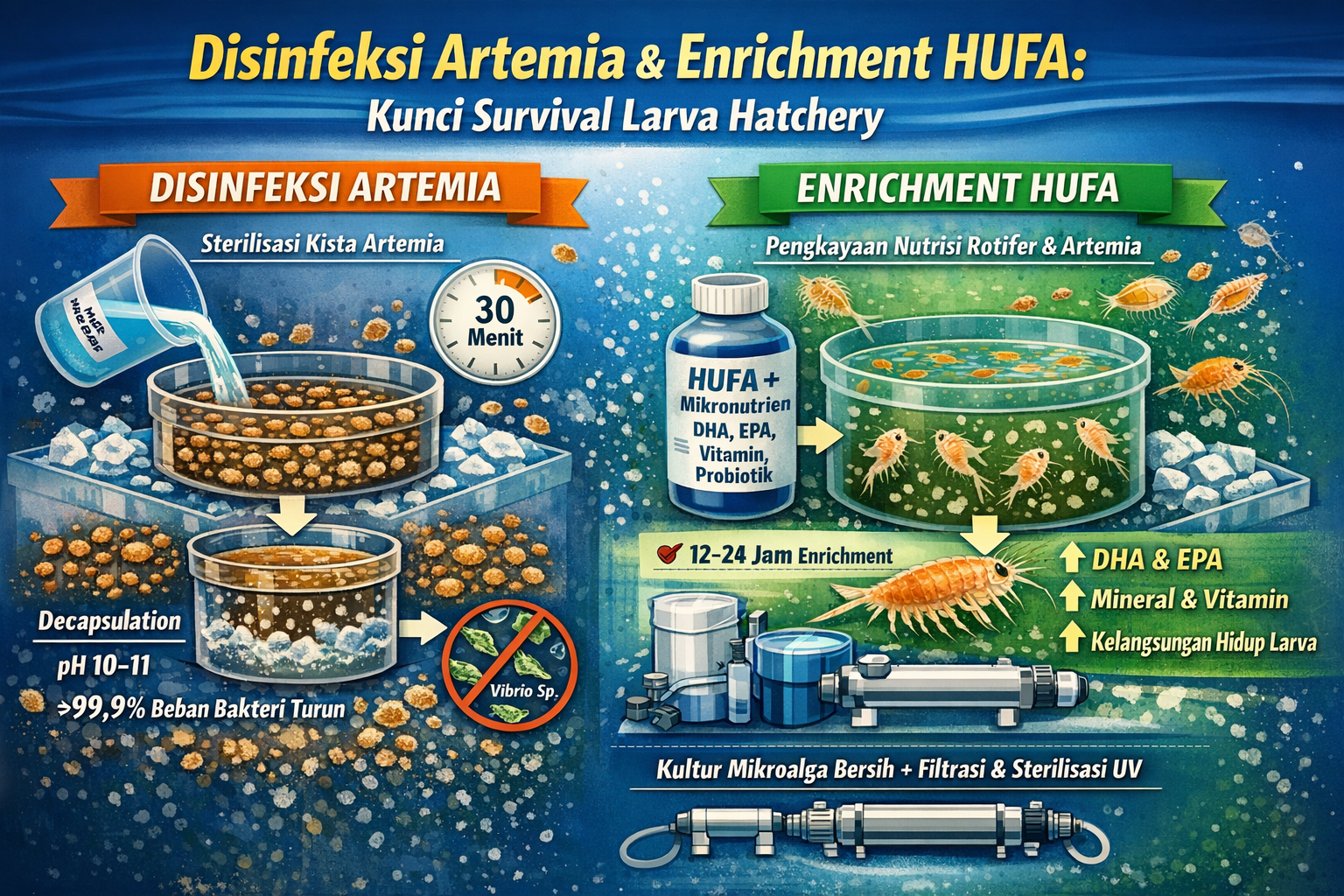
The countermeasure is brutally simple and surprisingly effective: disinfect — and then enrich. A 30‑minute, ~200 mg/L sodium hypochlorite (NaOCl; liquid bleach) bath before hatching at ~50 g cysts/L, followed by structured HUFA (highly unsaturated fatty acids) enrichment, has become standard practice (FAO).
Chemical cyst disinfection parameters
FAO guidance is explicit: soak Artemia cysts 30 minutes in ~200 mg/L NaOCl at ~50 g cysts/L; in practice, that equates to ~20 mL of 11–13% bleach per 10 L seawater, then rinse the cysts on a 125 µm sieve until no chlorine odor remains (FAO).
The pay‑off is immediate: surface bacterial counts drop by >99.9%, yielding “disinfected” nauplii (FAO) (FAO). Hatcheries aiming for reproducible dosing typically standardize chemical addition with an accurate dosing pump to avoid overdosing live feeds.
Decapsulation workflow and outcomes
For complete sterilization, many operators decapsulate, oxidizing the shell after a 1–2 h hydration. The benchmark is ~0.5 g active hypochlorite per g cyst buffered to pH 10–11 (with NaOH or Na2CO3), under aeration and ice‑cooling to ~15–20 °C; after ~3–15 minutes — signaled by a grey/orange color shift — cysts are removed and rinsed thoroughly (FAO) (FAO).
A deactivation dip in 0.1 N HCl (hydrochloric acid) or 0.1% sodium thiosulfate neutralizes residual chlorine (FAO). Decapsulation yields pathogen‑free, shell‑free nauplii; Indonesian extension literature notes decapsulated Artemia are “free from contaminants, fungi and other harmful microorganisms” (Buleleng extension). Commercial dechlorination is routinely supported by a dechlorinations agent to ensure zero residual oxidant reaches larvae.
Nutritionally, decapsulation is not just hygiene. Decapsulated nauplii deliver ~30–55% more energy per animal (because they have not spent energy breaking out), and hatchability often rises markedly — with hatch output increases of +23–144% across cyst strains (FAO) (FAO). In carp larviculture, using decapsulated cysts cut Artemia usage by ~33% compared to live nauplii (FAO).
Alternative oxidizers and neutralization steps
A hydrogen peroxide dip on fully hydrated cysts — e.g., 5% H2O2 for 5–10 minutes — further reduces microbes without harming viability if tightly controlled (FAO). Exposure is time/temperature‑sensitive: limit to ≤10 minutes and rinse immediately to avoid toxicity (FAO) (FAO). Iodophors (e.g., povidone‑iodine) or other halogens are less common for cysts but remain standard for fish eggs.
Across protocols, rigorous rinsing and neutralization prevent disinfectant carryover. Routine disinfection is now standard because “live food can be an important source of pathogenic bacteria” (FAO). Left unchecked, Vibrio and fungal loads in hatching tanks can reach ~10^7 CFU/mL (FAO).
HUFA bioencapsulation protocols
Rotifers and newly hatched Artemia lack adequate LC‑PUFA (long‑chain polyunsaturated fatty acids) such as EPA, DHA, and ARA relative to copepods; deficiencies impair larval growth and immunity (MDPI/PMC) (PMC).
The fix is bioencapsulation: feeding live prey nutrient‑rich emulsions shortly before use. Commercial HUFA emulsions (e.g., Alltech’s Super Selco®, DHA Selco®, Selco S.presso®) are widely used to boost prey DHA/EPA (PMC). Typical Artemia protocols add ~0.2–0.5 g/L emulsion with aeration for ~12–24 hours, often starting ~6 hours post‑hatch.
Performance data are clear. An 18‑hour enrichment with DHA‑rich microalgal emulsions lifted Artemia DHA from 0.61% to 3.15% of total fatty acids (about 5× higher) and tripled 22:5n‑6 (DPA) (PMC) (PMC). Penaeus vannamei postlarvae fed these enriched Artemia showed ~70% higher DHA content (9.8% vs. 5.8% of total FA), alongside more robust hepatopancreas development and cell integrity (PMC) (PMC).
Across trials, HUFA enrichment raises larval tissue EPA/DHA by 2–3× and improves stress tolerance (PMC) (PMC). For fish larvae, rotifer DHA can be driven from ~0.1% to >15% by co‑feeding microalgae and emulsions (MDPI/PMC), with common practice enriching rotifers for 12–24 hours at 15–20 ×10^3 cells/mL using emulsions or algal pastes. Meta‑analyses affirm that elevating rotifer DHA/EPA significantly improves larval outcomes (PMC) (MDPI/PMC). In one case, enrichment raised cod larval DHA content by ~1.7× and survival by >>X% (data above).
Micronutrient co‑enrichment strategies
Beyond lipids, live feeds often run short on micronutrients. Rotifers tend to contain much less vitamin C, iodine, zinc, and selenium than copepods (MDPI/PMC) (ResearchGate).
Co‑enrichment closes those gaps. Rotifers dosed with ascorbyl palmitate (a stable vitamin C form) have delivered significantly higher larval growth (MDPI/PMC). Matching copepod trace profiles — for example, enriching rotifers with iodine and selenium — produced Atlantic cod larvae with 32% higher survival than controls (ResearchGate).
Trace shortfalls are material: rotifers typically carry ~50–90% less Zn, Se, and I than copepods (ResearchGate) (ResearchGate). Hatcheries tailor baths accordingly; additions such as 1–5 mg/L Se or 0.5–1 mg/L iodine to rotifer/Artemia baths have been reported to improve stress and disease resistance in finfish larvae (c.f. Hamre et al., 2008).
Probiotic enrichment in live feeds
Beneficial bacteria are emerging as a high‑leverage add‑on. In an Indonesian shrimp hatchery experiment, enriching rotifers and Artemia with Bacillus licheniformis + Bacillus subtilis at 10^6 CFU/mL lifted shrimp larval survival to ~65% versus ~25% in unenriched‑fed controls — a 2.6× improvement — and larvae grew ~30% larger (PubMed).
Bacillus spp. likely outcompete opportunistic Vibrios and supply digestive enzymes. Other labs report similar benefits using Bacillus, Lactobacillus, or Phaeobacter (PubMed). Best practice introduces probiotics during enrichment — e.g., co‑culture live feed with 10^5–10^6 CFU/mL for several hours — rather than dosing larval tanks directly.
Quantified enrichment protocols and verification
Effective programs quantify inputs and timing. A common template incubates rotifers or Artemia in green water with >200 mg/L emulsified DHA or a mixed microalgal diet (Isochrysis, Nannochloropsis, Chlorella) for 12–24 hours, followed by a rinse or transfer to clean water before feeding (FAO) (FAO).
Verification matters. Subsampling enriched prey for gas chromatography confirms target fatty acids, and published studies consistently tie these steps to measurable gains in larval growth, survival, and stress resistance (PMC) (PubMed).
Pathogen‑free algal starter cultures
High‑quality algae underpin live‑feed systems. Axenic (pathogen‑free) or tightly controlled cultures of Isochrysis galbana, Nannochloropsis oculata, Chaetoceros calcitrans, or Tetraselmis sp. are recommended; contamination sources include the starter inoculum, unfiltered seawater, air, and vessels (FAO).
In practice, completely axenic cultures are costly, so many farms run “xenic” systems but minimize risk. Intake seawater is often filtered through sand and carbon and then UV‑sterilized (PMC); dual‑media beds such as a sand/silica filter or an activated‑carbon unit are common pre‑UV steps, with a downstream ultraviolet reactor providing 99.99% pathogen kill without chemicals. Cultureware and transfer lines are sanitized between batches, and 0.2 µm‑filtered seawater is used for starters (FAO).
Operationally, maintain moderate algal densities (≤2×10^6 cells/mL) to avoid self‑shading and oxygen depletion, and monitor via microscopy or PCR to catch invaders early.
Nutrient media formulations and ratios
Algal growth depends on balanced macro‑ and micronutrients. Enriched seawater recipes — Walne or Guillard’s F/2 — supply nitrogen, phosphorus, silica (for diatoms), trace metals, and vitamins (FAO) (FAO).
F/2 delivers ~75 mg/L nitrate‑N, 5 mg/L phosphate‑P, and (for diatoms) 30 mg/L silicate (FAO). Trace metals include micromolar Fe as FeCl3 plus Co, Cu, Mn, Mo, Zn with EDTA chelate, and vitamins thiamine (B1), cyanocobalamin (B12), and biotin (FAO) (FAO).
To cut costs, many hatcheries use simplified fertilization (urea or ammonium salts plus K2HPO4 and micronutrient mixes), but skipping micronutrients slows growth: Fe or vitamin starvation depresses cell density and HUFA content; iron limitation tends to trigger excess lipid accumulation while cell division stalls, shrinking biomass output. An N:P ratio near ~15:1 (Redfield) supports maximal algal protein content (FAO).
Consequences are measurable. FAO manuals note inadequate seawater enrichment limits phytoplankton yield and larval growth; rotifers fed under‑fertilized algae show >20% drops in protein and HUFA (FAO). Well‑fertilized cultures can reach >10^7 cells/mL and ~0.5–1.0 g/L dry biomass within days. Practical monitoring targets chlorophyll and cell counts, e.g., 1–5 ×10^6 cells/mL for Thalassiosira or Chaetoceros diatoms. Nutrient dosing consistency is often maintained with a hatchery‑grade dosing pump to keep media stoichiometry on spec.
Documented outcomes and sources
Across systems, the thread is consistent: upstream investments in sterile intake water, balanced media, and quantified enrichment translate into denser, nutrient‑rich live feeds and larvae with higher growth, survival, and stress tolerance (PMC) (PubMed); by contrast, cheap or diluted media tend to yield “thin” algae and weak feed.
Sources: peer‑reviewed aquaculture literature and FAO manuals on live feeds. Notably, FAO guidelines detail effective bleach and peroxide disinfection protocols (FAO) (FAO). Experimental studies document enrichment outcomes — DHA/EPA boosts in Artemia and larval tissues (PMC) (PMC) — and survival gains with probiotic‑fed live feed (PubMed). Indonesian extension materials echo these points (e.g., decapsulation and culturing guidance) (Buleleng extension).