

Semiconductor fabs move thousands of tons of corrosives, solvents and toxic gases every year, and one acid alone can dominate the waste stream. Here’s the safety, storage, transport and disposal protocol—down to the permits and PPE—that keeps operations compliant and workers safe.
Industry: Semiconductor | Process: Wafer_Fabrication
Semiconductor plants are chemical powerhouses. One study of Korean wafer fabs found an average of ~210 chemical products on-site, covering 135 distinct constituents (pmc.ncbi.nlm.nih.gov). Annual liquid use averaged ~10,495 tons per fab (range 241–44,371 t) plus dozens of gas/solid materials (pmc.ncbi.nlm.nih.gov).
The hazard mix spans corrosives, flammables, oxidizers and toxic or reactive materials. Hydrofluoric acid (HF, a highly corrosive etchant) is so prevalent that HF waste can account for >40% of a fab’s hazardous waste stream (www.mdpi.com). The scale and diversity mean robust controls for handling, storage and disposal are mandatory.
Hazard profile and scale
Typical risk sources include acid baths, solvent benches and toxic hydrides (arsine, phosphine), as well as flammable silane. Local inventories are documented down to product and constituent counts, reflecting hundreds of hazards in routine use (pmc.ncbi.nlm.nih.gov). Volumes fluctuate widely by site, with some fabs exceeding 40,000 t of liquids annually (pmc.ncbi.nlm.nih.gov).
Etch acids such as HF dominate the waste picture in many lines, making engineered neutralization and sludge handling a critical compliance anchor (www.mdpi.com).
Training and procedural controls
All personnel are trained on Safety Data Sheets (SDS) and hazard communication, and each chemical/gas has a documented Standard Operating Procedure (SOP) covering compatible tools and utensils. Employers identify and evaluate exposures under established guidance (www.osha.gov).
Inventory discipline is part of the control layer, including an up‑to‑date chemical list and the “B3 report” in Indonesia. Regular inspections and clearly posted run/stop procedures keep responses consistent, with MSDS and first‑aid plans readily available.
Engineering controls and monitoring
Modern fabs lean on enclosed systems and automated delivery—closed chemical supply lines, sealed hoods—and integrate leak‑detection sensors and automatic shutoffs on gas pipes and process chambers (www.nist.gov). Local exhaust systems (fume hoods, scrubbers) capture vapors at source to maintain breathing‑zone concentrations well below limits.
Continuous gas monitoring alarms are standard for toxic hydrides (arsine, phosphine) and flammables (silane). Cleanroom air is filtered and rapidly recirculated to dilute any fugitive emissions (www.nist.gov). Corrosive service lines and housings in acid areas often use corrosion‑resistant materials; facilities standardize on composite options such as FRP cartridge housings for chemical resistance where filtration is integrated into feed or waste loops.
Emergency preparedness systems
Spill‑response kits (absorbents, neutralizing packs) are staged in process areas, and staff are trained for cleanup and evacuation. Emergency eyewash and shower stations are positioned where corrosive materials are handled (www.osha.gov).
Indonesia’s guidance explicitly recommends a spill kit with neutralizing agents for large spills (sib3pop.menlhk.go.id). After widespread adoption of such controls and training, overall incident rates among semiconductor workers have dropped steadily and are now among the lowest of all manufacturing industries (www.nist.gov; www.iloencyclopaedia.org).
Storage and segregation standards
Segregation by hazard class is baseline: acids are stored separate from caustics or oxidizers; flammables reside in approved flammable‑liquid cabinets; oxidizers are isolated from combustibles. Pressurized gas cylinders (H₂, N₂O, NH₃, silane) are upright, secured by straps or chains, with valve caps on when not in use, in well‑ventilated areas away from heat sources. NFPA/OSHA guidelines—or Indonesian equivalents—determine quantities per cabinet or room.
Secondary containment is routine: compatible, clearly labeled containers under roof with drip trays or dykes; tanks of acids or solvents rely on double‑wall designs or spill pallets. Indonesian regulations emphasize that B3 chemicals demand special handling in storage (sib3pop.menlhk.go.id).
Ventilated storerooms and separate enclosures house incompatible chemicals (e.g., chromic acid apart from organic solvents). Certain gases (oxygen, high‑purity NF₃) require climate control; flammables are kept cool and away from ignition sources. Inventory control uses GHS (Globally Harmonized System) labels and up‑to‑date SDS for all containers. Indonesian law (KEP‑187/1999) mandates a report on chemical quantities for all B3 substances (sib3pop.menlhk.go.id), and sites limit on‑hand volumes to operational needs.
Transport compliance and manifests
Shipments—on‑site moves or off‑site transport—follow hazardous goods rules (UN Model Regulations; IATA for air; ADR for road). Each package or cylinder carries the correct UN number, hazard labels and emergency contact information, with transport documentation (MSDS or technical sheet) traveling with the load.
Packaging uses UN‑certified drums or cylinders. Bulk trucks for acids or solvents incorporate double‑valving and truck‑mounted containment (bunds). Cylinders are manifolded or individually locked, and pulse lines from central liquid gas supplies reduce cylinder swapping.
Handlers are trained/certified for hazardous materials (including DGSA—Dangerous Goods Safety Adviser—in EU/Indonesia context) and equipped with PPE for loading/unloading. Chain‑of‑custody records (manifests) accompany all outgoing hazardous waste under “cradle‑to‑grave” accountability (www.nist.gov). In Indonesia, moving B3 waste involves licensed carriers and prior notification to authorities.
PPE specification and respiratory protection
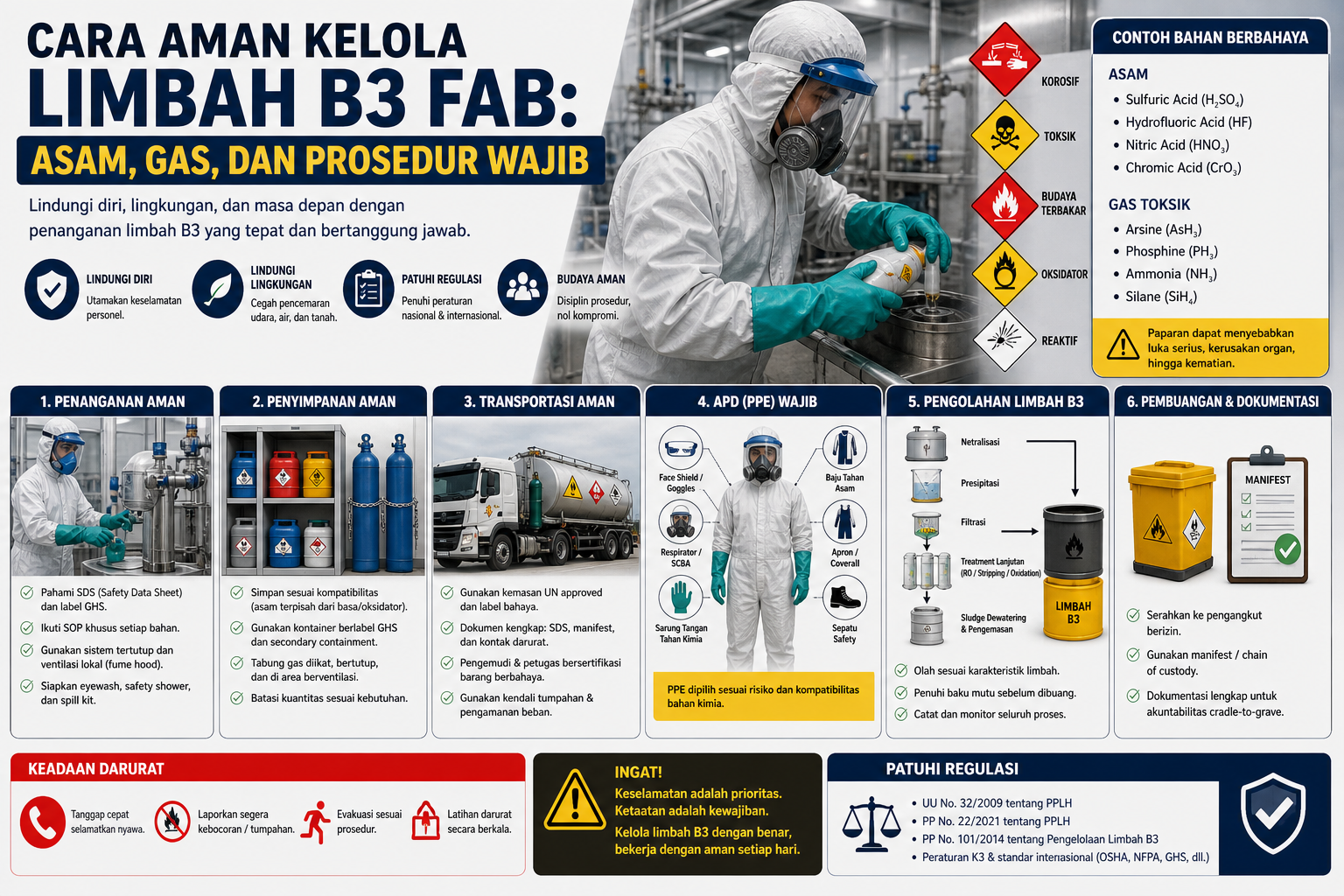
Eye and face protection covers splash goggles and face shields; indirect‑vented chemical goggles paired with a full‑face mask or hood are used for corrosive splash zones. Skin protection includes acid‑resistant aprons or suits (polyethylene‑coated or neoprene) and chemical‑resistant gloves chosen for compatibility (nitrile, butyl, neoprene or PVA). Many fabs require full‑body “acid suits” with SCBA (self‑contained breathing apparatus) for HF operations, and PPE is inspected to ANSI/ISEA standards prior to use.
Respirators are provided when airborne concentrations might exceed limits: supplied‑air or SCBA for toxic gases (arsine, HF), particulate masks for insoluble particulates/smoke, and organic‑vapor cartridges or SCBA for solvent vapors. Indonesian regulations—like OSHA 1910.134 referenced in OSHA guidance—call for approved respiratory protection when needed; fit‑testing and training are required (www.osha.gov). Fixed gas detectors complement PPE at dosing panels and leak‑prone areas; operations halt at any exposure symptoms.
Spill response operations
Containment kits match the hazard: neutralizers (alkali for acid spills; acid for caustics), absorbent pads and spill pillows. HF kits include calcium gluconate gel. Employees are trained to deploy spill kits safely.
Isolation protocols evacuate non‑essential personnel, shut processes where safe, and isolate electrical sources. Local exhaust can confine vapors, and impervious berms prevent spread to drains during large releases. Clean process water lines are separate from storm drains in a fab.
Cleanup proceeds with absorption and neutralization; solids are collected into waste containers, tools are cleaned with detergent (not bare water), and HF skin exposures receive calcium gel. All spills are documented internally; major spills trigger regulator reporting per requirement. Where filtration accompanies cleanup or polishing, facilities may specify industrial housings appropriate for corrosives, such as steel filter housings for high‑pressure service.
Waste disposal pathways and permits
In Indonesia, hazardous/toxic waste (Limbah B3) is defined as any waste that can pollute or endanger life due to its properties or concentration (sib3pop.menlhk.go.id). This includes virtually all spent acids, solvents and dopant gases. By law, management is “cradle to grave,” from generation through transport to approved treatment/disposal (www.nist.gov; sib3pop.menlhk.go.id). All B3 waste streams are inventoried, reported and handled under license (in line with PP 22/2021 and Permen LHK 6/2021 in Indonesia), and the legal framework also references PP No. 101 on hazardous waste (peraturan.bpk.go.id).
Permitted routes vary by waste: oil‑based solvents and organic photoresists go to high‑temperature incinerators; acidic wastes (sulfuric, nitric, HF) are neutralized, with metal salts settled and collected as solid sludges (e.g., CaF₂ from HF neutralization). Gaseous etch byproducts (SiF₄, NF₃) pass through abatement towers or catalytic oxidizers prior to release. Ministerial regulations specify allowable treatments (incineration, chemical stabilization) for each B3 type, and direct discharge of untreated hazardous effluent is prohibited. For etch acids, regulations generally require neutralization to near‑neutral pH and heavy metals below strict limits before any sewer discharge. Neutralization dosing is typically controlled at skids; facilities align chemical addition with an industrial dosing pump platform.
Solid/liquid separation follows neutralization. Settled sludges and clarified effluent are routed through equipment consistent with site permits; many plants rely on a dedicated clarifier before off‑site disposal or further treatment. Where organics polishing is needed upstream of discharge, activated media such as activated carbon can be integrated into the train.
Recycling, reuse and record‑keeping
Companies hold permits for B3 waste removal and ensure treatment facilities are licensed. Detailed manifests document each shipment to incinerators or disposal sites, and many fabs blend on‑site treatment (e.g., acid recycling or solvent recovery) with off‑site disposal. U.S. EPA data show semiconductor firms recycle or treat most wastes: one survey found 65.4% of HF waste was recycled and ~20% treated on‑site (www.mdpi.com).
Top‑performing fabs treated virtually 99% of their spent sulfuric acid on‑site and released only ~1.3% to the environment (www.mdpi.com). Some sites also pursue source reduction and beneficial reuse within their permits (www.nist.gov), which can include water quality polishing steps such as ultrafiltration feeding a brackish-water RO stage, depending on local reuse objectives and discharge limits.
Enforcement and audits
Regulators audit waste logs and inspect facilities. In Indonesia, violations of B3 handling can result in fines or shutdowns. Compliance programs therefore span safe handling procedures, complete documentation (SDS files, training records, waste manifests) and regular internal audits, with physical treatment assets and ancillaries documented as part of the system. Where post‑treatment polishing is required for ultrapure lines without chemical regeneration, plants may deploy UF upstream and evaluate non‑regenerant options alongside systems such as EDI, aligned to the site’s permitted water strategy.