

Industry: Coal_Mining | Process: Wastewater_Treatment
Coal-mine effluent can come out at pH below 4 with iron (Fe) and manganese (Mn) in the tens to hundreds of milligrams per liter (mg/L), according to MDPI. In Indonesia, operators design around discharge standards of pH 6–9, Fe ≤7 mg/L, Mn ≤4 mg/L, and total suspended solids (TSS) ≤400 mg/L (greenchem.co.id). Untreated mine water sampled in Aceh, for example, showed Fe up to 8.24 mg/L — above the 0.3 mg/L Class‑II freshwater limit (ResearchGate).
The target is neutral pH and >90–99% removal of Fe/Mn, then a final polish. Regulatory trends are pushing that direction: Indonesia’s 2022 regulation (Permen LHK No. 5/2022) explicitly mandates constructed‑wetland treatment for mining wastewater (peraturan.bpk.go.id).
Hydraulics matter. One mine pumping 15,300 m³/day — about 177 liters per second (L/s) — used an 8,176 m³ polishing pond for roughly 0.54 day of retention (US EPA). Most designs allow at least 1–2 days of storage to buffer peaks.
Design targets and rulebook context
AMD (acid mine drainage) chemistry skews acidic and metal‑rich (MDPI). The compliance bar — pH 6–9, Fe ≤7 mg/L, Mn ≤4 mg/L, TSS ≤400 mg/L — is set out in Indonesian coal‑mining discharge standards (greenchem.co.id). A centralized plant therefore has to neutralize, precipitate, separate, and polish — and, under Permen LHK No. 5/2022, incorporate constructed wetlands where feasible (peraturan.bpk.go.id).
Equalization pond sizing and hydraulics
A large equalization basin smooths surges and lets coarse solids settle. Designers typically assume 24–48 hours of retention on average flow; in one EPA case, 1,586 m³/day fed an 11,355 m³ pond for about seven days’ retention (US EPA). Longer retention can cut chemical dose: that same case needed only 0.383 kg of Ca(OH)₂ per m³ (0.608 t/day of lime) (US EPA), while a smaller system (4,040 m³/day, 1.0 day retention) ran around ~1.5 kg/m³ (US EPA).
Standard features include ≥3 m depth, baffling for mixing, and overflow weirs. Modeling or pilots should characterize diurnal and seasonal swings. Supporting hardware such as baffles and weirs falls under typical water‑treatment ancillaries.
Primary solids removal (clarifier or DAF)
After equalization, a coagulation step followed by a clarifier or DAF is the workhorse for TSS control. Chemical coagulation — ferric chloride or anionic polymers — conditions flocs; plants commonly pair coagulants with flocculants to improve separation efficiency.
In practice, a flocculant‑assisted clarifier removes ≥80–95% of suspended solids; one site ran a 24.4 m clarifier plus a 3,786 m³ pond to polish sludges (US EPA). Alternatively, DAF (dissolved‑air flotation) — which floats micro‑bubbled flocs to the surface — can achieve very high metal and TSS removal when optimized, often 90%+ under ideal conditions (GYDAF industry summary).
Units should be sized for peak flow; an 80‑ft diameter clarifier, for example, handled roughly 7×10³ m³/day in one reported design (US EPA). Post‑separation, expect a sludge yield by volume of about ~5–10% of treated flow before chemical steps (US EPA). Where upstream chemistry requires fine‑tuning, pairing coagulants with a dedicated coagulant program is standard practice.
pH neutralization and metal precipitation
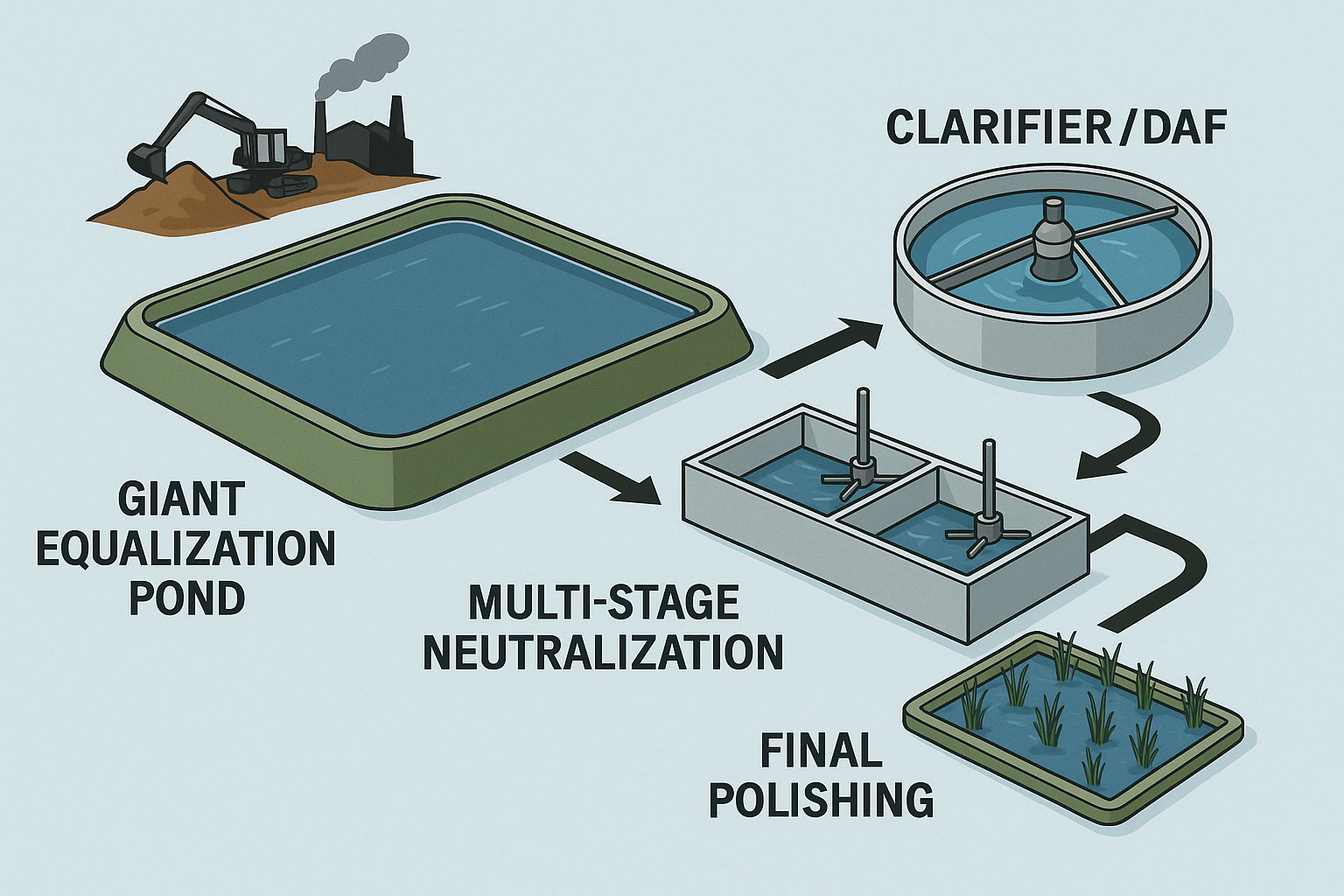
Neutralization typically uses lime — Ca(OH)₂ (hydrated lime) or limestone — in a multi‑stage cascade. The first stage “flash” raises pH to ~7, followed by aeration‑oxidation to convert Fe(II)/Mn, then a second alkali dose to pH ≈9–10 to polish residual metals such as Ni, Zn, and Cu and optimize Fe(OH)₃ formation. One lab test found 200 mg/L of quicklime (CaO) lifted pH from 3.31 to 7.01 and removed 99.9% Fe and 95.8% Mn (Undip Journal).
Industrial practice ranges around 0.4–1.6 kg Ca(OH)₂ per m³, depending on acidity. One EPA case added 6.35 t/day of lime at 4,596 m³/day (78.9 L/s) — about 0.94 kg/m³ — to achieve neutralization (US EPA), while a weaker AMD flow (1,586 m³/day) used 0.383 kg/m³ (US EPA). Optimal pH for Fe removal sits near 8–9, though flocs can settle poorly at these extremes (US EPA), so designers often oxygenate in baffled aeration tanks before final pH correction.
Precipitation of metal hydroxides and carbonates is rapid — minutes with good mixing — and dosing is typically controlled via a dedicated dosing pump. The mixed‑metal hydroxide sludge is voluminous (5–10% of treated water by volume, up to 30% for very high Fe/Al) and requires downstream thickening and filtration (US EPA).
Final polishing options and wetlands
Polishing secures pH neutrality and trims residual metals (e.g., <10 mg/L Fe after clarification and neutralization). Options include a tertiary clarifier or a sedimentation pond; one plant used an 8,176 m³ reservoir as a polishing pond (US EPA). Where media filtration is warranted, dual‑media beds using sand/silica can capture fine particulates, and anthracite can extend run length; multi‑layer designs routinely pair sand with anthracite media.
In Indonesia, constructed wetlands are widely advocated for passive polishing: systems using oyster‑shell or clamshell substrates have been shown to raise pH and adsorb residual metals, achieving >90% Fe removal and ~80% Mn removal (ResearchGate review). One clamshell‑based wetland study reported 85–99% removal for Zn, Cu, Pb and 64–83% for Mn (ResearchGate review).
Wetland or lagoon designs should allow several days’ detention; emergent plants like Typha or Phragmites aid root‑zone oxygenation. If wetlands are impractical, a final equalization/polishing pond with ≥1–2 days’ retention and periodic discharge can hold turbidity below 20 NTU (Nephelometric Turbidity Units) and stabilize pH. The outcome should reliably meet or exceed Indonesian mine effluent limits (pH ≈7, Fe ≪7 mg/L, Mn ≪4 mg/L; greenchem.co.id), and is typically orders of magnitude cleaner than raw AMD that often violates freshwater standards (ResearchGate).
Sludge handling and disposal logistics
The chemical cascade yields iron‑rich sludge that is light, gelatinous, and slow‑settling (US EPA). Dewatering — e.g., a filter press — removes >90% of water before disposal. Expect 5–10% slurry by volume of feed for moderate Fe, up to 30% in worst‑case chemistry (US EPA).
Sludge should be characterized (pH, metals) and is often stabilized with additional lime before landfilling. Settled solids from the equalization pond must be periodically removed to maintain capacity. Layouts typically include storage and handling areas and draw on standard wastewater ancillaries for pumps, bins, and connections.
Performance, costs, and operations
Well‑tuned plants routinely drive effluent Fe from hundreds of mg/L to less than 0.1 mg/L, Mn below detection, at pH around 7–8. A lab study reported Fe removal near 100% and Mn ~96% with only 0.2 g/L lime (Undip Journal); wetland polishers then remove remaining trace metals by about ~90% (ResearchGate review). TSS reductions exceed 95% in typical trains.
Meeting the pH 6–9, Fe <7 mg/L, Mn <4 mg/L standard (greenchem.co.id) then requires modest final polishing. Capital and O&M costs scale with flow — EPA cost curves show cost per cubic meter falling as capacity rises — so centralized designs benefit from throughput. Operationally, plan on monitoring pH, metals, and TSS and keep lime feed flexible season to season. Where coagulation is sensitive to influent swings, a defined coagulant program helps, paired with the right clarifier internals.
Putting the train together
The resulting centralized plant reads as: a large equalization pond sized for 24–48 hours (or more) with ≥3 m depth and baffles; a coagulation step backed by flocculant dosing; a peak‑flow‑sized DAF or clarifier; multi‑stage pH neutralization and oxidation with controlled dosing; and a final polish via pond, media filtration using sand/silica or anthracite, or a constructed wetland. Sludge is thickened and dewatered before compliant disposal.
Sources: Regulatory standards and case data from Indonesian and US EPA documents (greenchem.co.id) (US EPA) (US EPA); laboratory studies from recent literature (Undip Journal) (ResearchGate review); and industry reports and technical manuals (US EPA) (ResearchGate review). All design guidelines reflect best practices in current peer‑reviewed and government sources.