

Industry: Brewery | Process: Wastewater_Treatment
Breweries are dealing with more than just foam: heavy debris from malt and hops, plus surplus yeast, can overwhelm wastewater systems. The first line of defense is simple and, according to suppliers, “absolutely necessary”: 1–5 mm pre‑treatment screens that intercept coarse solids before anything hits a pump (clearfox.com; craftbrewingbusiness.com).
What follows is a playbook that breweries large and small are standardizing: headworks screening to catch spent grains and fragments, primary clarification to remove finer suspended solids, and source programs that recover yeast and handle spent grain efficiently—so most of the solids never become “wastewater” at all.
Headworks screening and raking (1–5 mm)
At the headworks (the front end of a treatment plant), bar, drum, or screw screens with 1–5 mm openings trap husk, grain fragments, hops, and packaging particles before they enter downstream processes (clearfox.com; craftbrewingbusiness.com). Tsurumi’s bar‑screen units routinely use 1–5 mm spacing and mechanical rakes to scrape collected material out of the flow (craftbrewingbusiness.com).
Because barley husks and grain fragments are denser than water, headworks screening can capture virtually all heavy particulates, preventing pump clogging and cutting the biological load on the plant (clearfox.com). Many facilities pair screens with compact physical‑separation skids; in practice that looks like an upstream module for screens and primary separation before any biological tank.
When selecting hardware, plants often use a simple manual bar rack at low flows and step up to a continuous, self‑cleaning unit for reliability; a headworks outfitted with a manual screen can be a low‑cost start, while an automatic screen delivers continuous debris removal with minimal operator attention.
Primary clarification and dissolved air flotation
After screening, a primary separator—either a conventional clarifier or a compact lamella settler—lets remaining husk fragments and yeast flocs settle. Clarifiers target total suspended solids (TSS, particles that remain in suspension) and ease the load on downstream biology. One reported brewery train—screens, trickling filters, and a combined aeration/clarifier—achieved ~40% TSS removal and ~78% biochemical oxygen demand (BOD, a measure of oxygen required to degrade organics) removal (nepis.epa.gov).
A primary clarifier is common, and many breweries favor compact lamella settlers for space efficiency. Where oils/fats or fine colloids are present, dissolved air flotation (DAF) excels: specialized brewery DAF systems, often with flocculant addition, routinely float out >90% of residual TSS (clearfox.com). Vendor data also note DAF can remove up to 99% of suspended solids (SS) (clearfox.com).
Plants commonly dose coagulants or floc aid to improve separation; in that case, pairing a DAF unit with plant‑tuned flocculants is standard practice. Efficient solids removal in primary units reduces load on biological systems, whether that is an activated‑sludge aeration tank or a biofilm system such as MBBR.
Yeast recovery programs and reuse
Breweries generate a surplus yeast stream during fermentation and aging. Capturing that yeast—via cropping, centrifugation, or filtration of “green beer”—recovers a valuable product and prevents heavy organic loading of the wastewater (condorchem.com). Typical outputs of recoverable yeast are on the order of 1–3 kg of wet yeast per 100 L of beer (i.e., per hectoliter, hL) (condorchem.com), and even up to ~0.3 kg of dry yeast per 100 L (mdpi.com).
Spent yeast is high in organic content (proteins, vitamins, residual beer) and each kilogram contributes substantially to BOD/COD if discharged (beer-brewing.com). About ~50% of the volume of surplus yeast slurry is actually beer, so recovery directly saves product; if that slurry is sent to sewer, plants face a large BOD surcharge (brewer-world.com).
Well‑run programs reclaim nearly 100% of fermenter yeast, and surplus yeast represents ~2–3% of total output by volume (brewer-world.com). Decanted yeast and associated beer can be returned to production or sold as dry yeast/fertilizer feed. Spent yeast is also commonly repitched or sold as animal feed; it is high in protein and B vitamins (beer-brewing.com). In sum, a yeast recovery program cuts influent TSS/BOD at the source while creating a saleable by‑product.
Spent grain and trub handling at the source
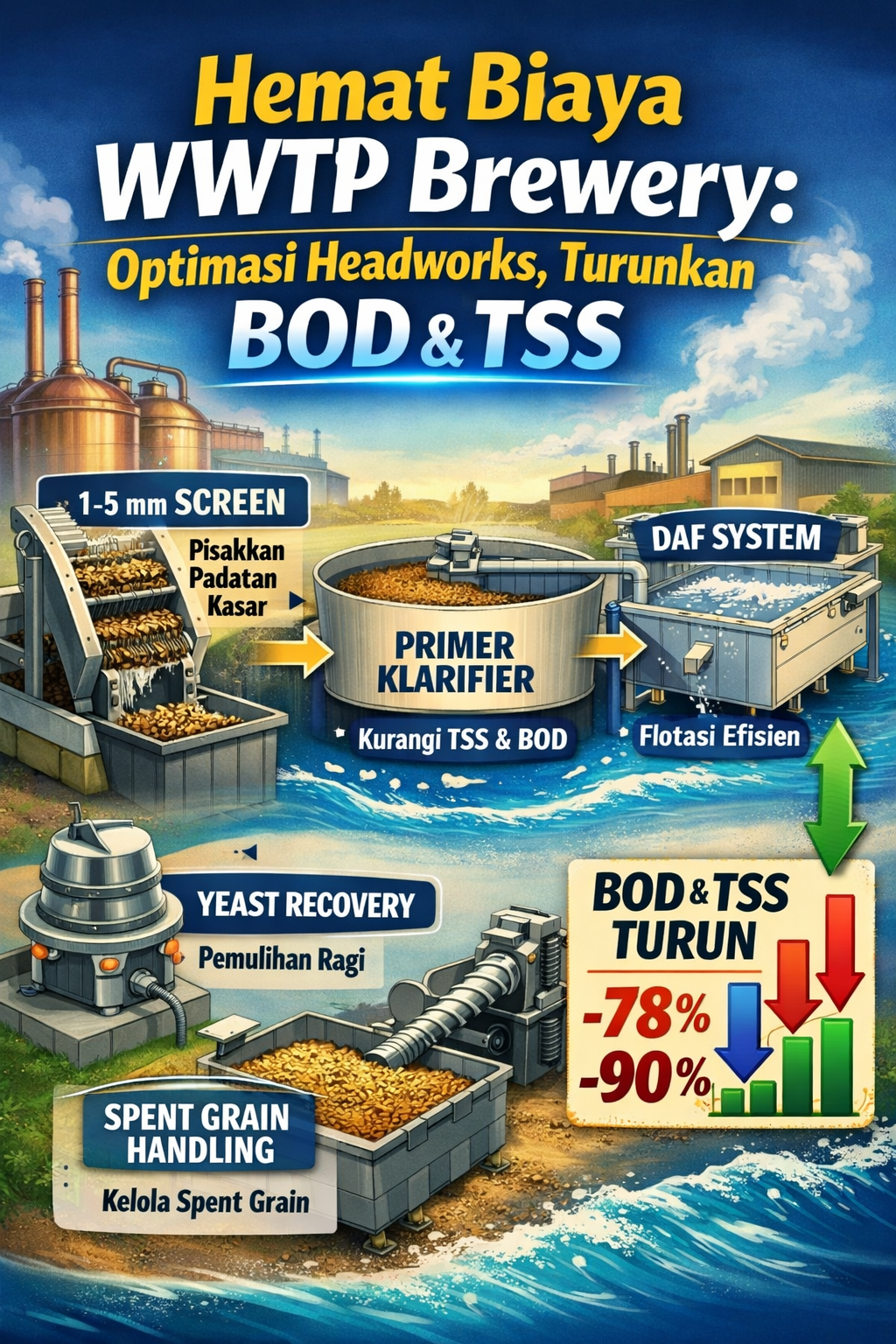
Spent grains and trub (hop residue) are the largest solid byproducts. They typically total 17–23 kg per 100 L of beer—about ~20 kg/hL—and account for up to ~85% of a brewery’s organic waste (condorchem.com; condorchem.com). Best practice is immediate separation at the lauter tun or mash filter, followed by dewatering/drying and prompt removal from the plant—keeping nearly all of that load out of the wastewater stream.
Wet spent grain is ~80% moisture; pressing or drying reduces weight for transport. Because it carries fermentable starch and fiber, dumping it to sewer would dramatically spike BOD/COD, whereas diverting it to animal feed or anaerobic digestion removes its full organic load (condorchem.com). Discharging trub to sewer is explicitly discouraged due to high BOD/COD and extract loss; adding it to the spent grain stream is considered best practice (beer-brewing.com).
On site, breweries use conveyors and screw presses to move spent grain to silos or trailers, sometimes with pneumatic pumps or continuous presses to reduce moisture before loading. Data show that well‑operated spent‑grain removal insulates up to ~100% of those solids from the wastewater system (beer-brewing.com).
Separated spent grain is typically sold as livestock feed or used in biogas systems, which covers disposal costs and repurposes the organic content. Valorizing spent yeast and spent grain aligns with “zero waste” goals and minimizes sewer surcharges, shifting an enormous organic load from “wastewater” to “valuable byproduct.”
Trends in compact solids removal
Automated, self‑cleaning screw screens and lamella clarifiers are common for compact, efficient solids removal, and vendors offer integrated screen/DAF modules tailored to breweries (clearfox.com). For plants upgrading headworks, a modular DAF package paired with a DAF clarifier can be slotted after primary screening. Where clarifier basin space is constrained, compact settlers remain attractive.
What the numbers add up to
Key figures from industry literature show the impact: one example saw ~78% BOD and ~40% suspended solids (SS) removal after a screen + clarifier train (nepis.epa.gov). DAF systems, especially with flocculant addition, routinely achieve >90% residual TSS removal and can reach up to 99% SS removal (clearfox.com).
Layered onto that, source‑reduction yields are significant: separating ~20 kg/hL of spent grains and ~1–3 kg/hL of yeast can potentially eliminate most of a brewery’s solids from the influent (condorchem.com; mdpi.com). Collectively, these strategies translate into tangible outcomes—lower treatment volumes, reduced energy, and fewer surcharge fees—that justify implementation.
Source notes and case references
Authoritative reviews and industry guides consistently emphasize upstream screening and gravity separation for brewery wastewater (nepis.epa.gov; clearfox.com) and the valorization of solid wastes (condorchem.com; beer-brewing.com). For example, an EPA study documented ~40% TSS removal alongside ~78% BOD removal with a screen + clarifier configuration (nepis.epa.gov), while suppliers report brewery DAF performance exceeding 90% TSS removal and up to 99% SS removal (clearfox.com).
Statistics on by‑product generation (spent grain and yeast) come from brewery sustainability research and technical reviews (condorchem.com; mdpi.com), and industry sources detail operational practices for yeast recovery, trub handling, and headworks screening (brewer-world.com; craftbrewingbusiness.com; beer-brewing.com). All cited materials provide background data or case results for design of brewery wastewater pre‑treatment and solids management.