

Industry: Semiconductor | Process: Solvent_&_Acid_Waste_Collection
Chip manufacturing runs on chemistry. A single fab leans on hundreds of reagents — often ~200 high‑purity organics and inorganics — across deposition, etching, and cleaning steps (mdpi.com). The waste is just as complex, and some of it is explosive in the wrong mix.
One number sets the stakes: hydrofluoric acid (HF)–containing wastes alone can exceed 40% of a fab’s hazardous effluent (mdpi.com). Industry guidance adds that “the largest‑volume process waste streams include mixed acids, bases and water‑soluble solvents” (toxicdocs.org).
The playbook that’s become non‑negotiable: segregate everything. Dedicated networks for spent acids, spent bases, and organic solvents keep incompatible chemistries apart on the way to treatment or recycling — and unlock measurable ROI.
Hazardous waste streams and scale
Spent acidic wastes dominate, including sulphuric (H₂SO₄), nitric (HNO₃), and hydrochloric (HCl) acids, often mixed with oxidizers like hydrogen peroxide (H₂O₂). Hydrofluoric acid (HF) — the glass‑etching outlier — is especially prevalent; HF‑containing wastes can exceed 40% of hazardous effluent (mdpi.com). These concentrated acids (often >30–98%) are extremely corrosive and toxic.
On the alkaline side, standard cleans (e.g., Standard Clean 1, SC‑1: NH₄OH + H₂O₂) and amine‑based developers generate spent ammonium hydroxide and other bases with high pH, which can release heat if neutralized improperly. Organic process wastes — acetone, isopropyl alcohol, propylene glycol monomethyl ether, N‑methyl‑2‑pyrrolidone (NMP) — are typically flammable or volatile. Dilute rinse waters carry traces of dissolved metals/salts and residual chemicals, including mixed aqueous streams (such as sulfuric‑peroxide “piranha,” HF‑ammonium fluoride, or phosphoric mixtures) requiring careful handling.
The sector is among the largest generators of acid/base wastes; “the largest‑volume process waste streams include mixed acids, bases and water‑soluble solvents” (toxicdocs.org). That scale is why modern fab design mandates segregation of incompatible wastes so that acidic, basic, and organic streams never mix — a point reinforced across industry and regulatory materials (mdpi.com).
Regulatory and safety drivers
Mixing hazards are textbook: acid‑base neutralization is exothermic, and solvents must be isolated from oxidizers. Dedicated routing prevents accidental cross‑contamination. In Indonesia, new rules make source separation explicit: MOEF Regulation No.9/2024 (amending the 2020 Government Regulation) requires sorting of B3 waste — the hazardous, toxic category — at the point of generation (arma-law.com). The regulation categorizes industrial (limbah) and household (sampah) B3 separately and mandates tailored handling, proper facilities, licensing, and transfer to authorized processors (arma-law.com) (arma-law.com).
Segregation also aligns with the U.S. EPA waste‑management hierarchy — source reduction, recycling, then treatment — and with industry sustainability drives (mdpi.com) (mdpi.com). Leading chipmakers report that improving chemical reuse and recycling is both environmentally and economically beneficial, with one standout case detailed below.
Dedicated piping network design
A segregated system uses separate pipe networks for each chemical class: Waste Acid Lines (HAL/AL), Waste Base Lines (WBL), and Organic Waste Lines. Each tool’s waste port and wet bench drains into segregated sumps or manholes by chemistry. Mixed or neutral rinse water is kept separate or discharged after on‑site treatment. For context on primary treatment equipment categories, see screens, oil removal, and primary systems.
Pipes are color‑coded and labeled for contents — e.g., red for acids, green for bases, yellow for organics — per ANSI/SEMATECH safety codes to reduce human error during maintenance.
Material compatibility is the crux. Fluoropolymer piping (PTFE/PFA) or PVDF/CPVC is used in acid lines, while PP or FRP can serve bases. Fluoropolymers are used because they “do not react with the chemicals” and provide high inertness (toxicdocs.org), and instrumentation exposed to fluids (e.g., level sensors) relies on inert materials or isolation to avoid degradation (toxicdocs.org).
Secondary containment trays or drip pans sit under joints, and vent lines — scrubbed if necessary — keep line pressure balanced. For solvent lines, explosion‑proof pumps and static‑dissipating pipes may be used. Continuous leak‑detection sensors and bunded trenches allow early capture, while rapid‑closing valves or rack isolation (e.g., in the tool room or at a manifold) prevent cross‑flow if overpressure or backflow occurs. Combining strong acids in non‑fluorinated systems can cause cracks and dangerous leaks, as SIA guidance warns (toxicdocs.org).
Dedicated collection tanks and facilities
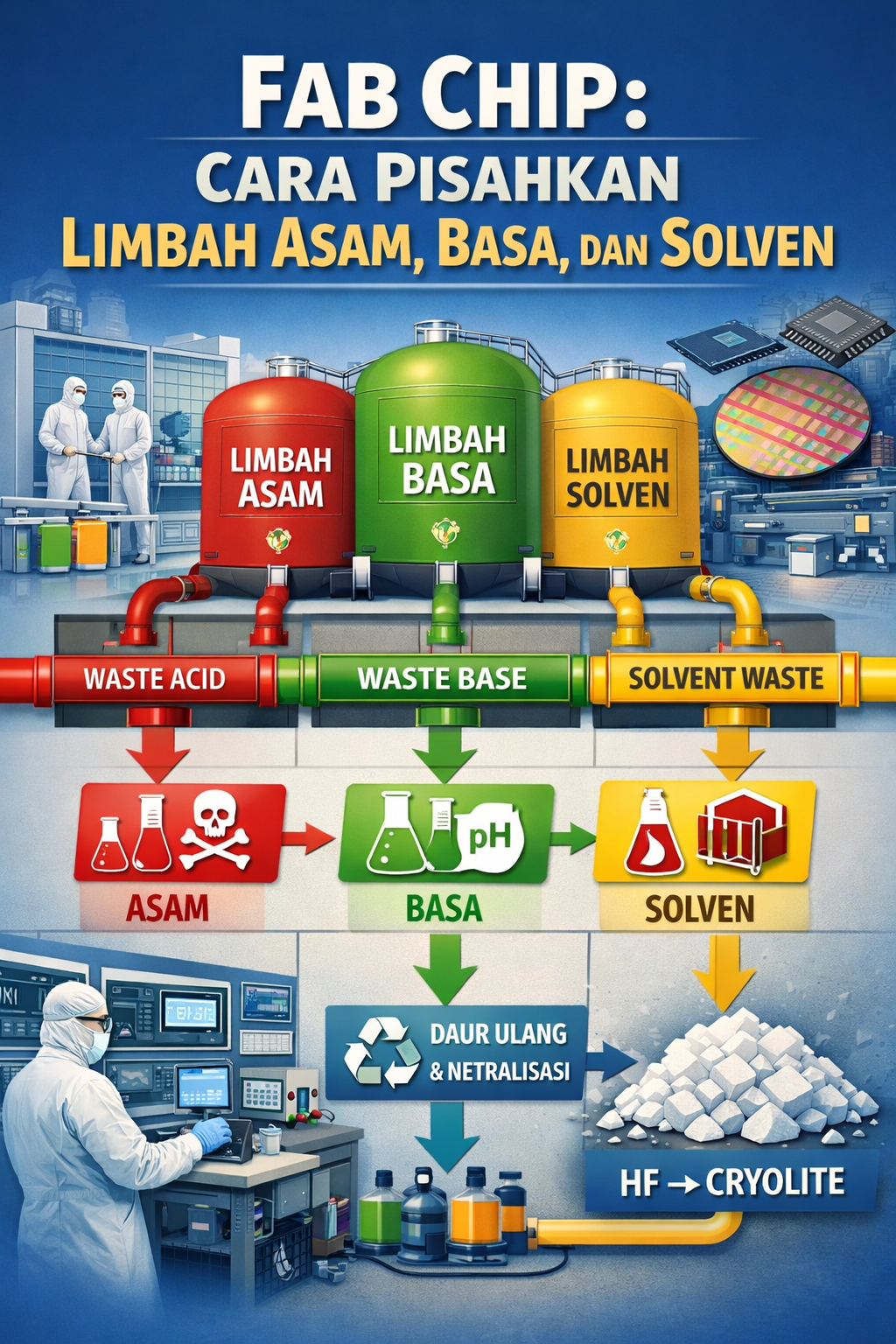
Each waste stream discharges into its own holding tank or buffer sump. Spent‑acid and spent‑base tanks are sited separately — often outdoors or in well‑ventilated berms — to avoid common spill containment. Organic solvent tanks are likewise segregated, with fire‑protective design if flammable. Bunds or berms are typically sized to 110–125% of tank capacity per regulation.
Capacity is sized for hours to days of generation. A single 300 mm fab can generate thousands of liters of acid waste per day. TSMC designs suggest ≈46,000 ton/year of HF raw waste for multiple fabs (esg.tsmc.com), implying ~125 ton/day if evenly spread — one reason oversized buffers matter.
Construction and materials match the waste (details below). Each tank has a dedicated inlet and a pump or gravity outlet to treatment or recycling, with overflows and vents directed to safe neutralization or scrubbers. Instrumentation — level sensors, pH monitors (for mixed neutralization tanks), and flow meters — feeds a central control system; alarms trigger on high level or leak detection. This “smart tank” capability yields measurable outcomes (e.g., reducing accidental spills to near zero through automated shutdowns). For controlled neutralization, accurate chemical dosing is a standard control input; see dosing pump options.
Materials of construction by waste type
Hydrofluoric acid (HF) and fluoride mixtures are extremely aggressive. Fluoropolymer piping (PTFE/PFA) or PVDF is mandatory (toxicdocs.org). Tanks are often FRP (fiberglass‑reinforced plastic) lined with a fluoropolymer coating, or solid PTFE vessels for smaller volumes. National storage charts list HDPE/XLPE tanks for up to ~48% HF (with PTFE/polyolefin piping) (nationalstoragetank.com). SIA warns that conventional materials (PP, rubber, glass‑lined steel) can fail within hours under HF exposure (toxicdocs.org), hence the use of fluoropolymer‑lined FRP or PH‑2 grade systems for HF‑bearing wastes.
For concentrated sulfuric, hydrochloric, and nitric acids (35–98%), FRP or PP/HDPE tanks are typical. For example, 98% H₂SO₄ is commonly stored in reinforced PP or FRP (vinyl ester or phenolic resin) tanks (nationalstoragetank.com). Pipes of CPVC or PVDF are used for concentrated acids. Stainless steel (304/316) is generally unsuitable for these acids — and not allowed for HF — due to ion leaching and corrosion (toxicdocs.org). Gaskets and bolts default to high‑grade alloys (Hastelloy, Alloy 20) or inert polymers (Viton, Teflon).
Strong oxidizers (e.g., sulfate‑H₂O₂ “piranha,” chromic etch) drive similar selections to acids but with special liners because oxidizers can embrittle plastics; PTFE‑lined steel or high‑grade FRP are used, and materials must tolerate elevated temperatures without degradation.
Ammonium hydroxide and other bases are handled well by PP, PVC, or FRP tanks and pipes; glass or enamel‑lined vessels are also used for base waste. Ammonia at high concentration can attack copper or zinc, so metal contact is avoided in these alloys. Dilute NH₄OH (0.1–1 N) is moderately corrosive, reinforcing the polymer choice.
Organic solvents (acetone, IPA, PGMEA, etc.) are generally compatible with stainless steel (316L) or HDPE; because many are flammable, tanks are bonded and grounded, with flame arrestors on vents. Stainless steel is often chosen for VOC solvent storage, whereas ducting in process areas may use PVDF/PP to prevent acid residues from contacting metals. Some fabs even recycle photoresists via distillation, relying on non‑reactive materials such as PP‑lined columns. For component choices in stainless, note the role of 316L housings in clean service; see 316L stainless steel housings.
In summary, inert fluoropolymers are typically the safest choice for the most aggressive wastes (toxicdocs.org) (toxicdocs.org). PP/HDPE/FRP suit moderately corrosive streams, and stainless or plastics carry organic wastes safely. Proper selection extends system life; fluoropolymer systems often “last decades” versus <5–10 years for inferior materials (toxicdocs.org).
Enabling recycling and measurable outcomes
Segregation prevents accidents and also enhances treatment options. With dedicated acid and base streams, on‑site or off‑site recycling becomes feasible: concentrated H₂SO₄ waste can be evaporated and reused; spent NH₄OH can go to metal recovery via ammonia stripping; organic wastes can be distilled. When streams are pure, recovery yields are high. For water reuse contexts, pretreatment steps such as ultrafiltration are often referenced alongside other supporting equipment (water‑treatment ancillaries).
One concrete outcome is TSMC’s HF recycling. By segregating HF waste and installing an in‑fab regeneration system, the company converts waste HF into commercial cryolite (sold as an aluminum‑flux). The project mitigates 46,000 tons/year of HF waste (from multiple fabs) and produces 12,000 tons of cryolite annually, with an economic benefit of NT$400 million (~US$12M) per year (esg.tsmc.com).
Segregated collection also simplifies environmental compliance by minimizing mixed hazardous waste volumes requiring off‑site disposal and by streamlining regulatory reporting (each tank’s volume is tracked). Emergency response is easier, because valves can isolate one stream. In practice, fabs that adopt full source segregation report near‑zero incidents of cross‑stream contamination and set clear metrics for waste reduction and recycle rates; advanced sites now routinely target >90% reuse or recycling of process chemicals, supported by their dedicated collection systems.
Summary and compliance context
Routing acids, bases, and solvents through their own piping networks into dedicated, chemically compatible tanks eliminates hazardous reactions — acid/base neutralizations and acid‑organic fires among them — while creating clean streams for recycling. Core practices include color‑coded, leak‑monitored piping; bunded tanks sized for peak loads; and inert materials, especially fluoropolymers for aggressive acids (toxicdocs.org) (toxicdocs.org). These measures comply with Indonesia’s B3 waste rules — including MOEF Reg 9/2024’s sorting‑at‑source requirement (arma-law.com) — and with international best practice (arma-law.com), reinforced by the U.S. EPA hierarchy (mdpi.com).
In quantitative terms, segregation has enabled semiconductor plants to divert tens of thousands of tons of waste into reuse — the HF‑to‑cryolite pathway above is emblematic — and to realize multi‑million‑dollar savings (esg.tsmc.com) while lowering hazardous disposal volumes and spill risks.