

High-pressure membranes can drive sulfate to near-zero; biology can slash loads for less energy. The best choice in nickel laterite wastewater comes down to the discharge number — and the bill.
Industry: Nickel_Mining | Process: Wastewater_Treatment
Nickel laterite processing — think HPAL (high-pressure acid leach) — runs on sulfuric acid and leaves behind high‑sulfate wastewater. Operators now face a stark, technical trade: push sulfate through membranes or have microbes eat it via biological sulfate reduction (BSR). Membrane separation (reverse osmosis, RO; nanofiltration, NF) physically rejects sulfate ions, while BSR converts sulfate to sulfide (H₂S/HS⁻) or elemental sulfur using sulfate‑reducing bacteria (SRB). The differences show up in removal efficiency, operating cost, and waste byproducts — and in whether a permit reads 500 mg/L, 100 mg/L, or 10 mg/L.
Membrane separation performance and pressure
RO systems, typically running at 30–80 bar, remove >99% of sulfate and produce sulfate‑free permeate (Membranes). NF — charged polyamide films where “Donnan exclusion” (charge‑based repulsion) augments size sieving — generally rejects 80–95% of sulfate. In a lab study, commercial NF270 and DL‑NF posted >98% rejection at 370–460 mg/L sulfate, while a lower‑cost DK‑NF did ~82% (Membranes).
Advanced thin‑film or nanocomposite membranes can lift flux and rejection further (Membranes). In practice, RO reliably drives sulfate to very low levels — even <50 mg/L or <10 mg/L — by brute‑force rejection, whereas NF alone often leaves “tens of mg/L” that need polishing (Membranes). That reality underpins the rise of integrated membrane systems designed for industrial wastewater, with NF stages (nano‑filtration) feeding high‑rejection RO blocks (e.g., brackish‑water RO).
Membrane costs, markets, and brine
Energy for high‑pressure pumps dominates membrane OPEX. Recent benchmarks put RO‑based sulfate removal around $0.33/m³ and NF+UF (ultrafiltration) at ~$0.31/m³ (Membranes), while a separate analysis cites RO at $0.50–2.50/m³ for sulfate‑rich waters (World Bank 2019; Front. Bioeng. Biotechnol.). In short: ~$0.3–2.5/m³, depending on design and local energy/maintenance prices (Membranes; Front. Bioeng. Biotechnol.). The UF step is common in sulfate service, which aligns with the cost pairing; when specified, operators lean on ultrafiltration ahead of RO to temper fouling.
Market momentum reflects adoption: global RO system investment jumped from ~$11.7B in 2020 to ~$19.1B by 2025, and NF membranes from $518M (2019) to ~$1.2B (2024) (Membranes). The flip side is a concentrate stream: membranes produce a brine (often 10–20% of influent volume) that carries away sulfate and co‑ions; disposal/management can be challenging or costly. Scaling — notably CaSO₄ — and fouling require chemical control or periodic cleaning (Membranes), where programs frequently incorporate membrane antiscalants and scheduled membrane cleaning.
Biological sulfate reduction (BSR) kinetics
BSR harnesses SRB like Desulfovibrio under anaerobic conditions to convert sulfate to sulfide. One two‑stage membrane‑biofilm reactor (MBfR — a gas‑delivery biofilm system) fed with H₂ reduced sulfate to sulfide at 92–97% efficiency and tolerated 1.5 g/L sulfate; a second, aerobic stage re‑oxidized sulfide to elemental sulfur (S⁰) or back to sulfates to avoid H₂S off‑gassing (Front. Bioeng. Biotechnol.). High‑rate lab systems have logged volumetric sulfate reductions of 1.7–3.7 g S/m³‑d at ~95% removal (Front. Bioeng. Biotechnol.). Cold‑adapted or organic‑fed SRB trains (using ethanol, lactate, or wastes) also remove substantial sulfate, though typically at slower rates (Front. Bioeng. Biotechnol.).
Well‑designed BSR can achieve very high conversions — the MBfR case hit ~95% to sulfide — but driving effluent sulfate to extremely low levels (e.g., <10 mg/L) is difficult. Barr Engineering’s assessment notes BSR “is unlikely to achieve 10 mg/L” in effluent, though it readily meets higher limits; biological units in practice often leave “tens of mg/L” without polishing (Barr Engineering). BSR is particularly attractive at high influent sulfate (per‑volume removal is large), enabling smaller reactors for a given mass load (Barr Engineering). In mining contexts, plants often frame BSR as a core step within broader biological digestion trains.
BSR operating costs and dosing
BSR’s energy draw is low versus RO/NF, but it needs an electron donor. Bijmans et al. (2011) estimate an H₂‑fed sulfate reactor OPEX of ~$0.20 per kg SO₄ reduced; ethanol is ~$0.26/kg SO₄ (Front. Bioeng. Biotechnol.). In the referenced MBfR case, electrolytic H₂ at ~$2/kg H₂ translated to ~$0.17 per kg SO₄, or ~$0.27/m³ at 1.5 g/L sulfate input; the total was judged competitive against RO’s $0.5–2.5/m³ range (Front. Bioeng. Biotechnol.). Bottom line: for high‑sulfate streams, BSR can run ~$0.2–0.3/m³, often comparable to or lower than membranes (Front. Bioeng. Biotechnol.).
Trade‑offs persist. BSR typically needs larger reactor volumes (long detention times) and may require nutrient and mineral supplements (Front. Bioeng. Biotechnol.). Where supplements are specified, operators source standard consumables (e.g., nutrients) through wastewater consumables.
Byproducts: brine versus sulfur
Membranes produce a liquid concentrate; BSR yields sulfide that must be contained. Systems manage sulfide via iron precipitation (FeS) or controlled biotic oxidation to elemental sulfur — the MBfR setup converted nearly all sulfide to S⁰, a recoverable solid (Front. Bioeng. Biotechnol.). Alternatives include wetlands or sulfide‑contact tanks to immobilize sulfide. The need to control toxic H₂S/HS⁻ is the key BSR complexity; conversely, brine handling is the membrane bottleneck (Front. Bioeng. Biotechnol.). Ancillary handling gear is part of the package in both cases, commonly sourced as water treatment ancillaries.
Where each option fits
BSR shines in mining — high sulfate, large flows — and scales well above >500 mg/L influent; it is less proven in low‑sulfate municipal wastewater. Warm climates (tropical/temperate, e.g., Indonesia) favor biological systems. However, BSR cannot quickly hit very stringent effluent caps near drinking‑water quality without polishing (Barr Engineering).
Membrane tech dominates research and market growth — >130 studies on membrane sulfate removal in the past two decades (Membranes) — and NF/RO markets show ~10–18% CAGR (Membranes). Industry reviews also note NF outperforms older methods like ion exchange or precipitations (Membranes), a nod that matters when comparing against legacy ion exchange systems.
Permits, receptors, and local context
Indonesia’s nickel industry standard (Permen LH No.9/2006) does not specify sulfate, so permits may defer to local water‑quality standards (often ~250 mg/L for drinking water) (Nikel.co.id). Where the ultimate receptor is sensitive — for instance, rice fields requiring <10 mg/L in Minnesota — membrane/NF treatment is mandatory (Barr Engineering).
Decision framework: limits, loads, and lifecycle cost
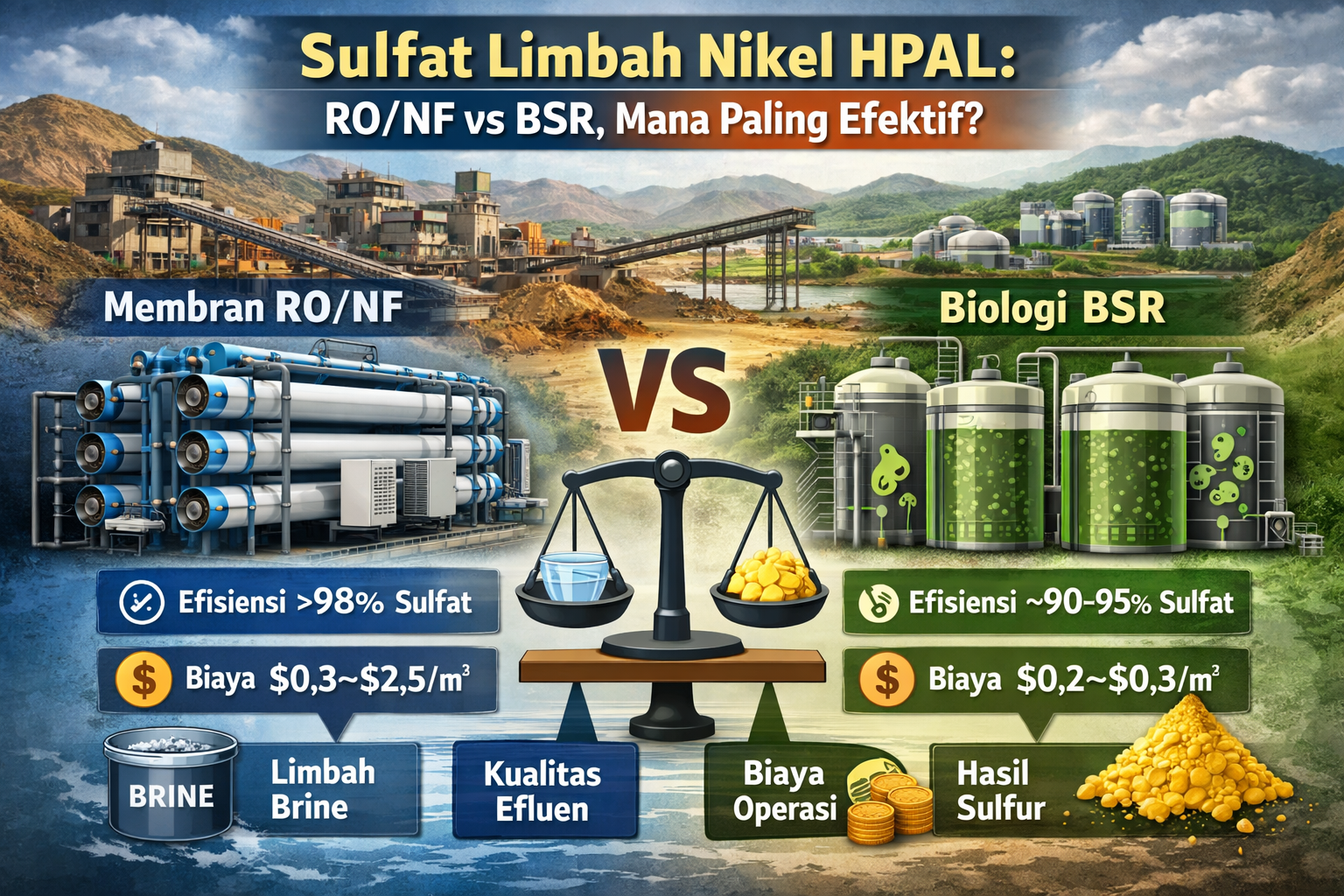
Start with the effluent number. For very stringent targets (<50–100 mg/L), RO is the default, with NF as a pre‑cut or polish; biological alone will likely leave tens of mg/L (Membranes; Barr Engineering). For moderate caps (200–500 mg/L), BSR or NF often suffices; permits allowing >100 mg/L can see BSR remove 90–95% with simple polishing, and NF can achieve significant cuts at lower pressure (Front. Bioeng. Biotechnol.; Membranes). Lax limits (>500 mg/L) can even permit passive measures or dilution, with BSR alone very attractive.
Next, look at load. High sulfate >>1000 mg/L favors BSR first to strip mass, then membrane polishing. Example: 1,500 mg/L influent to 100 mg/L effluent (93% removal) can run direct RO+NF, or a hybrid with BSR down to ~100–200 mg/L and NF polish; the latter tends to cut energy and brine by treating a smaller residual, often at lower cost (Membranes; Front. Bioeng. Biotechnol.). Hybrid trains commonly specify NF polishing stages via nano‑filtration modules.
Then, price it. Use published OPEX ranges: RO/NF ~$0.3–0.5/m³ (Membranes; Front. Bioeng. Biotechnol.) and H₂‑driven BSR ~$0.27/m³ (with electrolytic H₂ at ~$2/kg), noting BSR OPEX is donor‑driven while membranes are energy‑driven. If electricity is costly or H₂/organics are cheap, BSR wins; if energy is cheap but brine disposal is expensive, BSR can still be preferable (Front. Bioeng. Biotechnol.). For RO design cases, brackish service typically routes through brackish‑water RO blocks.
Finally, weigh byproducts and site factors. Zero‑liquid‑discharge goals or brine‑disposal constraints tilt toward BSR (no liquid concentrate and potential sulfur recovery), while odor/H₂S risk or minimal sludge needs can make membranes simpler (no sludge, but a brine) (Front. Bioeng. Biotechnol.). Footprint (BSR usually larger), climate (SRB prefer warm), and in‑house expertise also matter. Where NF serves as polish or pre‑cut, projects bundle units within integrated membrane systems.
Bottom line for nickel operators
Membranes deliver the lowest residuals — often necessary where discharge limits are very low — but bring energy demand and a brine stream. BSR removes large sulfate loads at lower energy and can yield recoverable sulfur, yet typically needs polishing for ultra‑low targets. Reviews and market data underscore the membrane tilt (>130 membrane sulfate studies; NF/RO markets growing ~10–18% CAGR; NF outperforms older methods such as ion exchange/precipitations) (Membranes; Membranes; Membranes). In many nickel circuits, a hybrid — BSR up front, membrane polish at the back end — matches both the permit and the P&L. The decision is best made with site‑specific math: $/kg‑SO₄ removed, final sulfate ppm, and total lifecycle cost, as the cited sources detail (Front. Bioeng. Biotechnol.; Barr Engineering).