

Industry: Aquaculture | Process: Hatchery_&_Larval_Rearing
Hatchery wastewater is far stronger than domestic sewage and far more variable. Simulated effluent can carry 500–2,000 mg/L COD (chemical oxygen demand), 25–125 mg/L NH₄‑N (ammonium‑nitrogen), and 5–25 mg/L PO₄‑P (phosphate‑phosphorus) (ResearchGate). In shrimp hatcheries the organic load (BOD/COD) tends to be moderate but pathogen counts are high (Global Seafood Alliance), while fish hatcheries see similar nutrient strengths.
Left untreated, discharges can trigger eutrophication and local toxicity. Modern designs aim for >80–90% removal of dissolved N and P and to push total suspended solids (TSS) below discharge standards. Fluidized‑sand biofilters in recirculating aquaculture systems (RAS) have documented ~86–88% TAN (total ammonia nitrogen) and ~66–82% BOD (biochemical oxygen demand) removal (Wiley).
Compact treatment train design
In a small footprint, mechanical pretreatment captures solids before biofiltration. Drum filters, settling tanks, and swirl separators commonly remove 50–90% of TSS (Wiley). Protein skimmers or pressurized sand filters polish particulates; operators often specify sand media filters for removing 5–10 micron particles at this stage.
Effluent then flows to biofiltration for nutrient conversion. Using moving bed biofilm reactors (MBBR)—tanks with suspended plastic carriers that grow attached biofilms—plants can size for an HRT (hydraulic retention time) of 1–2 hours to achieve ~99% nitrification (NH₄ to NO₃) (ResearchGate). Typical setpoints are DO (dissolved oxygen) ~4–6 mg/L and temperature 25–30°C to support dense biofilm growth.
When total nitrogen limits require it, an anoxic zone (or a secondary anoxic MBBR) with external carbon dosing enables denitrification. Typical post‑biofiltration goals: <1 mg/L NH₄, <5–10 mg/L NO₃ after denitrification, and >80% total‑N reduction (ResearchGate). Phosphate can be removed biologically—lab systems report up to ~95% under optimized MBBR operation—or with chemical precipitation where extremely low P is mandated (ResearchGate).
To reduce pathogen risks without chemical residuals, many discharge lines add UV disinfection (99.99% pathogen kill rate without chemicals, low operating cost). In recirculating schemes, most treated water is reused and only a small fraction is discharged.
Performance benchmarks and footprint
Documented performance in multi‑stage MBBR is strong: 99.7% NH₄–N removal, 80.9% total‑N removal, and 95.8% P removal under optimum conditions (ResearchGate). Commercial RAS biofilters report nitrification rates around ~110.9 g N/m³·d and BOD removal typically 66–82% (Wiley, Wiley).
High efficiency stems from large protected biofilm areas—carriers offer ~500–600 m²/m³ surface area (MDPI). Where high‑area media are required, suppliers specify options such as honeycomb bio media to maximize biofilm growth in compact tanks.
MBBRs “minimize production of suspended solids and have a smaller footprint than conventional systems” (MDPI). For illustration, one 10 m³/d hatchery line can pair a drum filter (~1–2 m³ volume) with three 5 m³ MBBR tanks, occupying roughly 5–10 m² base area—far smaller than pond or large clarifier systems. In applications that do require solids settlers, compact plates can help; packaged clarifier units are typically specified on tight sites.
Nutrient removal with MBBR
MBBR (moving bed biofilm reactor) technology has become a standard aquaculture option thanks to high efficiency, operational stability, and compactness (Water Online, MDPI). Under well‑managed conditions, reported outcomes include >99% ammonia‑N removal and ~80–90% total‑N removal with an anoxic stage (ResearchGate), and ~96% phosphorus in lab systems (ResearchGate).
Capacity is material: review data indicate ~110.9 g TAN/m³/day (Wiley). Put differently, a 1 m³ reactor can process ~0.11 kg N per day. In practice, biofilters often exceed 80% cBOD₅ removal (Wiley), and trials have driven effluent nitrate to ≈2–5 mg/L (from 10 mg/L) at 2 h HRT (MDPI).
Footprints are typically 40–60% smaller than equivalent activated‑sludge clarifier setups, with self‑cleaning carriers and no large secondary clarifier requirement; one review notes MBBRs “provide a sustainable solution for biological nitrogen removal” with “a smaller footprint” (MDPI). For carriers optimized to boost treatment rate, operators consider media like foam‑based MBBR media.
Biofilm diversity supports robustness under feed and temperature swings; solids don’t clog readily as carriers stay suspended. Rapid startup strategies using seeding with floc are also reported (Water Online, ResearchGate). A 50 m³/day hatchery effluent line can use two 25 m³ MBBR tanks in series (anoxic + aerobic) to achieve ammonia <1 mg/L and TN removal >75%.
Where whole‑plant optimization is the goal, integrated packages for nutrient removal and biological digestion are often aligned with MBBR process conditions.
Dechlorination of backwash and rinses
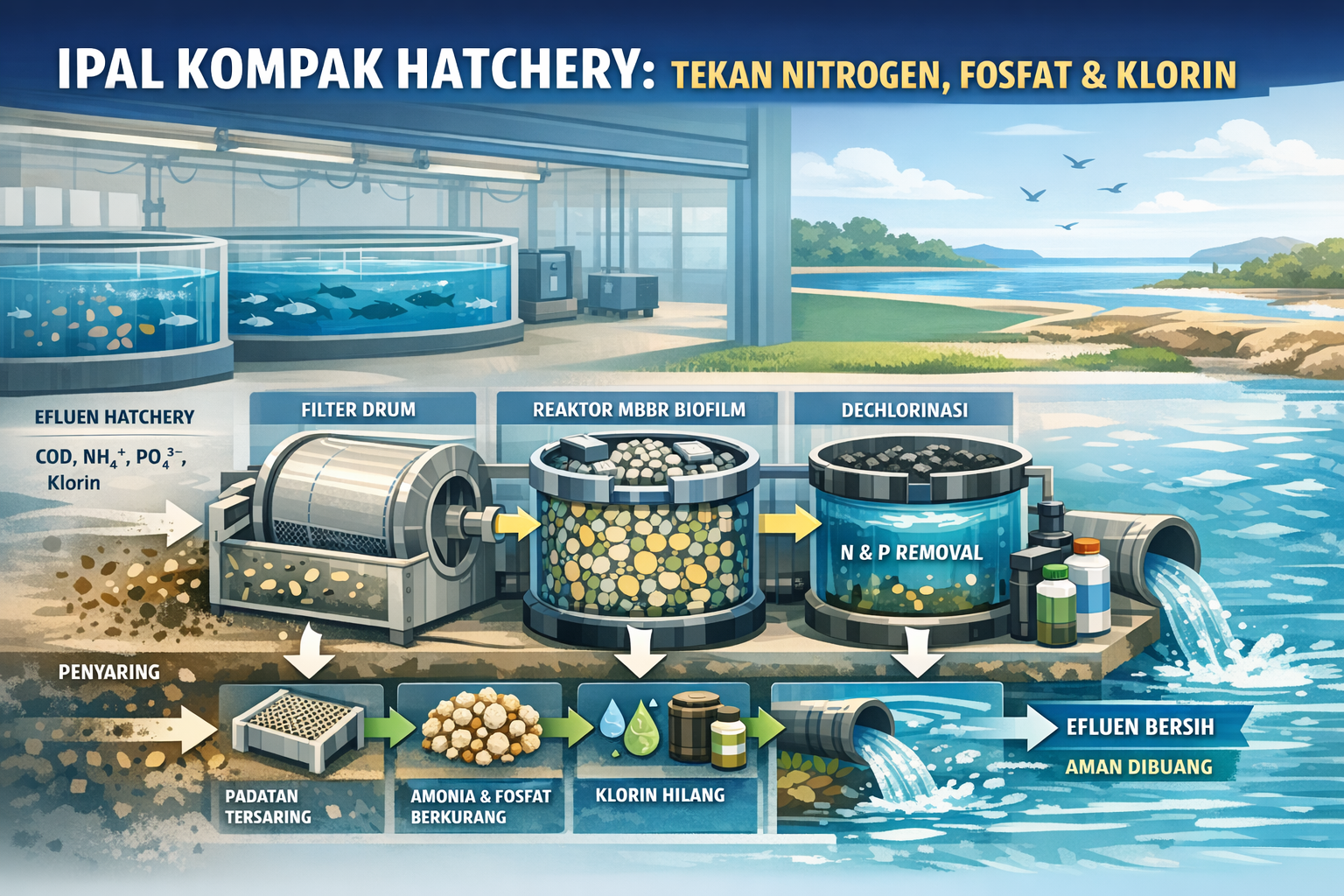
Chlorine (e.g., bleach) is widely used for tank and filter disinfection, leaving backwash or rinse water with free chlorine residuals of roughly 1–10 mg/L Cl₂ that must be neutralized before discharge. One route is chemical neutralization with sodium metabisulfite (Na₂S₂O₅) or sodium bisulfite. The stoichiometry is roughly 1.3–1.5 mg Na₂S₂O₅ per mg free Cl₂, and in practice guidelines recommend about 3 mg of metabisulfite per 1 mg of chlorine (ENKI). For tank‑cleaning water at 5 mg/L Cl₂, dose ~15 mg/L Na₂S₂O₅ via an injection pump and allow mixing/contact to complete the reaction, which converts chlorine to chloride: Na₂S₂O₅ + H₂O + OCl⁻ → 2 Cl⁻ + sulfate and salts (ENKI, ENKI). Residual chlorine should read <0.1 mg/L before discharge.
Dechlorination setups frequently pair a dosing skid with a dosing pump and safety controls. Where chemicals are minimized, a small GAC filter can adsorb chlorine efficiently; a column sized for backwash flow (e.g., 10–20 cm bed) can remove free chlorine to <0.1 mg/L and also reduce trace chloramines (ENKI). This is commonly implemented with activated carbon, replaced periodically (often around annual cadence depending on loading).
Many hatcheries segregate backwash and tank rinses into a “cleaning sump” with mixer and dosing or an in‑line GAC module. After neutralization and settling of solids, discharge proceeds; this approach avoids acute toxicity in receiving waters, where 3 mg/L Cl₂ can kill many invertebrates. Chemical inventories often include a packaged dechlorination agent to maintain response readiness.
Outcomes and operating trends
Water reuse is a headline outcome: by recirculating >80–90% of treated water, freshwater intake falls accordingly, and many RAS hatcheries report water exchange rates <10% per day. Load reductions stack—simple sedimentation can remove ~70–90% of TSS, and a combined settler + biofilter train often surpasses >80% net BOD reduction (Global Seafood Alliance, Wiley). Under optimum lab MBBR conditions, effluent TN ≈2 mg/L and PO₄ <0.5 mg/L have been reported (ResearchGate).
Environmental impact is correspondingly reduced. Reviews note that well‑managed hatcheries with treatment present minimal eutrophication risk; one FAO review cited integrated RAS with solids capture keeping effluent nutrients comparable to municipal effluent (Reuters). Pathogen control is addressed by dechlorination combined with UV or ozonation so there is no chlorine toxicity while mitigating pathogen release—surveys point to the importance of disinfection without residual chlorine where multiple hatcheries share a watershed (Global Seafood Alliance).
Fine solids polishing on discharge lines is commonly delivered through cartridges; compact laterals often rely on a cartridge filter to capture 1–100 micron particles before UV.
Compliance and monitoring framework
In Indonesia, requirements derive from PP No. 82/2001 on water quality/pollution control and related Permen LHK standards (e.g., Permen 68/2016 for domestic‑like wastewater). There is no single “aquaculture effluent” standard; operators target the strictest applicable class of receiving water. For example, Indonesian class‑2 waters (suitable for fisheries) typically require BOD ≤6 mg/L, COD ≤20 mg/L, and TSS ≤15 mg/L, while discharging to a less sensitive class or marine area may allow ~20–30 mg/L BOD/TSS (Environesia).
Permitting typically includes AMDAL/UKL‑UPL environmental assessment and an Izin Pembuangan Air Limbah (IPAL) from KLHK or local ESDM, supported by a treatment plan and monitoring schedule. Routine monitoring installs flow metering and monthly sampling for pH, TSS, BOD₅, ammonia, total‑N, total‑P, and residual chlorine. Trend charts help catch upsets early; in practice, many hatcheries find post‑treatment values an order of magnitude below limits when systems operate as designed.
Ongoing upkeep focuses on mechanicals and biology. Teams clean filters, check sludge and SBBRs (sequencing batch bio‑reactors), and replace or replenish MBBR carriers/media to maintain active biofilm. Where SBR trains are installed, packaged SBR systems are maintained alongside aeration and mixing checks. Chemical controls are kept tight by calibrating dosing gear so live chlorine tests sit near zero; ancillary packages such as wastewater ancillaries support instrumentation uptime.
Operator practice emphasizes recordkeeping (maintenance, monitoring, chemical use, incidents), adherence to Indonesian technical guidance (BKIPM/KKP or KLHK publications), and reuse of treated water in irrigation or grow‑out loops toward zero discharge. Staff training covers chemical handling and keeping septic or closed‑loop cleaning flows segregated. Startups often add cultures and nutrients to stabilize biology, with consumables like a starter bacteria or a bacterial nutrient used according to process needs.
Bottom line on impact
With solids separation, MBBR biofiltration, and dechlorination, compact hatchery systems routinely trim pollutant loads by >90% before discharge, supporting both legal compliance and ecological protection (ResearchGate, Wiley, ENKI). For inline debris control ahead of treatment trains, packaged automatic screens complement the pretreatment step described (Wiley), rounding out a compact setup that matches today’s hatchery realities.