

Industry: Fertilizer_(Ammonia_&_Urea) | Process: Wastewater_Treatment_(Ammonia_&_Urea_Removal)
Ammonia strippers are energy‑intensive, often consuming stripping steam equal to 20–40% of the wastewater flow. But data from fertilizer plants show that pushing stripper pressure higher, tightening the steam‑to‑water ratio with advanced controls, and harvesting waste heat from hot effluent can shift the economics dramatically. In reported cases, steam duty fell by about two‑thirds by moving to superheated, high‑pressure operation, with another 5–10% trimmed via controls and 30–50% of sensible heating replaced by heat recovery (ResearchGate) (Yokogawa).
The stakes go beyond utilities. Indonesian fertilizer wastewater standards—Ammonia N around 90–100 mg/L in effluent—underscore why efficient ammonia removal matters (ResearchGate).
High‑pressure steam operation
Raising steam pressure/temperature is a proven lever. In fertilizer plant condensate strippers, a high‑pressure unit (≈3–4 MPa, MPa = megapascal) used only ~14 t/h of steam versus ~42 t/h for a low‑pressure (0.35 MPa) unit treating a similar feed (t/h = tonnes per hour) (ResearchGate). Modern designs report steam/water ratios of roughly 0.20–0.35 (t/t), but pushing below ~0.25 can drive overhead ammonia above discharge limits (≈10 ppm NH₃; ppm = parts per million) (ResearchGate).
Case studies quantify the energy gains. Converting low‑pressure condensate strippers to high‑pressure saved about 0.05–0.07 Gcal per tonne of product (Gcal = gigacalorie; ≈60–84 MJ/ton, MJ = megajoule) (ResearchGate). Plants report that high‑pressure steam can be returned to the reformer or power cycle rather than vented (ResearchGate). One facility raised stripper pressure to ~4.15 MPa (≈41.5 kg/cm²) so the hot condensate—cooled from ~90 °C to 40 °C—could preheat makeup water, combining pressure lift with heat recovery for the cited 0.05–0.07 Gcal/tu savings (ResearchGate) (ResearchGate).
Shifting to superheated, high‑pressure steam—or adopting multi‑effect configurations—can cut steam needs by roughly two‑thirds. As a rule of thumb for 40 t/h wastewater, high‑pressure steam needs are ≈0.25 t/h per ton of feed, compared with 0.60–1.0 t/h in low‑pressure service (ResearchGate).
Model‑predictive control and pH loop
Modern advanced process control (APC) can hold the stripper at its optimal steam‑to‑water setpoint. Multivariable APC—such as model‑predictive control—applied to steam flow and feed pH/flow loops reduces variability in feed concentration, flow, and temperature, allowing tighter margins against ammonia carryover and minimizing steam use (Yokogawa) (Yokogawa). Industry surveys indicate APC projects routinely cut energy use by several percent in distillation/stripping processes (Yokogawa).
In practice, real‑time ammonia/NH₃ analyzers and temperature sensors adjust steam so effluent meets spec (e.g., <1–5 ppm) with minimal excess. Closed‑loop control of the steam–water ratio prevents routine over steaming during load changes. Even tuning PID loops (proportional–integral–derivative controllers) on level control can often reduce steam use by ~5–10% with no hardware changes (Yokogawa) (Yokogawa). Careful control of feed pH (usually with lime or caustic addition) also lowers the steam requirement for a given ammonia load. In such pH control loops, dosing equipment such as a dosing pump is germane to the metering step.
Feed–effluent heat exchange integration
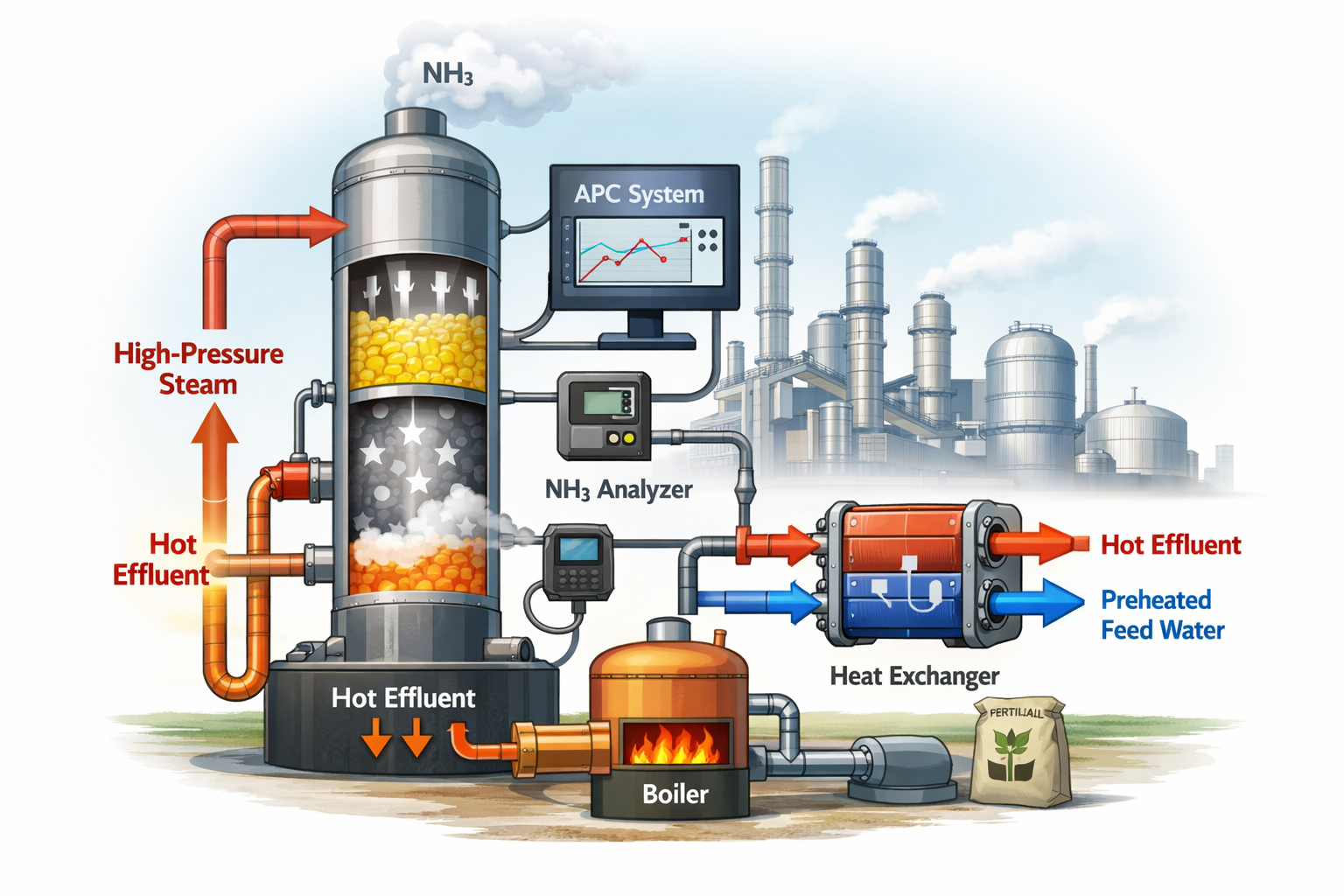
The stripped effluent typically leaves hot (70–80 °C), making it a ready heat source to preheat incoming wastewater. A feed–effluent heat exchanger can recover a large fraction of the heating duty; one fertilizer plant cooled condensate from ~90 °C down to 40 °C through a plate heat exchanger to preheat the feed, using the ~50 K temperature drop to lift the feed into an optimal entry range (≈75 °C) (ResearchGate). This alone saved “huge” amounts of fuel because the boiler no longer had to supply that portion (ResearchGate).
Quantitatively, that integration—plus raising stripper pressure—saved ~0.05–0.07 Gcal/ton of product (Baboo et al.) (ResearchGate) (ResearchGate). A design example: raising feed from 25 °C to 75 °C (a 50 K lift; K = kelvin temperature difference) for 40 t/h flow would require ~8.3 MW of heating assuming Cp≈4.2 kJ/kg·K (Cp = specific heat capacity). If stripper bottoms supply about 40–60 °C of this lift, roughly 5–6 MW can come from recovered heat, saving ~1.5 t/h of steam (4 MPa) versus direct heating. In practice, placing a feed/effluent intercooler ahead of the reboiler means steam supplies mainly latent heat of vaporization.
Patent literature proposes the same approach: a heat exchanger between outgoing wastewater and incoming ammonia‑laden feed to “preheat the ammonia‑containing water prior to the ammonia stripper” (Google Patents). Beyond plate heat exchangers, shell‑and‑tube units or even cascading a secondary stripping tower to capture residual heat are options, and the cooling tower on stripped water can be downsized when much of the heat is diverted.
Combined energy outcomes
High‑pressure steam alone cut steam duty by ~67% in reported cases (ResearchGate). APC can add a further 5–10% reduction by minimizing off‑target operation (Yokogawa) (Yokogawa). Heat recovery can substitute for 30–50% of boiler heat input in practical designs.
Together, these measures can drop specific steam use from ~0.60–1.0 t steam per t feed down to ~0.2–0.3 t/t, depending on feed ammonia levels. For a 40 t/h wastewater flow, that equates to reducing steam from ~14 t/h to ~5–6 t/h—on the order of 0.05 Gcal per tonne of product or more (ResearchGate) (ResearchGate). With steam priced around ~$10–20/Gcal (fuel and generation), the savings translate to tens of thousands of dollars per day in a large fertilizer plant.