

Industry: Coal_Mining | Process: Wastewater_Treatment
In coal mining, not all sludge is created equal — and mixing it is a costly mistake. Coal wash tailings behave one way; metal-laden hydroxide sludges from mine water treatment behave another. Indonesia’s environmental rulebook adds stakes: effluent must hit pH 6–9, TSS ≤400 mg/L, Fe ≤7 mg/L, and Mn ≤4 mg/L, or it’s a nonstarter (mdpi.com).
The fix, backed by peer-reviewed data and vendor performance claims: separate streams at source, thicken hard, then mechanically dewater to the point of “dry stacking” — and send hazardous fractions down a dedicated, compliant path. The result is quantifiable: 74% water recovery from thickening alone and up to 93% with filtered tailings, with corresponding drops in storage footprint (mdpi.com).
Sludge types and source segregation
Coal-mine wastewater sludge generally falls into two broad categories: coal tailings (fine coal or rock dust in wash water) and metal-hydroxide sludges (precipitates from neutralizing acid mine drainage or treating effluents with aluminum/iron salts) (mdpi.com). Coal tailings are largely inert carbonaceous solids with some clay and trace metals, whereas metal‑hydroxide sludge concentrates heavy metals (Fe, Al, Mn) in flocs.
Indonesia’s standards (MoE Decree 113/2003) are explicit — TSS ≤400 mg/L, Fe ≤7 mg/L, Mn ≤4 mg/L, pH 6–9 — and untreated metal-hydroxide sludges would violate them even when thickened (mdpi.com). Regulators also classify many mine residues as hazardous (B3) by volume or toxicity: Freeport tailings, for example, are officially B3 “not because [they] contain toxins but due to the large volumes” (antaranews.com). In practice, metal‑hydroxide sludges must be managed as B3. Coal tailings — although often treated as B3 — are chemically inert and amenable to reuse.
Segregating streams at the mine avoids “diluting” hazardous sludges into larger volumes and simplifies disposal. That means routing acid‑drainage precipitates into dedicated thickeners or clarifiers, while allowing coal wash effluent to flow to standard thickening. Segregation maximizes safe reuse of relatively clean tailings and confines hazardous sludge to specialized treatment.
Thickening to cut volume and recover water
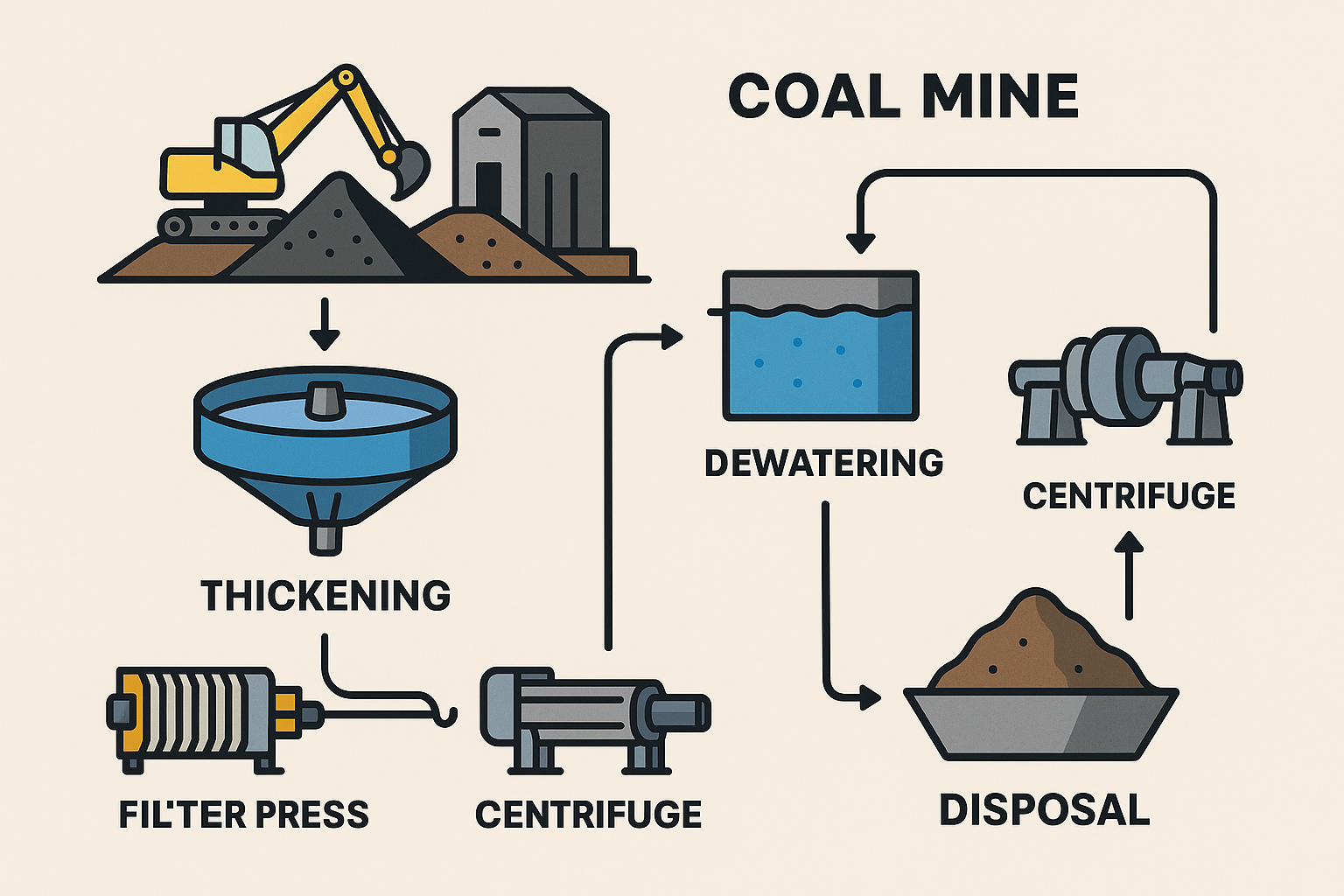
Thickening (gravity separation enhanced by polymers) is the first step, raising solids content and reclaiming water. A well‑operated high‑rate thickener can concentrate a 1–5% solids slurry to 15–30% solids in the underflow (mdpi.com). Modern deep‑cone “paste” thickeners push underflow to ~50–60% solids by design (steep cones, flocculated feed) (fls.com), and a design case showed thickened tailings at 50% water content (~50% solids) (mdpi.com).
The math is stark: if feed is 5% solids, taking it to 50% solids yields roughly a 9–10× volume reduction. Thickening with polymers recovers most of the water — one study predicts ~74% water recovery for thickened tailings (mdpi.com). Flocculation chemistry is central here, making flocculants and aluminum‑based coagulants relevant when sludges originate from aluminum/iron salt treatment; field teams typically meter these via a dosing pump. The overflow (clarified water) cycles back to process, reducing freshwater make‑up, with supporting wastewater ancillaries handling the hydraulics.
Filter presses and centrifuges for mechanical dewatering
Mechanical dewatering squeezes or spins out water beyond what gravity can achieve. Filter presses (plate‑and‑frame or recessed‑plate) pump sludge into cloth‑lined chambers under high pressure. Vendor data shows filter‑cake moisture in mining applications is only 8–25% (that is, 75–92% solids), with coal tailings at ~80–90% solids and dense metal‑hydroxide sludges at ~40–55% solids (45–60% moisture) (roxia.com). McLanahan notes presses “provide the highest level of mechanical dewatering” and allow tailor‑made cycles (mclanahan.com), with QUICKCHANGE cloths designed to reduce downtime (mclanahan.com).
Centrifuges (decanter or basket) run continuously and discharge wetter solids than presses but much drier than thickener underflow. McLanahan places centrifuge cake “somewhere between that of a thickener and filter press” (mclanahan.com), typically ~40–60% solids for mineral slurries. Metal‑hydroxide sludges (fine precipitates) often need polymer conditioning; coal tailings (coal powders and clays) respond differently. Often a two‑stage approach is ideal: first a centrifuge (or belt press) to capture easy water, then a filter press to maximize recovery. Together, thickening + pressing can recover >90% of water from tailings slurries (mdpi.com).
Quantified gains in water and volume
In a 100,000 tpd (tonnes per day) tailings case study, three scenarios were compared: simple thickening (TTD), paste tailings (PTD), and filtered tailings (FTD). The filtered case (80% solids in cake) recovered 93% of incoming water (mdpi.com), versus 74% for ordinary thickening. Thickening left 1,157 L/s of water in the tailings, while filtering left only 289 L/s (mdpi.com), so filtered tailings held ~25% as much residual water as thickened tailings.
The disposal implications are direct: typical filter‑press moisture (20–30%) yields cakes occupying 4–5× less volume than thickener underflow. Decreasing wasted volume by 70–90% cuts area and dam height; swapping ponds for dry stacks reduces footprint and relies on small containment structures (mdpi.com; mdpi.com).
Disposal, reuse, and dry stacking
Coal tailings, once heavily dewatered, are relatively inert and often repurposable if leaching tests confirm low toxicity: backfilling mined‑out voids (with or without cement binders), or use as construction aggregate or fill. Indonesia has begun approving tailings reuse: in 2020, KLHK permitted Freeport’s B3‑classified tailings as road base aggregate, with the permit (SK.129/2020) explicitly allowing use to meet SNI road standards and for public infrastructure (ppid.menlhk.go.id).
If reuse is infeasible, engineered storage is required. Wet storage (a lined tailings dam with decant) remains common but is now often paired with dewatering. For maximum safety, plans favor dry stacking: place pressed cakes on a lined pad or in closed pits, forming a stack with no free water. Dry tailings can be graded and vegetated during closure, with real‑world examples showing >90% water recovery and correspondingly tiny residual volume for filtered stacks (mdpi.com).
Metal‑hydroxide sludge is different. After pressing, it typically needs stabilization (e.g., cementing) and disposal in a designated hazardous waste landfill under Indonesian B3 rules. Alternatively, it can be mixed into cement backfill in mined voids if immobilization is confirmed. Wherever it goes, the site requires impermeable liners and controlled leachate collection, keeping in mind that these precipitates (Fe(OH)₃, Al(OH)₃) immobilize most toxic metals but the solid is still treated as B3.
Compliance and policy in Indonesia
Wastewater discharges must comply with Environmental Quality Standards — pH 6–9, TSS ≤400 mg/L, Fe ≤7 mg/L, Mn ≤4 mg/L (mdpi.com). Mine waste plans are scrutinized by the Ministry of Energy and Mineral Resources (ESDM) and KLHK permits (esdm.go.id), with KLHK signaling a circular‑economy approach. Beyond Freeport’s permit, a late‑2020 roadmap emphasized “3R” (reuse, recycle) of mining B3 wastes, backed by joint ministerial policy in 2019 (ppid.menlhk.go.id).
Recent legal changes (Omnibus Law PP22/2021) reclassified certain coal residues (FABA) out of B3 status, but mining sludges were not explicitly exempted. In practice, many coal‑washing tailings still require careful handling or B3 procedures, as KLHK communications and coverage indicate (ppid.menlhk.go.id; antaranews.com). Tailings are considered B3 but can be repurposed if meeting technical standards. The safe fallback is engineered containment; any reuse must be validated by regulators.
Chemical treatment and operations toolkit
The chemistry that generates metal‑hydroxide sludges — treatment with aluminum/iron salts — is part of the plan’s logic, making the choice of coagulants relevant to how solids later dewater. Plants commonly leverage aluminum‑based coagulants such as PAC/ACH families where appropriate, with options like PAC/ACH coagulants aligning to that practice.
Operationally, segregated conveyance to thickeners, polymer conditioning, and calibrated dewatering cycles drive outcomes. Dedicated installations and service gear keep systems reliable, from clarifier trains at the front end to filter press cloth handling. Water sent back to process after thickener overflow is kept in spec by the right chemical feed and metering, a place where a well‑sized dosing pump matters.
Bottom line: a holistic plan with quantified payback
A data‑driven sludge plan does the following: segregate streams at source; apply flocculant‑aided thickening to reach ~50% solids; then use centrifuges and/or filter presses to reach >80% solids — with filter‑press cakes at 8–25% moisture, coal tailings at ~80–90% solids, and metal sludges ~40–55% solids (roxia.com; mdpi.com).
This yields ~90%+ water recovery and 70–80% volume reduction (mdpi.com). Concentrated cakes are then managed per type: coal tailings as backfill or construction material (subject to SNI and reuse permits, including KLHK’s road base approval, SK.129/2020: ppid.menlhk.go.id), and metal sludges as hazardous waste in lined, monitored landfills, with discharges meeting EQS (mdpi.com; ppid.menlhk.go.id).