

Industry: Coal_Mining | Process: Dewatering
Mine dewatering is a heavy, continuous load. Studies find that pumping can consume on the order of tens of percent of a mine’s total energy — in open‑pit coal mines, water pumps may use about 18% of all energy and roughly 40% of electrical energy (ResearchGate) (ResearchGate).
In practice, large coal mines can expend tens of GWh per year on pumping. One Indonesian producer (Pt Adaro) reports about 190,500 MWh used for electrified dewatering over 2016–2023 (prosiding.perhapi.or.id).
Because dewatering must run continuously for safety and production, even modest efficiency improvements yield large energy and cost savings. Nearly all pumping energy cost manifests as carbon emissions; Adaro cites about 133,000 tCO₂ avoided after diesel‑to‑electric conversion (prosiding.perhapi.or.id).
High‑efficiency pump and motor selection
Pump efficiency starts with selecting the right equipment and sizing it properly. Pumps and impellers should be matched to the required duty (flow/head), and run near their Best Efficiency Point (BEP, the operating point on the pump curve where hydraulic efficiency peaks) rather than being oversized and throttled. Industry assessments flag inlet/outlet throttle valves as a major inefficiency; better practice is to trim impellers or install variable‑speed drives (VSDs, also called VFDs) instead (Engineering News). Proper system design — right pump curve, minimal piping losses, multiple pumps staged appropriately — reduces waste.
Upgrading motors also pays. One analysis estimates that a motor’s energy cost is about 97% of its life‑cycle cost while purchase price is only around 2% (North American Mining). That means a 5–10% improvement in motor efficiency pays back quickly. Modern IE3/IE4 (premium/super‑premium) motor classes typically improve efficiency by a few percentage points over older standards. For high‑duty applications, permanent‑magnet (PM) motors can reach about 94% efficiency — roughly 10–12 percentage points above a generic induction motor — enabling up to ~6–21% energy savings in continuous pump duties (North American Mining).
Ensuring motors are properly sized — so actual load is above 75% of nameplate capacity — helps maintain high efficiency (Efficiency Vermont). Tightening motor maintenance (clean cooling vents, secure coupling alignment, etc.) prevents losses from wear.
Illustratively, one dewatering example uses a 300 HP pump 100% of the time, consuming about 2.56 MWh/year on a standard motor. Replacing it with a 94%‑efficient PM motor cut power use by roughly 6%, saving approximately 154 MWh over ten years (about US$120k at $0.07/kWh) (North American Mining). In general, new high‑efficiency pumps/motors can yield double‑digit percentage savings in electricity.
Variable‑frequency drives (VFD) for variable flow
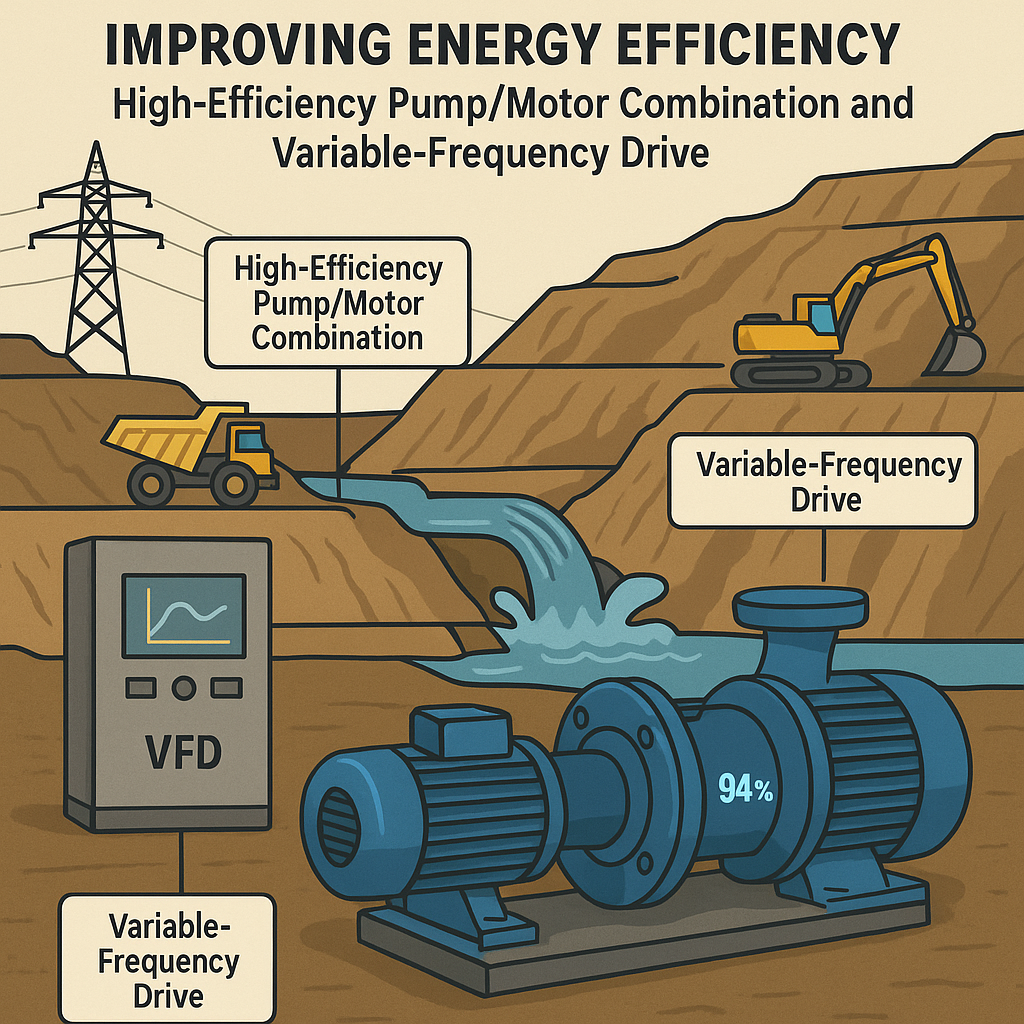
Inflows and pressure needs fluctuate with rainfall events, mine progression, and diurnal patterns. Variable‑frequency drives (VFDs — electronic controllers that vary motor speed and torque) dynamically match pump output to real‑time demand. By contrast, fixed‑speed pumps must throttle flow with valves (wasting energy) or overpump at unnecessary rates.
The physics are compelling: by pump affinity laws (relationships linking speed, flow, head, and power), power varies roughly with the cube of speed. In practice, cutting pump speed by 50% typically cuts energy demand by about 75% (Efficiency Vermont).
Empirical data back this up. An RMI study comparing roof‑support pumps in Chinese mines found full VFD control saved about 20% energy versus fixed‑speed pumping (Global Mining Review). Even adding a VFD to one out of multiple pumps gave approximately 10% savings (Global Mining Review) (Global Mining Review). Such drives also allow soft‑starts (preventing pressure spikes), reducing mechanical stress and maintenance.
In sum, VFDs can often cut pump energy use by 10–30%, depending on how much duty varies. One underground pumping system analysis showed that converting throttled constant‑speed pumps to VFD control reduced annual energy by over 20% (Global Mining Review). Design guidelines therefore emphasize VFDs for any pump with frequently varying demand, especially continuous or near‑continuous service.
Pump‑system energy audit framework
Best practice (used by the South African NCPC and others) runs in two phases. Scoping assessment: catalog all dewatering pumps, motors, controls, piping and operations — including supporting equipment (supporting equipment for water treatment) where relevant. Measure each pump’s duty (flows, heads) and operating hours; use power loggers or on‑site meters to estimate current energy use. This phase “obtain[s] a representative picture of … pumping systems” and flags high‑energy systems for deeper analysis (Engineering News). In one undertaking, a steel plant audit identified a handful of pumps that consumed more than 70% of pump power, accounting for roughly R13.5M/year potential savings (Engineering News).
Detailed audit: for the highest‑impact pumps, gather precise data — actual flow and head via sensors, pump performance curves, motor loading. Determine each pump’s BEP and compare to real operating points; analyze how often the pump is off‑BEP. Log power draw under different conditions. Look for telltales of inefficiency: large throttling losses (valves partially closed) (Engineering News), motors running far below rated load, or pumps run in parallel when one could suffice.
From the data, quantify waste and savings (for example, power lost by throttling or oversizing). Evaluate retrofit options: install a VFD, trim impellers, replace with a higher‑efficiency pump or motor, resize piping, or change pump hierarchy. Where throttling is common, examine downsizing the impeller or using VFDs to clip back speed — an approach recommended by NCPC (Engineering News). Consider control strategy: stagger multiple pumps and switch some off when flows are low. For each measure, estimate cost and payback; in the RMI study, a full VFD retrofit yielded greater than 20% annual power saving (¥1.5M/year) (Global Mining Review).
Audits routinely find large potentials. NCPC‑SA reports typical pump‑system audits uncovering 20–40% savings: one case found about 30% of identified energy could be saved immediately with no‑capex fixes (better controls and operations) (Engineering News), and a pipeline system study flagged possible savings of roughly R30M with around 40% achievable via minor control changes (Engineering News).
A pump energy audit should therefore deliver: 1) baseline energy use (kWh and cost) for each pump/motor; 2) performance gaps (throttling, part‑loading, cycling); 3) upgrade options (for example, swap to IE3/IE4 motor, add VFD, trim impeller) with ROI; 4) operational changes (optimize pump scheduling, eliminate unnecessary idling) and any minor‑capital fixes.
Implementing these measures yields measurable outcomes. One mining audit estimated that converting a fixed‑speed pump offshore to VFD could save about 20% power — equating to hundreds of thousands USD over a decade. Overall, combining high‑efficiency equipment with VFDs and audit‑driven controls can slash dewatering energy use by 20–50% in many cases.
Sources: Peer‑reviewed studies, industry reports, and mining case studies were used to quantify savings and guide best practices (Global Mining Review) (ResearchGate) (Engineering News) (Efficiency Vermont) (North American Mining) (prosiding.perhapi.or.id).