

Industry: Semiconductor | Process: Wastewater_Treatment
Semiconductor etch lines generate highly acidic, fluoride‑rich effluents, often in the hundreds to thousands of mg/L of F⁻ (fluoride ion). Chang & Liu (2007) note typical F⁻ ≳100–1000 mg/L in etch water (ResearchGate). Regulators push for low numbers: Zhou et al. (2023) cite a 10 mg/L discharge standard, which from an 1800 mg/L influent demands ∼99%+ removal (ACS ES&T Water). Indonesia’s environmental limits would likely be similar (Permen LH targets on the order of 4–10 mg/L for industrial discharge), and WHO’s drinking‑water guideline is 1.5 mg/L — context that pushes fabs toward high‑efficiency treatment.
At these loads, chemical precipitation to convert dissolved F⁻ into solid CaF₂ (calcium fluoride) is the workhorse; adsorption and membranes are generally less effective or much costlier at high fluoride, multiple reviews note (ResearchGate; ResearchGate).
Regulatory fluoride limits and loads
In one case study, raising a highly concentrated waste (initial F⁻ ≈1800 mg/L) to the target operating window delivered 99.49% defluorination to ~10 mg/L (ACS ES&T Water). That scale of reduction aligns with discharge limits on the order of 10 mg/L and underscores why precipitation dominates this niche for microelectronics (Bull. Natl. Res. Ctr.).
Calcium precipitation chemistry
The core reaction is straightforward: Ca²⁺ + 2 F⁻ → CaF₂(s). Two calcium sources are standard. Lime (Ca(OH)₂ or CaO) is inexpensive and raises pH while dissolving; drawbacks include slow dissolution, handling of slaked lime, and potential CaCO₃ (calcium carbonate) formation if CO₂ is present. Calcium chloride (CaCl₂) dissolves immediately without raising pH; Zhou et al. (2023) used CaCl₂ “instead of lime” for an ≈1800 mg/L F⁻ waste, citing fast Ca²⁺ release, but the added Cl⁻ can become a secondary compliance item if chloride limits are tight (ACS ES&T Water; Bull. Natl. Res. Ctr.).
Stoichiometry sets the design baseline: 1 mol CaF₂ (78 g) forms from 1 mol Ca and 2 mol F. Removing 1 mg F consumes 1.98 mg Ca in CaF₂ formation, and about 2.05 mg CaF₂ is produced per mg F. Practically, 1000 mg/L F⁻ generates ~2.05 g/L CaF₂ solids; at 1800 mg/L, the precipitate mass is ~3.7 g/L (ACS ES&T Water). Precise metering, often via dosing pumps, is therefore central to hitting targets without ballooning sludge volume.
pH and Ca/F optimization
pH control is decisive. At low pH (<5), HF (the un‑ionized form of fluoride) dominates and remains soluble; at very high pH (>8–9), OH⁻ competes, diverting calcium into Ca(OH)₂ or CaCO₃ rather than CaF₂ (Int. J. Mol. Sci.). Sinharoy and Lee (2024) reported an optimum at pH ≈6, delivering 81.8% F removal with 96.6% CaF₂ crystallization efficiency; performance fell off at pH lower or higher (Int. J. Mol. Sci.). In a separate trial, raising a highly acidic influent to pH 8.5 (with CaCl₂ addition) produced larger agglomerates and 99.49% defluorination to ~10 mg/L (ACS ES&T Water). Chang & Liu (2007) met a <15 mg/L effluent by operating between pH 6.5–8.5 (ResearchGate).
The optimal Ca²⁺/F⁻ molar ratio sits near the stoichiometric 0.5 (1 Ca per 2 F). Sinharoy et al. reported 94.8% crystallization at Ca²⁺/F = 0.5 (ResearchGate); Zhou et al. achieved 99.49% removal at the same ratio (ACS ES&T Water), and Chang’s experiments tracked that practice (~0.5) to meet spec (ResearchGate). Overdosing Ca increases sludge (as excess Ca(OH)₂ or CaCO₃) without improving F removal; underdosing leaves residual F⁻.
Reactor and separation train
A practical line‑up includes equalization, pH adjustment (often with NaOH or lime) to the 6–8 range, a precipitation reactor where CaCl₂ or Ca(OH)₂ is fed, and solid–liquid separation. Fine CaF₂ crystals benefit from coagulant/flocculant addition: Chang et al. observed that PAC (polyaluminum chloride) and anionic polyacrylamide were needed to flocculate otherwise poorly settling precipitates (ResearchGate). Many plants standardize on PAC and tailor polymer flocculants to nail clarifier performance.
For primary separation, gravity units remain common, with conventional tanks or compact options like a lamella settler to reduce footprint. Full‑scale lines often finish with a clarifier or, for polishing, micro‑/ultrafiltration; some designs couple precipitation with ceramic membrane filtration to ensure sub‑micron CaF₂ is captured. Where membranes are selected, ultrafiltration serves as a robust polishing step after precipitation.
Performance benchmarks at scale
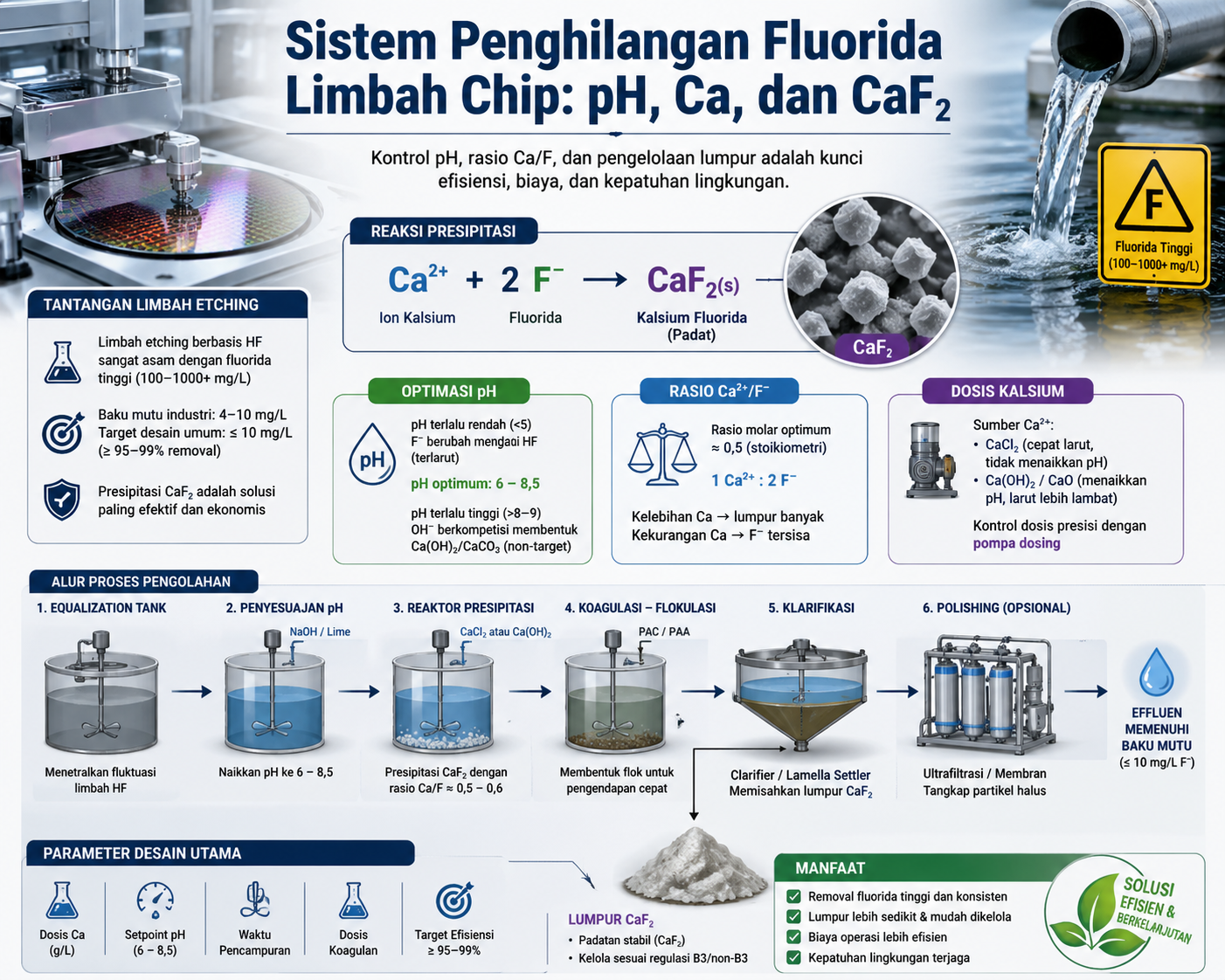
Under optimized conditions, very high removal is routine. Zhou (2023) reported 99.49% removal of ~1800 mg/L F⁻ to ~10 mg/L at Ca²⁺/F = 0.5 and pH 8.5 (ACS ES&T Water). Cao (2024) achieved >95% removal on a 200 mg/L F⁻ synthetic waste using an “icy‑lime” protocol, lowering F to 8.64 mg/L (Water Sci. Technol.). Chang & Liu (2007) similarly reported effluent well below 15 mg/L under Ca/F ~0.5 and pH 6.5–8.5 (ResearchGate).
Design targets follow end‑use: achieving <0.5 mg/L F⁻ (drinking‑water level) likely requires >99.5% removal, while industrial limits of 5–10 mg/L require ≈95–99% removal. CaF₂ precipitation alone tends to stall around ~10–15 mg/L final F⁻ (ResearchGate), so single‑digit mg/L often hinges on tight mixing/flocculation. Measurable anchors include calcium dose (g/L), pH setpoint, mixing time, and coagulant dose. For example, treating 1000 mg/L F⁻ (≈52.6 mmol/L) at Ca²⁺/F = 0.5 needs 26.3 mmol/L Ca²⁺ (≈1.05 g/L Ca²⁺ or ≈4.3 g/L CaCl₂), yielding ≈2.05 g/L CaF₂. Pilot tests (Cambustion, Chang, Zhou) have confirmed ~95–99% removal when these conditions are met and flocculation is aided (ACS ES&T Water; Water Sci. Technol.; Int. J. Mol. Sci.).
Calcium fluoride sludge management
Sludge is the cost center. Roughly 2.05 g of CaF₂ solids form per 1 g of F removed, so a 1000 mg/L F⁻ stream yields ~2.05 g/L CaF₂; at 1800 mg/L, ~3.7 g/L is produced (ACS ES&T Water). Fresh particles are very fine (Zhang et al. 2016; Sinharoy et al. 2024 note submicron crystals), and Chang (2007) reported “fine precipitates … with poor settleability,” underscoring the value of flocculation and, where needed, filtration (ResearchGate). Post‑separation, a filter press or centrifuge typically dewaters to a heavy cake (often 70–80% moisture).
Composition varies. Under optimized conditions, Cao (2024) recovered 93.5% pure CaF₂ nanoparticles (<600 nm) (Water Sci. Technol.). But studies of “fluorine‑containing sludge” show only 30–60% CaF₂ content in real systems, with the balance from added lime, CaCl₂, coagulants, etc., which complicates separation (Processes). CaF₂ itself has low solubility (K_sp ≈ 3.9×10⁻¹¹), so it is not readily leachable, but heavy metals/organics can co‑occur; most regimes require sludge testing such as TCLP (toxicity characteristic leaching procedure) before landfill. Even at 30% solids, the cake is dense (≈2 kg/L wet), and dust control is prudent during handling.
Reuse routes and disposal challenges
Beyond landfill, reuse options exist. Acid recovery via reacting CaF₂ with sulfuric acid can regenerate HF and gypsum. A glass‑ceramic route has also been demonstrated: Takaya et al. (2010) showed blending CaF₂ sludge into silicate glass dramatically lowers the melting point and immobilizes heavy metals. A 60:40 (sludge:glass) mix melted at 1163 °C (vs 1378 °C for pure CaF₂), and the final glass‑ceramic fixed >90% of heavy metals, offering a long‑term stable matrix (PubMed).
Conventional solidification can disappoint: Kim & Qureshi (2011) found that blending CaF₂ sludge with fly ash and lime failed to reach standard compressive strength (ResearchGate). Regulations may classify fluoride sludge as Dangerous Waste if HF remains; ensuring <10 mg/L F⁻ in the supernatant, as achieved by the precipitation steps above, helps. In practice, sludge management is often the main cost driver after chemicals — making control of Ca²⁺/F⁻ (≈0.5–0.6), pH, and flocculant dose crucial to minimize volumes while delivering compliance. Where reuse is feasible, >93% CaF₂ purity enables material recycling (Water Sci. Technol.); otherwise, plants plan for dewatering, safe storage, and disposal — often with help from wastewater ancillaries that keep the line running reliably.