

Industry: Semiconductor | Process: Cleaning
Chip fabrication is one of industry’s thirstiest pursuits. Analysts peg global semiconductor water consumption at roughly 264 billion gallons per year (≈1×10^12 liters), and a single leading‑edge fab can draw “tens of millions of gallons” per day (Semiconductor Digest). In 2023, TSMC alone used 101×10^6 m³ of water (≈27×10^9 gallons) (IDTechEx). Demand is rising, with a forecast that semiconductor water use will double by 2035 as IC production scales (IDTechEx).
Much of that water is UPW (ultra‑pure water; water that has been stripped of ions, organics, and particles to extremely low levels) used to rinse wafers between wet‑etch and deposition steps. Classic nodes include dozens of wet cleans: one report noted ~70 cleaning steps in a 0.25 μm DRAM process and ~80 in a 0.18 μm CMOS flow (ScienceDirect). Cleaning stages are therefore a major fraction of fab water use.
The industry’s response: conserve and recirculate. Hong Kong’s ASE reported an 84.3% process‑water recycling rate (saving ~825,000 metric‑tons in 2023, ~5.47 million total) by rigorously segregating rinse streams (Semiconductor Engineering). This level of rigor—paired with more efficient rinsing—sets the template for fabs aiming to cut UPW draw without risking yield.
Megasonic cleaning (1–2 MHz micro‑jets)
Megasonic cleaning uses high‑frequency ultrasound (≈1–2 MHz) to create micro‑cavitation jets that dislodge nanoscale particles while avoiding the violent turbulence of conventional ultrasonics. Vendors report that megasonics “dislodges contaminants while leaving the wafer…undamaged,” enabling similar or better cleanliness with lower chemical concentrations (Modutek). In practice, megasonic modules in single‑wafer or immersion‑tank tools boost particle removal efficiency, allowing shorter rinse times or fewer passes—an indirect but material cut in water demand.
The resource impact can be two‑fold: less chemical carry‑over and fewer re‑cleans. As Modutek notes, megasonics “reduces chemical use and final product rejection rates” (Modutek)—meaning the same cleanliness with fewer inputs.
Spray‑based single‑wafer rinsing
Spray tools and spin‑rinse dryers deliver UPW via targeted jets/nozzles onto a spinning wafer, in contrast to immersion benches that fill large tanks. A classic analysis found that scaling a 300 mm immersion bath to full size would require ~3.6× the volume of a 200 mm tool, whereas a single‑wafer “full‑flow” processor needed only ~1.8× volume—so 300 mm single‑wafer tools can use less water per silicon area than an equivalent 200 mm immersion bench (Semiconductor Digest).
Industry reporting aligns: spray/spin rinsers dramatically cut per‑wafer water, and “spray‑in‑air” modules are increasingly common. One estimate suggests that raising fab‑wide recycle from ~45% to 60% could save more than 4 million gallons per day (Techovedas)—a target reachable only by process improvements and better rinsing technologies. In parallel, companies like NXP, Onsemi and TI reuse rinse effluent for cooling loops (IDTechEx).
Rinse‑water recycling treatment trains
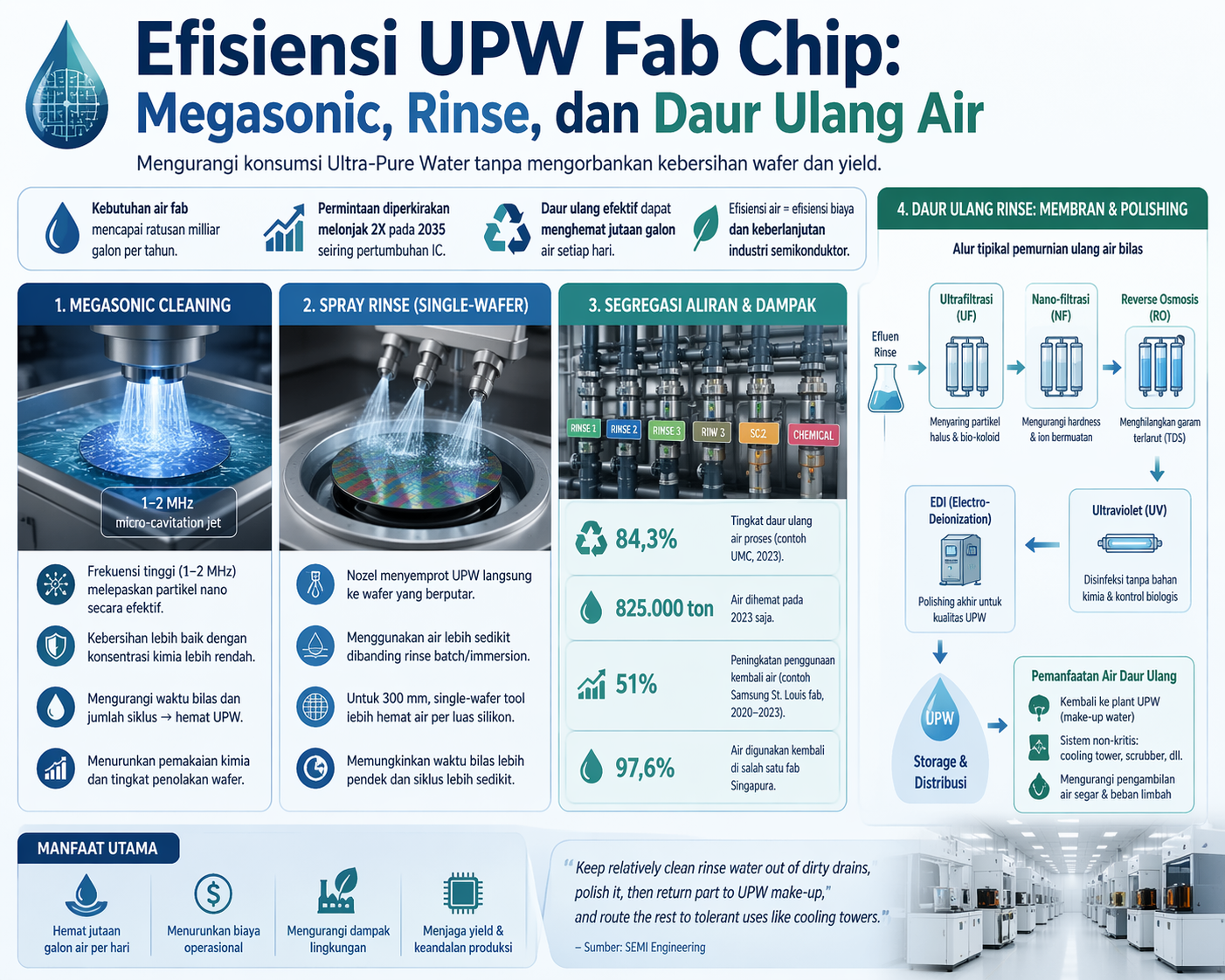
Spent rinse water is relatively “clean” (low in solids) and amenable to polishing. Typical treatment trains include membrane processes such as ultrafiltration (UF; pressure‑driven separation that removes fine particulates) and nanofiltration (NF; tighter membranes that also screen multivalent ions), along with reverse osmosis (RO; high‑rejection desalination) followed by UV/oxidation or ion exchange. For membrane‑centric design, fab engineers increasingly turn to integrated membrane systems to standardize reclaim skids.
As pretreatment, ultrafiltration helps protect downstream RO from fine solids and colloids. Where hardness or selective ion control is a concern, nano‑filtration can reduce multivalent ions under lower pressure than RO. For the main desalting and polishing step, fab reuse skids commonly deploy brackish‑water RO to achieve high rejection before final polishing.
Post‑RO polishing often includes UV for pathogen control and oxidation of trace organics; in UPW contexts, ultraviolet systems offer a 99.99% pathogen kill rate without additional chemicals. To finish ion removal or adjust ionic balance, fabs apply ion exchange resins as a final guard bed or as part of reclaim loops.
A Korean patent proposes an eco‑friendly UF+RO sequence designed to clean semiconductor wastewater back into UPW feed (Google Patents). In practice, recycled water is often split: some is returned to UPW make‑up after polishing, and the rest routed to tolerant uses like equipment scrubbers or cooling towers—“keep relatively clean rinse water out of dirty drains, polish it…then return part to UPW make‑up, and route the rest to tolerant uses like cooling towers” (Semiconductor Engineering). UMC’s hybrid system polishes at tool level (“point‑of‑use reclaim”) to minimize residence time—and thus bio‑growth—then finishes purification centrally (Semiconductor Engineering).
Risk controls and yield protection
Recycling is non‑trivial because spent rinse can carry exotic chemistries (metal complexes, etch byproducts) not found in municipal feed. Even trace residues can foul UPW filters or resins (Semiconductor Digest). To manage this, fabs implement strict monitoring and diversion controls, and guard filtration—such as dedicated cartridge filters—to protect polishing stages.
As one review notes, recycled UPW feed must meet purity limits to avoid yield risk—“a single contamination event can negate years of savings” (Semiconductor Digest). The flip side is that, when done properly, recycled rinse often exceeds municipal feed quality (Semiconductor Digest), lowering production costs. Best‑in‑class targets for reclaimed UPW approach ~65% by 2030 (Semiconductor Engineering; Techovedas).
Measured outcomes and case examples
Stream segregation and efficient cleaning underpin the biggest wins. UMC demonstrated that with 27 distinct waste streams, it could reach 84.3% water recycling fab‑wide (Semiconductor Engineering). That rigor mirrors the earlier example of Hong Kong’s ASE: 84.3% process‑water recycling, saving ~825,000 tons in 2023 and ~5.47 million tons cumulatively (Semiconductor Engineering).
Samsung’s St. Louis fab (now SK Hynix) increased reused water volume by 51% from 2020–2023 (IDTechEx). In Singapore, one fab is already reusing 97.6% of its water, reclaiming ~4×10^6 tons per year (Semiconductor Engineering). SK Hynix aims for net‑zero water use by 2030 and already collects more than 50% of its rinses for reuse (IDTechEx).
Technical pilots are broadening the toolkit. Samsung Austin piloted an electrodialysis system with ceramic membranes to concentrate rinse wastewater, reducing trucked waste volume and enabling onsite reuse of the permeate (Ultra Facility Portal). Intel’s foundry operations pledge “surplus freshwater” by 2030, and Intel sites in the US and India already report net‑positive water (Intel). Modeling underscores the stakes: going from ~45% to 60% reuse saves millions of gallons per day (Techovedas), while fab case studies show multi‑10^5 – 10^6 ton per year water savings (Semiconductor Engineering; IDTechEx).
Regulatory context and local signals (Indonesia)
Indonesia has no octant‑specific semiconductor water rules on the books, but general environmental laws apply. Effluent standards under Government Regulation 22/2021 and related PermenLHK govern any industrial discharge, and recent 2025 regulation updates mandate real‑time monitoring of wastewater for high‑volume dischargers (Greenlab). Limits are tightening in proxy sectors such as chemicals and metalworking (Greenlab), suggesting any local fab would need stringent closed‑loop performance.
Multinationals are moving accordingly: TSMC’s Arizona fab is designed to recycle ~65% of water (BINUS), and Intel targets net‑positive water by 2030 (Intel). Trends in rinse technology and recycling are increasingly essential compliance tools, not just cost levers.
Procurement notes (UPW reclaim components)
For fab teams standardizing reclaim infrastructure, integrated RO, NF, and UF systems can form the backbone of rinse‑water polishing. Pretreatment with UF stabilizes downstream performance, while selective hardness reduction via NF can trim RO load. Core desalination often uses RO, with pathogen control via UV and ionic polishing on ion exchange where required. Guard filtration with cartridge filters helps protect resins and membranes from trace foulants referenced in industry reviews.
Sources and references
Sources include industry analyses and case studies that quantify water use and savings (Semiconductor Digest; IDTechEx), equipment supplier insights on megasonics (Modutek), and engineering media on segregation and reuse (Semiconductor Engineering; IDTechEx; Semiconductor Digest). Regulatory and corporate sustainability contexts are drawn from Indonesia‑relevant materials (Greenlab) and corporate pledges (Intel), as well as commentary on TSMC Arizona’s ~65% recycling design (BINUS). Each citation above underpins the data points and examples presented.