
Semiconductor plants consume millions of gallons a day, but membrane tech and smarter process segregation are pushing reuse to near zero liquid discharge. This roadmap shows how fabs move from 40–70% reuse to 98–99% — with the gear, targets, and pitfalls to watch.
Semiconductor manufacturing drinks deep: state‑of‑the‑art fabs withdraw millions of gallons per day (up to ~40 000 m³/day) for processes, cooling, and cleaning (spectrum.ieee.org) (xflow.pentair.com). Many are sited in water‑stressed regions such as Taiwan and Arizona, and one forecast says water use across semiconductor manufacturing will double by 2035 as chip output grows (idtechex.com) (idtechex.com).
The scale is staggering: TSMC used 101 million m³ of water in 2023 (idtechex.com), and in 2022 it recycled ~216×10^6 m³ with an average recovery rate of 85.7% (researchgate.net). Historically, fabs reused 40–70% of water (spectrum.ieee.org), but new membrane systems are pushing reuse to 98–99% (spectrum.ieee.org) (semiengineering.com).
Targets are rising: Intel has pledged net‑positive water globally by 2030 and in 2024 reported conserving ~10.5 billion US gallons (~39.7×10^6 m³) via efficiency and watershed projects (intel.co.id). In Indonesia, water reuse aligns with Government Regulation No.82/2001 (water quality). The roadmap below explains how to design a comprehensive recycling and reuse program — and how to close the loop on wastewater, moving toward zero liquid discharge (ZLD).
Process water specifications and loops
The most stringent water grade is ultra‑pure water (UPW), typically 18.2 MΩ·cm resistivity (>0.055 µS/cm; microsiemens per centimeter) with sub‑ppb (parts per billion) total organic carbon (TOC), used in on‑wafer steps like lithography development and rinses (semiengineering.com). UPW must meet ISO/SEMI specs such as SEMI F63 for sub‑ppb organics and sub‑10 nm particles (semiengineering.com).
Less demanding grades include high‑purity DI water (1–5 MΩ·cm) for certain baths and rinses, and potable/chilled water for utilities such as tool cooling, humidification, scrubbers, and WC sanitizing. Experts note UPW touches the wafer once, while spent rinse and low‑load streams can feed cooling towers or scrubbers that tolerate higher conductivity and organics (semiengineering.com).
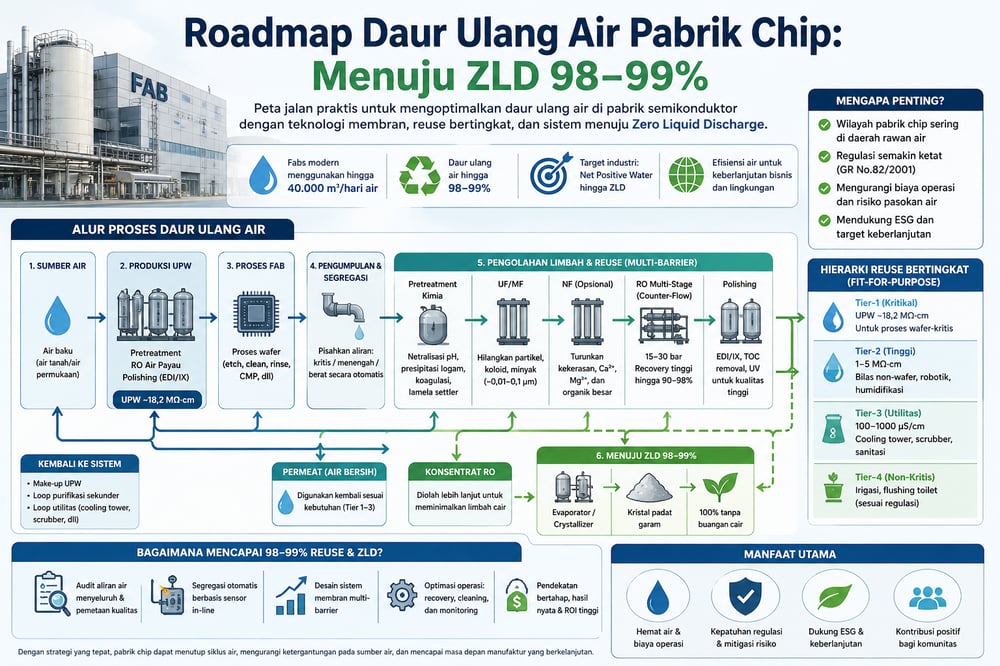
In practice, fabs run two or three loops: a primary UPW loop (~0.055 µS/cm with <20 ppt [parts per trillion] silica/TOC), a secondary purified loop (e.g., 1–5 MΩ·cm), and a utility loop. Segregating the finest water only to wafer‑critical processes preserves downstream reusability (semiengineering.com). Non‑critical processes (including wafer etch neutralization or cleanroom humidification) can use recycled “service” water.
Audit and automated segregation
The first step is a full water audit: quantify flows by process, tag critical vs. non‑critical uses, and map wastewater chemistry. Installing in‑line sensors (flow, conductivity, TOC) enables automated segregation so near‑pure drains route to reclaim while dirtier streams head to treatment (semiengineering.com).
At the tool, equip drains with conductivity/chemical monitors to triage: near‑pure post‑rinses back to UPW make‑up or a secondary loop; moderately contaminated acid/alkali drains to chemical pretreatment; gross waste (heavy metals, plating baths) to specialized trains. Even simple rerouting of spent rinses into cooling tower makeup can deliver about 60% recovery gains (samcotech.com). This “embedded reuse” reduces treatment load.
Fit‑for‑purpose reuse hierarchy
Build a tiered reuse scheme tailored to quality needs (semiengineering.com):
Tier 1 (critical): UPW loops (~18.2 MΩ) typically supplied by reverse osmosis (RO) plus polishing. Tier 2 (high‑quality post‑process): RO permeate or recycled rinses (1–5 MΩ) for non‑wafer cleaning, robotics, humidification. Tier 3 (utility): RO/NF rejects or fully recycled secondary effluent for cooling towers, scrubbers, booster pumps — tolerating ~100–1000 µS/cm conductivity. Tier 4 (non‑critical): final RO concentrate or blends for landscape irrigation or toilet flush where allowed (after meeting health standards), or disposal.
Recycling 50–70% is now routine, with >90–98% achievable with added treatment (spectrum.ieee.org) (chemicalprocessing.com). One integrator recently boosted a customer from ~30% to 65% reuse by optimizing existing systems, saving ≈US$30M capital (semiengineering.com).
Multi‑barrier membrane treatment train
The core is a multi‑barrier sequence culminating in RO — exactly the domain of integrated membrane systems for industrial reuse.
Pretreatment tackles bulk contaminants to protect downstream membranes: pH adjustment and chemical precipitation for metals, plus coarse filtration or sedimentation. For organics, many plants deploy activated carbon. Chemical feeds for neutralization and precipitation benefit from accurate dosing pumps.
Ultrafiltration (UF) or microfiltration removes colloids, emulsified oils, and fine solids (~0.01–0.1 µm) to protect RO. As a dedicated step, packaged ultrafiltration pretreatment improves RO uptime and lowers turbidity.
Nanofiltration (NF) selectively removes hardness (Ca²⁺/Mg²⁺) and large organics, reducing scaling risk before RO. Lower‑pressure nano‑filtration is an effective hardness barrier on fab streams.
Reverse osmosis is the centerpiece. Modern thin‑film composite membranes run at ~15–30 bar, with a single stage recovering ~60–80% permeate and rejecting most salts, fluoride, and ammonia. For typical fab TDS, brackish‑water RO configurations are standard. Multi‑stage and counter‑flow RO arrangements have demonstrated 95–98% wastewater recovery, and fabs in Asia have reached 99% (semiengineering.com).
For polishing to UPW, electrodeionization (EDI) or mixed‑bed ion exchange can be added. Where non‑critical reuse is the target, polishing may be minimal; when needed, continuous systems like EDI or high‑purity mixed‑bed ion exchangers provide sub‑ppb silica and very low TDS.
Performance benchmarks and ZLD pathway
UF+RO alone has reclaimed ~70% of wastewater in reported cases (chemicalprocessing.com). By adding stages or smarter control (e.g., semi‑batch operation), RO recovery can jump from 50% to ~65% (semiengineering.com). Multi‑stage/counter‑flow RO systems, including six‑stage cascades, have delivered 95–98% recovery and up to 99% in some fabs (semiengineering.com).
One analysis showed advanced UF/RO could cut fresh intake from 10 million gallons/day to ~200,000 gallons (2% of baseline) (spectrum.ieee.org). Pushing recovery also shrinks downstream thermal systems: maximizing membrane recovery reduces the size and cost of evaporators/crystallizers needed for ZLD (chemicalprocessing.com).
For true ZLD, RO concentrate is treated in evaporators/crystallizers, often with mechanical vapor recompression. Silica is a key design constraint: high pH in evaporators keeps silica soluble, leading to scaling. Desalter pretreatment has been developed to precipitate silica upstream — protecting both RO and the evaporator (ide-tech.com). Final brine solids (metal salts, fluoride salts, silica) are collected for proper disposal or reuse. Semiconductor wastewater treatment also meets rising expectations around PFAS and broader contamination control (ide-tech.com).
Phased implementation and KPIs
Phase 1 (0–1 year): audit and quick wins. Install flow meters/sensors; segregate major streams; recycle rinse water to cooling towers for a ~60% reuse gain (samcotech.com). Set up preliminary onsite treatment (neutralization, fine filters) and begin sending processed UPW permeate to non‑critical uses.
Phase 2 (1–3 years): pilot and scale membranes. Trial UF/RO on representative dilute effluent (e.g., spent rinses, demin plant blowdown), then scale to full plant with 70–85% recovery targets. Reassign RO permeate to wash stations, leak/drip collection, cooling makeup; track quality, recovery, and chemical savings.
Phase 3 (2–5 years): optimization and ZLD integration. Add stages or semi‑batch control — even counter‑flow RO — to push recovery above 90% (semiengineering.com) (semiengineering.com). Integrate an evaporator/crystallizer for RO concentrate to approach near‑zero discharge; apply advanced analytics (digital twins, ML) to track KPIs such as cycles of concentration, TOC/COD loads, and reuse rate in real time (semiengineering.com) (semiengineering.com).
Targets, regulations, and energy profile
Performance targets: recycle ≥90% of influent and cut freshwater intake by >90%. A 98% recycle rate turns a 10 MGD requirement into ~0.2 MGD external draw (spectrum.ieee.org). Monitor “liters reused per wafer” and “% reduction in raw water” against benchmarks like TSMC’s 85.7% recovery (researchgate.net), with 98–99% as world‑leading (spectrum.ieee.org) (semiengineering.com).
Throughout, comply with local limits including Indonesia’s Government Regulation No.82/2001 (water quality) and any PLTU 82/01 effluent limits. Many companies in water‑scarce regions are already targeting >95% reuse (chemicalprocessing.com). The energy penalty for water treatment is modest — reported at <5% of fab energy — relative to the strategic value of water security (researchgate.net).
Bottom line
From segregation at the tool to multi‑stage RO and thermal polishing, the technology exists to cut raw water use by an order of magnitude and virtually eliminate discharge. The industry trend is clear: while 50–70% reuse is routine today, advanced membrane configurations are making 98–99% internal recycling feasible (spectrum.ieee.org) (semiengineering.com). For fabs designing new capacity or retrofitting legacy sites, the multi‑barrier membrane approach — anchored by UF, NF, and RO — is the most direct path to resilient, cost‑effective water management.
